Fiduciary accounting is a trustee's formal written record of trust property, receipts, payments, principal and income, cash, and known liabilities. In Texas, it helps beneficiaries understand what happened to the property and assess whether the trustee handled it properly.
Your family may be facing this question after a parent's funeral: one sibling is managing the trust, another wants to know what happened to the house proceeds, and everyone is trying to avoid turning grief into conflict. A clear accounting can give the family a shared record to review. It's more than a bank statement or a quick update, because it connects transactions and assets to the trustee's administration.
A Simple Definition and Why It Matters in Texas
Think of a fiduciary accounting as a careful record of what came in, what went out, what remains, and how transactions were classified. A trustee prepares it for trust property; an executor accounts for estate property under applicable probate rules. The report helps beneficiaries follow the money and gives the fiduciary a way to show how the property was managed.
A bank statement can show a deposit or payment, but it usually won't explain whether a receipt was income or principal, why an expense was paid, or how an asset was valued. A fiduciary accounting places those details in context. That distinction matters because a distribution can affect beneficiaries differently depending on whether it comes from income or principal.
Texas law sets requirements for trust accountings and provides a way for beneficiaries to request one. For estates, the Texas Estates Code includes a separate accounting rule for independent administrations. These rules reflect a basic fiduciary principle: a person entrusted with someone else's property must keep records and be able to explain its administration. For a broader introduction to estate planning and probate issues that can affect family property, see probate and asset protection help.
Accounting also supports tax reporting. The IRS uses Form 1041 to collect information about estate and trust income, deductions, gains, losses, distributions, and tax liability. Congressional Research Service data reported for 2022 included approximately 3.2 million fiduciary tax returns, $542 billion in fiduciary income, and $89 billion in distributions; those figures cover estates and trusts that filed fiduciary returns, not every trust in existence. A reliable accounting preserves the records needed to support reporting and explain what beneficiaries received (IRS statistics on income from estates and trusts).
What a Texas Accounting Must Actually Contain
Texas's statutory model calls for more than a list of account balances. The accounting should work like a household inventory, check register, and balance sheet combined. A beneficiary should be able to trace property from the beginning of the reporting period through the transactions and ending balances.
The required elements include:
- Property identification: Identify trust property not previously inventoried and adequately describe each asset being administered. Think of this as the inventory of what the trust owns.
- Transaction record: Show receipts, disbursements, and other transactions. This is the check register, with enough detail to understand what entered or left the trust and why.
- Principal and income: Distinguish the trust's principal, sometimes called corpus, from income. This helps show whether a transaction affects the long-term trust fund or current income.
- Asset descriptions: List and adequately describe each administered asset. A vague entry such as “investments” may not tell a reader what property is involved.
- Cash and depository: State the cash balance and identify where it is held. The reader should be able to connect reported cash to a bank or other depository.
- Known liabilities: Disclose known obligations, so the report doesn't make the trust appear to have more available property than it does.
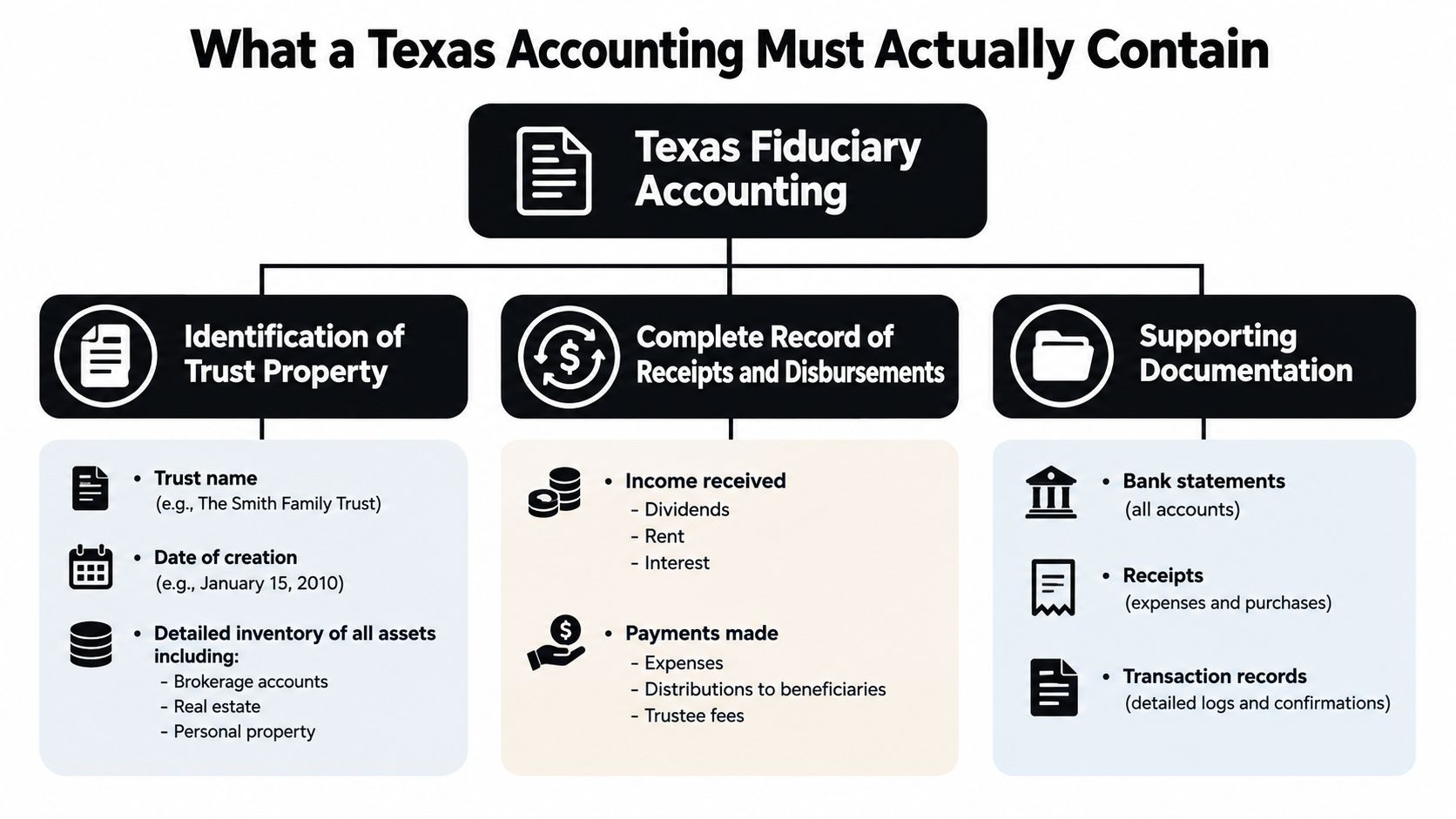
A receipt should have enough context to show its source and nature. A payment should identify what it covered, such as a trust expense, a distribution, or a fiduciary fee. Supporting statements and transaction records make the accounting easier to verify, rather than asking beneficiaries to accept unexplained totals.
Principal-and-income decisions can affect who benefits economically from a transaction, even when the trust's total value hasn't changed. The governing instrument and applicable law guide the classification, and a careful transaction-level process helps make the result reviewable. For more on allocation questions, see this guide to the Texas Uniform Principal and Income Act allocation.
Trustee and Executor Duties Behind Every Accounting
The accounting is the paper trail behind a fiduciary's decisions. A trustee's duties under the Texas Trust Code include acting loyally, following the trust's terms, managing property responsibly, and keeping records that explain the administration. Executors also owe duties to the estate and its interested parties, subject to the will and the Texas Estates Code.
A clear report can help show how a fiduciary acted, but the totals alone don't settle whether a decision was proper. The useful question is whether the accounting provides evidence that the fiduciary followed the governing instrument, treated beneficiaries fairly, and dealt responsibly with trust or estate property.
| Fiduciary Duty | Accounting Element That Demonstrates It |
|---|---|
| Loyalty | Clear disclosure of transactions, compensation, and any relationship between the fiduciary and a transaction party |
| Prudence | Records of asset activity, gains or losses, and the reasoning or supporting documents for significant decisions |
| Impartiality | Consistent principal-and-income classifications and distributions explained in light of the trust terms |
| Recordkeeping | Reconciled transaction detail supported by statements, receipts, and other primary records |
A vague entry can prompt a reasonable follow-up, but it doesn't automatically prove misconduct. For example, a payment to a company connected to a trustee deserves context: what service was provided, how the cost was determined, and whether the trust authorized it. Likewise, a market loss needs to be understood in light of the asset, the decision, and the fiduciary's duties, not treated as proof of a breach by itself.
The rule for independent estates is distinct from a trust accounting. Texas Estates Code §404.001 allows an interested person to demand a sworn written accounting from an independent executor after the statutory waiting period has passed. For an overview of trustee administration that can help place these duties in context, see this 2026 trust guide for trustees. Texas trustee obligations are also addressed in this guide to trustee duties under the Texas Trust Code.
Timelines, Statutory Deadlines, and How Often You Can Ask
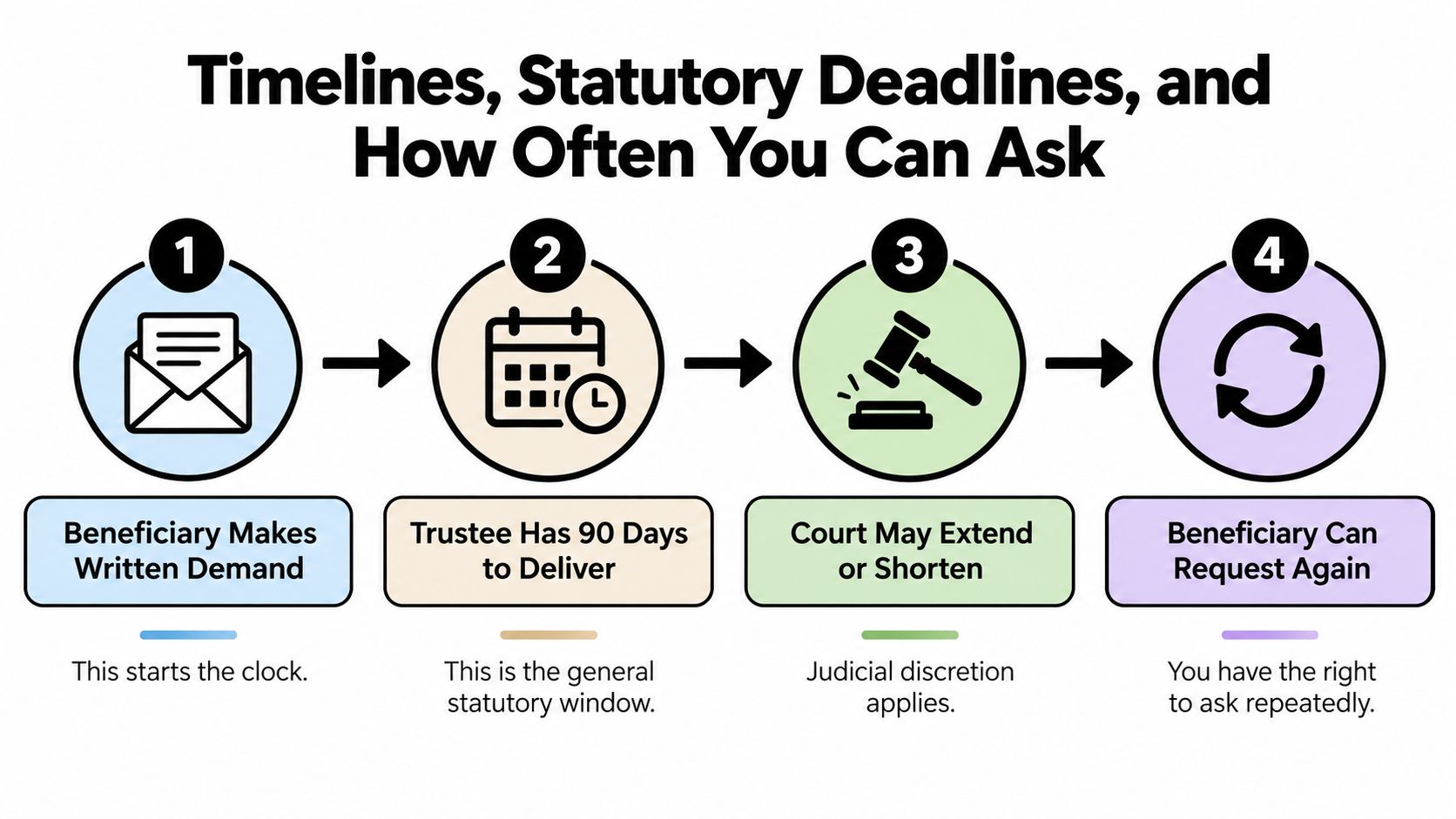
A Texas trust beneficiary can make a written demand for an accounting covering transactions since the last accounting. If no accounting has occurred, the demand may cover transactions since the trust began. The trustee generally has 90 days to provide the accounting, unless a court allows a longer period (Texas Property Code §113.151).
The ordinary rule is that a trustee isn't required to account more frequently than once every 12 months, unless a court orders otherwise. That doesn't mean a beneficiary must wait a year to ask questions about a specific concern. It means the statute sets an ordinary interval for required accountings, while the beneficiary's written demand and any court order can shape what happens in a particular situation.
A useful sequence is simple:
- Send a written demand. State that you're requesting an accounting and identify the period it should cover.
- Track the response period. The trustee generally has 90 days to provide it.
- Review and follow up. Ask focused questions about missing records, unclear classifications, or transactions that need explanation.
- Consider court assistance if needed. A beneficiary may sue to compel production if the trustee fails to provide the accounting within the statutory period; a court may also allow more time or order a different reporting schedule.
For an estate under independent administration, a different statute applies. After 15 months have passed from the date the probate clerk first issues letters testamentary or letters of administration, an interested person may demand a sworn written accounting from the independent executor. The executor generally has 60 days after receiving the demand to comply, and later accountings may be demanded at intervals of at least 12 months. The process for making a trust-accounting demand is explained in this resource on the 90-day demand for a trust accounting in Texas.
A Worked Example of a Small Texas Trust Accounting
Consider a fictional family trust with two siblings as beneficiaries, a brokerage account, and a rental property. The trustee's report shouldn't present those assets as one unexplained total. It should show what the trust held, what income it received, which expenses it paid, and how cash and investments changed during the accounting period.
Suppose the rental property brings in rent and the brokerage account receives dividends. The accounting lists those receipts separately and identifies their source. It then records property expenses, such as taxes and maintenance, along with any distributions to the siblings. It distinguishes income from principal according to the governing instrument and applicable law, rather than assuming every dollar received is available for immediate distribution.
A sample ledger might use descriptions like these, without relying on invented amounts:
| Entry | Classification | What the record should explain |
|---|---|---|
| Rent received | Income, subject to the trust terms and applicable law | Property and period associated with the payment |
| Brokerage dividend | Income, subject to applicable classification rules | Security or account that generated the receipt |
| Property tax payment | Expense | Property involved and documentation of payment |
| Maintenance invoice | Expense | Work performed and the supporting invoice |
| Distribution to a sibling | Distribution | Recipient, date, amount, and basis under the trust |
| Trustee fee | Fiduciary compensation | Basis for the fee and supporting record |
| Accountant fee | Administration expense | Service provided and invoice or other documentation |
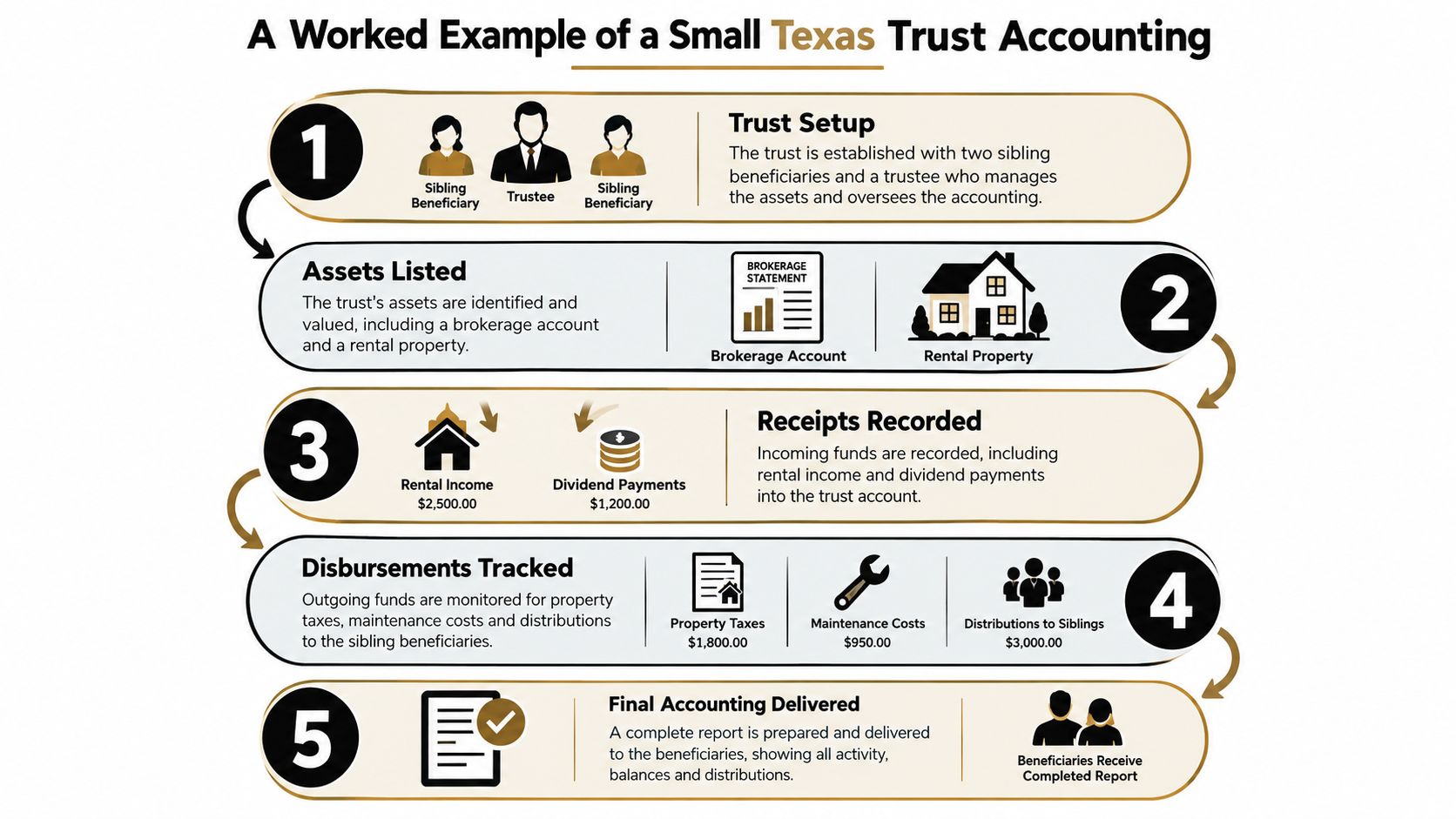
The trustee then reconciles the opening assets with receipts, disbursements, investment activity, and transfers to show what remains. Cash should tie to the identified depository, and the report should disclose known liabilities. If an asset's value changed, the accounting should make clear what the reported figure represents and what records support it.
The example is deliberately modest, but the method scales to more complex property. A concentrated business interest, real estate, or private investment may require clear valuation support and a careful explanation of transactions. The point isn't to make every accounting look identical. It's to make each entry traceable to a record and understandable in light of the trust's terms.
The video below offers another visual introduction to trust accounting:
What Beneficiaries Should Look For Beyond the Numbers
A fiduciary accounting is also a decision-review tool. Don't stop at whether the ending balance seems reasonable. Ask whether the report explains why the trustee made significant decisions and whether those decisions fit the trust's terms and fiduciary duties.
Texas law holds a trustee accountable for trust property and for profits arising from administration, subject to applicable rules and the governing instrument. But a trustee isn't automatically liable for a decline in value or a failure to earn a profit when no statutory or other fiduciary duty was breached. A loss doesn't prove wrongdoing, just as a gain doesn't by itself prove that the trustee acted properly.
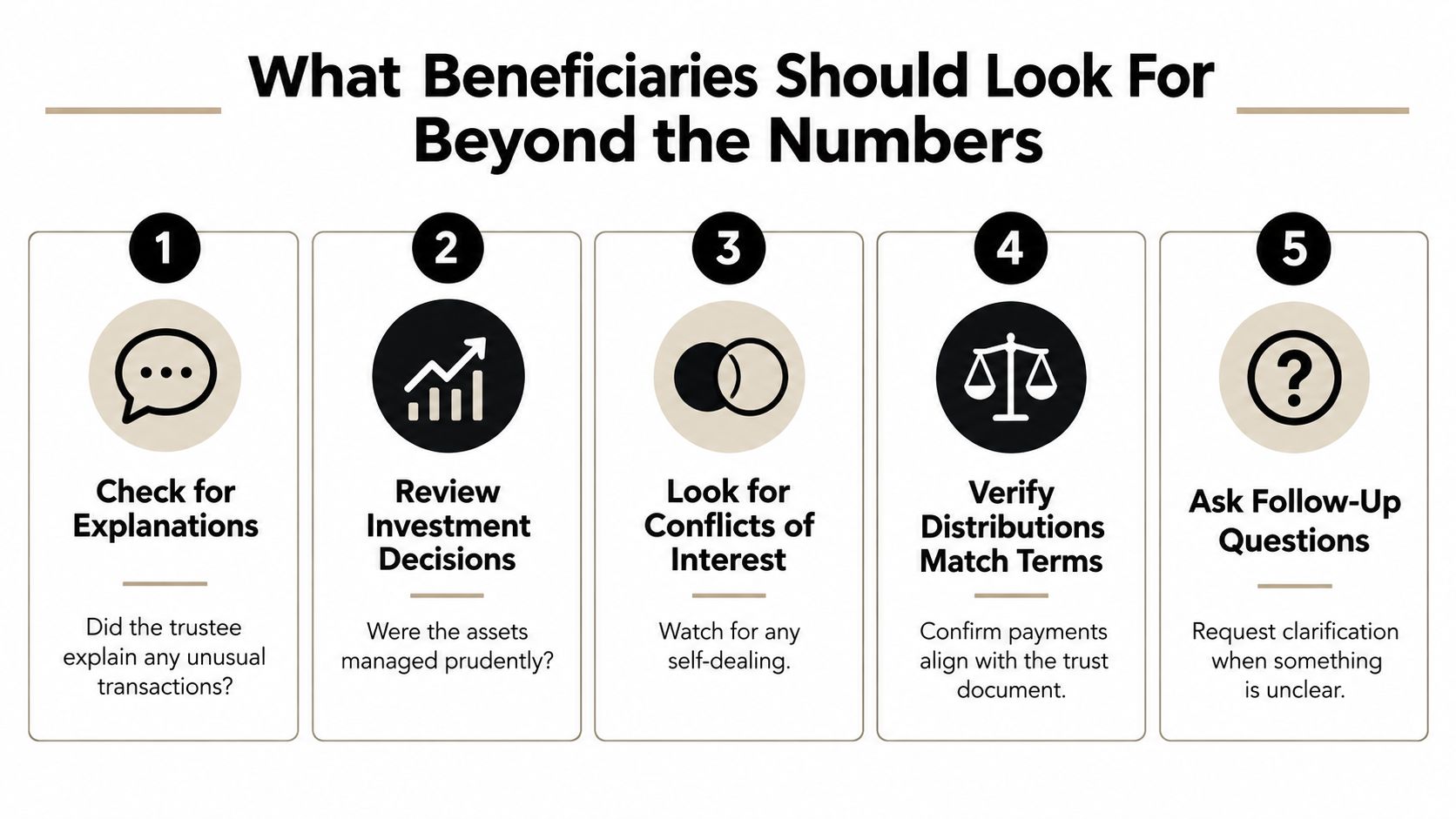
As you review the report, look for explanations of:
- Trustee compensation: Does the accounting identify the fee and provide a basis for it?
- Related-party transactions: Does a transaction involve the trustee or someone connected to the trustee, and is the relationship disclosed?
- Unequal distributions: Does the report explain how the distribution follows the trust's terms?
- Investment losses: Are the transactions and relevant supporting records clear enough to understand what happened?
- Principal and income classifications: Could the classification shift economic value between current-income and remainder beneficiaries?
A practical review starts with the trust document, then compares it with the accounting and supporting records. Write down specific questions tied to an entry, date, asset, or distribution. This is more useful than accusing someone based only on a disappointing result, and it gives the trustee a fair chance to explain the decision.
Practical rule: Separate the question “Did the asset lose value?” from “Did the fiduciary act loyally and responsibly?”
Preparing and Reviewing an Accounting Step by Step
For a trustee, steady recordkeeping is easier than reconstructing transactions later. Gather bank and brokerage statements, invoices, tax documents, valuation records, distribution approvals, and documents supporting investment decisions. Then reconcile the records, classify transactions, and prepare explanations for entries that might not be clear from a description alone.
A practical preparation workflow looks like this:
- Collect source records. Keep statements, receipts, invoices, and tax documents together by accounting period.
- Reconcile the activity. Match ledger entries to statements and investigate unexplained differences.
- Classify each transaction. Identify receipts, disbursements, transfers, gains, losses, distributions, and fees, and distinguish principal from income.
- Explain important decisions. Preserve the reason and supporting documents for significant expenses, investment choices, or distributions.
- Check the report against the trust. Confirm that the accounting reflects the governing instrument and known obligations.
A successor trustee starting the role can use First Steps for a Successor Trustee in Texas for information about what to do immediately after stepping into the trustee role.
Beneficiaries can review the same work from the other side. Match reported balances to statements, check that receipts and expenses have descriptions, compare distributions with the trust terms, and flag items that lack support. Ask for clarification in writing and keep the question focused on the specific entry or decision.
Good records protect beneficiaries' ability to understand the administration and help fiduciaries explain their work.
If the trust has taxable interest, dividends, capital gains, business income, or rental income, the fiduciary should coordinate accounting records with tax planning. For 2026, the IRS generally requires estimated tax payments when an estate or trust expects to owe at least $1,000 after withholding and credits, and those credits are less than the smaller of 90% of the current-year tax or 100% of the prior-year tax. A 110% prior-year safe-harbor percentage applies when prior-year adjusted gross income exceeded $150,000, subject to the form's conditions; qualifying farmers and fishermen have a special 66⅔% current-year threshold (IRS Form 1041-ES). A fiduciary should work with the estate's tax professional to gather income and expense records, estimate taxable income, review distributions and beneficiary reporting, and calendar payment deadlines.
Disputing an Accounting and Getting Help in Texas
Start with a written request for clarification. Identify the transaction, asset, or missing document and explain what information would help you understand it. A trustee or executor may be able to resolve a misunderstanding by providing records or a fuller explanation.
If a Texas trustee doesn't provide an accounting after a valid demand, a beneficiary may seek court help to compel production. If the accounting reveals evidence of a breach, available remedies may include a surcharge against the fiduciary or removal, depending on the facts and applicable law. For an independent executor, the sworn accounting demand has its own statutory requirements and deadlines, so confirm which process applies before taking action.
A Texas trust administration lawyer can help a trustee prepare and explain an accounting or help a beneficiary evaluate whether the records raise a legal concern. The Law Office of Bryan Fagan, PLLC also provides guidance on estate planning, probate, guardianship, and asset protection. A Texas estate planning attorney can also discuss planning questions, including how to modify a trust in Texas, when modification is relevant to a family's circumstances.
If you're managing a trust or planning your estate, contact Law Office of Bryan Fagan, PLLC for a free consultation. The firm helps Texas families and fiduciaries with trust administration, accounting, tax planning, and disputes in Houston, Dallas–Fort Worth, Austin, San Antonio, The Woodlands, and surrounding communities. Reach out to discuss the records, deadlines, and next steps that apply to your situation.