Managing a family trust can feel overwhelming, especially when you and your spouse already did what seemed like the hard part. You signed a joint revocable trust, retitled some assets, and figured the paperwork had settled who owns what. Then life happens. One spouse dies, a child asks questions, a bank wants documents, or a trustee realizes the trust says one thing while the deed, account agreement, and Texas marital-property rules suggest something else.
That's where many Texas families get stuck. A joint revocable trust is a powerful estate planning tool, but it doesn't replace Texas community property law, it doesn't erase separate property, and it doesn't automatically answer what happens to the house, the brokerage account, or the tax basis at the first death. The trust is one document in a larger legal system that also includes the Texas Family Code, Texas Estates Code, fiduciary duties, and the practical recordkeeping that supports trust administration.
This guide walks through community property in a joint revocable trust in Texas the way a careful Texas estate planning attorney would explain it at a kitchen table. We'll sort out the labels first, then the trust mechanics, then the evidence, and finally the issues families often discover too late, including survivorship, homestead rights, trust accounts, and the first-death basis adjustment.
Why This Question Trips Up Texas Families
Mark and Elena have been married for years. They signed a joint revocable trust because they wanted a simple plan. Their home was deeded to the trust. One investment account was moved over. Another stayed in their joint names. Elena also brought an inheritance into the marriage and later deposited some of it into an account the couple used for household needs. Now Mark has died, and Elena wants to know a very human question. "What's mine, what was ours, and what passes under the trust?"
The answer depends on three layers that rarely line up on their own: marital-property law, trust language, and the titling documents.
In Texas, community property remains a legal classification that matters even after assets are transferred into a joint revocable trust. Under Texas Family Code Section 3.002, community property is property acquired by either spouse during marriage unless it qualifies as separate property, and that rule has been in the statute since it was added in 1997, effective April 17, 1997. Texas is also one of only nine U.S. community-property states under that same authority, which is one reason couples moving from common-law-property states often misunderstand what trust funding does and doesn't change.
Why title alone doesn't settle the issue
A trust can change management during incapacity and distribution at death, but it generally does not automatically erase the underlying community or separate-property character of an asset once it goes into the trust under Texas Family Code Section 3.002. That underlying character can still affect beneficial interests, creditor analysis, divorce rights, tax planning, and the allocation of trust assets after the first death.
Practical rule: A joint revocable trust answers who manages and who receives. It doesn't always answer what character the asset had when it went in.
That's why families get confused. They're often looking at three different layers at once:
- Marital-property law decides whether an asset began as community or separate property.
- Trust language decides who can manage, amend, revoke, and receive trust property.
- Administration documents like deeds, account agreements, and beneficiary designations decide how a specific asset moves at death.
Where trustees and families usually go wrong
The biggest mistake is assuming the trust document stands alone. It doesn't. Trustees still have fiduciary duties under Texas law to read the governing documents carefully, protect beneficiaries, keep accurate records, and avoid making distributions based on assumptions. Executors and successor trustees often need to compare the trust with titles, statements, prior agreements, and source-of-funds records before taking a single step.
Families also tend to underestimate how much the first death changes the legal picture. What looked easy during life can become a trust administration problem, a probate question, or a tax planning opportunity. Getting those pieces aligned early is often the difference between smooth administration and a painful dispute.
Community Versus Separate Property in Plain English
The labels come from Section 3.002, quoted earlier. What they mean in a living room looks like this.
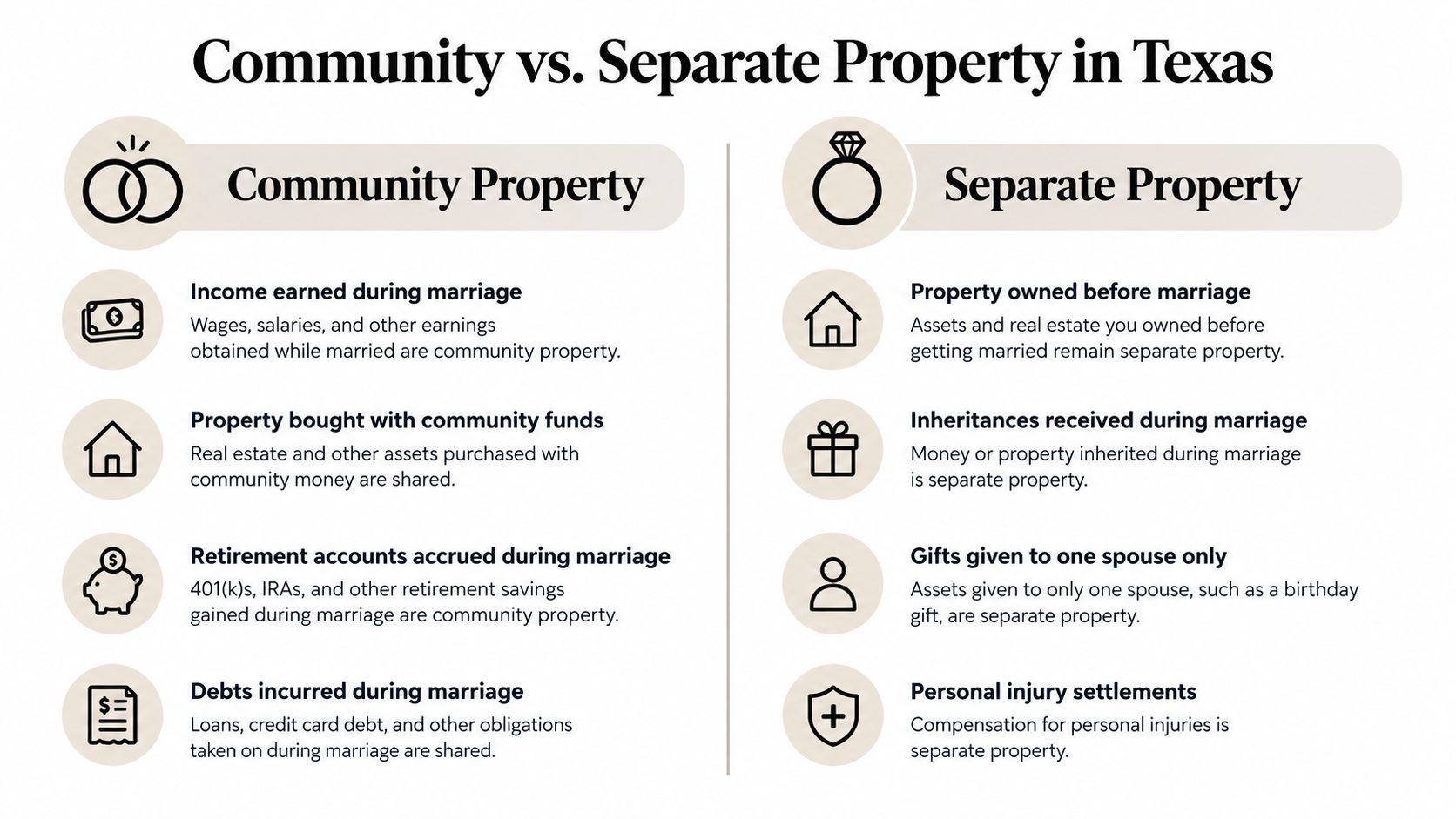
A paycheck earned during marriage is the classic example of community property. Even if only one spouse earned it, Texas usually treats that paycheck as part of the marital estate. The same logic extends to property bought with those marital funds, so a car purchased with salary income generally carries the community label even if the title shows one name.
Separate property works differently. It usually means property a spouse owned before marriage, or property received individually by gift or inheritance. That's why people often remember the rule this way: paycheck equals community, inheritance equals separate.
A simple way to classify household assets
Try labeling assets in your own home with these questions:
- When was it acquired? If it came in during the marriage, Texas often starts with a community-property view.
- How was it received? If one spouse inherited it or received it as a gift, that points toward separate property.
- What funds bought it? If community funds purchased it, that usually matters more than whose name appears on the title.
- Has it been kept distinct? If separate funds were mixed into common accounts, proving the original character can get harder.
Readers often get tripped up here. They assume a deed, bank title, or trust schedule controls everything. Those documents matter, but the character of property can follow the asset into another container. A house can move into a trust. A brokerage account can be retitled. An LLC interest can be assigned. The legal label may still remain community or separate depending on how the asset was acquired and documented.
Management rights matter too
Texas also distinguishes management rights over community property. Texas Family Code Section 3.003 explains that community property is generally subject to joint management, control, and disposition, while some categories may be under one spouse's sole management. The same statute also notes that if separately managed community property is mixed together, it becomes subject to joint management unless the spouses agree otherwise in writing.
That's one reason trust administration can become delicate. A joint trust may hold assets with different histories, different management rights, and different proof problems. A trustee who ignores those distinctions risks distributing the wrong property to the wrong beneficiary. That practical point shows up often when trustees work through Distributing Trust Assets to Beneficiaries in Texas, because distribution is only as accurate as the characterization work that came first.
Property labels don't disappear because the paperwork got neater. They travel with the facts.
How a Joint Revocable Trust Holds Property
A joint revocable trust is a framework for ownership, management, and succession. It does not act as a magic box that changes every asset into the same kind of property. A married couple can place community property, separate property, or both into the same trust while preserving different legal interests in those assets.
Most couples who create a joint revocable trust serve as both settlors and trustees. While both are living and able to act, they usually manage trust property much as they did before transferring it. If one spouse becomes incapacitated or dies, the other can often continue as trustee without immediate court involvement. That continuity is one reason families may choose a trust instead of relying only on probate.

Trust title and underlying ownership are different
The trust may hold legal title, while the spouses retain different underlying marital-property interests in the assets contributed. Transferring community property into a joint revocable trust does not automatically eliminate either spouse's underlying marital-property interest. Texas generally presumes property acquired during marriage is community property. Property subject to both spouses' management, control, and disposition is treated as joint-management community property, as discussed in the Texas Bar discussion of Texas Family Code Section 3.102(b).
The title tells you who holds the asset for trust administration. The property's history helps determine what each spouse owns beneath that title. Good drafting therefore addresses each spouse's ownership interest, trustee powers, revocation rights, and consent requirements. Without those instructions, administration can become unclear when the couple separates responsibilities, changes beneficiaries, or reaches the first death.
When one spouse acts alone
Suppose a husband transfers community investment property into a revocable trust and later tries to redirect it without his wife's knowledge. The trust's existence does not automatically validate that decision. The Texas Bar source explains that a spouse's unilateral transfer of community property into a revocable trust may be voidable by the other spouse under the illusory transfer doctrine, rather than automatically void as to the entire asset.
That distinction matters to trustees, beneficiaries, and the surviving spouse. Trust administration should be coordinated with marital-property rules, any required spousal consent, and the trust's amendment provisions. A trustee should review those documents before treating a unilateral change as final.
Fiduciary duties after the first death
After the first spouse dies, the surviving trustee should not assume every trust asset is automatically the survivor's property. The trustee must identify the trust property, follow the instrument, protect the beneficiaries, and account for the assets under applicable Texas trust administration principles.
The review should ask:
- Which assets were funded into the trust
- Which assets were community, separate, or mixed
- Whether the trust allows unilateral action by the survivor
- Whether a homestead right, survivorship agreement, or account contract changes the result
A Texas trust administration lawyer can help resolve uncertainty, particularly when the trust involves a blended family, inherited property, or business interests. The trust document sets the framework, but the asset's history and outside legal rules still shape what the trustee may do.
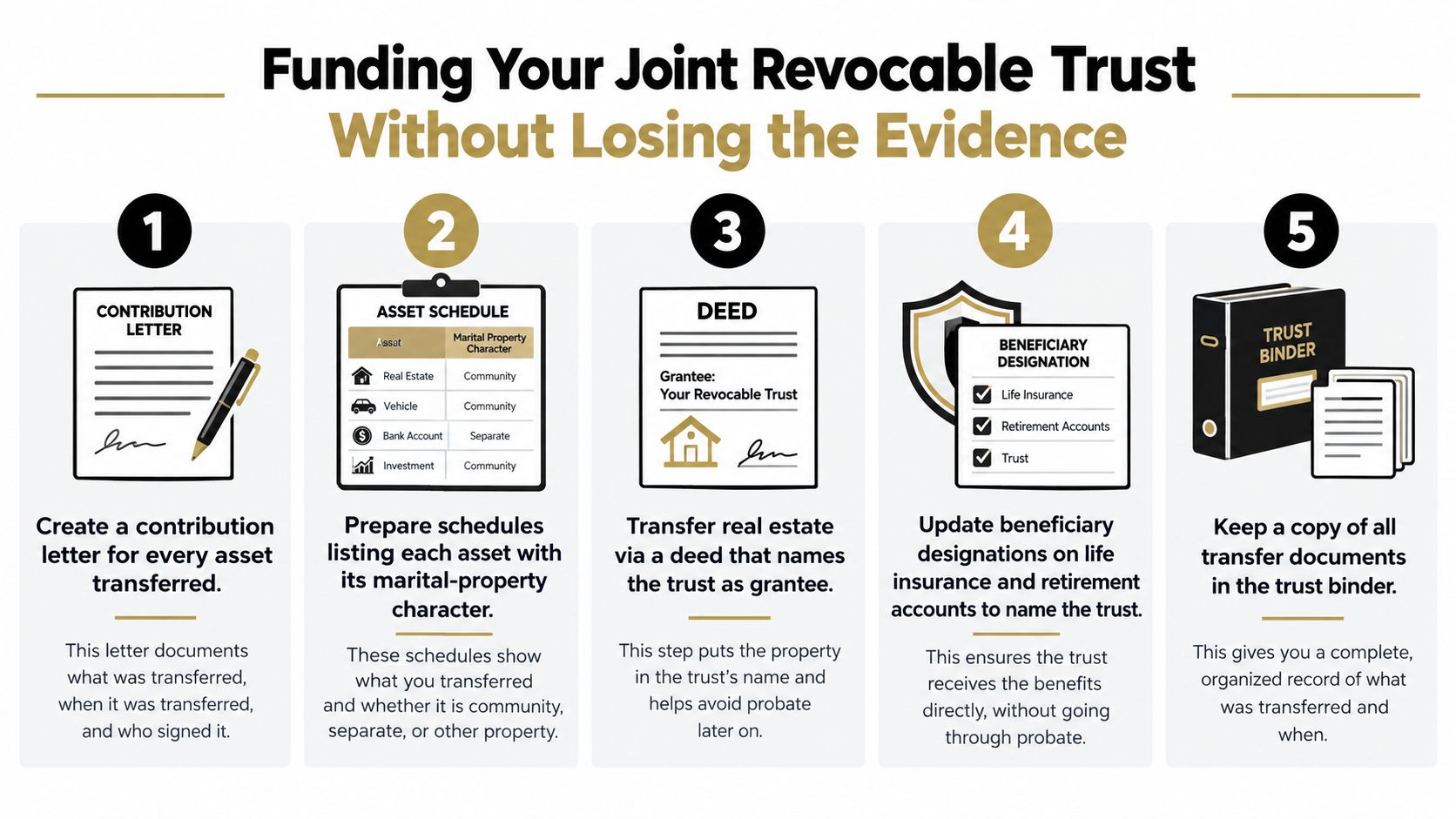
Funding the Trust Without Losing the Evidence
A couple may transfer a house, investment account, or inherited funds into one joint revocable trust and still face a dispute later about ownership. The trust can hold community property, separate property, or a mixture of both. Its title does not erase the asset's history. Without a clear paper trail, proving that history becomes much harder.
Under the community-property presumption of Texas Family Code Section 3.003, property possessed by either spouse during marriage is generally treated as community property unless the spouse claiming separate status proves otherwise by clear and convincing evidence. Trust funding therefore serves two purposes: it moves an asset into the trust and preserves the facts needed to classify that asset.
What clear and convincing evidence looks like in real life
A useful file should answer three questions: where did the asset come from, who owned it at the start, and what happened to it afterward? Records that may help include:
- Acquisition records showing when the asset was purchased or received.
- Gift or inheritance documents showing that one spouse received property individually.
- Account histories and statements tracing funds from one account to another.
- Deeds and transfer documents showing when title changed and who received it.
- Written agreements between spouses that changed the property's status.
Texas law also permits spouses to partition or exchange existing or future community property by agreement. Property transferred under a valid agreement may become separate property under Texas Family Code Section 4.102. The agreement should be stored with the trust documents because it may explain why the trust schedule labels an asset as separate rather than community.
Keep the trust, deeds, source records, account statements, and marital-property agreements together. A trustee cannot establish a classification from an unsupported label alone.
A practical funding checklist
A careful funding process can include:
- A contribution letter for each asset transferred.
- A schedule identifying the asset as community, separate, or mixed.
- Real-estate deeds that match the trust's legal name exactly.
- Account statements showing balances before and after transfer.
- A review of beneficiary designations so retirement and insurance assets do not conflict with the estate plan.
Retitling is part of funding, not a substitute for documentation. For a practical explanation of deeds and other transfer steps, see this guide on how to transfer property to a trust in Texas.
Why commingling causes so much trouble
Commingling may not destroy a separate-property claim, but it can make tracing difficult. For example, inherited funds may enter a joint account, mix with earnings, purchase an investment, and later move into the trust. Each transfer creates another point that the spouse must explain with records.
Separate schedules, separate accounts where practical, and updates after a sale, inheritance, refinance, or major contribution can preserve that explanation. The trust records should show both the legal title and the property history.
Intent matters, but trustees and courts need evidence of intent. A well-organized file gives them a reliable path from the original source of the asset to its place in the trust.
Probate, Creditors, and the Step-Up at the First Death
A Texas couple may have a fully signed trust when one spouse dies, yet still face three immediate questions: Does any asset require probate? Who may reach it? What happens to its tax basis?
A properly funded revocable trust often avoids probate for assets titled in the trust. The trust document alone does not answer every question. The asset's marital-property character can affect creditor analysis and tax treatment, so the successor trustee needs the death certificate, trust records, title documents, and account history.
Why community-property characterization matters for tax basis
For federal income-tax basis planning, properly characterized community property in a Texas joint revocable trust can produce a different result from separate-property assets. The IRS explains that federal tax consequences depend on state-created property rights, and it recognizes that Texas management-and-control classifications affect collection exposure against community assets in IRM 25.18.1.
Internal Revenue Code Section 1014(b)(6) generally permits a basis adjustment for the entire community-property asset at the first spouse's death when the legal requirements are met, rather than only the deceased spouse's half, as explained in the same IRS community property manual. The example there is concrete: if community property is worth $1,000,000 and has a $300,000 aggregate basis, a full adjustment to about $1,000,000 can eliminate the prior $700,000 built-in gain used in later capital-gain calculations, assuming the characterization and ownership requirements are satisfied.
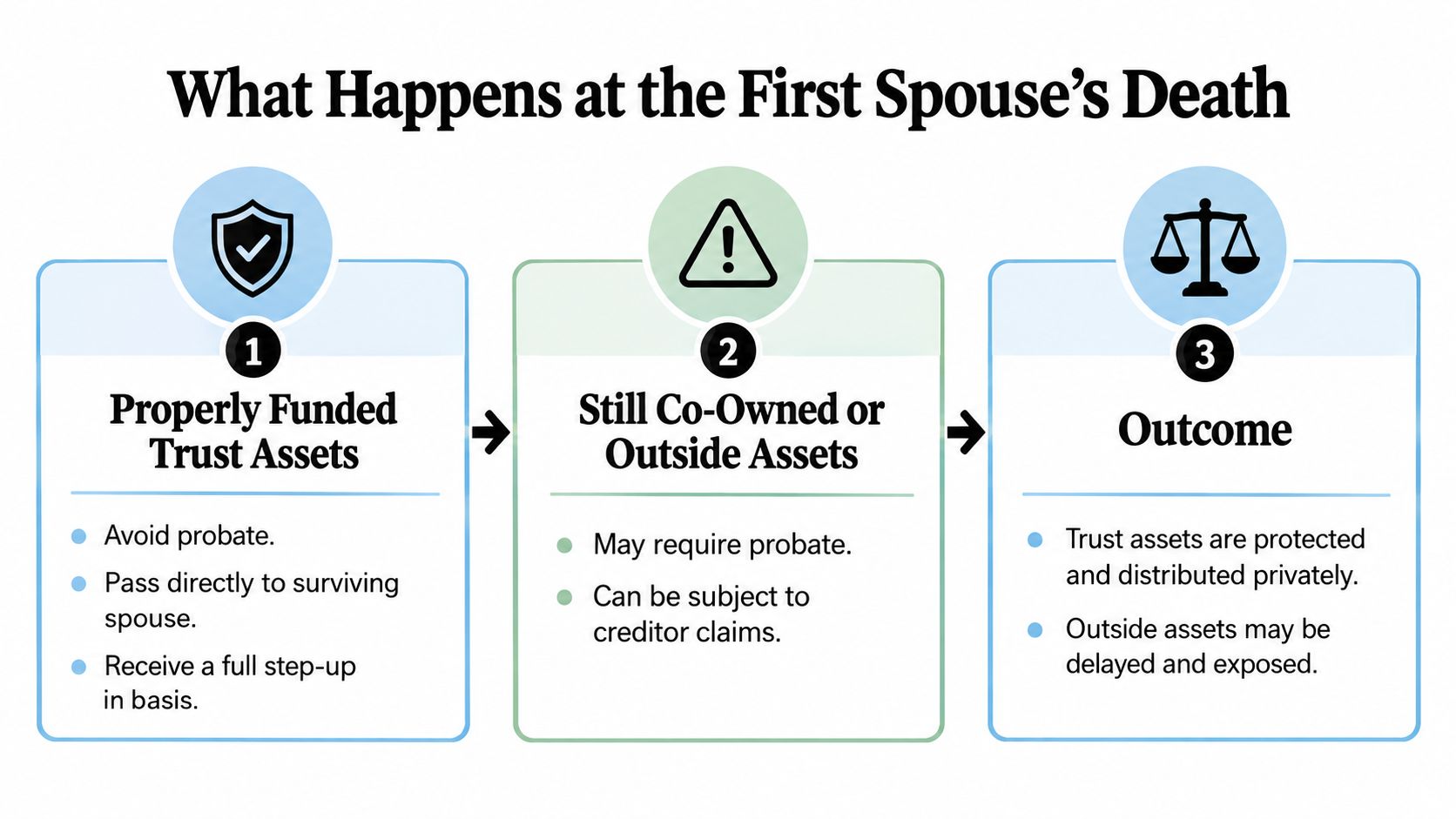
The result depends on evidence. A trustee must be able to show what the asset was, who owned it, and how it entered the trust. A label such as “joint” or “community” may not resolve a mixed account or an asset transferred without a clear paper trail.
What trustees should do first
A successor trustee or surviving spouse can approach the first death in a deliberate order:
- Confirm trust funding by gathering deeds, assignments, and account registrations.
- Identify character by separating community assets from separate or mixed assets.
- Review creditor exposure under Texas ownership and management rules.
- Preserve tax records so the surviving spouse and CPA can support basis reporting later.
For a focused explanation of the tax issue, see step-up in basis for trust assets in Texas.
A trust can avoid probate for the asset it owns. It can't avoid confusion about an asset that was never funded or never clearly characterized.
Probate and fiduciary administration still matter
Some assets remain outside the trust. Depending on title, beneficiary designations, and governing agreements, those assets may require probate or another transfer procedure. Having a trust does not mean every asset bypasses court involvement.
A careful Texas trust administration lawyer or Texas estate planning attorney will examine the trust, any pour-over will, funding records, and outside assets together. That review helps protect beneficiaries, support fiduciary accounting, and preserve a basis adjustment that could otherwise be weakened by incomplete documentation.
Homestead, Survivorship Agreements, and Trust Accounts
Many disputes don't come from the trust itself. They come from another document that governs the same asset.
That is especially true with the family home, survivorship arrangements, and financial accounts. A trustee who reads only the trust may miss rights created by the Texas Estates Code, and that can lead to distributions, sales, or transfers that shouldn't happen yet.
The house may be in the trust, but homestead rights still matter
Texas homestead protections remain important even when a residence is characterized as separate or community property. Under Texas Estates Code Chapter 102, the homestead rights and the respective interests of a surviving spouse and children are the same whether the homestead was the decedent's separate property or community property between the spouses. That same chapter also limits partition. The homestead may be partitioned only when the surviving spouse dies, sells the spouse's interest, elects to stop using or occupying the property as a homestead, or when a court no longer permits a guardian of minor children to use and occupy it.
That means a trustee should not assume trust ownership wipes away occupancy rights. Before selling or refinancing a residence, the trustee should compare the trust terms, the deed, and the family's homestead status. For families sorting out deed and residence issues, putting your house into a trust in Texas step by step gives a practical framework.
A survivorship agreement is not the same thing as a trust plan
Texas law permits spouses to hold community property with a right of survivorship, but only if that arrangement is created in a written agreement signed by both spouses under Texas Estates Code Chapter 453. That's a separate legal step. Putting an asset into a trust does not, by itself, answer whether the first spouse's interest passes automatically to the survivor or remains subject to administration under the trust and estate documents.
Here's the comparison trustees need to keep in front of them:
| Instrument | What It Decides | When It Wins |
|---|---|---|
| Trust agreement | Trustee powers, beneficiary rights, distribution terms | When the asset is properly funded to the trust and no stronger controlling document changes the transfer path |
| Deed | Real-property title and grant terms | When land records show ownership and any homestead or joinder issue must be honored |
| Community-property survivorship agreement | Whether community property passes automatically to the survivor | When there is a valid written agreement signed by both spouses |
| Account agreement | Registration, signature authority, pay-on-death or trust-account mechanics | When the financial institution's governing contract controls the account balance |
| Beneficiary designation | Named recipient for certain nonprobate assets | When the asset passes by designation rather than trust title |
Trust accounts have their own rules too
Under Texas Estates Code Chapter 113, a written agreement signed by the trustee or trustees can provide that when the last surviving trustee dies, the remaining account balance belongs to the named beneficiaries who survive. The same statute says a trust account generally is not part of the trustee's estate and does not pass under the trustee's will or intestacy, subject to the statutory exception described there.
If the trust says one thing and the account contract says another, pause and reconcile the documents before moving funds.
That is a core fiduciary principle. Trustees have a duty to administer according to the controlling instruments, not according to family assumptions or verbal instructions.
Drafting Moves, Sample Clauses, and Common Pitfalls
Good drafting doesn't just say who inherits. It preserves evidence, allocates authority, and gives the future trustee a clean set of instructions to follow.
For community property in a joint revocable trust in Texas, the trust should usually work together with contribution schedules, deeds, account registrations, and any marital-property agreement. A useful drafting pattern is a clause stating that each transferred asset keeps the character shown on the attached schedule unless changed by a later written agreement signed by the spouses. Another helpful pattern requires joint consent before either spouse transfers, amends, revokes, or retitles certain trust assets that were contributed as community property.
Sample drafting approaches that help in practice
A well-built file often includes:
- A characterization schedule listing whether each asset was community, separate, or mixed when contributed.
- A revocation clause describing whether one spouse may revoke only that spouse's own contributed interest, or whether both must act together.
- A consent provision for homestead transfers, major sales, and amendment authority.
- A records clause directing the trustee to preserve account histories, deeds, and source documents as part of fiduciary administration.
- A coordination clause that references any partition agreement or survivorship agreement so the documents don't conflict with one another.
Law firms and fiduciaries also increasingly use software and document systems to track those moving parts. For attorneys comparing workflow tools, the 2026 estate planning software guide from CasePulse is one resource that discusses how law practices organize drafting and administration processes.
The mistakes that cause the biggest trouble
Some problems show up over and over:
- Unilateral transfers of community assets into or out of the trust.
- Commingled accounts with no tracing support.
- Missing homestead joinder on residence-related documents.
- Beneficiary designations that point to a person or office title instead of the trust itself.
- Trustee distributions made because a relative said “that's what Mom wanted,” without checking the governing documents.
For families seeking practical help with trust administration, estate planning, probate, guardianship, or asset protection, the Law Office of Bryan Fagan, PLLC is one Texas-based option that handles those issues as part of broader trust and estate representation. The key is not the label on the law firm. It's whether the drafting and funding are coordinated well enough that the successor trustee can administer the plan.
Texas Couples Ask, and When to Call an Attorney
Texas couples usually ask four questions first. Can a joint revocable trust hold premarital property and inheritances? Yes, but the records need to preserve character. Does community property lose that character once it's in the trust? Not automatically. How should we handle the house? Carefully, because title, homestead rights, and other signed documents may all matter. When is one spouse better off with a separate trust instead of a joint one? Often when there is significant separate property, a blended family, or concern about later control.
Trustees ask a related question. “When do I stop guessing and call counsel?” The answer is simple. Call when the trust, deed, account agreement, or family story don't line up. That is usually cheaper and safer than making a wrong distribution and trying to undo it later.
For attorneys and firms thinking about how client education and trust-centered relationships grow over time, community building strategies for attorneys from LegalRev offers broader professional context beyond the legal rules themselves.
If you're managing a trust or planning one with your spouse, the attorneys at Law Office of Bryan Fagan, PLLC help Texas families sort out property characterization, trust funding, homestead issues, fiduciary duties, and first-death administration in plain English. A free consultation can help you decide whether your current trust protects your community and separate property the way you intended, and what steps to take next.