No, ordinary private trusts in Texas generally don't have to be registered with a state agency. Trustees may still need to complete asset transfers, tax filings, beneficiary notices, and other administration steps under Texas law and federal tax rules.
Managing a parent's trust after death can feel overwhelming. You may have the signed trust agreement in one hand, a bank's document request in the other, and family members asking when distributions will be made. The natural question is simple: do Texas trusts have to be registered?
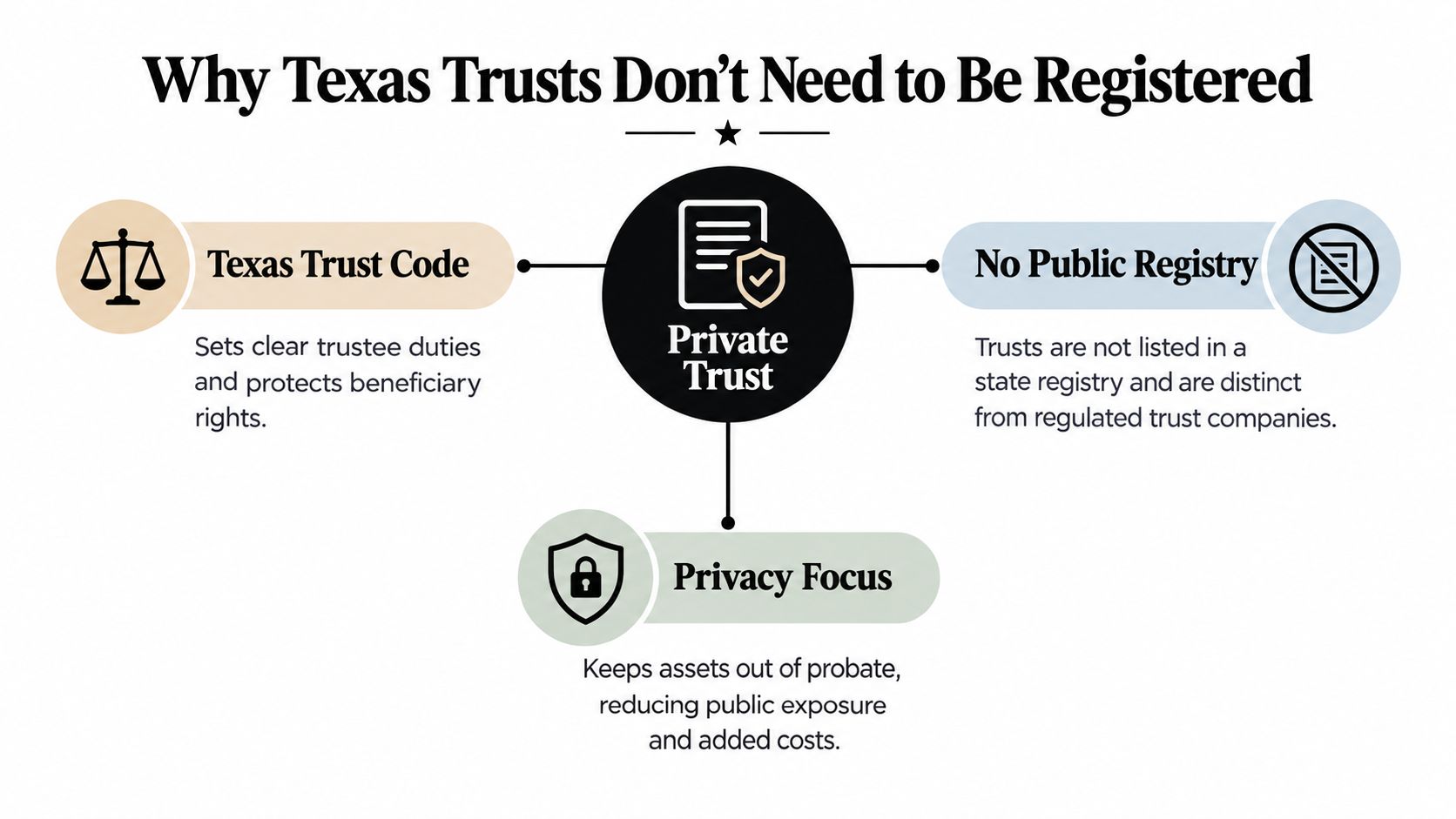
For most family situations, the answer is no. Texas doesn't maintain a universal public registry for ordinary private trusts. That usually includes revocable living trusts, irrevocable trusts, testamentary trusts, and many asset-protection trusts. The trust agreement generally remains private unless a court case, tax filing, trust administration matter, or transaction involving trust property requires disclosure.
That privacy doesn't eliminate responsibility. A trustee still needs to identify trust property, follow the trust terms, protect assets, keep records, communicate with qualified beneficiaries, and comply with applicable fiduciary duties. Think of registration as putting a document on a public government list. Trust administration is the work of managing everything inside the document.
The Short Answer Most Texas Families Need
A family may create a revocable living trust, transfer a home and investment account into it, and never submit the trust agreement to the Texas Secretary of State or a probate court merely because the trust exists. Texas law generally treats the trust instrument, the transfer of property, and the trustee's conduct as the center of administration, not a registration certificate. The Texas Trust Code, found in Title 9, Subtitle B of the Texas Property Code, provides the primary framework for private trust administration.
That answer often brings relief, but it can also create a new misunderstanding. “No registration” doesn't mean “no paperwork.” It means the state ordinarily doesn't require a separate filing to place an ordinary private trust in a public registry. The trustee may still need to record a deed, provide a certification of trust to a bank, obtain an employer identification number, file a federal return, or send information to beneficiaries.
Registration and administration are different tasks
Suppose Maria's father dies with a funded trust. His successor trustee doesn't usually register the trust before beginning work. Instead, the trustee should locate the signed instrument and amendments, identify assets, confirm ownership, review beneficiary provisions, secure authority from financial institutions, and address taxes and debts.
A trust-owned home may require a recorded deed or other title documentation. A bank may request a certification of trust rather than the entire private agreement. Beneficiaries may be entitled to information or an accounting under the trust terms and applicable law. None of these steps is the same thing as registering the trust itself.
Practical rule: Ask what the asset, institution, beneficiary, or tax authority requires. Don't assume every document request is a trust-registration requirement.
Privacy is one practical benefit of this system. A private trust document generally isn't placed in a public registry just because the settlor signed it. That can help families keep financial details outside routine probate filings, although disclosure may become necessary in litigation, court administration, tax reporting, or a transaction involving trust-owned property.
Tax questions often add confusion because inheritance and trust income are different issues. Families comparing those concerns may find Allied Tax Advisors' inheritance tax guide useful background, but a trustee still needs advice focused on the trust's particular assets and tax status.
The most important takeaway is this: Texas usually doesn't require ordinary private trust registration, but it does require responsible trust administration.
Why Texas Law Does Not Require Registration
Texas separates the creation and administration of a private trust from the regulation of businesses that provide trust services. The Texas Trust Code addresses matters such as trustee powers, beneficiary rights, trust property, administration, and remedies for breaches of duty. It doesn't create a general rule requiring every private family trust to be filed with the Secretary of State.
That framework applies to common planning structures. A revocable living trust may help manage property during incapacity and direct distribution after death. An irrevocable trust may hold property under terms that limit the settlor's control. A testamentary trust may arise under a will after death. The structure and purpose differ, but the trust itself ordinarily isn't submitted to a universal public registry.
The statute governs conduct, not a public list
A trustee's legal duties arise from the trust instrument, the Texas Trust Code, and general fiduciary principles. Those principles can require loyalty, prudent management, proper recordkeeping, protection of trust property, and fair treatment of beneficiaries. A trustee can face consequences for mismanagement even though nobody was required to register the trust when it was created.
This distinction protects privacy while preserving accountability. The trust document may stay private, but the trustee's actions remain subject to legal review. A beneficiary who believes the trustee failed to provide information, mishandled property, or violated the trust terms may have remedies through a demand, mediation, or court proceeding.
The law also treats a regulated trust business differently. A company that conducts a trust business may need authority under the Texas Finance Code. That requirement concerns the company offering fiduciary services, not a parent creating a trust for children or a family member serving as trustee. The Texas Finance Code provision addressing trust business activity illustrates why families should identify the category involved before assuming a filing rule applies.
Privacy doesn't mean invisibility
A private trust can remain outside a public registry while still appearing in records connected to specific property or events. A deed may identify the trustee or trust-related ownership. A tax return may report trust income. A court file may contain trust documents if a dispute requires judicial intervention.
For readers who want a broader explanation of the difference between trust administration and probate, Texas Trust Administration: A Trustee's Guide provides that overview. The practical point remains the same. Texas families usually create and operate private trusts through documents and transactions, not through a general registration application.
Exceptions Where Filings or Registration Do Apply
The phrase “Texas trust” can describe very different arrangements. A private family trust, a foreign business trust, a regulated trust company, and a trust that owns Texas real estate don't all follow the same filing rules. Classification comes first.
The clearest registration exception involves a foreign business trust. The Texas Secretary of State explains that a foreign business trust has been required to register since January 1, 2006, when the applicable Texas Business Organizations Code provisions took effect. Form 312 is an application for registration of a foreign business trust, real estate investment trust, or another foreign filing entity. The rule generally applies when the entity will transact business in Texas. The Secretary of State also explains that Texas doesn't specifically define “transacting business” and lists activities that don't qualify, so an entity-specific review matters. See the Texas Secretary of State's foreign entity guidance.
Compare the category before filing
| Situation | What usually matters |
|---|---|
| Ordinary private family trust | No general trust-registration filing merely because it exists |
| Foreign business trust conducting business in Texas | Registration may be required under the Business Organizations Code |
| Company conducting a trust business | Separate financial-services authority may apply |
| Trust acquiring or selling Texas real estate | Deeds and title documents may need recording |
| Certain charitable structures | Separate nonprofit, tax, or reporting rules may apply |
A family trust that buys a Texas home isn't necessarily registering the trust. Instead, the transaction may require a properly prepared and recorded deed, title review, lender documentation, and homestead analysis. Families handling a residence should distinguish trust administration from property-tax filings, including questions about filing a Texas homestead exemption.
Trust business is not family trusteeship
A bank or trust company serving the public operates under a different regulatory framework than an individual trustee managing an aunt's inheritance. The first involves a business providing fiduciary services. The second involves administration of private property under a trust agreement. Using the same word, “trust,” doesn't make the legal requirements identical.
Charitable and nonprofit arrangements can create additional reporting duties, especially where federal tax status, charitable assets, or regulatory oversight is involved. Those duties shouldn't be treated as a universal registration rule for private estate-planning trusts. A trustee should ask whether the filing relates to the trust itself, the entity conducting business, the underlying asset, or a tax status.
Practical Steps Trustees Still Need to Take
Consider a common Texas scenario. A parent dies, and the named successor trustee finds the original trust agreement in a home office. The family expects quick distributions, but the trustee first needs to establish what the trust owns and what authority the document provides.
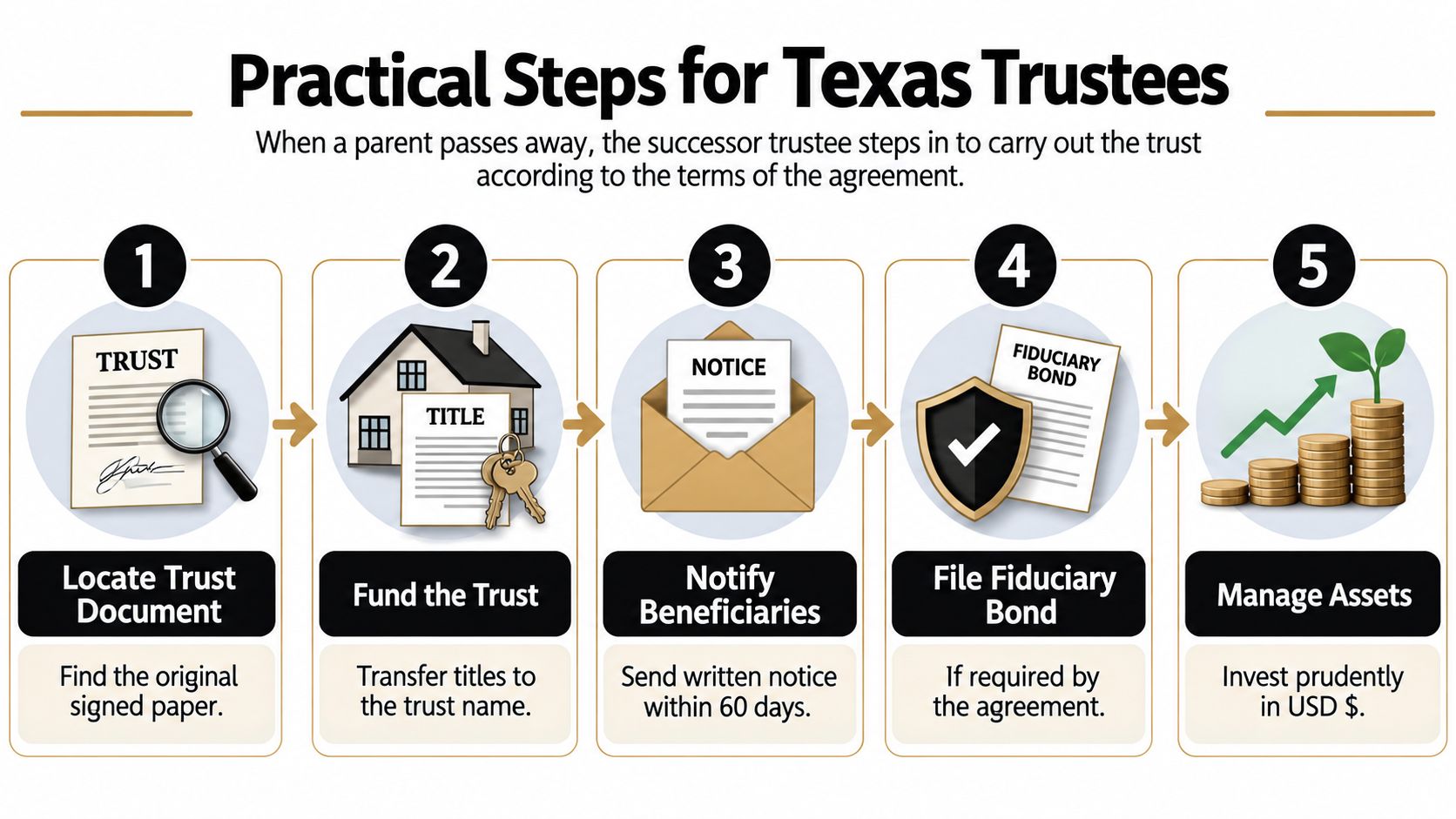
The trustee's work usually begins with documents rather than a registration form. The original signed trust, amendments, death certificate, asset statements, insurance information, deeds, beneficiary designations, and prior tax records help establish the trust's position. The trustee should also identify which assets passed under the trust and which passed through probate or another transfer method.
Build the administration file
A practical file may include:
- Confirm authority. Read the trustee appointment and successor provisions. Determine whether a certification of trust, affidavit, death certificate, or other proof will be needed.
- Inventory property. List real estate, accounts, business interests, personal property, insurance proceeds, and debts. Confirm title instead of relying on family recollection.
- Separate funds. Use a dedicated trust account and avoid mixing trust money with personal funds. Keep statements, receipts, decisions, and distribution records.
- Address Texas real estate. Ask a title professional or attorney whether a deed, affidavit, or other instrument must be prepared and recorded.
- Communicate carefully. Identify qualified beneficiaries and provide notices, information, or accountings required by the trust and applicable law.
Banks often don't need the entire private trust agreement. They may request a certification of trust showing the existence of the trust, the current trustee, trustee powers, and other relevant facts without exposing every private provision. Trustees handling that request can review what Texas banks may require in a certification of trust.
A successor trustee's strongest protection is a clean paper trail. Record why an asset was valued, why a distribution was made, and how the decision follows the trust terms.
The trustee should also separate trust administration from estate administration. If one account belonged to the decedent individually, an executor may need to handle it through probate. If the home was titled in the trust, the successor trustee may handle it under the trust instrument. One person can hold both roles, but the roles and records should remain distinct.
Federal Tax and EIN Obligations That Apply
Texas trust registration and federal tax compliance are separate questions. A trust may not need a Texas registration filing, yet still need an employer identification number and a federal income tax return after it begins earning income.
The IRS instructions for Form 1041 identify a filing threshold of $600 or more in gross income for the tax year for a domestic trust taxable under Internal Revenue Code section 641. The same instructions also identify situations requiring a return, including circumstances involving a nonresident-alien beneficiary, so income alone isn't the only factor. Trustees should review the current IRS Form 1041 instructions and consult a tax professional when the trust's status is unclear.
Separate the tax checklist from the legal checklist
A trustee should ask:
- Does the trust need an EIN?
- Is the trust treated as a grantor or nongrantor trust?
- Did it receive interest, dividends, rent, business income, gains, or other taxable income?
- Does Form 1041 apply?
- Must the trustee provide beneficiary tax information?
- Are distributions documented and traceable?
A separate trust account makes those questions easier to answer. It also helps the trustee distinguish trust income from personal funds and preserve reliable records for beneficiaries, accountants, and potential court review. A trustee should never assume that a missing Texas registration filing excuses a required federal return.
Trust income, principal, distributions, and tax liability can interact in ways that aren't obvious from a bank statement. Trustees who need a practical starting point can review trust tax return and Form 1041 guidance, then coordinate with a CPA or tax attorney for the trust's specific facts.
Where the real risk often sits
Families sometimes spend their energy searching for a nonexistent state registration certificate while overlooking more serious issues. Commingling assets, failing to retitle property, ignoring beneficiary information rights, misclassifying the trust, or missing tax filings can create substantial problems. The trustee's job is to build a reliable compliance system from the trust instrument, asset records, communications, and filings.
Common Misconceptions About Trust Oversight in Texas
“No registry” is often mistaken for “no oversight.” That's incorrect. The Texas Trust Code can impose duties on trustees, and beneficiaries may seek information, an accounting, or court relief when administration goes wrong. A trustee can be accountable because of conduct, not because a public official first approved the trust.
A signed agreement also isn't the entire administration file. It may say who should receive property, but the trustee still needs to establish what property exists, confirm title, preserve records, and document decisions. If the trustee distributes everything without checking debts, taxes, competing claims, or the trust's conditions, the signature alone won't provide much protection.
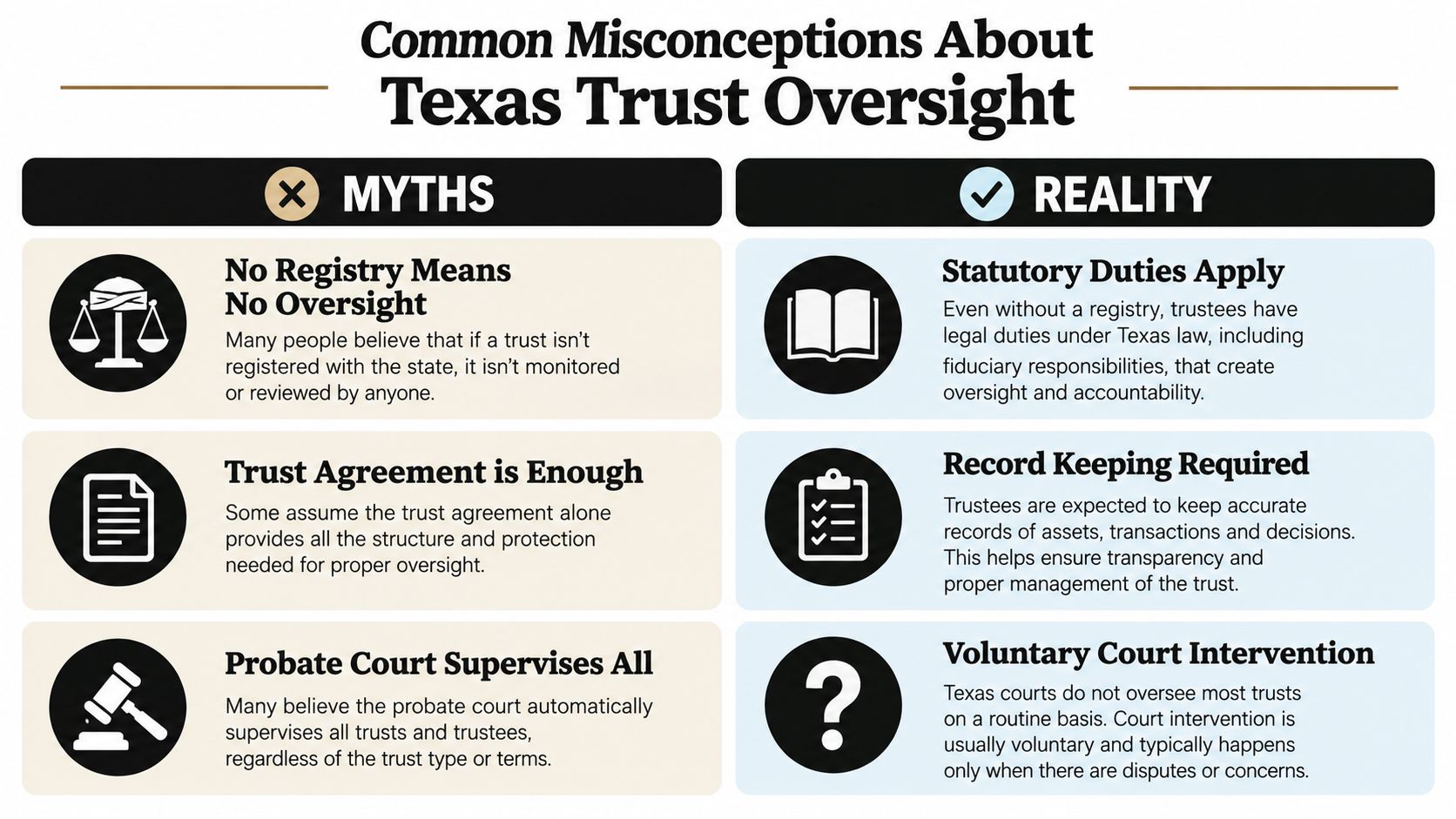
Probate court doesn't supervise every trust
The Texas Estates Code governs probate administration of a decedent's estate. It includes rules for personal representatives and independent administration. In an independent administration, once the appointment order and required inventory, appraisement, and list of claims, or an affidavit allowed in place of that filing, have been filed, further probate-court action generally doesn't occur unless the Estates Code authorizes it.
That process applies to the probate estate, not as a universal trust-registration system. A trust may receive estate property, and a court may become involved in a trust dispute or construction issue, but those events don't mean every private trust begins under routine court supervision.
For a clearer look at the public-record question, trustees and beneficiaries can review whether trusts are public record in Texas. Privacy and accountability can exist at the same time. A trust may stay private while the trustee remains answerable to beneficiaries and the law.
The absence of a registry changes where oversight begins. It doesn't remove the trustee's fiduciary duties.
When to Consult a Texas Trust Administration Attorney
A Texas family should consider legal advice when the trust owns real estate, business interests, closely held investments, or property in more than one state. Counsel can help determine which assets belong to the trust, which require probate, and which documents must be recorded or delivered to third parties.
Legal guidance also becomes important when beneficiaries disagree, a trustee has stopped communicating, the trust language is unclear, or someone asks how to modify a trust in Texas. A court petition, negotiated agreement, or trustee action may be appropriate, but the correct path depends on the instrument, the people involved, and the nature of the conflict.

A trustee dealing with taxable income should coordinate with a CPA and a Texas trust administration lawyer. A family planning before death may benefit from a Texas estate planning attorney who can align the trust with beneficiary designations, real estate ownership, guardianship planning, and asset-protection goals. Beneficiaries facing incomplete records or suspected misuse may need advice about fiduciary duties in Texas and available remedies.
The core answer is reassuring but limited. Ordinary private trusts generally don't need a state registration filing. Trustees still need to administer property carefully, preserve privacy appropriately, communicate with beneficiaries, and complete filings triggered by assets, tax status, business activity, or court proceedings.
This short video offers another way to think about the relationship between trust documents and administration:
If you're managing a trust or planning your estate, contact The Law Office of Bryan Fagan, PLLC for a free consultation. Our attorneys provide trusted, Texas-based guidance for every step of the process.
The Law Office of Bryan Fagan, PLLC helps trustees and families organize trust administration, address fiduciary responsibilities, coordinate estate planning and probate matters, and respond to beneficiary concerns. Schedule a free consultation to discuss the documents, assets, filings, and next steps specific to your Texas trust.