Managing a loved one's trust can feel overwhelming, especially when you arrive at a Texas bank ready to protect the trust's assets and the banker asks for a document you didn't expect. You may have the full trust agreement, death certificate, appointment papers, and your identification, yet still hear, “We need a Certification of Trust.”
That request doesn't necessarily mean you've done anything wrong. Texas law allows a trustee to provide a focused certification instead of routinely handing over the entire estate plan. The challenge is that the law and a bank's internal procedures operate together. This guide explains the statutory checklist, the documents banks commonly request, practical certification language, and ways to avoid a second trip to the branch.
The Day a Trustee Walks Into a Texas Bank
A successor trustee walks into a Houston branch carrying a binder filled with estate documents. The trust agreement is signed, the trustee appointment is documented, and the account needs to be retitled or accessed. The banker reviews the paperwork, then asks for a Certification of Trust rather than the complete agreement.
The trustee may reasonably wonder why the full trust document isn't enough. The answer is usually practical. Banks need proof that the trust exists, that the person in front of them has authority, and that the requested transaction fits within that authority. They also have procedures designed to limit unnecessary exposure to private inheritance instructions.
That can feel unsettling when you're already managing someone else's property. A trustee owes fiduciary duties in Texas, including acting carefully, following the trust's terms, protecting trust property, and keeping accurate records. A bank request can therefore feel like a test of whether you're handling the role correctly.
Practical rule: A Certification of Trust is evidence of authority for a transaction. It isn't a replacement for understanding the trust agreement.
The gap between statutory permission and bank practice causes much of the frustration. Texas law permits abbreviated proof, but a particular bank may still request identity records, signatures, excerpts, beneficiary information, or its own forms. Those requests often reflect account-opening, fraud-prevention, and risk procedures rather than a conclusion that the trust is invalid.
The rest of this article gives you a preparation plan. You'll see what Texas Property Code Section 114.086 covers, how Texas Finance Code Section 34.306 affects trust-owned deposit accounts, what supporting records to gather, and how to use a sample checklist before speaking with the bank's trust department. If you're stepping into the role for the first time, First Steps for a Successor Trustee in Texas addresses immediate actions after assuming that responsibility.
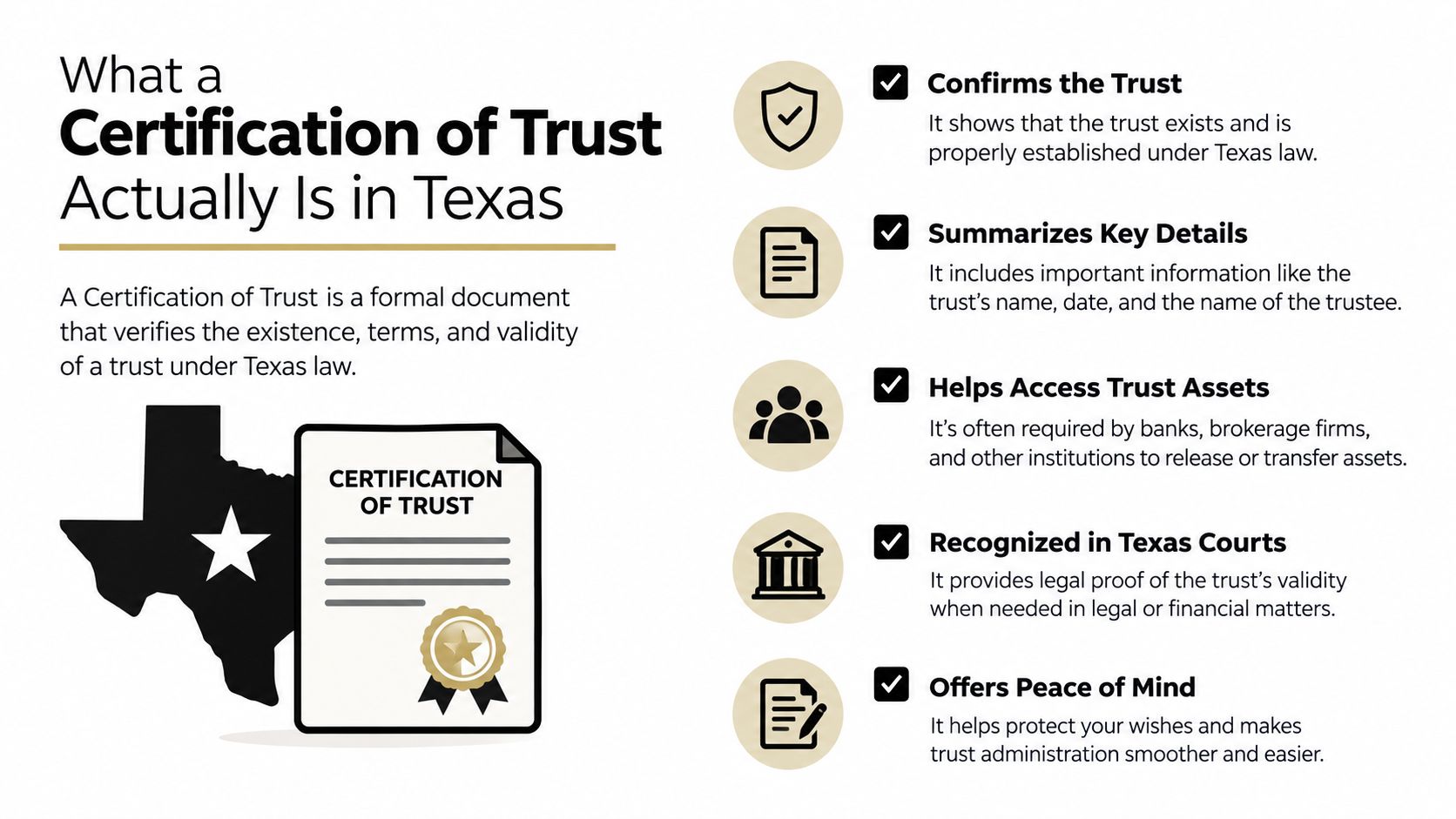
What a Certification of Trust Actually Is in Texas
You are at a Texas bank with a trust-owned account that needs to be retitled. The banker asks for proof that you can act, and producing the entire trust agreement may expose private family instructions. A Certification of Trust gives the bank a focused record of the trust's authority, while helping you bring the pages and signatures relevant to the transaction.
Texas Property Code Section 114.086 permits a trustee to provide this certification instead of the entire trust agreement. It works like an authority summary: the bank can review the trust's existence, key participants, and transaction powers without receiving every provision of the estate plan.
The Texas Property Code checklist
Start with the trust's execution date, confirmation that the trust exists, the settlor, and the currently acting trustee. Include the trustee's mailing address so the bank can connect the document with the person requesting the transaction and has a reliable contact point.
Authority details deserve careful attention. The certification should describe at least one trustee power that relates to the proposed transaction or confirm that the trustee has the statutory powers provided by Texas trust-administration law. For a request to retitle a deposit account, the bank needs a clear reason the trustee can take that action.
The document should state:
- Trust status: Whether the trust is revocable or irrevocable.
- Revocation power: The person who holds any power to revoke the trust.
- Co-trustee authority: Whether one, some, or all co-trustees must sign or otherwise authenticate a transaction.
- Property title: How trust property should be titled.
These entries connect the certification to the trust's governing terms and applicable fiduciary principles. One trust may allow a single trustee to act alone. Another may require every co-trustee to approve the same transaction, so the signing instructions should match the actual arrangement.
What the bank generally doesn't need
Keep dispositive terms out of the certification. Inheritance provisions, distribution standards, and private family instructions usually have no bearing on whether a trustee may manage a particular account.
A bank may request excerpts identifying the trustee or confirming authority for the pending transaction. Prepare only the pages that address the bank's specific question when possible. This narrower review gives the institution a way to investigate a concern while limiting exposure of the broader estate plan.
Before signing, the trustee must affirm that the trust remains accurate as presented. Check whether it has been revoked, amended, or modified in a way that changes the certification. An outdated statement can create problems for both the trustee and the bank, especially when the signature and authority provisions no longer match.
What Texas Law Requires Banks to Accept and What Banks Still Ask For
A trustee arrives at a Texas bank with a signed certification and expects to open or manage a trust-owned account. The banker reviews it, then asks for the bank's own form, an indemnity, and details about successor trustees. This result can feel inconsistent until you separate the statutory checklist from the bank's operating requirements.
Texas Finance Code Section 34.306 sets a framework for trust-owned deposit accounts. The certification must be an affidavit by the trustee and include the trust's effective date, trustee's name, method for selecting successor trustees, each beneficiary's name and address, the trustee's authority, what happens to the account when the trustee or surviving trustee dies, other information required by the bank, and an indemnification protecting the bank. The statutory language appears in Texas Finance Code Section 34.306.
Texas Property Code Section 114.086 authorizes trustees to submit a focused certification. When the required certificate is furnished, the bank may administer the account from that document without requiring the full trust agreement. The certification functions like a labeled folder: it gives the bank the pages and facts needed for the account while keeping unrelated estate-planning terms private.
How the statute and bank practice meet
Consider a trust checking account. The certification may identify the acting trustee and explain signing authority under the statute. The bank may still require its own signature card, identity review, successor-trustee information, and an indemnification before allowing a withdrawal or account change. Finance Code Section 34.306 addresses the bank's acceptance framework, while the institution's procedures address its compliance and operational risks.
The statute does not require a bank to open or maintain an account when the trustee declines to provide the trust agreement. It also does not require the bank to search its records for a named beneficiary. A certification can satisfy the legal checklist and still prompt a request for targeted trust excerpts or additional records.
The bank's practical documentation floor
Review every bank form before signing. An indemnification generally protects the bank if it relies on the certification and later faces a claim connected to that reliance. Your signature represents a fiduciary statement, not merely a routine account instruction.
Ask the branch or trust department for its current requirements and whether it uses a proprietary certification form. Banks establish credibility through layered verification, a practice explained through proven website trust signals. Arriving with the statutory certification, requested signatures, and indemnity helps prevent a second trip.
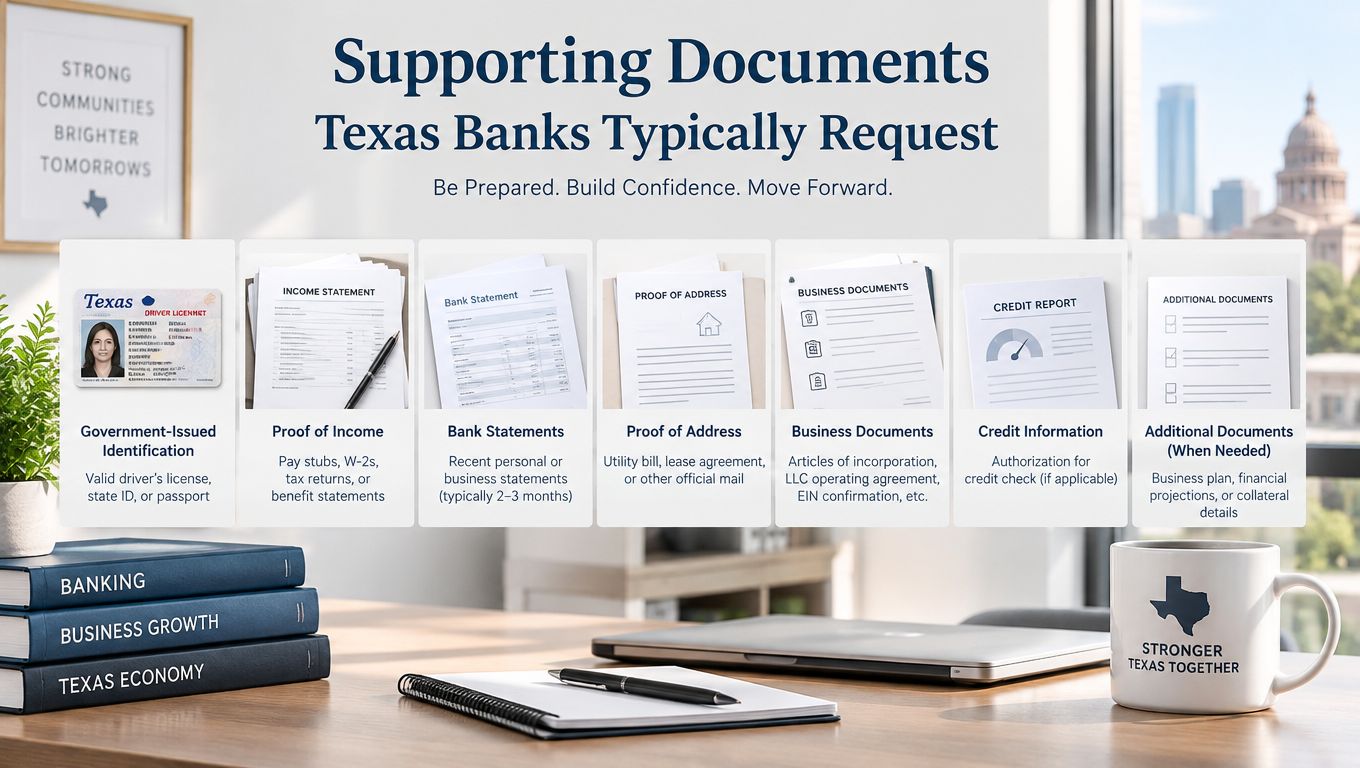
Supporting Documents Texas Banks Typically Request
A prepared trustee brings more than the certification itself. The goal isn't to disclose every private provision in the trust. It's to have the records that prove identity, appointment, authority, and the account's intended ownership when the bank asks for them.
Start with identity and appointment records
Bring government-issued identification for each trustee who may sign. If there are co-trustees, confirm whether the trust requires one, some, or all of them to authenticate the transaction.
Gather evidence showing how you became trustee. Depending on the situation, that may include an appointment document, a successor-trustee provision, a written acceptance, or evidence that a prior trustee died or became incapacitated. If the trust requires a bond, bring evidence addressing that requirement.
A bank may also request the trust's EIN or confirmation that an application has been made. The correct tax identification approach depends on the trust's structure and circumstances, so don't guess if the bank's request conflicts with advice from the trust's tax professional.
Bring only the relevant trust pages
Keep a certified copy of the trust's signature pages or relevant excerpts available. The bank may want to confirm the trustee's identity, appointment, authority, co-trustee rules, or a provision concerning the account.
If the trust already exists and has been administered, the bank may ask for a prior fiduciary accounting or related records. That request can arise when the institution needs to understand the account history or reconcile a change in authority.
Corporate fiduciaries should bring organizational documents showing that the entity exists and identifying the person authorized to act. The bank may also require a resolution, signature authority record, or comparable internal document.
For account ownership changes, review the practical process described in how to transfer bank accounts to a trust in Texas. The bank's ownership paperwork remains important because a private trust document alone may not change the account title.
Understand the indemnification
Before signing an indemnification, identify what the bank is asking you to promise. The language may protect the bank if it relies on your affidavit or certification, but the precise effect depends on the document.
Ask whether the indemnification is limited to the pending transaction or written broadly. Ask which trustee must sign and whether the bank will accept a separate attorney-reviewed form. Never sign a statement that you believe is inaccurate merely to move the account forward.
Variations Between Texas Banks and Common Stumbling Blocks
A trustee can arrive at a Texas bank with a valid trust and still leave without completing the transaction. The branch may request a beneficiary address, a trust excerpt, or an internal affidavit that another institution never mentions. These differences reflect the bank's own review process, so calling ahead can reveal which pages, signatures, and identification documents to bring. Trustees comparing institutions can find Texas banking leaders, but the bank holding the account controls the practical preparation.
Consider a stalled visit. The trustee arrives alone even though the trust requires every co-trustee to sign. The certification predates an amendment, beneficiary addresses are missing, and the bank's form remains unsigned. The authority review stops, and the trustee must collect the missing pieces before returning.
A smoother visit begins with a short call to the branch or trust department. Confirm the bank's certification form, required signers, identification standards, beneficiary information, and any indemnification language. Bring the current certification, the relevant trust pages, and the people whose signatures the trust requires. The paperwork should answer the bank's authority questions without exposing unnecessary dispositive terms.
Common problems that delay approval
- An outdated certification: An amendment may change the trustee, revocation power, co-trustee rules, or authority. Compare the certification with the current trust before delivering it.
- Missing co-trustee signatures: If all co-trustees must act, one signature may not establish authority.
- Incomplete beneficiary information: Addresses for minor or incapacitated beneficiaries may be unavailable. Ask the bank how it wants those records documented.
- Unclear successor authority: The bank may request evidence showing how the successor trustee was selected and accepted the appointment.
- Conflicting internal forms: Compare the bank's affidavit or certification with the trust. Ask whether counsel may review it before signing.
Your fiduciary duties remain the same regardless of the bank's process: act in good faith, preserve trust property, and avoid inaccurate statements. Read every indemnification carefully, especially language that could extend beyond the pending transaction.
If authority or ownership is disputed, another bank form may not resolve the problem. A resource explaining a Heggstad petition in Texas may help trustees understand how court involvement can address certain property and authority questions. The appropriate procedure depends on the trust and the disputed facts.
Sample Certification Language and a Printable Checklist
A sample can help you see how the pieces fit together, but it isn't a substitute for reviewing the actual trust. Non-standard provisions, amendments, special trustee powers, and unusual co-trustee rules can change the wording.
Plain-language sample
You may use the following as a starting framework for discussion with counsel and the bank:
Certification of Trust
I, [Trustee full name], certify that [full trust name] exists and was executed on [execution date]. The settlor is [settlor full name]. The currently acting trustee is [trustee full name], whose mailing address is [trustee mailing address].
The trustee has authority to [describe the relevant trustee power], or the trustee has the statutory powers provided by Texas trust-administration law. The trust is [revocable or irrevocable]. Any power to revoke the trust is held by [name of person holding revocation power].
The co-trustee signing rule is [one trustee, specified trustees, or all trustees must sign or authenticate]. Trust property for this transaction should be titled as follows: [insert proper title].
The recipient may request excerpts confirming who serves as trustee and establishing the trustee's authority for the pending transaction. The dispositive terms of the trust are not included in this certification.
I affirm that the trust has not been revoked, amended, or modified in a way that would make this certification inaccurate.
[Trustee signature]
[Printed name and date]
For a deposit account, the bank may require an affidavit containing the additional information described by Texas Finance Code Section 34.306, including beneficiary names and addresses, successor-trustee selection, account treatment at the trustee's death, and indemnification.
Bank-visit checklist
Print or adapt this list before calling the bank:
- Certification: Confirm the execution date, settlor, trustee, mailing address, authority, revocability, revocation power, co-trustee rule, and titling language.
- Signatures: Identify every trustee who must sign and bring valid identification.
- Appointment: Bring the acceptance, appointment evidence, and records concerning any former trustee.
- Trust excerpts: Prepare relevant pages concerning trustee authority and the pending transaction.
- Tax records: Gather the trust EIN or applicable confirmation.
- Beneficiary information: Compile names and addresses in the format the bank requests.
- Account details: Confirm the proposed title and whether the bank will retitle the existing account or open a new one.
- Indemnification: Ask for the bank's form in advance and review its promises before signing.
- Questions: Ask whether the bank requires its own affidavit, whether all trustees must attend, and whether an original or certified copy is required.
A broader trust administration checklist can help you organize related duties beyond the bank appointment. Have an attorney review the certification if the trust contains unusual powers, conflicting amendments, complex tax provisions, business interests, or real estate.
Next Steps for Trustees and When to Call a Texas Trust Attorney
The practical answer to certification of trust Texas what banks require is a two-layer standard. Texas law gives trustees a simple way to prove authority, while each bank may set additional documentation requirements for its own records and risk procedures.
Keep the certification current. Refresh it after an amendment, a change in trustees, or any event that affects revocation power, co-trustee signatures, authority, or property title. Store a signed original in the trust records and treat the indemnification as a serious fiduciary promise.
A trustee may also want help when a bank has already rejected a certification, when the trust owns real estate or business interests, or when the account balance and family circumstances make an error especially costly. The Law Office of Bryan Fagan, PLLC provides guidance on trust administration, fiduciary accounting, estate planning, tax planning, asset protection, probate, guardianship, and trust disputes. If you need to finalize signatures electronically, review a practical free PDF signature tool as one administrative option, while confirming that the bank accepts electronic signatures.
A Texas trust administration lawyer can compare the certification with the controlling trust, explain your fiduciary duties in Texas, and communicate with the bank when authority is disputed. A Texas estate planning attorney can also review whether the trust, account title, beneficiary designations, and broader plan still work together, including questions about how to modify a trust in Texas.
If you're managing a trust or planning your estate, The Law Office of Bryan Fagan, PLLC can prepare and review trust certifications, organize bank documentation, and provide Texas guidance on administration, estate planning, probate, guardianship, and asset protection. Schedule a free consultation by visiting Law Office of Bryan Fagan, PLLC so you can approach the bank with accurate documents and a clear plan.