Managing a loved one's trust can feel overwhelming, especially when the document no longer matches the family's reality. A beneficiary may now have special needs, a trustee may struggle with outdated administrative terms, or a tax objective that once made sense may no longer justify the restrictions. You may be asking, how to modify a trust in Texas without violating the settlor's wishes or exposing the family to a costly dispute.
Texas law provides several possible paths. Some changes may be handled through the trust document, trustee authority, or a private agreement. Other changes require a court proceeding under Texas Property Code Section 112.054, often called the judicial modification of a Texas trust 112.054 process. The right answer depends on the trust's language, the people affected, the reason for the requested change, and the evidence available.
When a Trust No Longer Fits the Family
A family discovers the problem during an ordinary conversation. Their parent created an irrevocable trust years ago, intending to protect assets and provide orderly support for the children. Since then, one beneficiary has developed significant care needs, the original trustee has become unable to serve, and the trust's distribution instructions have become difficult to apply. Everyone agrees the family needs a practical solution, but nobody wants to disregard the parent's wishes.
That situation doesn't necessarily mean the trust was drafted improperly. Trusts are built for a particular set of facts, and families, assets, laws, and relationships can change. A provision that was sensible when the settlor signed the document may later create waste, delay, or a conflict with the trust's central purpose.
Modification protects purpose, not preference
Judicial modification isn't a general permission slip for beneficiaries to rewrite an inheritance plan because they've changed their minds. A court looks for a legally recognized reason to intervene and must keep the settlor's probable intention at the center of the decision. Texas Property Code §112.054 allows a court to consider modification, trustee changes, authorized acts, or termination when statutory conditions are established. Texas Property Code §112.054 describes the structured authority courts use in these circumstances.
A useful first step is to identify the problem precisely:
- Administrative problem: The trustee appointment, investment language, or management instructions no longer work.
- Purpose problem: The trust's objective has been fulfilled, become impossible, or become illegal.
- Family circumstance problem: An unforeseen development now makes a change helpful in carrying out the trust's purpose.
- Tax problem: A change may be necessary to accomplish the settlor's tax objectives.
- Distribution problem: The existing terms create a result that may conflict with the trust's intended function.
Practical rule: A family's agreement is helpful, but agreement alone doesn't always give a trustee authority to change an irrevocable trust.
The trust document should be reviewed before anyone signs a family agreement, distributes property differently, or files a petition. Families can also use educational resources on trust mistakes to avoid to spot drafting and administration concerns before they become larger disputes. A Texas trust administration lawyer can then separate a correctable administrative issue from a change that requires judicial approval.
Understanding Texas Property Code Section 112.054
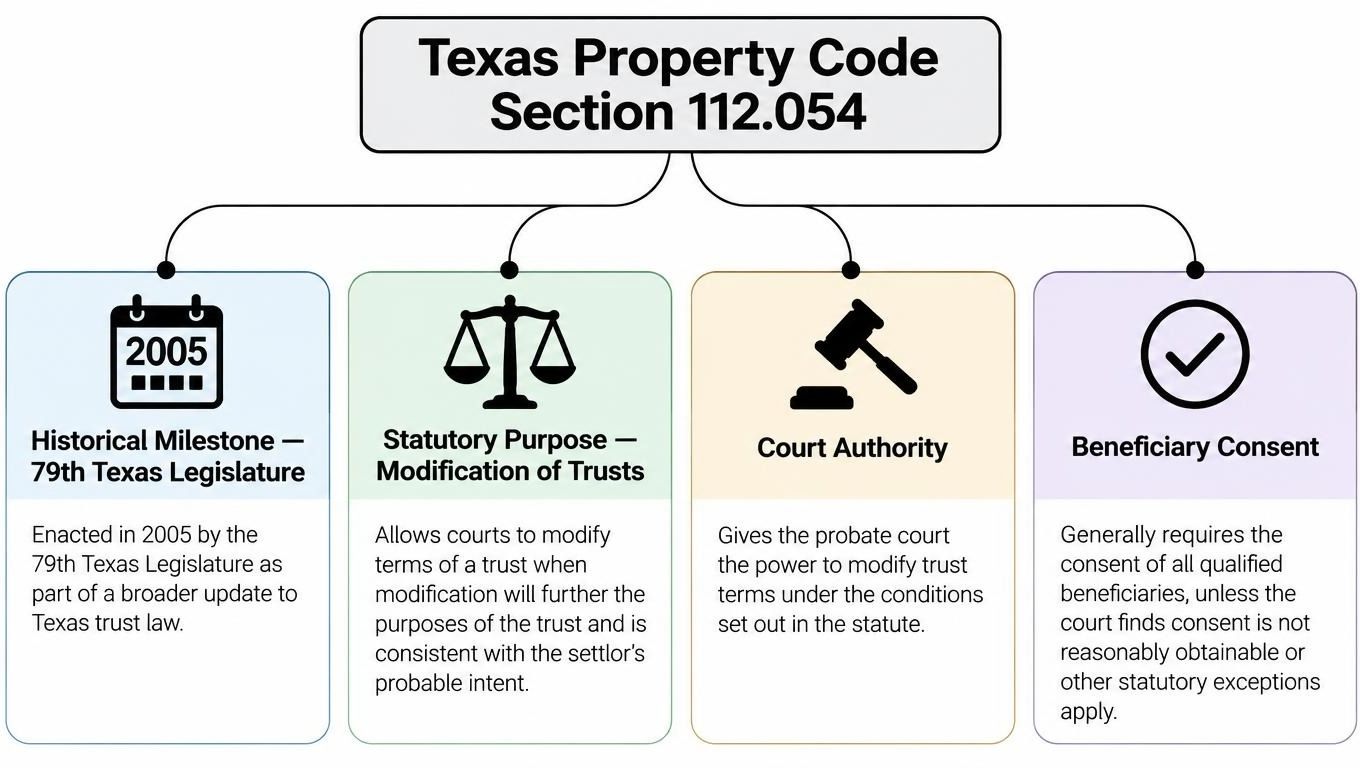
Texas Property Code §112.054 gives courts unusually broad, but structured, authority over trust administration. On petition from a trustee or beneficiary, a court may change the trustee, modify trust terms, authorize or forbid an act, or terminate the trust in whole or in part when a statutory ground is proven. The court isn't free to act because a different arrangement seems more convenient.
The statute identifies several core grounds for relief. A court may act when the trust purpose has been fulfilled, or when that purpose has become illegal or impossible. It may consider unforeseen circumstances when modification would further the trust's purpose. It may approve administrative changes needed to prevent waste, and it may enter an order necessary to achieve the settlor's tax objectives. These grounds give courts flexibility while preserving a legal standard for intervention. The Texas Legislature's House Bill 1190 analysis explains the 2005 legislative effort that reorganized and modernized this framework.
The settlor's probable intention controls
The central safeguard is intent. When a court modifies or terminates a trust, the order must conform as nearly as possible to the settlor's probable intention. That means a judge may correct a provision without turning the trust into something different from the plan the settlor created.
For example, if a trust was designed to preserve property for a beneficiary's support, a court may consider a change that improves administration or makes distributions workable. A requested amendment that redirects the property to people the settlor never intended to benefit would face a much more serious problem.
The statute also permits retroactive effect for certain orders. That can matter when an administrative action, tax-related decision, or prior event needs a legally effective correction. The precise relief depends on the facts and the language of the order.
How the Texas Trust Code fits into administration
The Texas Trust Code governs the creation, administration, modification, and termination of trusts. The Texas Estates Code commonly becomes relevant in connected estate matters, including probate, executor responsibilities, guardianship, and related court proceedings. A trust case may touch both bodies of law, particularly when the settlor has died, an estate remains open, or a beneficiary's capacity affects administration.
Fiduciary principles apply throughout the process. Trustees must act within the authority granted by the trust and applicable law, keep proper records, protect trust property, and treat beneficiaries according to the governing terms. The same practical discipline helps executors and guardians manage estate and court responsibilities. Texas Trust Administration: A Trustee's Guide provides an overview of what trust administration involves and how it differs from probate.
The 79th Texas Legislature enacted House Bill 1190 in 2005, and the statutory text reflected these rules in Chapter 112 by 2006. Later appellate decisions, including decisions issued in 2023 and 2024, continued applying the same basic structure: the party seeking relief must establish a statutory predicate, and the court must tailor the remedy to the settlor's likely intent. That history shows why §112.054 is a durable statewide mechanism rather than a narrow emergency remedy.
Procedural Steps and Pleading Requirements
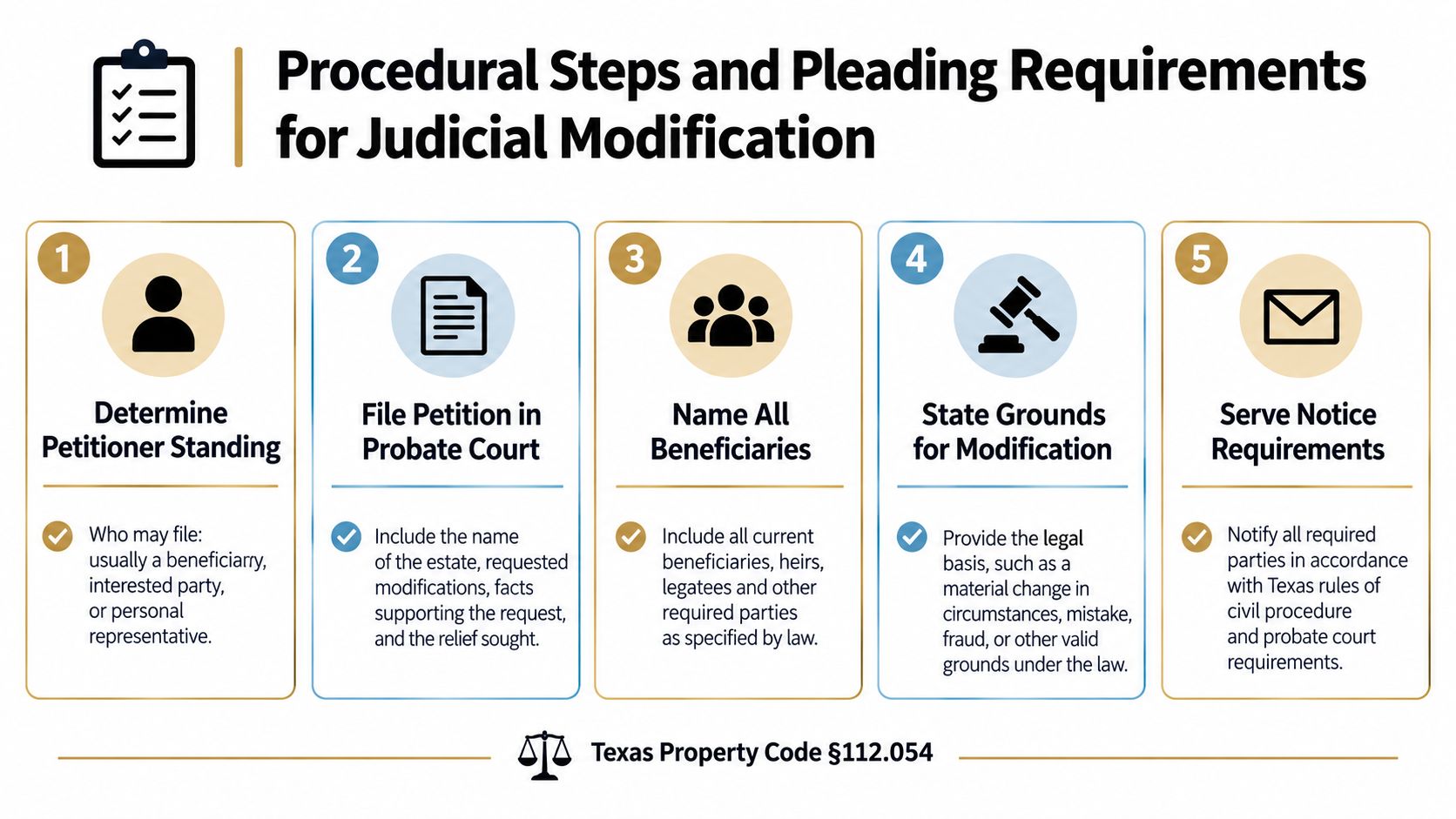
A strong petition begins with procedure, not emotion. The petitioner must show why the court has authority to act, identify the people whose interests may be affected, and provide evidence connecting the requested relief to a statutory ground. A family's sincere belief that a trust is outdated won't replace those requirements.
Start with standing and the trust document
The statute allows a trustee or beneficiary to petition for relief. The first review should confirm the petitioner's role, the trust's current status, any successor trustee provisions, and whether the requested change affects present, contingent, or remainder beneficiaries.
Gather the complete trust instrument and amendments, not just a summary or a page describing distributions. Also collect account statements, property records, trustee correspondence, tax materials, medical or care information when relevant, and documents showing the circumstance that allegedly justifies modification.
A petition generally needs to explain:
- Who is asking for relief: Identify the trustee or beneficiary and describe the legal relationship to the trust.
- What the trust says: State the provisions that create the problem and attach the controlling documents where appropriate.
- What changed: Describe the event, condition, administrative issue, or tax objective with supporting evidence.
- What the statute permits: Connect the facts to the applicable ground under §112.054.
- What order is requested: Ask for a specific modification, trustee change, authorized act, or termination, rather than an open-ended rewrite.
Notice and fiduciary conduct matter
All interested parties must be identified carefully. That may include current beneficiaries, contingent beneficiaries, remainder beneficiaries, trustees, and other persons whose rights could be affected. The exact party and notice analysis depends on the trust, the requested relief, and the applicable court rules. A missed beneficiary can cause delay and may undermine the reliability of the proceeding.
During the dispute, a trustee still has fiduciary duties in Texas. Filing a petition doesn't automatically suspend the trustee's responsibilities. The trustee should preserve trust property, avoid self-dealing, maintain useful records, communicate appropriately, and avoid making the requested change before receiving authority to do so.
The procedural issue resembles other modification disputes in law because the parties must define the legal rights being changed and provide proper notice. For example, readers comparing court-based modification processes may find the explanation of child support modification in Wells Branch useful as a general reminder that a requested change must be supported by facts and presented through the correct legal procedure. It isn't a trust authority, but the procedural comparison can help explain why informal requests aren't enough.
Spendthrift terms don't end the analysis
A spendthrift provision may restrict a beneficiary's ability to transfer an interest or protect trust assets from certain claims. It still doesn't automatically prevent a court from considering modification or termination. The statute treats spendthrift provisions as a factor, not an absolute bar, while the court remains focused on the settlor's probable intention. The Texas statutory provisions on modification and termination state this principle and also address retroactive tax-related orders.
Before filing, review the required parties and notice issues carefully, including the analysis discussed in necessary parties to a Texas trust lawsuit. A carefully defined petition gives the judge a workable remedy and gives beneficiaries a fair opportunity to respond.
Judicial Modification Versus Nonjudicial Alternatives
Court involvement is sometimes necessary, but it shouldn't be the automatic first choice. A trust may contain amendment authority, a trust protector provision, or trustee powers that address the concern without a lawsuit. Texas law also provides mechanisms such as decanting, while families may use properly structured settlement agreements for certain disputes and administrative matters.
The important distinction is between changing the trust's beneficial terms and solving an administration problem. Replacing a trustee, clarifying reporting, or addressing a practical management issue may require a different strategy than changing who receives trust property.
| Modification Method | Court Involvement | Relative Cost | Privacy Level |
|---|---|---|---|
| Judicial modification under §112.054 | Required | Generally higher because pleadings, notice, and court proceedings are involved | Lower, because the matter is handled through a court process |
| Trustee-authorized administrative action | Usually not required, if the trust permits it | Generally lower | Higher, because the action may remain within administration |
| Decanting | Often not required, subject to statutory and trust-based authority | Varies with complexity and tax review | Generally higher than litigation |
| Family settlement agreement | May be avoidable for an appropriate dispute, but legal limits apply | Often lower than a contested court case | Generally higher |
| Trust protector action | Usually not required if the document grants the power | Varies with the scope of review | Generally higher |
These are relative descriptions, not promises about fees, timing, or outcome. A private route can become expensive if beneficiaries disagree, the trustee lacks authority, or the proposed change affects tax treatment. A court process may provide needed certainty when the parties cannot agree or when a material trust purpose is at stake.
Questions to ask before choosing a path
- Does the trust authorize the proposed action? Read the entire document, including amendment, decanting, trustee, and protector provisions.
- Does everyone whose interest is affected agree? Agreement can simplify some disputes, but it doesn't create authority where the law requires a court order.
- Will the change alter beneficial interests? A change in who receives property is more sensitive than a correction to administration.
- Could the change affect tax planning? The settlor's tax objectives may be central to the trust's purpose.
- Is a private solution enforceable? A written agreement should identify authority, consideration where applicable, releases, and the limits of what the parties can change.
Decanting can be useful when a trustee has the required authority and the proposed new trust stays within statutory limits. A detailed explanation of decanting a trust in Texas can help families understand why this option is different from asking a judge to rewrite trust terms.
Real World Scenarios for Trust Modification
The legal standard becomes easier to understand when it's connected to ordinary family decisions. The following examples are hypothetical, but each reflects a type of problem that can arise during Texas trust administration. The outcome would depend on the trust language, evidence, affected beneficiaries, and the proposed order.

A tax purpose that no longer works
A parent creates a trust with carefully drafted provisions intended to accomplish a tax objective. Later, the legal and financial environment changes, and the original structure creates administrative burdens without serving the purpose the parent identified.
The trustee shouldn't distribute the property differently. The trustee should gather the original planning documents, tax advice, trust accounting, and evidence showing why the existing structure no longer accomplishes the settlor's objective. Section 112.054 expressly recognizes action necessary to achieve the settlor's tax objectives as a possible basis for a court order. Tax counsel should review any proposed modification before filing or implementation.
A beneficiary with changing care needs
A trust provides support to an adult beneficiary, but the beneficiary later develops needs that the original distribution language doesn't address well. The family worries that direct payments could interfere with benefit eligibility or that rigid instructions may prevent the trustee from paying for appropriate care.
The family's concern is understandable, but a court still needs a legally supported solution. Evidence may include the trust's purpose, the beneficiary's current circumstances, professional care information, and a proposed structure that preserves the settlor's protective intent. The requested modification should solve the mismatch without creating an unrelated change in beneficial ownership.
A family business that is losing value
A trust holds an interest in a family business. Market conditions, management problems, or changes in the business may make the original holding strategy costly or impractical. Continuing the same arrangement could create waste or impair the trust's purpose.
The trustee should document the business condition, obtain appropriate valuation or financial advice, review the trust's investment and distribution terms, and consider whether administrative relief is enough. If the evidence shows that a change is needed to prevent waste, that fact can support a carefully considered request. The court's job isn't to guarantee a profitable result. It's to determine whether the requested action fits the statute and the settlor's probable intention.
A family considering this type of issue may also benefit from reviewing modifying an irrevocable trust in Texas before deciding whether a judicial petition is appropriate. The review should include the trustee, beneficiaries, financial advisors, and tax professionals when the proposed action affects property or tax planning.
Common Pitfalls in Trust Modification Petitions
Many unsuccessful petitions begin with a reasonable family concern. The problem is that a reasonable concern isn't always a statutory ground. Courts need evidence showing why the trust's current terms create a legally recognized problem and why the proposed remedy preserves the settlor's plan as closely as possible.
Mistakes that create avoidable problems
- Treating inconvenience as unforeseen circumstances: A family's changed preferences may not prove that an unexpected circumstance justifies modification.
- Ignoring contingent beneficiaries: A person who receives property only if another beneficiary dies or fails to qualify may still have an interest that requires attention.
- Requesting an open-ended rewrite: Courts need a specific proposed change, not a general request to make the trust “fair.”
- Overlooking tax consequences: A modification that helps administration may undermine the tax objective the settlor intended to preserve.
- Acting before authority exists: A trustee shouldn't make the requested change merely because a petition has been filed.
- Failing to preserve records: Trust account statements, communications, valuations, and professional advice may help prove both the problem and the proposed solution.
Fiduciary duties in Texas continue during disagreement. A trustee should remain neutral between beneficiaries, avoid using trust property for personal purposes, and communicate within the limits of the trust and applicable law. Beneficiaries should also avoid pressuring a trustee into an unauthorized distribution or signing a release without understanding the consequences.
Before filing: Ask whether the requested order solves a documented legal problem while keeping the settlor's probable intention intact.
A Texas trust administration lawyer can help compare judicial modification with decanting, trustee replacement, settlement, or another available remedy. That early analysis may prevent a petition that is too broad, names the wrong parties, or relies on facts the court can't verify.
Securing Trusted Legal Guidance for Your Trust
Trust modification affects more than a document. It can change trustee authority, beneficiary expectations, tax planning, investment decisions, and family relationships. A careful strategy starts by reviewing the trust and amendments, identifying every affected person, and defining the smallest change that solves the actual problem.
A Texas estate planning attorney can also evaluate whether the trust issue is part of a larger plan involving wills, probate, guardianship, business succession, or asset protection. Executors and trustees may need separate guidance because their responsibilities differ, even when the same family and property are involved. Families should keep the trust's records organized and avoid informal distributions until counsel confirms the available authority.
The Law Office of Bryan Fagan, PLLC handles trust creation, trust administration, modification, termination, fiduciary accounting, tax planning, beneficiary communication, estate planning, probate, guardianship, and asset protection matters for Texas families. The firm also represents trustees and beneficiaries in trust disputes and provides consultations about the practical choices available under the Texas Trust Code and related Texas Estates Code issues.
A free consultation can help you determine whether your situation calls for a judicial petition under §112.054 or whether a more private alternative may be available. Bring the complete trust document, amendments, recent account information, and a written description of the problem so the attorney can evaluate the facts efficiently.
If you're managing a trust or planning your estate, Law Office of Bryan Fagan, PLLC offers guidance on judicial modification, trust administration, estate planning, probate, guardianship, and asset protection. Schedule a free consultation to discuss your trust's terms, your family's concerns, and the most practical path forward.