Managing a loved one's trust can feel overwhelming, especially when the trust document uses language built for a different investing era. A trustee may read “pay the income” and assume the job is simple, only to discover that the portfolio holds growth stocks, real estate, or closely held business interests that don't produce much traditional income at all.
That's where many Texas families get stuck. The trustee wants to treat everyone fairly, the income beneficiary wants a dependable distribution, and the remainder beneficiaries want the trust preserved for the future. A unitrust election can help, but only if the trustee handles the process carefully and understands how Texas trust law, fiduciary duties in Texas, and later modification powers fit together.
When Trust Administration Feels Outdated
A common Texas trust administration problem looks like this. A parent created a trust years ago for a surviving spouse, with the children receiving what remains later. The trust says the spouse receives income, but the trust assets now sit in low-yield investments, growth funds, or land that may increase in value without sending much cash to the trust each year.
The trustee then faces pressure from both sides. One beneficiary asks why the trust isn't paying more. Another asks why the trustee would ever shift investments just to generate dividends if that hurts long-term growth. The old income-versus-principal model can make ordinary administration feel like a no-win exercise.

Why older trust language causes friction
Traditional trust accounting separates receipts and disbursements into income and principal. That framework still matters under the Texas Trust Code and related rules for administration, but modern investing often doesn't line up neatly with those categories. A healthy portfolio may grow mostly through appreciation rather than current yield.
Texas law evolved to address that problem. Texas codified a total-return framework for noncharitable unitrusts and tied the annual payout to asset value rather than only accounting income. Texas law defines a unitrust as a trust requiring a payout of a fixed percentage of not less than 3% and not more than 5% each year of the trust's net fair market value, with valuation at least annually, and it treats that payment as a distribution of all trust income under Texas Property Code Chapter 116.
Why trustees start looking for another path
A total-return structure gives the trustee room to invest for overall performance instead of chasing yield for accounting reasons. That's often more consistent with prudent investing and the trustee's duty to act fairly among beneficiaries.
Practical rule: If a trust's distribution standard forces the trustee to choose between good investing and satisfying the income beneficiary, the administration model deserves a closer look.
Trustees who are still sorting out income and principal issues often find it helpful to review how the trustee power to adjust between principal and income works in Texas. That issue frequently comes up before anyone decides whether a unitrust election makes sense.
What Is a Unitrust Under Texas Total Return Law
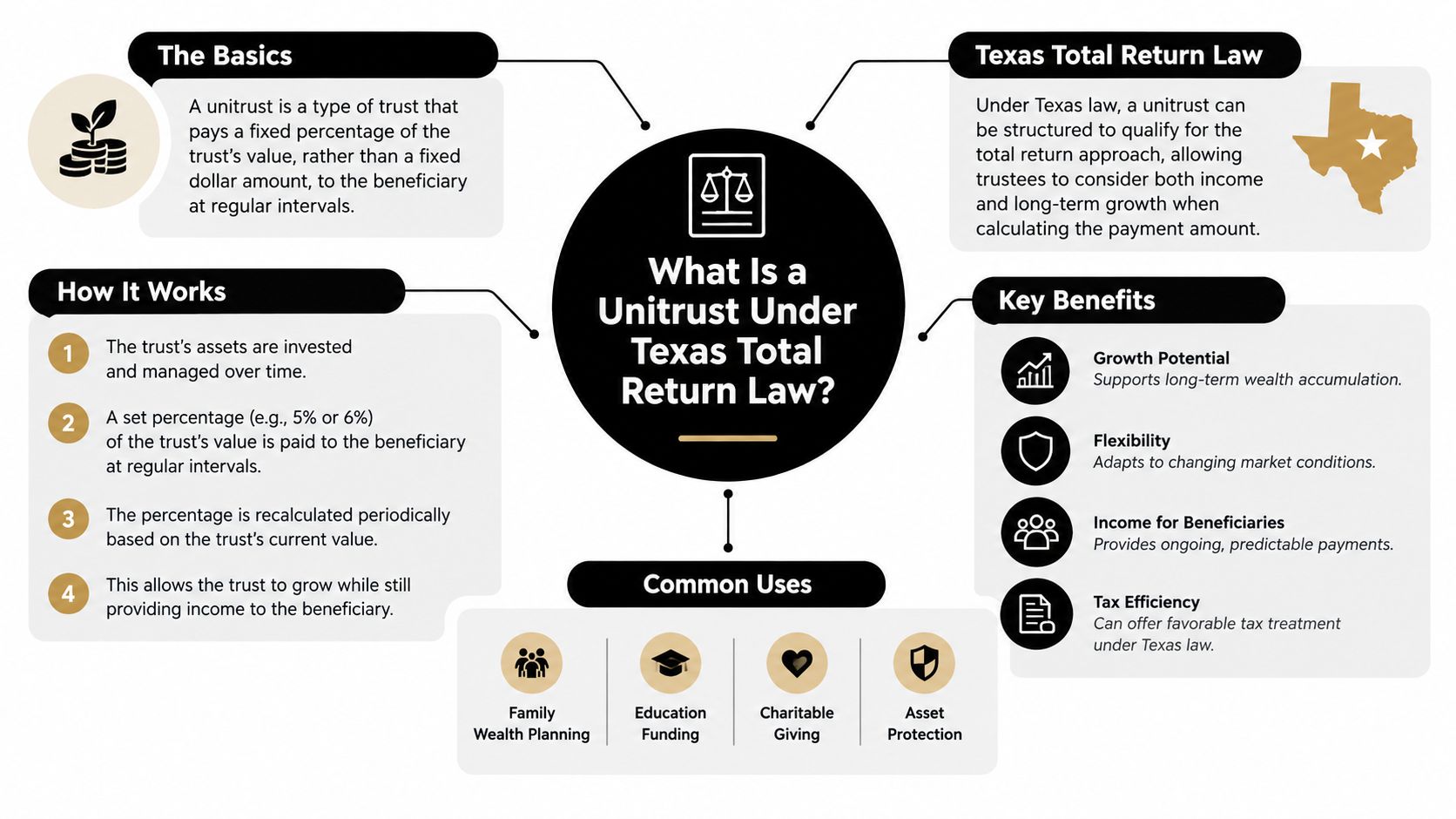
A trust invested mainly for long-term growth can leave its income beneficiary waiting for cash, even while the portfolio increases in value. A unitrust addresses that administrative problem by replacing an income-only distribution approach with a payout based on the trust's value and governing terms. That distinction matters when a Texas trustee is considering whether to convert from income-based accounting.
Under a unitrust structure, the trust distributes a set percentage of its net fair market value rather than limiting distributions to interest, dividends, rents, and other accounting income. The trustee can manage the portfolio for total performance, while beneficiaries receive payments tied to trust value instead of the particular assets producing current cash.
The Texas definition in plain English
Texas Property Code § 116.007 defines a noncharitable unitrust as a trust requiring distribution of a fixed percentage of not less than 3% and not more than 5% each year from the trust's net fair market value. The property must be valued at least annually, and the distribution amount may be calculated from one year or more than one year of value under Texas Property Code § 116.007.
The valuation period creates a practical drafting and administration choice. A single-year calculation can make distributions respond more sharply to market changes. Using more than one year of value can smooth payments. The appropriate method depends on liquidity, portfolio volatility, beneficiary needs, and the trust's purpose.
A trustee should review the governing instrument before treating the statutory election as a routine conversion. Consent requirements, notice, valuation language, and any available modification power can affect whether the proposed structure is valid and workable. Those procedural questions belong alongside the payout calculation, not after it.
Why the change matters in real administration
The structure can suit a portfolio containing appreciating assets that produce limited current income. The trustee has less reason to reshape investments merely to increase accounting income, while still having to protect both current and remainder beneficiaries.
A successor trustee should establish a reliable recordkeeping process before handling a change this technical. First Steps for a Successor Trustee in Texas covers immediate administrative steps after appointment. Trustees managing family businesses or startup-related assets also need organized valuation and cash-flow records. Support such as fast accounting support for Texas startups may help maintain those records for annual administration.
A unitrust does not eliminate fiduciary judgment. It changes where that judgment is applied.
The trustee must still follow the trust instrument, the Texas Trust Code, and duties of loyalty, impartiality, prudent administration, and accurate recordkeeping. A unitrust election is a legal and administrative change, not a shortcut around beneficiary interests or careful drafting.
Income Method versus Unitrust Total Return
The easiest way to understand the difference is to compare how each system pushes trustee behavior.
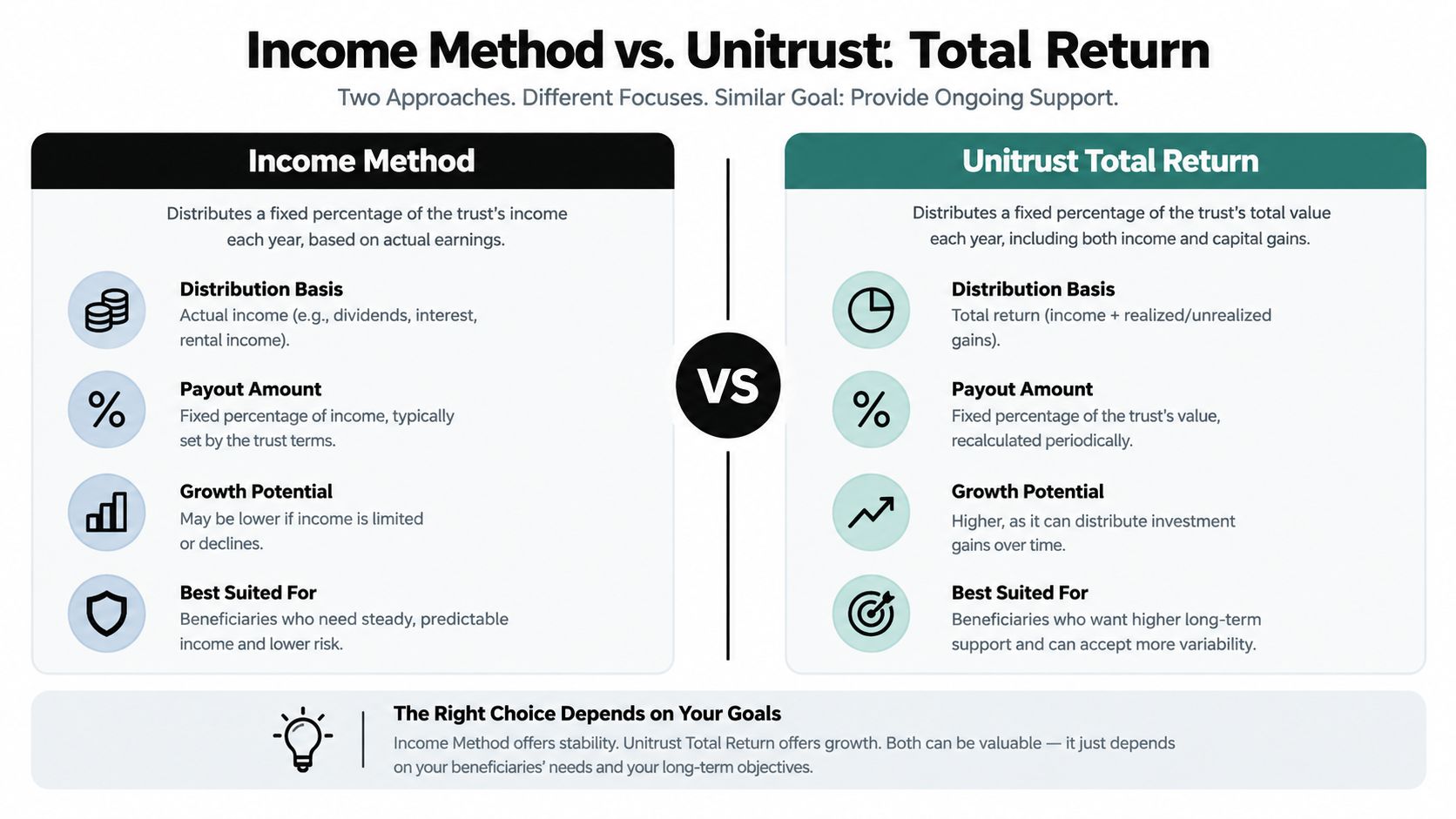
Under the income method, the trustee tracks trust accounting income and distributes according to that figure. If the trust says one beneficiary gets income and another receives the remainder later, the trustee has to be careful not to favor one side unfairly. Assets that produce little current income may leave the income beneficiary frustrated even if the portfolio is growing well.
Under the unitrust total-return method, the trustee distributes a fixed percentage of value instead. The investment strategy can be built around long-term portfolio management rather than yield alone.
Side-by-side practical differences
| Method | What drives distributions | Common pressure point |
|---|---|---|
| Income method | Accounting income | Low-yield assets can leave an income beneficiary dissatisfied |
| Unitrust method | Fixed percentage of fair market value | Valuation method and payout design must be chosen carefully |
A trust holding dividend-paying bonds may work comfortably under the income method. A trust holding growth equities, undeveloped land, or a concentrated business interest may not. The trustee may feel boxed in if every investment decision is measured against current income rather than overall return.
Where disputes usually begin
Problems often surface during uneven markets or when the trust owns assets that are valuable but not liquid. A beneficiary may say, “The trust is worth more, so why am I receiving so little?” Another may say, “Why would the trustee sell strong long-term assets just to create distributable income?”
Texas law recognizes that tension. The statutory total-return framework reflects the broader move away from a strict income-versus-principal split and toward portfolio-based trust management under Texas legislation addressing total return administration.
What works and what doesn't
What usually works:
- Matching structure to assets: Trusts with low-yield or mixed assets often fit better with a value-based distribution model.
- Clear valuation rules: Trustees reduce conflict when the trust spells out when and how values are determined.
- Consistent communication: Beneficiaries respond better when they understand why distributions rise or fall.
What often doesn't:
- Chasing income for appearance's sake: That can distort investment decisions.
- Assuming “income” means fairness: In some portfolios, it doesn't.
- Ignoring allocation law: Trustees still need to understand the Texas Uniform Principal and Income Act allocation rules, even if they are considering a different distribution framework.
How to Make a Valid Unitrust Election in Texas
A trustee may discover that an income-based trust no longer matches the assets it holds. Before changing the distribution method, the trustee must determine whether the trust instrument already permits a unitrust approach or whether consent, modification, or court involvement is required.
The trustee cannot rename the existing standard. A valid election must fit the governing document, protect existing beneficiary rights, and comply with Texas law. The practical question is whether the proposed structure changes administration only or affects a beneficiary's substantive entitlement.
Start with the document and current rights
Read every provision addressing income, principal, discretionary distributions, trustee adjustment powers, and amendment or modification procedures. Some instruments provide enough administrative flexibility for a trustee to act. Others require beneficiary consent or judicial approval. Identify any mandatory income interest, mandatory unitrust interest, mandatory principal distribution, or withdrawal right before proposing a change.
Texas Property Code § 112.085 restricts an authorized trustee's ability to modify beneficial interests through decanting-style authority. That power cannot be used to reduce or modify a beneficiary's vested right to a mandatory income or principal distribution, a mandatory annuity or unitrust interest, or certain withdrawal rights under Texas Property Code § 112.085.
A vested mandatory right can limit later flexibility, even when the trust otherwise grants broad administrative powers.
Decision points that require judgment
Trustees and families should address these questions before selecting a unitrust structure:
| Factor | Why It Matters |
|---|---|
| Existing distribution language | It shows whether the trust permits a shift from pure income accounting |
| Beneficiary rights | Mandatory or vested rights may restrict modification |
| Trustee status | An interested trustee may face additional limits |
| Asset mix | Liquidity and valuation complexity affect administration |
| Payout percentage | The rate affects sustainability and beneficiary fairness |
| Valuation period | The chosen period affects distribution timing and volatility |
| Documentation | A written record supports the decision if it is later challenged |
| Court involvement | Judicial approval may provide useful protection when authority is uncertain |
The statutory election is only one route. A trustee may also need to compare it with modification powers available under the trust instrument or other Texas procedures. That comparison matters when the proposed unitrust method could alter how beneficiaries receive value, rather than merely changing the accounting used to calculate distributions.
A workable process in practice
A careful election generally follows this sequence:
- Confirm authority. Review the trust and identify the provision that permits the trustee to act, if one exists.
- Identify protected interests. Examine mandatory distributions, vested rights, withdrawal powers, and any beneficiary consent requirements.
- Set the payout design. Texas law requires a fixed annual percentage within the statutory range. Texas Property Code § 116.007 describes a rate not less than 3% and not more than 5% of net fair market value under Texas Property Code § 116.007.
- Set the valuation method. Annual valuation is required, while the governing terms may determine whether the calculation uses one year or more than one year of value.
- Obtain required approval. If the trustee's authority or the effect on beneficiaries is unclear, obtain consent or seek court approval before implementation.
- Record the decision. Preserve notices, consents, legal analysis, valuation procedures, and the trustee's written explanation.
A Texas trust administration lawyer can compare the instrument, beneficiary rights, proposed modification route, and litigation risks. Families may also ask the Law Office of Bryan Fagan, PLLC to review those issues before the trustee makes the election.
Fiduciary Duties and Tax Implications
A unitrust election is an administrative and fiduciary decision, not just a math exercise. Even if the election is valid, the trustee still has to administer the trust prudently year after year. That means careful valuation, steady communication, and a written record showing why the decision fits the trust's purposes.
Fiduciary duties stay front and center
Under the Texas Trust Code, trustees remain bound by core fiduciary principles such as loyalty, prudence, impartiality, and compliance with the trust terms. A unitrust can improve fairness, but it can also create new friction if the trustee treats the election as self-executing and stops documenting decisions.
Good administration usually includes:
- Written rationale: Explain why the trust's assets and beneficiary structure support a total-return model.
- Annual review: Revisit liquidity, market conditions, and the practical effect of the payout.
- Clear accounting: Show how the annual amount was calculated and paid.
- Beneficiary communication: Reduce confusion before it becomes suspicion.
Trustees who need a grounded explanation of these obligations should review fiduciary duties of trustees in Texas, especially when one family member serves as trustee and also has a beneficial interest.
How federal tax treatment fits with Texas law
Federal tax rules generally recognize a state-law unitrust election when a trust pays a fixed percentage of value in full satisfaction of the beneficiary's income rights. The federal regulation specifically includes an example using a 4% payout under applicable state law in 26 C.F.R. § 1.643(a)-3.
That doesn't mean every election is automatically safe from challenge. The stronger practice is to keep the trust's legal authority, annual valuation method, payout calculations, and beneficiary notices aligned. If the trustee later changes course informally, or can't explain the apportionment as reasonable, tax and fiduciary questions become harder to answer.
Tax perspective: The IRS tends to respect a properly grounded state-law unitrust election. The paper trail still matters.
What trustees should document every year
A trustee doesn't need a massive file for every routine decision. But the following items often make the difference if someone questions the administration later:
- Current valuations
- The governing distribution formula
- How the trustee sourced the payment
- Board or trustee notes reflecting prudence and impartiality
- Communications sent to beneficiaries
- Any legal or tax advice obtained
Texas law also frames the unitrust amount as a reasonable apportionment of total return, which is why reasonableness and consistency should be visible in the trust records, not just assumed.
Planning for Long-Term Trust Success
A unitrust works best when it is part of a larger estate planning and administration strategy. It should fit the trust's purpose, the family's communication style, and the practical realities of the assets inside the trust. If those pieces don't line up, the election may solve one problem while creating another.
Families often discover that the hardest question isn't whether a unitrust is allowed. The harder question is whether the trust is drafted and administered in a way that preserves flexibility without stepping on beneficiary rights.

Draft for administration, not just theory
A sound plan usually answers these practical points in writing:
- How values are measured: The trust should say when valuation occurs and whether the formula uses one year or more than one year of value.
- How payments are funded: Illiquid assets can create trouble if the trustee has no practical way to make the required annual payout.
- How later changes are handled: Modification powers have limits, especially when mandatory interests are involved.
- Who resolves disputes: Some trusts benefit from clear procedures for notice, consent, or court review.
Common drafting mistakes
The most common mistakes are not dramatic. They are small omissions that create uncertainty later.
One mistake is assuming that a unitrust election automatically fixes tension between current and remainder beneficiaries. It doesn't. Another is ignoring valuation timing. A third is overlooking the difference between broad administrative flexibility and protected beneficial rights. For families deciding whether a trust or a will is the better planning vehicle in the first place, a plain-English comparison like wills vs trusts in Texas can help frame the bigger picture before distribution mechanics ever become an issue.
A well-drafted trust gives the trustee room to act without forcing the family into avoidable conflict.
Where total-return planning fits
This approach often fits nicely with broader estate planning, asset protection, and succession goals. It can also intersect with probate and guardianship issues when an aging settlor, a vulnerable beneficiary, or a change in decision-making capacity affects how the trust is managed.
That's why families often need coordinated advice from a Texas estate planning attorney, a CPA, and an investment professional. The law provides the framework. The success of the plan usually depends on how carefully those professionals apply it to the actual family and the actual assets.
Common Questions About Texas Unitrust Elections
Can a trustee switch to a unitrust just because the current system feels unfair
Not safely without checking authority first. The trustee must start with the trust terms and then measure any proposed election against Texas statutory rules and protected beneficiary rights. If the document is unclear, a formal modification path or court approval may be the better route.
Does every trust benefit from a unitrust election
No. Some trusts work well under a traditional income method, especially when the assets naturally generate distributable income and the beneficiaries' expectations match that structure. A unitrust is often more useful when the trust holds growth-oriented or mixed assets that create tension under income accounting.
Does Texas require a specific payout amount
Texas law requires the unitrust amount to be a fixed annual percentage within the statutory range. The trustee or drafter still has to choose the actual percentage within that band in a way that fits the trust's purpose and administration. Picking the number is a judgment call, not a clerical step.
How are annual valuations handled in practice
The trust assets must be valued at least annually. The governing terms may also use one year or more than one year of value for the formula. In practice, trustees should choose a valuation method they can apply consistently and defend if questioned later. Public market assets are easier to value than closely held businesses, mineral interests, or unique real estate.
What if the trustee is also a beneficiary
That situation deserves extra caution. Interested trustees may face tighter constraints under the statutory framework, and every decision should be documented carefully to show loyalty and impartiality. When the trustee benefits personally from the payout structure, informal decision-making becomes much riskier.
Can a later trust modification reduce a beneficiary's mandatory unitrust interest
Not through a power that Texas law limits. Texas law protects vested rights to mandatory income, principal, annuity, and unitrust interests from being reduced or modified through certain trustee distribution powers. That issue often surprises families who assume later flexibility tools can rewrite anything that has become inconvenient.
What if the trust already has discretionary distribution language
Discretionary language helps, but it doesn't answer every question. A trustee still has to determine whether that discretion reaches the specific change being proposed and whether exercising it would interfere with any protected beneficial interest. Broad language should never be read in isolation.
When should a family involve the court
Court involvement often makes sense when the trust language is ambiguous, the beneficiaries disagree, the trustee has a conflict, or the proposed change may affect a vested right. Seeking court guidance isn't a sign of failure. In trust administration, it can be the most prudent way to prevent a larger dispute.
How does this relate to probate, guardianship, and other estate planning issues
These issues overlap more than people expect. A trustee may also be serving as an executor, working through a probate estate, or managing funds for a beneficiary who needs a guardian or added protection. That's why the right legal advice often comes from someone who understands trust administration, probate, guardianship, and long-range planning together rather than in separate silos.
When you need to consult a Texas trust administration lawyer, ask about how to modify a trust in Texas, or clarify fiduciary duties in Texas before making a unitrust election, slow and careful analysis is usually better than fast action. The law gives trustees useful tools, but those tools work best when the trust document, beneficiary rights, tax treatment, and administration plan all point in the same direction.
If you're managing a trust or planning your estate, contact Law Office of Bryan Fagan, PLLC for a free consultation. Our attorneys help trustees and families evaluate unitrust elections, beneficiary rights, trust modifications, probate concerns, guardianship issues, and asset protection strategies under Texas law.