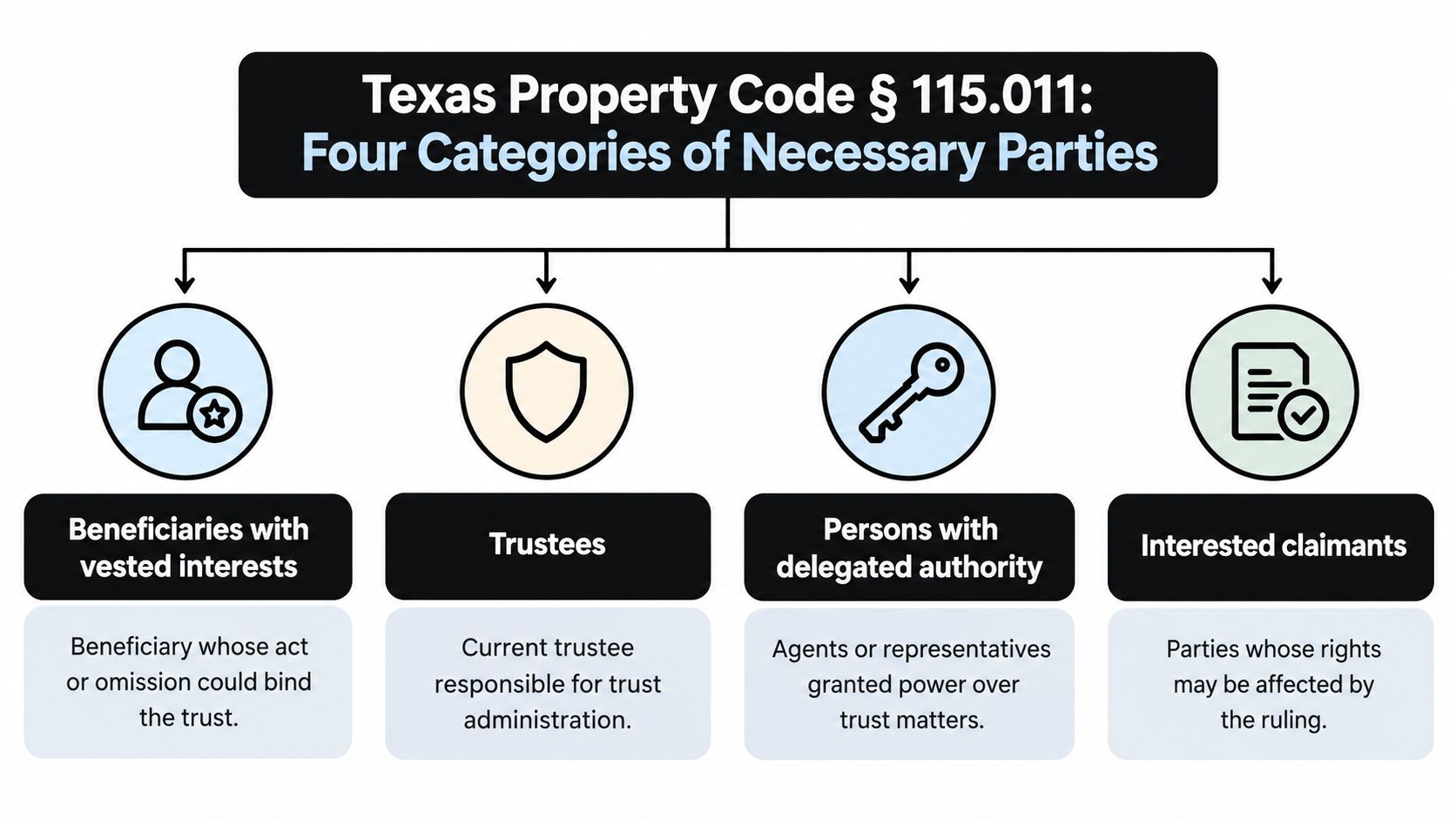
Under Texas Property Code § 115.011, four categories of people are necessary parties in a trust lawsuit: a beneficiary whose act or obligation is at issue, a beneficiary designated by name, a person receiving trust distributions when the case is filed, and the trustee serving at filing. Contingent beneficiaries identified only as a class are intentionally excluded from that list.
Managing a loved one's trust can feel overwhelming, especially when you believe the trustee is mishandling property or withholding information. A beneficiary may file suit expecting the court to address the problem, only to learn that someone who must be included wasn't joined. That procedural mistake can delay the case, increase legal expense, and put an otherwise valid claim at risk.
Why Getting the Right Parties Right Matters in Texas Trust Suits
Suppose you're a beneficiary who believes a trustee is mismanaging trust assets. You've asked for records, received vague answers, and finally decide that court action is necessary. You file a lawsuit against the trustee, confident you've identified the person responsible.
Weeks later, the court raises a different problem. Another beneficiary is named in the trust instrument, or a person was receiving distributions when the suit began, but that person wasn't included. The case may be abated, dismissed, or delayed while the parties argue about whether the court can proceed. Meanwhile, filing fees, attorney time, and family tension continue to build.

Joinder protects the judgment
Texas trust litigation is procedural as well as substantive. The court must have the people whose rights may be affected before it can reliably decide issues involving construction, accounting, distributions, or fiduciary conduct. The point isn't to create needless paperwork. It's to prevent the court from issuing a ruling that binds some interests while leaving other required parties outside the case.
Texas Property Code § 115.011 identifies a specific group of necessary parties rather than requiring every possible beneficiary to participate. The modern statute carries four categories, and the legislative materials for the 79th Legislature show that the enacted language was structured around those categories in 2005 and 2006. The statute also excludes contingent beneficiaries designated only as a class, which keeps large family and multigenerational trusts from becoming impossible to litigate. Texas Property Code § 115.011 provides the controlling framework.
Practical rule: Before filing, identify the trust's actual beneficiary structure, current distributions, disputed beneficiary conduct, and serving trustee. A short pre-filing review can prevent a long procedural detour.
A beneficiary considering claims against a trustee should also distinguish between a personal claim and a claim involving trust property. This practical discussion of whether a trust can sue can help clarify the difference, but the proper parties still depend on the trust instrument and the facts at filing.
Understanding Texas Property Code Section 115.011 and Its Four Categories
Section 115.011 is easier to apply when you read it as a checklist. It identifies exactly four categories of necessary parties in a Texas trust proceeding.
A beneficiary whose act or obligation is at issue
The first category covers a beneficiary whose own act, omission, or obligation is directly involved in the lawsuit. For example, if the dispute concerns whether a beneficiary complied with a condition connected to a distribution, that beneficiary belongs in the case.
This category protects the person whose conduct may be evaluated or whose duties may be affected by the judgment. A plaintiff shouldn't ask the court to decide that person's obligations without giving that person an opportunity to participate.
A beneficiary designated by name
A beneficiary named in the trust instrument is also a necessary party. The person doesn't have to be actively disputing the trustee's conduct. The named beneficiary's legal interest may still be affected by a ruling about administration, interpretation, or distributions.
Consider Sarah Jenkins, who is specifically named in the trust. Even if Sarah supports the trustee and has never complained, she may need to be joined because the court's ruling could change the way the trust is administered or affect her interest.
A person receiving distributions when suit is filed
The third category includes any person receiving trust distributions when the lawsuit begins. The statute focuses on what was happening at filing, not merely on what might happen later.
That distinction matters in a trust where one person receives monthly support, another receives income from trust property, or a beneficiary receives discretionary payments. The current recipient may have a practical interest in the challenged administration, even if the trust describes other people as future or contingent beneficiaries.
The trustee serving when the case begins
The fourth category is the trustee, if a trustee is serving at the time of filing. The trustee controls trust administration and may be the person responsible for producing records, defending decisions, or carrying out the court's instructions. A court generally can't resolve a trust administration dispute in a way that binds the fiduciary while leaving that fiduciary outside the lawsuit.
For a broader explanation of what trust administration involves and how it differs from probate, Texas Trust Administration: A Trustee's Guide provides useful background. The key procedural point remains simple: identify each statutory category before filing, then confirm the person's status on the filing date.
Contingent and Class Beneficiaries Are Not Necessary Parties
Many families assume that every person who might eventually inherit must be named in a trust lawsuit. That assumption is understandable, but it isn't the rule under § 115.011. Contingent beneficiaries designated only as a class are expressly excluded from the necessary-party list unless they also fall within one of the statute's listed categories.
A class designation might describe beneficiaries as “my grandchildren,” “my descendants,” or “issue per stirpes.” Those descriptions can include people who aren't known, aren't born, or won't receive anything unless a future event occurs. Requiring every member of that class to be joined would make many trust disputes unmanageable.
Why the exclusion matters
The Legislature's approach narrows joinder. The 2005 amendment made the trustee an express necessary party while retaining the exclusion for contingent beneficiaries designated as a class. The statutory design balances two concerns: people with direct or present interests should have a voice, but a lawsuit shouldn't require the plaintiff to locate every possible future beneficiary.
That distinction can be especially important in large family trusts. A trust may benefit a child during life, then pass to that child's descendants. The descendants may have a contingent interest, but the court doesn't automatically need every descendant in a dispute about the current trustee's accounting or administration.
Apply the rule to the trust document
Assume a trust refers to twelve grandchildren as a contingent class. None is specifically named, and none is receiving distributions when the lawsuit is filed. Those grandchildren generally aren't necessary parties solely because they could inherit later.
The result changes if one grandchild is named individually, receives distributions at filing, or has conduct or an obligation directly at issue. The label “contingent” doesn't end the analysis. The lawyer must compare the person's status with all four statutory categories.
The practical balance is narrow joinder, not careless joinder. Excluding a class beneficiary can be correct, but assuming every contingent beneficiary is excluded can also be a mistake.
Before filing, review amendments, distribution provisions, and trustee records. A current distribution recipient may not be obvious from the original trust document. Likewise, a later amendment may specifically identify someone who was previously part of a general class.
How Texas Courts Apply the Necessary Party Rule in Practice
Appellate decisions show that § 115.011 is more than a drafting suggestion. Texas courts have applied the rule in a way that makes party identification central to whether trust litigation can proceed.
In a 2020 Texas Court of Appeals decision, the court stated that in suits by or against a trustee and in proceedings concerning trusts, the trustee is a necessary party if the trustee is serving when the case is filed. The court cited both Texas Property Code § 115.001(a) and § 115.011(b)(4). The same authority notes that appellate precedent reaching back to 2010 treated a beneficiary designated by name in the trust instrument as a necessary party under § 115.001. See the court's discussion in the Texas Court of Appeals decision on necessary parties.

Joining the right parties
When the plaintiff identifies the trustee, named beneficiaries, current recipients, and any beneficiary whose conduct is at issue, the court can address the trust dispute with the relevant interests before it. The trustee can respond to allegations, provide records, and comply with any order. Named beneficiaries can protect their interests rather than learning about a judgment later.
Joining the required parties also reduces the risk of inconsistent obligations. A trustee shouldn't face one order in a case brought by one beneficiary and a conflicting demand from a person who should have been included in the original proceeding.
Failing to join someone required
The consequences can be serious. Courts may require the plaintiff to add the missing party, pause the case, or dismiss the action if the defect cannot be cured in the existing posture. The plaintiff may then need to refile or amend, paying additional fees and losing time while trust assets and records remain in dispute.
The problem also reaches beyond the immediate case. A judgment entered without a necessary party may invite a later collateral attack from someone whose legally protected interest was affected but who never had the opportunity to participate. That uncertainty undermines the value of the judgment and complicates settlement.
A trustee or beneficiary who wants to understand representation issues in trust proceedings can review virtual representation under Texas Trust Code § 114.086. Virtual representation may be relevant in some settings, but it shouldn't be treated as a substitute for a careful § 115.011 analysis.
Practical Steps to Determine Who Must Be Joined in Your Trust Lawsuit
A reliable joinder review starts with the trust instrument, not the family tree. The family may contain many people who expect to inherit someday, but the statute asks more precise questions about names, current distributions, disputed obligations, and the trustee's status.
Start with the controlling documents
Collect the trust agreement and every amendment you can locate. Then create a working list of:
- Named beneficiaries. Record each person identified individually in the trust instrument.
- Current recipients. Confirm who was receiving trust distributions when the lawsuit would be filed.
- Disputed conduct. Identify any beneficiary whose act, omission, or obligation is part of the controversy.
- Trustee status. Determine whether a trustee is serving on the intended filing date and obtain any resignation or successor documents.
- Class beneficiaries. Note contingent beneficiaries described only as a class, then test whether any also fit one of the required categories.
The filing date matters. A person's status can change, and the joinder analysis should reflect the facts when the suit begins.
Necessary versus optional parties
Not everyone connected to the trust needs to be included. Some people may be useful witnesses, interested participants, or potential intervenors without being necessary parties under § 115.011.
| Party Type | Required Under § 115.011? | Example |
|---|---|---|
| Beneficiary whose act or obligation is at issue | Yes | A beneficiary's compliance with a distribution condition is disputed |
| Beneficiary designated by name | Yes | Sarah Jenkins is individually named in the trust |
| Person receiving distributions at filing | Yes | A beneficiary is receiving regular trust payments |
| Trustee serving at filing | Yes | The current trustee administers the challenged trust |
| Contingent beneficiary designated only as a class | No, unless another category applies | “My grandchildren” with no individual designation or current distribution |
| Accountant, investment adviser, or family member | Not automatically | A professional who may provide records or testimony |
Confirm the claim and remedy
Party identification should match the relief requested. A petition seeking an accounting from the trustee has a different practical focus from a construction action involving named beneficiaries or a dispute over a beneficiary's obligation. The complaint should explain why each required party belongs in the case and what issue the court needs to decide.
A Texas trust administration lawyer can compare the proposed parties with the trust language, distribution history, and requested remedies before filing. That review is often more efficient than defending a motion based on nonjoinder after the case has already started.
Before signing a petition, ask one question for every person on your list: What statutory category makes this person necessary, and what document proves it?
Keep the analysis in the file. Save the trust provisions, payment records, trustee appointment documents, and communications showing who was receiving distributions. If the other side challenges joinder, a dated record of your review gives the court a clear explanation rather than a last-minute guess.
Protecting Your Interests in Texas Trust Disputes
The necessary-party rule protects more than courtroom procedure. It protects the value of the judgment and gives affected beneficiaries a fair opportunity to participate. The practical focus is identifying the four statutory categories without expanding the case to every possible future beneficiary.
A named beneficiary may need to be joined even if that person agrees with the trustee. A current distribution recipient may need to participate even if the recipient isn't accused of wrongdoing. A serving trustee must generally be included in proceedings involving the trust, while a class-based contingent beneficiary is not automatically required merely because a future interest exists.
Connect joinder with fiduciary duties
The Texas Trust Code governs the trustee's authority and fiduciary duties in Texas. The Texas Estates Code may become relevant when the trust dispute overlaps with probate, a decedent's estate, incapacity, or guardianship. Those bodies of law may interact, but they don't eliminate the need to analyze § 115.011 before filing a trust proceeding.
Trustees should preserve records, identify current recipients, and communicate carefully with beneficiaries. Beneficiaries should preserve the trust documents, payment history, written requests, and evidence supporting the requested relief. Families also benefit from addressing related planning needs through a Texas estate planning attorney, including estate planning, probate, guardianship, and asset protection counsel when those issues overlap with the trust.
Choose a measured path
A beneficiary considering suing a trustee in Texas should first determine whether the problem calls for an accounting, construction of the trust, compelled action, removal, or another remedy. Filing quickly without identifying the required parties can waste resources. Waiting indefinitely can create separate risks involving records, administration, and available relief.
The Law Office of Bryan Fagan, PLLC handles trust administration, fiduciary accounting, estate planning, probate-related disputes, guardianship matters, and asset protection planning for Texas families and fiduciaries. Its attorneys can review the trust structure, assess necessary parties under § 115.011, and help develop a practical dispute-resolution or litigation strategy.
If you're managing a trust or planning your estate, contact The Law Office of Bryan Fagan, PLLC for a free consultation. Our attorneys provide trusted, Texas-based guidance for every step of the process.
Visit Law Office of Bryan Fagan, PLLC to discuss the trust documents, identify the parties who must be joined, and plan a clear next step for administration or dispute resolution.