Managing a loved one's trust can feel overwhelming, but with the right legal guidance, it doesn't have to be.
A lot of Austin families land here in the same moment. A parent has died. A sibling has questions. A bank wants paperwork. Someone has just been named trustee and is suddenly responsible for assets, records, notices, and beneficiary communication. The trust may have been signed years ago, but the stress starts when administration begins.
That's where a trust lawyer in Austin, TX becomes useful. Not just for drafting documents, but for helping families carry out the trust correctly under Texas law, avoid preventable disputes, and keep the process organized when emotions are already running high.
When Managing a Trust Feels Overwhelming in Austin
On Monday, an Austin daughter is arranging a funeral. By Thursday, she is the successor trustee, sorting mail, fielding questions from her brother, and trying to figure out whether the house, the bank account, and the investment account are even titled in the trust. The document may be signed and valid, but pressure starts when someone has to carry it out.
That pressure surprises families. They expect the hard part to be creating the trust. In many cases, the harder part is what comes after death or incapacity, when the job shifts from planning to administration. At that point, the trustee is no longer just reading instructions. The trustee is keeping records, communicating with beneficiaries, handling property, and making sure tax and procedural tasks do not slip.
The first days matter more than many trustees realize.
Why families get stuck so quickly
A trustee is often a spouse, adult child, or family friend with no formal fiduciary training. That person is suddenly expected to act with care, keep trust property separate, answer reasonable questions, and make decisions that may affect several family members at once. It can feel like being handed the controls to an aircraft after takeoff.
Confusion usually starts with three basic questions. What is inside the trust. Who has a right to information. What has to be done first.
Poor communication makes each problem heavier. A beneficiary who hears nothing may assume the trustee is hiding something, even when the trustee is buried in paperwork. In Texas, that communication gap can become more than a family problem. It can become a legal one, because trust administration runs on deadlines as well as good intentions.
Two deadlines are easy to miss. After a trust becomes irrevocable because of death, a trustee may have a 60-day notice duty in some situations. A beneficiary may also have the right to demand an accounting, and the trustee may face a 90-day clock to respond. Those are the kinds of rules families rarely hear about when the trust is signed, but they become very important once administration begins.
A trust file gets safer when the trustee creates order early. It gets riskier when decisions live in text messages, memory, and loose stacks of paper.
A simple tracking system helps. Even basic habits like saving statements in one place, logging distributions, and writing down why a decision was made can reduce confusion later. The same kind of disciplined organization described in these case management best practices can help a trustee respond clearly when a beneficiary asks, “What is happening with the trust?”
What Austin-specific legal guidance really means
In Austin, trust administration often overlaps with real estate, business interests, retirement accounts, and blended-family concerns. A lawyer's job at this stage is to turn a stressful stack of tasks into an ordered process. That includes reviewing the trust terms, confirming what assets are involved, identifying notice and accounting duties, and helping the trustee handle post-death or incapacity administration in the right sequence.
The tax side also catches families off guard. Before a death or incapacity, the focus is usually on setting up the trust properly. After that event, the focus often shifts to procedural administration. New taxpayer identification issues may arise. Fiduciary income tax filings may be needed. Records have to support distributions and expenses. The work becomes less about signing a trust and more about running it correctly.
In practical terms, families usually need clear answers to questions like these:
- Which assets are under trustee control: Some property may be in the trust, some may pass by beneficiary designation, and some may still need separate probate handling.
- Who needs formal communication: The trustee may need to send notices and respond to beneficiary requests on a timetable set by Texas law.
- What records should be kept now: Statements, receipts, valuations, and a written ledger are often far more useful than a later summary created from memory.
- Whether tax and compliance tasks have started: After death or incapacity, administration often includes EIN, fiduciary accounting, and filing questions that did not exist during the planning stage.
Families in this position usually do not need more legal vocabulary. They need a calm explanation of what Texas law expects, what the immediate risks are, and what to do first.
What a Trust Lawyer Does for Austin Families
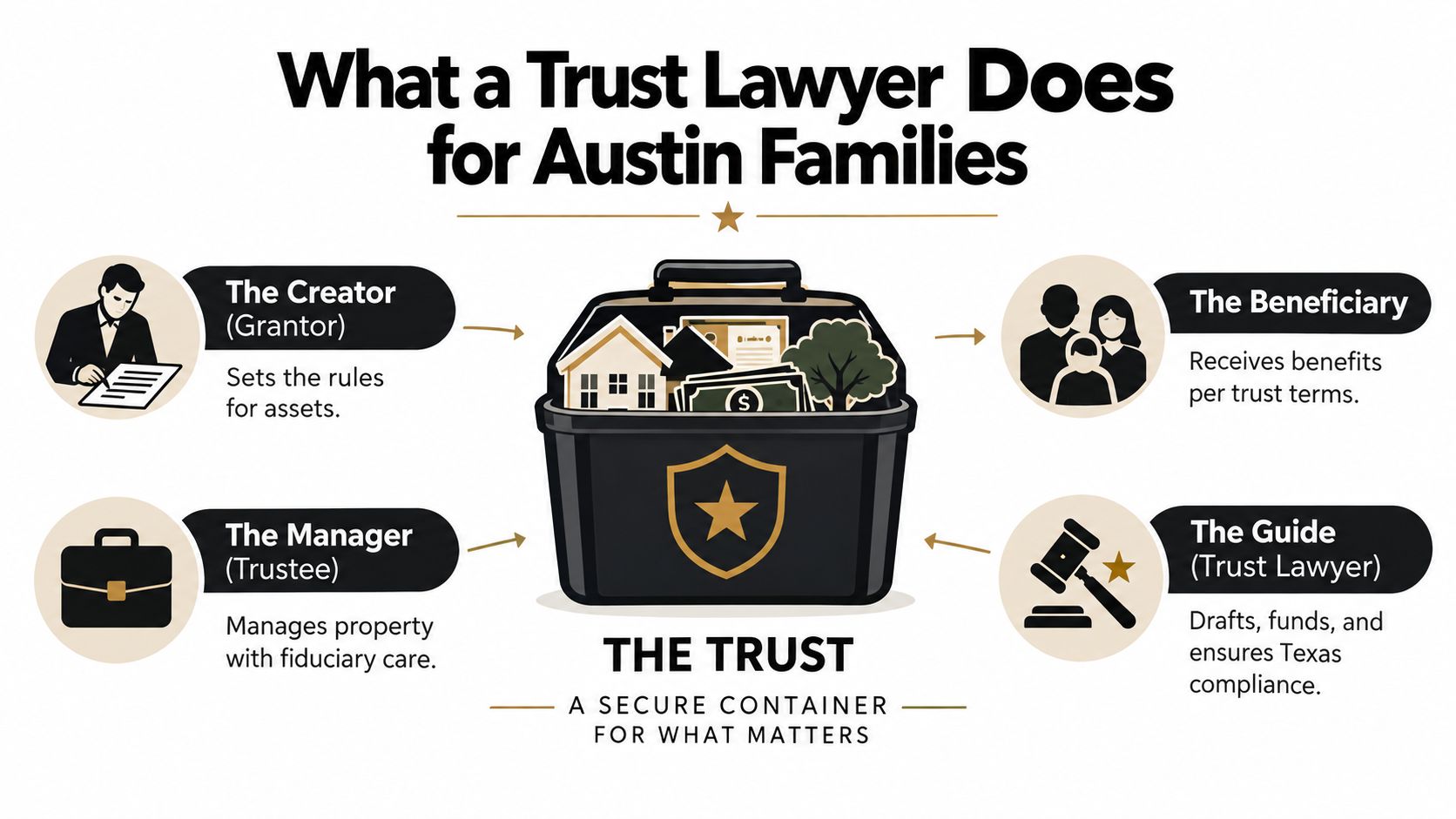
A trust works a lot like a rulebook plus a manager. The trust document sets the rules. The trustee carries them out. A lawyer helps make sure both parts work under Texas law.
Texas has a long trust-law history. The Legislature created the Texas Trust Act in 1943, replaced it with the modern Texas Trust Code in 1983, and that code became effective on January 1, 1984. The current code sits in Property Code Title 9, Subtitle B, Chapters 111 through 117, with Chapter 111 serving as the general provisions chapter, as shown in the Texas Property Code general provisions chapter.
The lawyer's role depends on where the family is in the process
If you're planning ahead, a lawyer helps create and fund the trust properly. If someone has died or become incapacitated, the lawyer helps the trustee interpret the document, identify legal duties, and manage the transition into active administration. If conflict has already started, the lawyer helps protect the trustee or beneficiary through negotiation, formal demands, or court action.
A Texas trust administration lawyer may help with:
- Creation and updates: Drafting or revising trust terms so they fit Texas law and family goals.
- Administration: Guiding trustees through notices, accountings, distributions, tax coordination, and recordkeeping.
- Modification or termination: Advising when a trust should be adjusted because circumstances changed.
- Disputes: Addressing fee disagreements, communication failures, missing records, or claims of improper administration.
For readers who want a closer look at that middle stage, this guide to Texas trust administration attorney services gives a practical view of what administration counsel handles.
Why local Texas counsel matters
Trust law isn't just about what sounds fair. It's about what the instrument says, what the Texas Trust Code requires, and what a court may compel if someone challenges the trustee's work.
Texas trust administration is built around explicit statutory duties rather than loose common-law ideas. Texas law requires trustees to keep beneficiaries reasonably informed and to invest and manage assets as a prudent investor would while considering the trust's purposes and distribution requirements, as discussed in this Texas trust administration scholarship article.
Practical rule: The trust document is the starting point. It usually isn't the whole answer.
That's why families often need legal help at moments they didn't expect. Drafting is only one piece. Administration is where most of the work happens.
Trustee Responsibilities Under Texas Law
A trustee doesn't just hold property. A trustee serves in a fiduciary role, which means the law expects careful, loyal, good-faith administration for the benefit of others.
Under Texas Property Code § 113.051, a trustee must administer the trust in good faith according to the trust's terms and the Texas Trust Code, and if the instrument is silent, Texas law also imports common-law trustee duties, as stated in the Texas Property Code trustee administration rules.
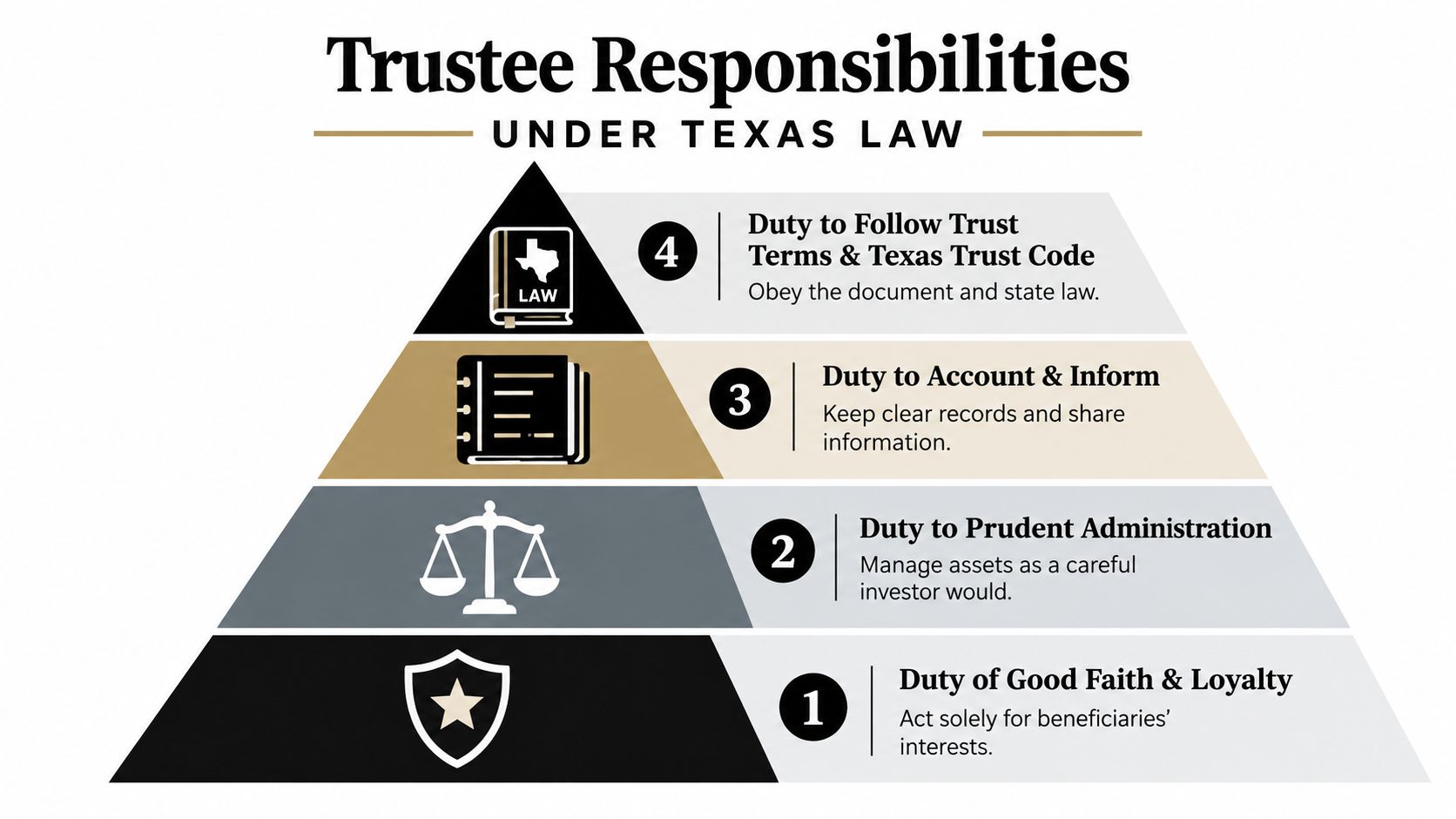
What these duties look like in daily life
A trustee's legal duties can sound abstract until you put them into ordinary situations.
- Good faith and loyalty: The trustee must act for the trust and its beneficiaries, not for personal convenience or family politics.
- Prudent administration: Investments and asset decisions should reflect care, judgment, and the trust's actual purposes.
- Impartiality: If there are multiple beneficiaries, the trustee usually can't favor one unfairly over another.
- Following the document: A trustee should read the trust closely and match each decision to its actual terms.
If a trust holds rental property, for example, the trustee should keep lease records, track income and expenses clearly, and avoid using the property as if it were personal property. If the trust holds investments, the trustee should be able to explain why the investment approach fits the trust's goals and distribution needs.
The core duties of loyalty, prudence, and impartiality under the Trust Code are also summarized in The Fiduciary Duties of a Texas Trustee.
Here's a helpful overview of trustee obligations in practice:
Recordkeeping is part of the duty, not extra paperwork
Many trustees think records matter only if someone asks for them. That's too risky. Texas disclosure rules are broader than a once-a-year report. Some trustee duties are nonwaivable, trustees must respond to beneficiary information requests with material facts affecting the trust, and courts can compel compliance if records are incomplete, as explained in this Texas CPA discussion of trustee duties.
That's why trustees should preserve:
- Asset inventories
- Bank and custody records
- Receipts and disbursement logs
- Distribution approvals or explanatory memos
- Notes showing why major decisions were made
For a trustee who wants a more detailed legal breakdown, this resource on Texas Trust Code trustee duties is a useful companion to the statute.
Notice and Accounting Rules Every Trustee Must Follow
Many Austin trust disputes begin. Not with theft. Not with dramatic misconduct. With missed deadlines, vague updates, and records that don't match the law.
Texas-focused materials note that beneficiaries should be notified within 60 days after a trustee assumes duties, that beneficiaries are entitled to be reasonably informed, and that a written accounting request generally must be answered within 90 days. Those same materials also note that trustees generally aren't required to account more often than once every 12 months unless a court orders otherwise, as summarized in this Austin trust administration guide.
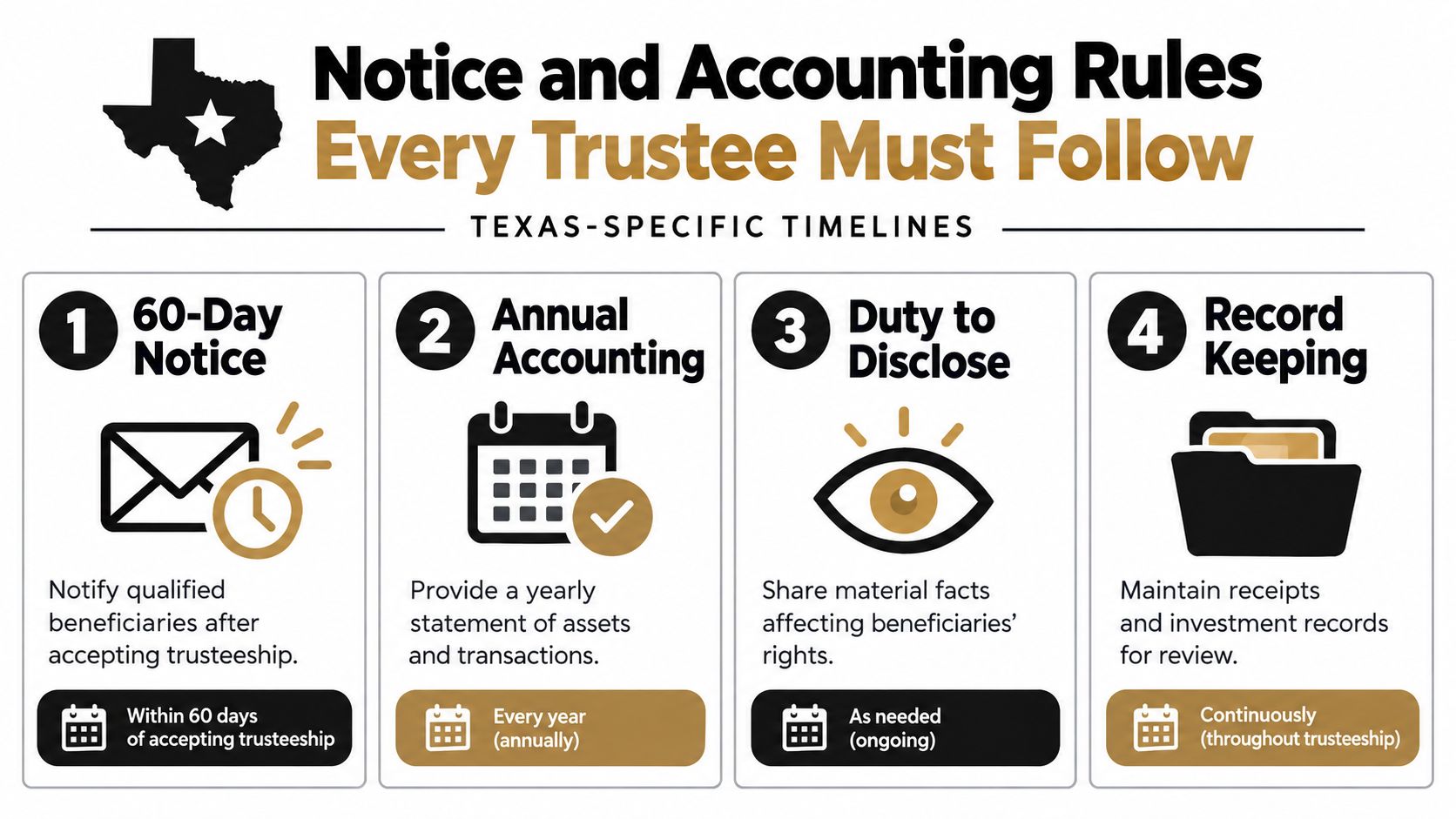
The notice problem trustees often miss
A trustee may think, “I'll reach out once I know more.” That delay can create unnecessary friction. Beneficiaries often become suspicious when they hear nothing after a trustee takes over.
Silence isn't always misconduct. But once formal notice duties and information rights apply, poor communication can shift from a family issue to a statutory issue.
If you're a trustee, early communication usually lowers conflict. If you're a beneficiary, a clear written request often matters more than repeated informal texts.
What a Texas accounting must actually include
When a beneficiary makes a written demand, the trustee must provide a written accounting within 90 days, and the accounting generally can't be required more often than once every 12 months unless a court orders otherwise under Texas Property Code § 113.152.
That accounting must include specific categories, including:
- All trust property known to the trustee
- A complete receipts-and-disbursements ledger, with principal and income shown separately
- A description of each asset being administered
- Cash balance and where the cash is held
- All known liabilities
That level of detail is why after-the-fact summaries often fall short. The trustee needs enough underlying documentation to reconstruct the financial history of the trust.
A simple compliance checklist
Trustees can use this short checklist as a self-audit:
- Notice given promptly: Identify who should receive communication after you accept the role.
- Records kept in real time: Preserve statements, ledgers, invoices, and proof of distributions.
- Written requests tracked: If a beneficiary sends a formal accounting demand, calendar the response deadline immediately.
- Information requests answered carefully: Material facts affecting the trust shouldn't be ignored.
- Reconciliation performed: Compare assets, income, expenses, and distributions regularly so errors don't compound.
The safest files are built from contemporaneous records, not reconstructed memories.
Real World Trust Scenarios Austin Lawyers Handle
A son accepts the role of successor trustee on Monday. By Friday, the bank wants new signature cards, the brokerage firm wants claim forms, and a beneficiary is asking when the first update will arrive. That is usually when trust administration stops feeling like paperwork and starts feeling like a job with deadlines.

In Austin trust matters, the pressure point is often timing. In our files, successor trustees commonly call within the first couple of weeks after they step in, especially when asset transfer forms and beneficiary questions arrive at the same time. Families are often surprised that poor communication can become a legal problem once the 60 day notice period and 90 day accounting response period start to matter.
A successor trustee after a parent's death
A daughter becomes trustee after her mother dies. She finds a home, a brokerage account, and a checking account tied to the trust, but no one left a clean instruction sheet. Her brother wants updates now. The CPA is asking for tax records. The financial institutions want proof of authority before they will talk with her.
A trust lawyer helps sort the file into two tracks. One track is ownership and control. What is titled in the trust, and what still has to be handled through probate or by beneficiary designation. The second track is administration after death. That includes getting tax identification in place if needed, gathering date of death values, organizing statements, and setting up a recordkeeping system that will hold up later if questions arise.
That shift catches families off guard. Creating the trust was the planning phase. After death or incapacity, the work turns into procedure, deadlines, and tax compliance.
A blended family disputes distributions
A surviving spouse is trustee. Adult children from a prior marriage believe the spouse is favoring current household expenses and delaying information. The spouse believes the children are demanding too much, too soon.
This kind of dispute often starts as a communication problem and then hardens into a legal one. If the trustee misses required notice, answers informally instead of clearly, or waits too long to respond to a proper request for information, suspicion grows fast. A lawyer's job here is part translator and part traffic controller. The trust language has to be matched to the facts, the family needs a communication plan, and the trustee needs help separating allowed discretion from conduct that creates exposure.
Sometimes the fight is not really about money at first. It is about whether anyone can trust the process.
A small trust costs too much to keep running
A trustee is managing a modest trust with scattered assets, recurring tax prep fees, and more administrative work than the trust is worth. Texas law can allow termination of a small trust, but that decision is not automatic and it is not just an accounting exercise.
Under the Texas trust termination statute, a trustee may terminate certain small trusts if the statutory conditions are met, including notice to beneficiaries who are or could become distributees. A lawyer helps the trustee test the facts against the statute, document the reasoning, and avoid a shortcut that creates a later dispute.
A small trust can still have a big emotional footprint. The house may be modest, but it may also be the family home.
A beneficiary's needs change over time
A management trust made sense years ago, but the beneficiary's disability, support needs, or living arrangement has changed. What once protected the beneficiary may now feel too rigid or too expensive.
In some cases, modification is the better answer. Texas Estates Code § 1301.201 gives a court authority to modify or revoke a management trust before the trust's termination date, as provided in the Texas Estates Code management trust modification rule. These cases often overlap with incapacity planning, public benefits concerns, and day to day questions about who is making decisions.
Families also ask whether the trustee should be paid. Texas Property Code § 114.061 states that a trustee is entitled to reasonable compensation unless the trust says otherwise, under the Texas trustee compensation rule. Fee disputes often appear alongside fights about records, timing, and whether the trustee has treated everyone fairly.
Across all of these scenarios, the legal problem is rarely just the trust document itself. The hard part is administering the trust correctly after death or incapacity, while keeping up with notice, records, taxes, and family communication before a preventable problem turns into a statutory one.
How to Hire a Trust Lawyer in Austin and What It Costs
Individuals typically start looking for a lawyer at one of three moments. They've just been named trustee. They're a beneficiary who isn't getting straight answers. Or they're planning ahead and want to avoid future problems.
The right lawyer for a trust matter usually isn't just a document drafter. You want someone who can read the trust, spot procedural risks, and explain what administration will require after death or incapacity.
What to bring to the first meeting
Bring the documents that tell the story, not just the trust itself.
- Core papers: The trust, amendments, death certificate if relevant, and any resignation or appointment documents for trustees.
- Financial records: Recent account statements, deeds, appraisals, tax documents, and a list of what you believe is in the trust.
- Communications: Letters, emails, or written requests from beneficiaries or co-trustees.
- Your questions: Write them down. Families often forget the most important ones once the meeting starts.
Some firms also educate trustees through articles, consultation calls, and resource libraries. For example, the Law Office of Bryan Fagan, PLLC publishes Texas trust administration resources for families and fiduciaries dealing with planning, administration, and disputes.
A useful side note when evaluating any professional service provider is to look at how clearly they explain scope, communication, and deliverables. The same kind of scrutiny described in this guide on how to choose law firm marketing vendors can help families ask sharper questions before hiring legal counsel.
Choosing your level of legal support
| Support Level | Best For | What Lawyer Handles | Cost Consideration |
|---|---|---|---|
| DIY with education only | A simple matter with cooperative family members | General guidance, issue spotting, limited review | Lowest upfront cost, but more risk if records or communication break down |
| Limited-scope counsel | Trustees or beneficiaries with one defined issue | Specific notices, accounting review, document interpretation, demand letters | Moderate cost tied to a narrower task |
| Full representation | Active administration, disputes, court issues, or complicated assets | Ongoing strategy, compliance, communication, negotiation, and litigation if needed | Higher cost, but broader protection and less burden on the client |
How lawyers usually frame fees and scope
Lawyers often separate the work into stages. Initial review. Administration guidance. Tax coordination. Dispute resolution if needed. That helps the family understand what's included and what may expand later.
If you're comparing firms, this overview of trust administration cost in Texas can help you frame the discussion. Ask whether the lawyer expects a one-time engagement, ongoing administrative support, or possible litigation planning.
For trustees, it also helps to remember that legal fees and reasonable trustee compensation are different issues. The trust document may address both, and if it doesn't, Texas law supplies a baseline for trustee compensation.
Planning Your Next Step With Trusted Texas Guidance
Many families think trust planning ends when the documents are signed. In practice, that's often where the hard part begins. Administration requires deadlines, records, judgment, and calm communication at a time when people are grieving or under pressure.
Recent analysis has framed estate and trust administration as a “procedural minefield” and pointed to a broader shift toward data-driven reporting and tax-ready administration, including projected reporting changes in other jurisdictions from 1 July 2026, as discussed in this estate and trust administration analysis. For Austin families, the lesson is simple. Good trust administration now means more than honoring intent. It also means preserving records that can support beneficiary reporting, tax filings, and future accountings.
A practical next-step checklist
If you're a trustee, start with the basics:
- Read the trust carefully: Don't assume memory or family tradition matches the document.
- Build the file early: Gather statements, titles, beneficiary contacts, and transaction records.
- Track communications: Save written requests and your responses.
- Get advice before acting on difficult decisions: Especially for distributions, compensation, investment changes, or possible modification.
- Think beyond the paperwork: Administration often touches probate, tax reporting, incapacity planning, and family conflict.
If you're a beneficiary, keep your requests clear, written, and focused. If you're planning ahead, ask not only how to create a trust, but how your chosen trustee will realistically administer it.
If you're managing a trust or planning your estate, contact The Law Office of Bryan Fagan, PLLC for a free consultation. Our attorneys provide trusted, Texas-based guidance for every step of the process.
If you need help with trustee duties, beneficiary rights, trust accountings, modification questions, or related estate planning concerns, the attorneys at Law Office of Bryan Fagan, PLLC provide Texas-based guidance grounded in trust administration practice. A free consultation can help you understand what the trust requires, what Texas law expects, and what step makes the most sense for your family now.