Managing a loved one's trust can feel overwhelming, but with the right legal guidance, it doesn't have to be. Many Texas trustees start in the same place. They're at a kitchen table with a binder, a death certificate, a trust document, and several worried family members waiting for answers.
The hard part is that grief and legal duty often arrive at the same time. A trustee may want to stay quiet until everything is organized. Texas law usually doesn't allow that. The trustee duty to inform beneficiaries in Texas requires communication that is timely, useful, and honest, even when the trustee is still sorting out the details.
Families often need plain English, not legal jargon. The trustee needs to know what must be disclosed, what can wait, when a formal accounting is required, how beneficiaries can challenge silence, and how to document every step so routine administration doesn't turn into a lawsuit. That same communication duty also fits into broader planning issues involving the Texas Trust Code, Texas Estates Code, tax planning, probate, guardianship, and asset protection.
When a Trustee First Learns About the Duty to Inform Beneficiaries
A common Texas scenario looks like this. A parent dies, and one adult child learns they've been named successor trustee. The trust names the children as beneficiaries. Everyone already suspects there's a trust, and everyone assumes the new trustee knows what to do.
Usually, the trustee doesn't.
They're grieving. They're worried about making a mistake. They don't know whether to send documents immediately, wait for a lawyer, or keep quiet until assets are collected. The first instinct is often to delay communication until every answer is in hand. That instinct creates trouble.
What the trustee is really asking
The question usually isn't, “Do I have to tell the beneficiaries anything?” It is, “What do I have to tell them now, and what can wait until I have cleaner records?”
Texas law expects the trustee to keep beneficiaries reasonably informed about trust administration and the material facts they need to protect their interests. That standard is practical. It doesn't require a trustee to flood the family with every draft email, every internal note, or every routine administrative choice.
It does require the trustee to stop acting like the trust is private family property.
Practical rule: Early silence causes more disputes than early disclosure. A short, accurate notice is usually better than waiting for a perfect report.
What works in the first week
A trustee is usually on safer ground when they do a few things quickly:
- Confirm the role in writing: Accept the trusteeship, review the trust document, and identify who the current and possible future beneficiaries are.
- Send a basic initial communication: Let beneficiaries know the trust is being administered, who the trustee is, and how they can send questions.
- Preserve records from day one: Gather statements, deeds, tax records, business documents, and prior account records before details get lost.
- Separate grief from administration: Family discussions at the funeral home or kitchen table often create confusion. Formal follow-up in writing works better.
A trustee who takes these steps usually lowers tension. A trustee who says, “I'll let you know when I'm ready,” often creates suspicion that lasts through the entire administration.
Why this moment matters
The first communication sets the tone for everything that follows. It affects whether beneficiaries cooperate, whether they trust the trustee's judgment, and whether later releases or consents are likely to hold up. In real practice, many trust disputes begin not with theft or self-dealing, but with silence.
That's why the duty to inform isn't just a technical rule. It's the operational starting point for trust administration, dispute prevention, and sound fiduciary practice in Texas.
Where the Trustee Duty to Inform Beneficiaries in Texas Comes From
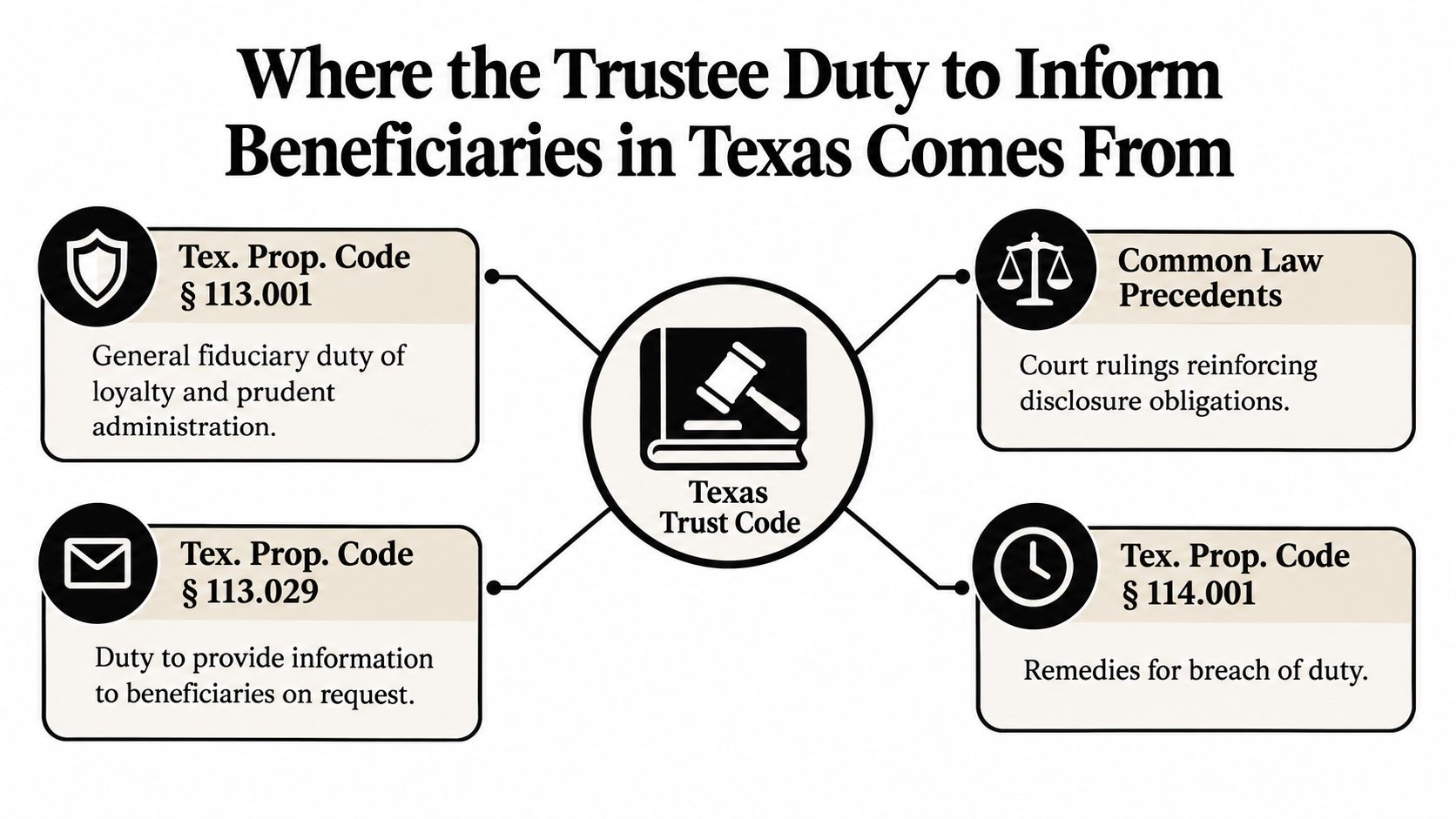
Texas trustees don't operate under one simple disclosure checklist. The duty comes from a mix of fiduciary principles, the Texas Trust Code, and common law. That's important because many trustees assume they only have to do what the trust document specifically says. Texas law is broader than that.
The legal foundation
Texas significantly expanded and then narrowed trustee disclosure duties in a short legislative window. In 2005, Texas enacted Property Code § 113.060, which required trustees to keep beneficiaries reasonably informed about trust administration and the material facts needed to protect their interests. In 2007, the Legislature repealed that standalone statutory duty and restored the common-law framework, while Texas Trust Code § 111.0035 continued to limit how far a trust instrument can waive mandatory duties, as discussed in this Texas trustee disclosure analysis.
That history matters because it explains why Texas disclosure law still feels flexible. The modern rule is not a rigid calendar system. It's a reasonableness standard shaped by both statute and equity.
For a broader discussion of trustee obligations, see this guide on Texas Trust Code trustee duties.
What reasonably informed means in practice
A trustee must give beneficiaries enough information to understand what is happening with the trust and to protect their interests. That usually includes the trust's existence, the identity of the acting trustee, major administrative decisions, and significant events affecting value or distribution rights.
It does not mean every beneficiary gets every internal file. Texas law gives the trustee room to administer efficiently, but not room to hide material facts.
Here is the practical split:
- Must usually be shared: major sales, changes affecting distribution rights, trustee changes, significant risks, and information needed to evaluate a release or object to conduct.
- Doesn't usually require full production automatically: every draft valuation, routine administrative notes, and every minor internal decision.
A trustee's job is not to narrate every thought. It is to provide the information a beneficiary reasonably needs to protect their interest.
How the trust document fits in
The trust instrument still matters. Texas allows limited restrictions on disclosure in certain settings, but the trust document cannot erase every fiduciary duty. Sources discussing Texas Trust Code § 111.0035 explain that some duties to inform and account remain mandatory even when the document uses broad privacy language.
That's why trustees should read the trust instrument carefully, then test those clauses against Texas law before relying on them. Good drafting can narrow disclosure in some situations. It usually can't justify complete silence.
What Texas Trustees Must Tell Beneficiaries and When
Once a trustee accepts the role, disclosure becomes an operating task, not an abstract legal principle. The safest approach is to think in terms of trigger events. Some communications should happen early. Others arise when something material changes.
Texas law does not impose a broad notice rule requiring trustees to notify beneficiaries whenever a trust is created, becomes irrevocable, or a new trustee takes over in the same way some other states do. But Texas materials also stress that trustees must keep beneficiaries reasonably informed, and that duty can require notice without waiting for a request.
Core notice events
A trustee should usually communicate promptly when any of the following happens:
- The trustee begins serving: beneficiaries should know who is acting, how to contact the trustee, and that administration is underway.
- A trustee resigns, dies, or is replaced: beneficiaries need to know who now controls records, accounts, and distributions.
- A material transaction occurs: a sale of real estate, redemption of a business interest, major tax-driven restructuring, or change affecting a beneficiary's rights should not stay hidden.
- A beneficiary's status changes: if a distribution right turns on age or another event, the trustee should address that directly.
One practical resource that tracks these early role-transition issues is First Steps for a Successor Trustee in Texas, which focuses on what to do immediately after stepping into the trustee role.
Trustee Notice Triggers and Required Content in Texas
| Trigger Event | Required Content | Texas Timing Guidance |
|---|---|---|
| Trustee begins acting | Identity of trustee, contact information, basic confirmation that trust administration is underway | Within a reasonable time |
| Trustee change | Name of successor trustee, where records and questions should go | Promptly |
| Sale of major trust asset | What was sold, that the transaction closed, and how proceeds affect the trust | Promptly after the event |
| Distribution-triggering event | Whether the event affects present distribution rights and how the trustee will administer that change | Within a reasonable time after the trigger |
| Significant risk or status change | Facts beneficiaries need to protect their interests | Promptly |
A real example
Suppose the trust owns a rental property in Harris County. The trustee decides to sell it. Current beneficiaries should ordinarily be told that the property was sold, the proceeds are now trust assets, and the sale may affect taxes or future distributions.
Texas law does not usually require the trustee to send every marketing note, every broker email, or every valuation file to every remainder beneficiary automatically. But hiding the sale itself is a different matter. A major asset sale is the kind of event that can become actionable if it is withheld.
The age issue many families miss
Texas sources also note a sharp age-related limitation. A trust term cannot eliminate the duty to inform beneficiaries of an irrevocable trust who are age 25 or older and entitled to distributions, as discussed in this Texas-focused guide on trust law and disclosure limits. That means younger beneficiaries may have much less visibility than families assume.
For trustees, that creates a real-world drafting and administration issue. The beneficiary list alone isn't enough. The trustee must also sort beneficiaries by status, age, and present distribution rights before deciding who gets what information.
Accountings, Reports, and the Right to Demand Information
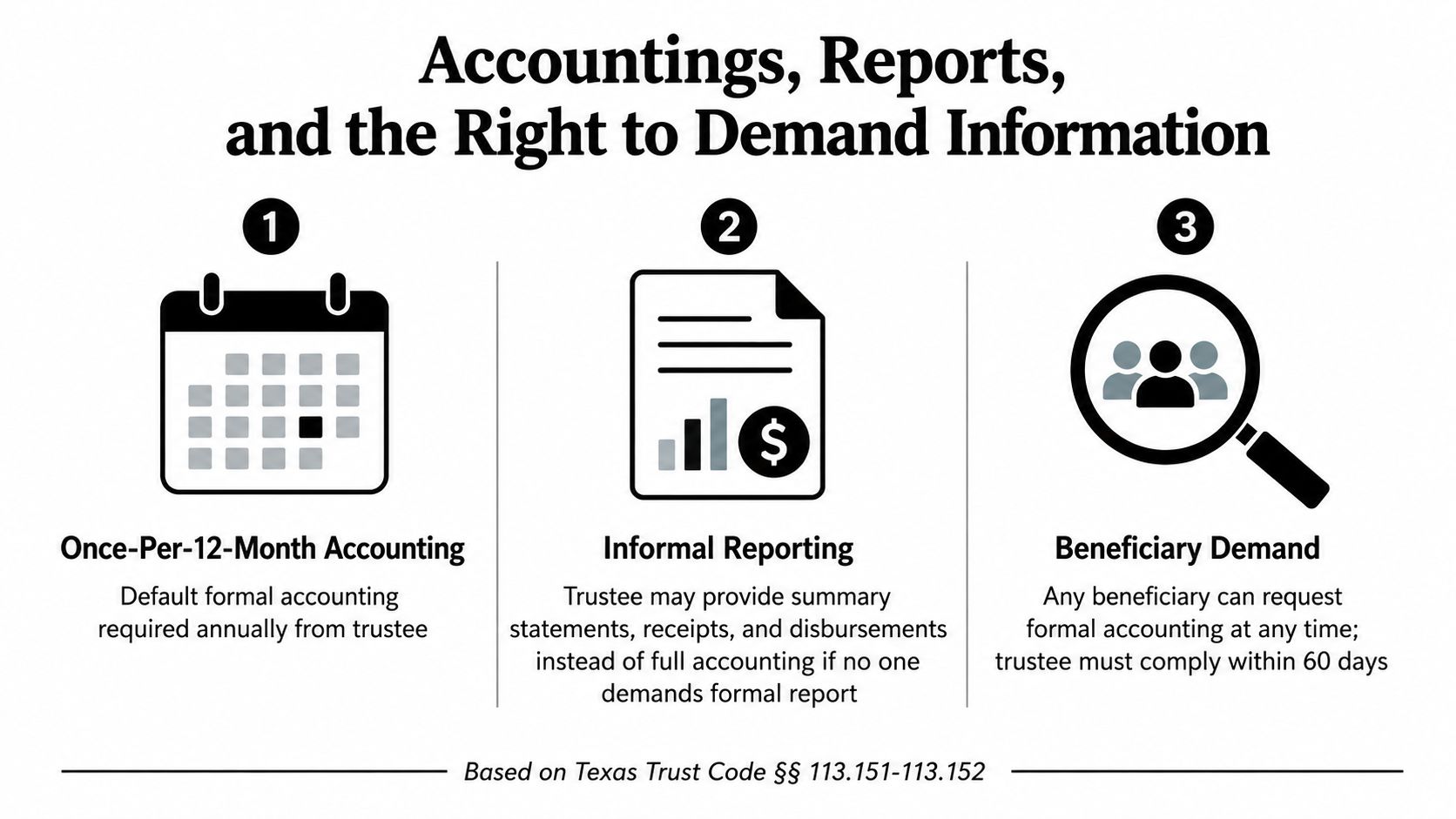
Informing beneficiaries and delivering a formal accounting are related, but they are not the same thing. Texas law does not impose a single standalone periodic-accounting statute for every trust. Instead, the trustee's disclosure obligation is largely functional. The duty centers on keeping beneficiaries reasonably informed about administration and material facts needed to protect their interests, as explained in this discussion of Texas trustee duties.
When a formal accounting is required
A beneficiary may demand a formal accounting from a trustee, but Texas generally limits how often that demand can be made. The trust code provides that a trustee is usually not required to provide more than one accounting in a 12-month period.
That rule helps both sides. Beneficiaries get a clear oversight tool. Trustees get protection from constant repetitive demands.
For deeper background on the accounting process, this page on trust accounting in Texas is a useful reference.
What a proper accounting should cover
In practice, a useful accounting should let a beneficiary trace what came in, what went out, what remains, and why distributions were handled the way they were.
A solid trustee report usually includes:
- Receipts: principal and income received by the trust
- Disbursements: expenses, taxes, fees, and other payments
- Current assets: what the trust owns now, with market values where available
- Liabilities: debts, pending obligations, or claims against trust property
- Distribution summary: what was distributed, to whom, and how the trustee calculated it
Checklist note: If a beneficiary can't tell what changed during the reporting period, the accounting probably needs more work.
Here is a practical explainer that many families find helpful before they review records or ask follow-up questions.
Informal reporting still matters
Even when no formal accounting has been demanded, trustees should still provide meaningful updates after major events. A short written report after a property sale, a tax issue, or a large distribution often prevents disputes that a year-end accounting cannot fix retroactively.
What doesn't work is vague reporting. Lines like “administrative expenses paid” or “asset adjusted” often trigger more conflict than a straightforward explanation with backup records attached.
Exceptions, Limited Disclosure, and Real-World Disputes in Texas
A trustee sells the ranch, uses part of the proceeds to pay expenses, and tells the family months later. By then, dispute is no longer just about the sale. It is about whether the trustee gave the people affected enough information, early enough, to ask questions, object, or seek court help before the decision became hard to unwind.
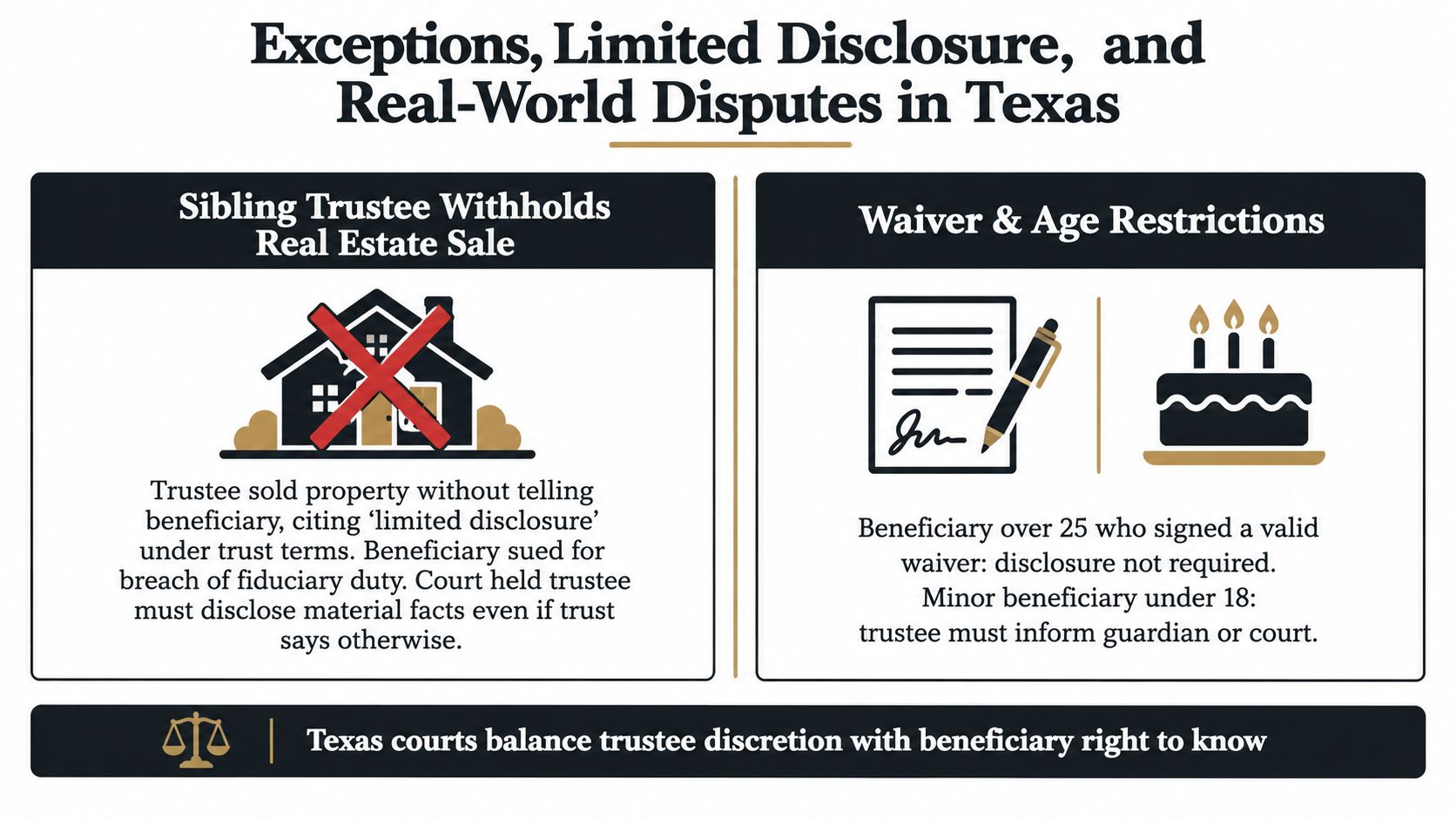
Texas law does allow narrower disclosure in some settings, and the trust instrument can matter. The limits are real, but they are not a free pass for selective silence. The practical question is usually narrower: who was entitled to know, what fact had to be disclosed, and whether the delay interfered with that beneficiary's ability to protect an interest in the trust.
Where limited disclosure can apply
Texas trust law has a layered history on the duty to keep beneficiaries informed. The statutory language changed over time, while common-law fiduciary principles continued to matter. Texas also left room for settlors to restrict disclosure in defined situations, including some revocable trust settings, some younger beneficiaries, and some beneficiaries whose interests are not yet current, as discussed in this review of Texas trust law developments.
In practice, that means a trustee should not assume every person named anywhere in the instrument gets the same records on the same timeline. It also means a trustee should not assume a confidentiality clause shuts off all reporting duties. Courts usually look past labels and focus on the beneficiary's status, the trust terms, and the significance of the withheld information.
The disputes that actually reach lawyers and courts
The hardest cases usually involve a break in the reporting chain, not a single missed email. The trustee does not give notice of a major transaction. No timely explanation follows. The accounting arrives late or leaves out backup detail. Then the beneficiary claims the delay blocked a challenge that could have been raised earlier.
Common flashpoints include:
- a trustee refusing to provide information after a written request
- a property sale or refinance disclosed only after closing
- distributions made without explaining how the trustee applied the trust standard
- payments to the trustee, a relative, or a related business without clear disclosure
- release documents sent before the beneficiary has enough facts to evaluate them
Materiality drives many of these fights. If the omitted fact affected value, timing, tax exposure, investment risk, or a beneficiary's chance to object, the trustee has a harder defense.
What usually helps, and what usually fails
Trustees are in a stronger position when they can show a paper trail. Keep the notice letter. Keep the email transmitting the sale summary. Keep the spreadsheet showing how a distribution was calculated. Keep notes reflecting why one beneficiary received funds for health or education and another did not. Good records do not guarantee peace, but they give the trustee something better than memory.
The arguments that fail most often are familiar. "I had discretion" is not the same as "I never had to explain myself." "We are family" is not a fiduciary defense. "The beneficiary did not ask" also has limits, especially after a material event that changed the trust's assets or the beneficiary's practical ability to respond.
Trust disputes also overlap with probate, estate planning, guardianship, and asset-protection concerns, especially where minors, incapacitated adults, or spendthrift provisions are involved. That overlap changes who should receive information directly, who may act through a representative, and how carefully the trustee should document each disclosure decision.
A Practical Compliance Checklist for Texas Trustees
A trustee often learns the hard way that silence creates risk. The trust sells a ranch, a beneficiary hears about it from someone else, and now the problem is not only the sale. It is the missing record of what was disclosed, when it was disclosed, and whether the trustee gave beneficiaries a fair chance to ask questions or object.
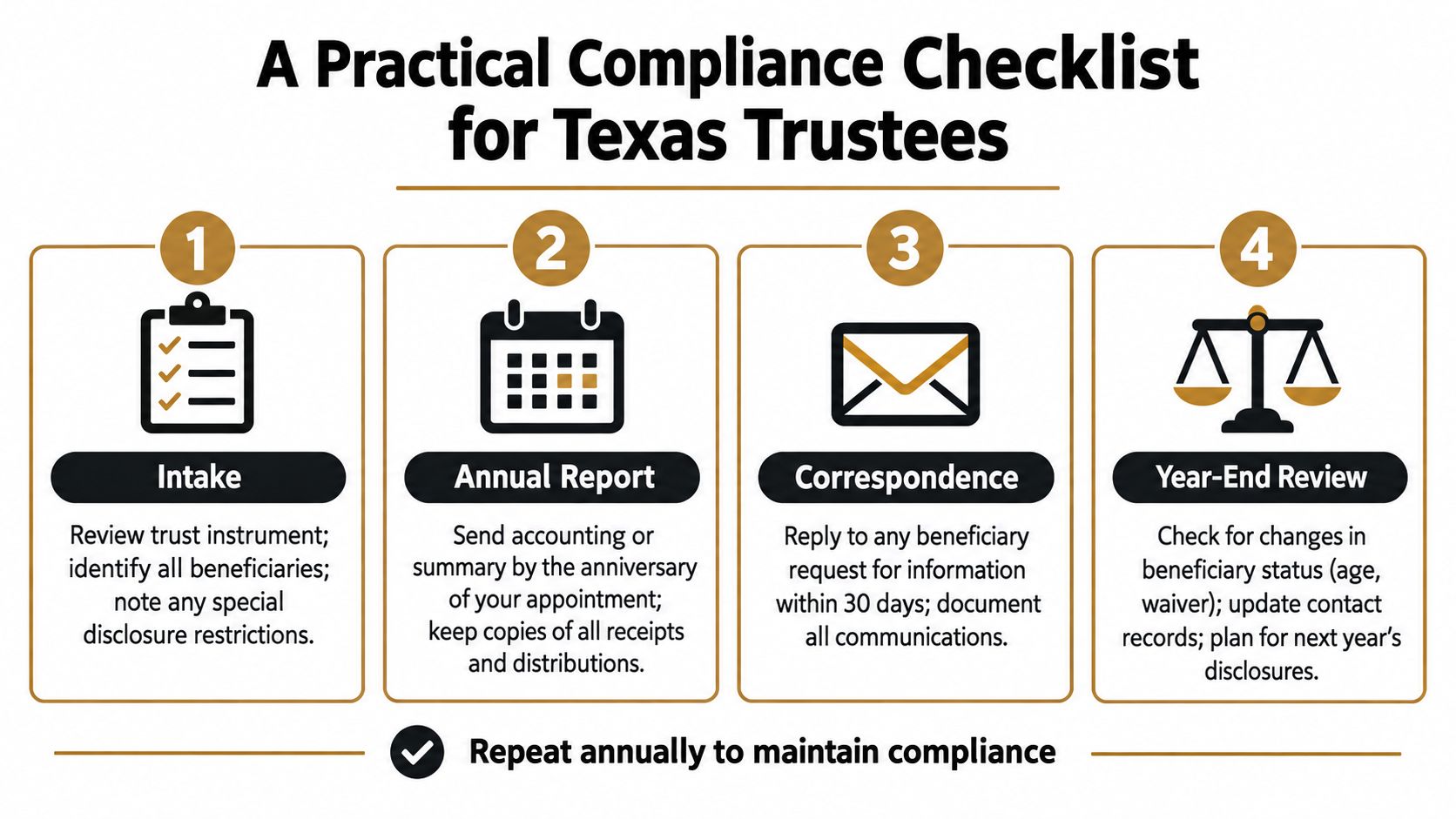
A workable checklist ties the full chain together. Start with who is entitled to information. Identify the events that trigger notice. Calendar accountings and response deadlines. Then keep proof that each step happened. Trustees who do that are usually in a much better position if a beneficiary later claims concealment or delay.
A working checklist, from intake through annual review
Use a process that can be repeated without guessing.
Read the trust instrument before taking action
Confirm who the current beneficiaries are, who holds a contingent interest, whether a representative may receive information for a minor or incapacitated beneficiary, and whether the document tries to limit disclosure in a way that needs legal review.Create a beneficiary and notice chart
List full names, mailing addresses, email addresses, capacity issues, and the basis for each person's right to receive information. Update it after deaths, births, trustee changes, disclaimer elections, or trust divisions.Send the opening trustee notice promptly
Identify the acting trustee, give reliable contact information, and tell beneficiaries how to request records or an accounting. Save the exact notice that went out, the date sent, and the delivery method.Flag events that call for communication before year-end
A sale of real property, a large distribution, a change in trustees, settlement proceeds, a significant tax issue, or a decision that changes one beneficiary's practical share should trigger a fresh disclosure review. Waiting for the annual accounting can be a mistake if the event is material now.Prepare accountings with enough detail to be useful
An accounting should let a beneficiary follow the money. Include beginning and ending balances, receipts, disbursements, gains or losses, compensation paid, liabilities, and the assets on hand. If a line item would raise an obvious question, answer it in the report or an attached explanation.Track and answer written requests
Log the date of each request, what was asked for, what was produced, and what was withheld. If something is withheld, note the reason. Many trustee disputes become expensive because no one kept a response log.Calendar annual and event-based reviews
Set a yearly date to review whether notices were sent, accountings are due, tax information has been shared where appropriate, and the beneficiary list is still accurate.
What belongs in the file
A trustee's file should show more than good intentions. It should show performance.
Keep:
- Copies of each notice and accounting sent
- Proof of mailing, email transmission, or portal delivery
- Trust bank statements, brokerage statements, and supporting records
- Closing papers for sales, loans, or major transactions
- A ledger for distributions and trustee compensation
- Notes explaining discretionary decisions
- Written beneficiary requests and the trustee's responses
- A calendar or tickler showing when reviews and reports were due
One point matters in practice. If the trustee cannot show when information was sent, a court may treat the issue as an unresolved fact dispute. That drives up cost quickly.
The compliance habit that protects trustees
The safest pattern is simple. Send clear notices. Give usable accountings. Respond to written requests. Preserve proof.
That record does more than show courtesy. It helps establish when beneficiaries had enough information to evaluate a transaction, ask for backup, or raise an objection. In contested matters, that timing can affect settlement posture, limitations arguments, and whether the trustee looks organized or evasive.
A trustee who needs legal review of notices, accountings, disclosure limits, or representative-recipient issues can consult a Texas trust administration lawyer. The Law Office of Bryan Fagan, PLLC handles trust administration, fiduciary accounting, dispute guidance, estate planning, and related Texas trust matters.
Beneficiary Remedies When a Trustee Stays Silent
When a trustee stops communicating, beneficiaries shouldn't guess their way forward. Texas law gives them a path, and that path works best when it starts with a clear written record.
The first move is usually a written demand for information or accounting. The demand should identify the beneficiary's interest, describe the records requested, and ask for a response in a reasonable time. Casual texts and family arguments rarely create the record a court wants to see.
Beneficiary Remedies at a Glance
| Remedy | Statute | Practical Effect |
|---|---|---|
| Petition for accounting | Texas trust accounting provisions | Can force the trustee to produce a formal report of trust activity |
| Petition to compel information | Fiduciary duty and trust administration principles | Can require the trustee to provide records or explanations |
| Surcharge claim | Breach of fiduciary duty remedies | Can seek recovery for losses caused by concealment or misconduct |
| Trustee removal | Removal provisions under Texas trust law | Can replace a trustee who won't perform duties properly |
| Notice compliance in trustee litigation | Texas Property Code § 115.015 | Can affect whether a case may proceed to judgment |
The 30-day notice rule many litigants miss
A key operational rule in Texas trust litigation is the 30-day notice requirement for lawsuits involving a trustee's contract or tort acts. Under Texas Property Code § 115.015, a plaintiff generally may not obtain judgment unless notice of the action is given to each known beneficiary with a present or contingent interest before the 31st day after suit begins, or earlier if the court sets a longer notice period. The trustee must provide the plaintiff a list of beneficiaries and addresses within 10 days after a written request, and notice must be sent by registered or certified mail, return receipt requested, as set out in Texas Property Code § 115.015.
That rule matters in real cases. A strong claim can still get delayed if beneficiary notice was handled poorly.
Matching the remedy to the problem
Different facts call for different requests:
- No records at all: petition for accounting
- Partial or evasive responses: motion to compel clearer disclosure
- Hidden self-dealing: surcharge and possibly removal
- Administration breakdown: seek removal if silence shows inability or refusal to perform
Beneficiaries who need to force an accounting often start with guidance like this article on compelling a trust accounting in court when the trustee refuses.
The key is to move deliberately. Document the requests. Preserve the responses. Then ask for the remedy that fits the actual breach, not the family's frustration alone.
When to Bring in a Texas Trust Administration Lawyer
Some trust problems are manageable with careful paperwork. Others move into legal-risk territory quickly. The shift often happens when the trust document is unclear, the trustee is also a beneficiary, a major asset is hard to value, or the family cannot even agree about what the duty to inform requires.
Signs self-help has reached its limit
A trustee should usually get legal help when:
- The trust language is ambiguous
- A beneficiary claims concealment or self-dealing
- The trust holds closely held stock, mineral interests, or unusual property
- A release or consent is being requested
- Litigation is threatened or already filed
- The trustee may face personal liability for a fiduciary decision
A beneficiary should usually get legal help when written requests are ignored, accountings are incomplete, major transactions were concealed, or court action may be needed to compel disclosure or seek removal.
What to gather before the meeting
The most useful consultation usually starts with documents, not conclusions.
Bring:
- the trust instrument and amendments
- recent accountings or summaries
- deeds, statements, and tax notices tied to disputed assets
- letters, emails, and texts between trustee and beneficiaries
- any proposed releases, consents, or settlement papers
This is also where broader planning law matters. Trust disputes often connect to the Texas Estates Code, probate administration, tax planning, guardianship for vulnerable beneficiaries, and questions about how to modify a trust in Texas when the current structure no longer works.
A Texas trust administration lawyer can help a trustee build a compliant notice process, prepare a defensible accounting, respond to a beneficiary demand, or seek court instructions before a problem grows. A beneficiary can use counsel to turn justified concern into a focused legal request instead of a family standoff. That's often the difference between a fixable administration problem and a long fiduciary dispute.
If you're managing a trust or trying to get answers from a silent trustee, the attorneys at Law Office of Bryan Fagan, PLLC help Texas families, trustees, and beneficiaries address disclosure duties, accountings, trust disputes, estate planning, probate, guardianship, and asset protection issues with clear next steps. A free consultation can help you understand what Texas law requires, what records matter most, and how to protect your position before the problem gets harder to fix.