Managing a loved one's trust can feel overwhelming, especially when one person controls the records and the rest of the family is left guessing. In Houston, I've seen that story play out more than once, a sibling-trustee stops returning calls, the bills keep getting paid, and the beneficiary just wants one clear answer about where the money went.
That feeling is common, and it's legally meaningful. In Texas, a trustee does not get to stay silent just because transparency is inconvenient. A beneficiary can demand a formal accounting, and when the trustee refuses, compelling a trust accounting in court becomes a real, practical remedy under Texas fiduciary law. If you want a plain-English overview of beneficiary concerns before you dig in, the guide by Wealth Collective is a useful place to see how these disputes typically start.
When the Trustee Goes Silent and What Texas Law Does About It
A familiar scene in Texas trust cases starts the same way. A parent dies, one child is named trustee, and the other siblings are told to be patient while the trustee “gets organized.” Then the calls stop being returned, the updates get vague, and the beneficiary starts wondering whether the trust is being administered carefully or just hidden behind silence.
A trust accounting is not a casual summary email. It is a structured statement of receipts, disbursements, and trust assets, the kind of document that lets a beneficiary see whether money moved where it should have, whether fees were taken, and whether distributions match the trust terms. That is why courts treat the duty to account as part of the basic fiduciary relationship, not as a favor the trustee can grant or withhold.
The duty to account exists because the trustee controls property that belongs to someone else's beneficial interest, not because the trustee feels ready to explain it.
Texas families often learn this the hard way. The trustee may say they are busy, grieving, or sorting out records, but none of that erases the beneficiary's right to transparency. A trustee who is administering the trust should be able to document what happened, and if they cannot, that itself becomes part of the problem.
For a broader Texas-focused discussion of beneficiary rights, the firm's resource on Beneficiary Rights in a Texas Trust helps frame the issue in practical terms. The key point is simple. Just asking nicely is only the beginning. Texas law gives you a structured way to move from unanswered calls to an enforceable demand, and that matters whether the trust is modest, complex, or somewhere in between.
The Legal Basis for Compelling an Accounting Under Texas Law
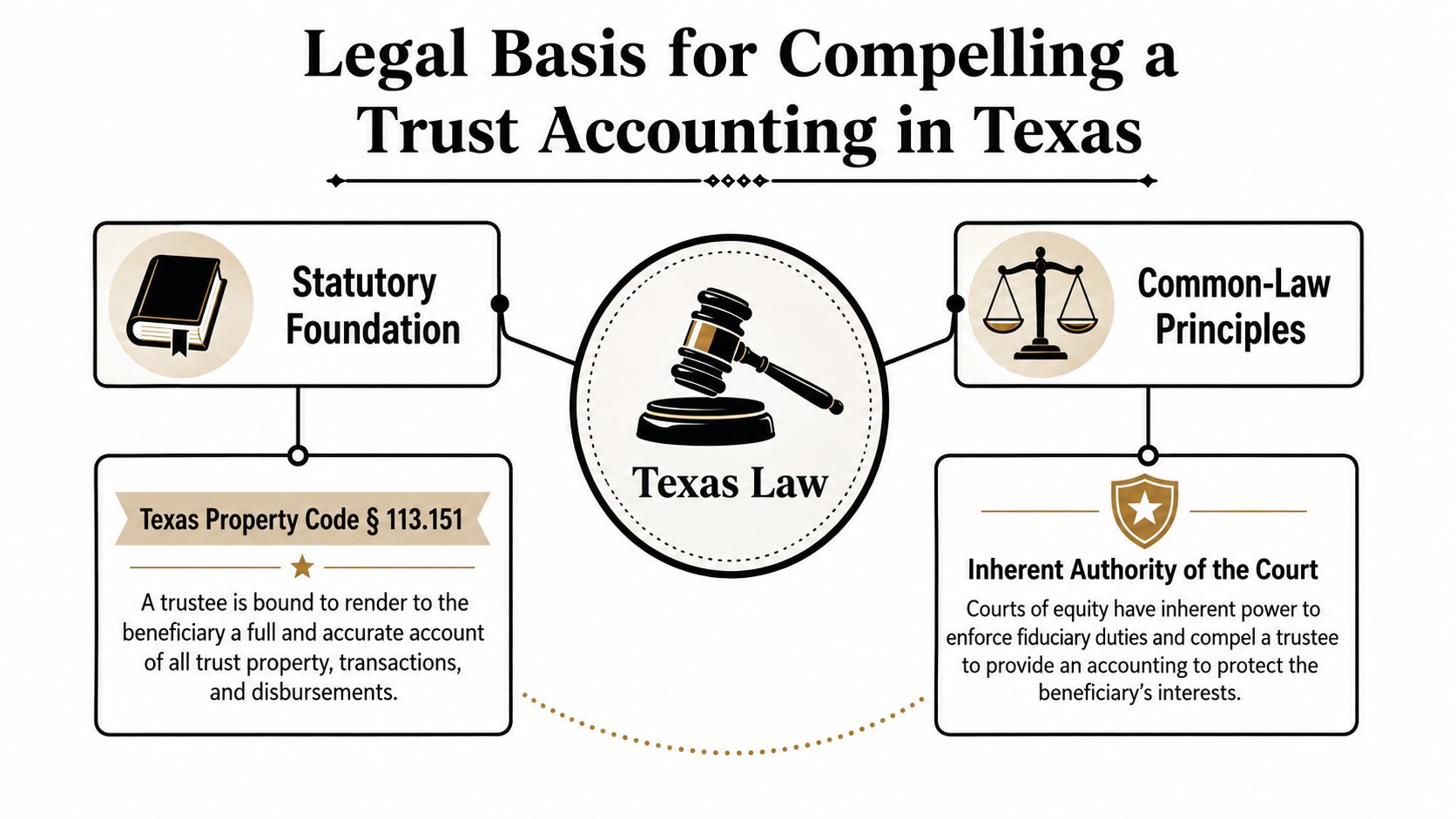
Texas Property Code § 113.151 gives the demand real force. A beneficiary can demand a trustee accounting in writing, and if the trustee does not deliver it within 90 days after receiving the demand, the beneficiary may file suit to compel the statement of accounts under Texas Property Code § 113.151(a) (Texas Property Code § 113.151). That written demand is the practical milestone. It starts the clock, and once day 90 passes without a response, the dispute is no longer just about family communication.
Texas fiduciary law also supplies the larger framework. Trustees owe duties of loyalty, prudence, and disclosure, and those duties sit alongside the Estates Code and the common law of trusts. In plain English, a trustee can't manage trust property for personal advantage, can't make careless decisions with trust assets, and can't hide the books when a beneficiary asks for them.
California is useful as a comparison point because it uses a 60-day request-to-petition structure in practice, along with a norm of annual reporting while a trust remains open (California trust accounting procedure overview). Texas gives a longer window, but the logic is similar. A beneficiary sends a written demand, the trustee has a clear deadline, and the court can step in if the response never comes.
Operative rule: If the trustee does not provide the accounting within 90 days after written demand, the beneficiary may sue to compel it under Texas Property Code § 113.151(a).
For trustees, that means the duty is not optional and not indefinite. For beneficiaries, it means the right to an accounting is grounded in statute and fiduciary obligation, not just fairness. If you keep trustee records for administration or compliance, a checklist for IOLTA compliance can also be a helpful reminder that trust money demands disciplined handling from the start.
Writing the Pre-Suit Demand That Starts the Clock
A trustee may answer in a way that looks responsive on paper and still miss the point entirely. A short summary, a partial ledger, or a vague offer to “explain things later” can leave a beneficiary with the same problem, no real accounting and no usable records. The demand letter should force the issue.
Name the beneficiary, identify the trust by its full title, and request a formal accounting for a specific period. Cite Texas Property Code § 113.151 and say plainly that the beneficiary is making a statutory demand for an accounting. That language matters because it shows the trustee this is not a casual inquiry or a request for general information, it is the start of a legal clock.
Send the demand in a way that proves it was delivered. Certified mail with return receipt is the safest baseline, and a courtesy email can help if the trustee regularly uses email. Keep the letter, the proof of mailing, the receipt, and every response, even if the response is incomplete or evasive. Those materials often become the backbone of the case if the dispute ends up in court.
Texts and loose email threads create avoidable problems. They may prove the beneficiary asked questions, but they often do not satisfy the statute's written demand requirement with enough clarity for a judge. A trustee who sends piecemeal summaries or casual updates may still be refusing to account in the legal sense, because the question is whether the trustee produced a proper accounting, not whether the trustee said something back.
Trust language can complicate the analysis, especially if the instrument claims to waive or narrow the duty to account. That provision still has to be read against the statute and the facts, and it deserves a lawyer's review before anyone assumes it controls. For a practical drafting example, demand for trust accounting in Texas gives a useful framework for how to make the request, and the duty itself is described in A Trustee's Duty to Account to Beneficiaries.
A short checklist helps keep the demand sharp:
- Name the trust clearly: Use the full trust title and the trustee's name.
- Ask for a real accounting: Request transactions, balances, receipts, disbursements, and distributions.
- Cite the statute: Reference Texas Property Code § 113.151.
- Set up your proof: Use certified mail and keep the receipt.
- Save every reply: Partial answers matter because they show what was, and was not, produced.
Filing the Petition to Compel and What Must Be Pleaded
A refusal to provide a real accounting usually turns into a pleading fight as soon as the demand period passes. The petition should go into the probate court, or the district court with probate jurisdiction, in the county where the trust is administered. It needs to identify the trust, the beneficiary's interest, the written demand, the trustee's non-response or incomplete response, and the relief sought. If the trust instrument is available, attach it. If it is not, plead the facts you have and ask the court to require production through the case.
A petition that works does more than accuse the trustee of stonewalling. It sets out facts showing standing, the date the demand was delivered, and what the trustee failed to provide after that. A sworn statement from the beneficiary about the trust interest helps because it gives the court a concrete reason to order an accounting, not just a vague complaint about secrecy. For a practical drafting model, the guide on petition for accounting in a Texas trust shows the kind of information that belongs in the pleading.
The gray area appears when the trustee answers, but the answer is not enough. A few statements, a partial ledger, or a summary with missing backup still leaves the beneficiary without the records needed to test what happened. That is the point to make in the petition, because Texas judges care about whether the response qualifies as an accounting, not whether the trustee sent something back.
The accounting claim often comes with other requests for relief. Breach of fiduciary duty is common when the records point to unexplained fees, self-dealing, or favoritism. Removal under Texas Property Code § 113.083 becomes relevant when the trustee's conduct is serious enough that continued administration no longer makes sense. Surcharge may follow if the accounting shows losses or unjustified expenditures, and attorney's fees can be requested under the Texas Trust Code when the refusal to account was not justified.

Discovery still matters, even when the petition is focused and specific. Bank statements, tax returns, the trust's general ledger, and transaction-level records can show whether the accounting is complete or just dressed up to look complete. Interrogatories and depositions let counsel identify who approved distributions, who received fees, and why specific entries were made. In many Texas courts, a motion to compel accounting can be heard before broad discovery runs its full course, which can keep a stalled case from dragging on.
For readers comparing process and cost, the firm's page on what it costs to sue a trustee in Texas and who pays is a practical next step. The drafting rule is simple, plead facts, not conclusions. Trustees often answer with counterclaims about interference or harm to reputation, so the petition should stay disciplined, specific, and built around documents.
Remedies Texas Courts Actually Order When a Trustee Refuses to Account
The remedy matters as much as the petition. A trustee who refuses to account may face a court-ordered accounting first, and that is often the most efficient answer when the trust is still being administered. In some cases the court appoints a neutral person, such as a special master or independent CPA, to prepare or reconstruct the accounting when the trustee's records are incomplete.
| Remedy | Statutory Basis | Best-Fit Scenario |
|---|---|---|
| Court-ordered accounting | Texas Property Code § 113.151 | The beneficiary needs the records, and the trustee has delayed or given an insufficient response |
| Surcharge | Fiduciary-duty principles and Texas trust remedies | The accounting shows losses, waste, or unjustified expenses |
| Removal of trustee | Texas Property Code § 113.083 | The trustee is conflicted, persistently unresponsive, or has committed a serious breach |
| Attorney's fees and costs | Texas Trust Code fee-shifting principles | The refusal to account was unjustified and forced litigation |
Surcharge is different from removal. It focuses on money, not office. If the accounting shows improper spending, a trustee can be personally liable for those losses even if the court allows the trustee to stay in place. Removal, by contrast, is the harder remedy and usually reserved for conduct that makes continued service a bad idea.
That distinction matters in settlement talks. A trustee facing only a corrected accounting may settle quickly because the court can still keep the trust running. A trustee facing surcharge, fee exposure, and a possible removal request has much more to think about. That is why a measured petition often creates persuasive force without forcing the beneficiary to overreach.
Removal is the exception, not the rule, even when the trustee has dragged their feet and given the family the runaround.
If you're comparing possible next steps, a Texas trust administration lawyer will usually look first at whether an accounting order can solve the problem before pushing the fight all the way to removal. In practice, the court's goal is often to make the trust transparent and functional, not to blow it up unless the facts justify that.
Common Defenses and How Texas Courts Evaluate Them
Trustees rarely admit the refusal was unreasonable. Instead, they often say the beneficiary waived the right, the trustee already gave something that counts as an accounting, or the demand came too late. Those defenses need to be taken seriously because the timing and wording of the paper trail matter almost as much as the substance of the dispute.
A “we already accounted” defense fails if the response was piecemeal, stale, or too vague to let the beneficiary evaluate the trust's receipts and disbursements. Courts care about whether the response was legally sufficient, not whether the trustee sent something. A trustee may also argue lack of standing or point to a bond requirement or forum clause, but those arguments don't erase the core duty to answer a proper demand when the statute applies.
Laches can become a real problem if the beneficiary waits too long after the refusal becomes clear. At the same time, filing too early, before a proper written demand or before the statutory clock runs, can lead to a dismissal without prejudice. The sequence matters, and so does the proof of service.
A typical Houston probate court scenario looks like this. The beneficiary sends a certified written demand, the trustee replies with a short email and a few balance figures, and the beneficiary files anyway. The court will usually ask whether the response meets the accounting obligation or whether it is just a placeholder designed to avoid litigation. If the record shows an incomplete response and no meaningful follow-through, the trustee's defense tends to look weak.
Texas courts also distinguish between a trustee who is overwhelmed and one who is concealing transactions. Overwhelm may buy a short extension if the records are being gathered in good faith. Concealment, delay, or selective disclosure pushes the case in the opposite direction. Beneficiaries should expect these defenses and build the record early, not improvise after the trustee files an answer.
Settlement Options and Your Practical Path Forward
A trustee's reply can be technically “given” and still leave the family with the same problem. That gray zone matters in trust fights, because the response may look responsive on paper while leaving out the records, detail, or explanation the law requires. At that point, the question is often which remedy will move the dispute the fastest: an accounting order, a surcharge claim, or removal.
Families usually get better results when they treat the dispute as a practical decision tree instead of a contest for its own sake. If the trust document, written demand, proof of delivery, and timeline are in order, negotiation becomes more realistic because the trustee can see the risk of an accounting order, surcharge, fees, and possible removal. Mediation often works best when both sides want to preserve the trust and avoid a public fight.
A neutral accountant can resolve the issue faster than a judge. That route is most useful when the main problem is missing records or incomplete records, not a claim that assets were flatly stolen. In the right case, pressing for a corporate fiduciary may also make sense if the family no longer trusts the current trustee to stay objective.
Before calling a lawyer, a short self-check helps keep the issue grounded:
- Do you have the trust document?
- Did you send a written demand?
- Can you prove delivery?
- Do you have a clean timeline of the trustee's response, or lack of one?
- Does the response answer the accounting request, or just avoid it?
For families who also need related help, the firm's resources on the trustee's duty to account and what happens when a trustee dies can be useful starting points. If your issue overlaps with estate planning, probate, guardianship, or asset protection, The Law Office of Bryan Fagan, PLLC handles those related matters too. The main point is simple. Texas law gives beneficiaries real tools, and you do not have to guess your way through the process.
If you're managing a trust dispute or trying to figure out whether a trustee's response is legally enough, The Law Office of Bryan Fagan, PLLC can help you review the records, the deadlines, and the remedy that fits the facts before the case gets harder. Visit Law Office of Bryan Fagan, PLLC to schedule a free consultation and get Texas-based guidance on trust administration, beneficiary rights, and the next right step.