Managing a loved one's trust can feel overwhelming, especially when you discover that a Texas home, bank account, or investment account was never retitled in the trust's name. The family may believe the trust controls the asset, while the deed or account statement tells a different story. That mismatch can leave a successor trustee, executor, and beneficiaries unsure whether the property belongs in trust administration or must pass through probate.
Many Texas families search for a Heggstad petition Texas solution because California has a recognized court procedure for this problem. Texas doesn't have a matching Heggstad statute, but that doesn't mean an unfunded asset has no possible remedy. The right path may involve trust construction, modification, reformation, probate, or another civil court filing supported by strong evidence of the settlor's intent.

This guide explains the California origin of the term, the Texas laws that may provide a practical alternative, and the documents fiduciaries should gather before taking action. It also addresses venue, service, beneficiary rights, and fiduciary duties in Texas so families can avoid treating an out-of-state procedure as though it were Texas law. A Texas trust administration lawyer can help evaluate the trust documents, title history, and available court remedies before a filing creates additional problems.
When a Loved Ones Trust Leaves an Asset Behind
After her father died, Maria found a revocable trust in his desk and a schedule listing his Texas home. She also found a deed showing that the home was still titled in her father's individual name. Her father had talked about placing the house in the trust, and the family assumed the schedule completed that task. Now Maria, serving as successor trustee, has to determine whether the house can be administered under the trust or whether the executor must address it through the estate.
That situation is common in form, even though each family's legal answer depends on its documents. A trust schedule can help show intent, but a schedule isn't the same thing as a recorded deed. Bank and investment accounts can create the same concern when statements remain in the settlor's name rather than the trust's name.
Practical rule: Don't distribute or sell an omitted asset until you've confirmed who legally owns it and which court, if any, has authority to resolve the issue.
The first task is to separate intent from title. The trust may show what the settlor wanted, while the deed, account agreement, or other ownership record shows what was transferred. Those facts can point in the same direction, or they can conflict. Beneficiary agreement may make administration smoother, but agreement alone doesn't automatically change legal title.
A pour-over will may provide another route. You can review how a pour-over will works in Texas to understand how a will may direct property left outside the trust into the trust through probate. That option still requires careful review of the will, the estate, and the asset.
The timeline also depends on the asset, the records, the people involved, and the court process. Families researching How Long Does Trust Administration Take in Texas? should focus on those practical factors rather than assuming a California procedure will control a Texas matter. A careful document review can protect the trustee from acting too quickly and help beneficiaries understand why a court filing may be necessary.
What a Heggstad Petition Really Is and Why Texas Is Different
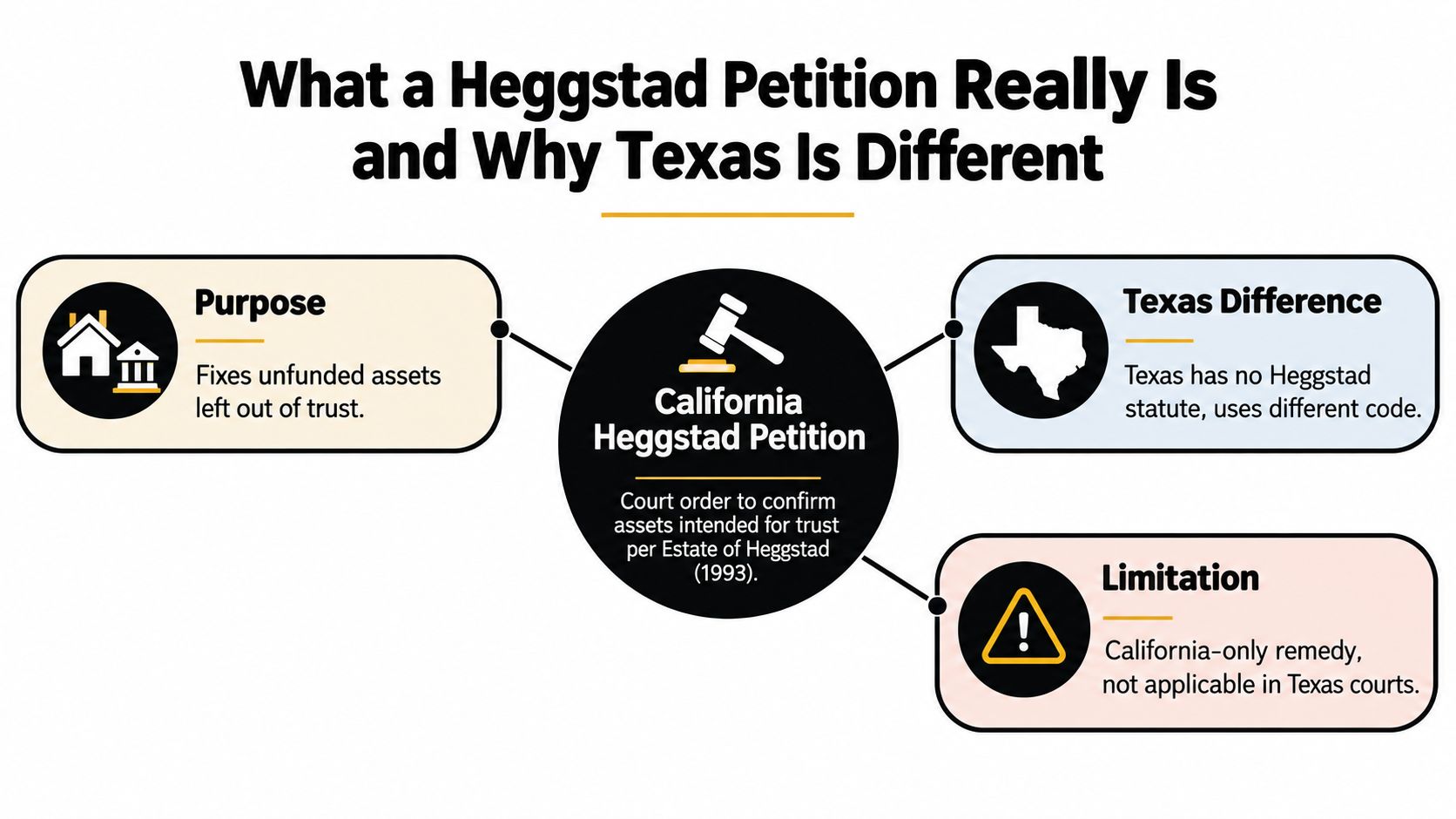
A Heggstad petition comes from California, not Texas. The phrase traces to Estate of Heggstad (1993) 16 Cal.App.4th 943, a California appellate decision recognizing that a properly written declaration of trust could help establish that an asset was intended to be trust property even though title hadn't been formally transferred. A detailed explanation of Estate of Heggstad describes why that decision became associated with a court request involving omitted trust assets.
In practical terms, a California Heggstad petition asks a probate court to confirm that a specific asset belongs in a trust. The asset might be a home, bank account, or investment account. The procedure focuses on the identified property rather than asking the court to administer the entire estate through a full probate proceeding.
Why the phrase creates confusion
Texas has no direct Heggstad statute. The term can still appear in online searches because Texas residents may own California property, use California counsel, or search for a shortcut after finding an unfunded asset. But a Texas court won't treat the California case name as a stand-alone Texas filing procedure.
That distinction matters for a family with a Texas trust and Texas property. The family should not copy a California petition and assume that a Texas probate court will hear it under the same authority. Texas procedure, venue, service, and available relief must come from Texas law and the facts of the case.
What the California concept teaches Texas families
Although the remedy doesn't transfer automatically, the California concept highlights the central issue: proof of settlor intent. A court may need to examine the trust, its schedules, title records, account statements, assignments, and communications with beneficiaries. A successor trustee usually has the clearest reason to address the issue because the trustee must identify and protect trust property.
Texas readers should treat “Heggstad petition Texas” as a research phrase, not a conclusion. The question is whether Texas law provides a way to clarify ownership, modify or reform trust administration, use a pour-over will, or address the asset through another probate or civil proceeding. That assessment belongs in the hands of a Texas attorney familiar with the Texas Trust Code and Texas Estates Code.
How Texas Law Handles Unfunded Trust Assets Instead
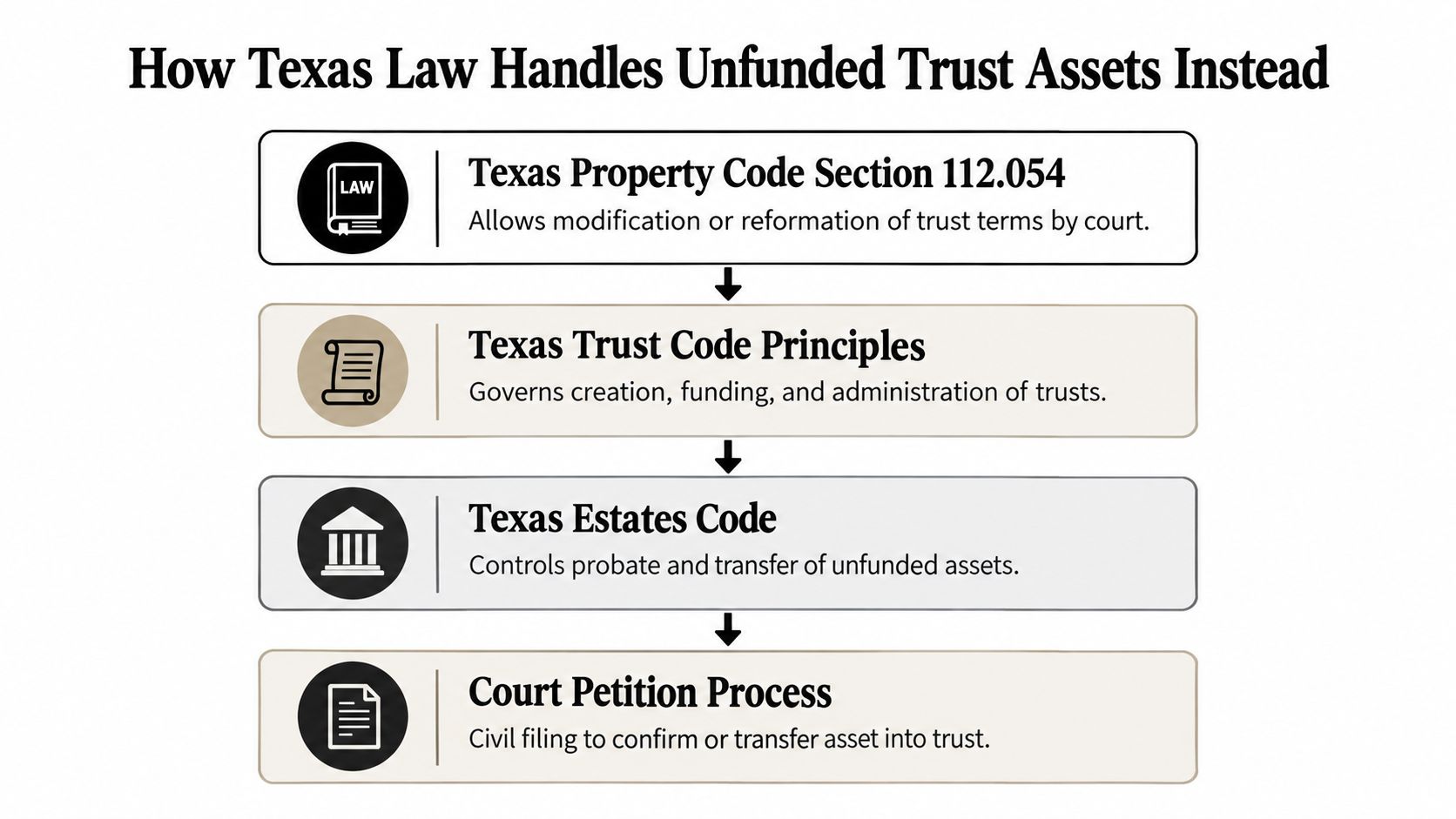
Texas approaches an omitted asset through the governing documents, ownership records, fiduciary principles, and the court's available authority. The starting point isn't the label “Heggstad.” It's the question of what relief the trustee or beneficiary needs and what legal basis supports that relief.
Texas Property Code section 112.054 allows a trustee or beneficiary to petition a court for several forms of relief. The court may change a trustee, modify trust terms, direct or prohibit an act, or terminate all or part of a trust. The statute addresses circumstances such as fulfilled, illegal, or impossible trust purposes, unforeseen circumstances, administrative terms that create waste or impairment, and tax objectives that can be achieved without contradicting the settlor's intent. Texas Property Code section 112.054 provides the statutory framework.
Start with the governing documents
A trustee should gather the complete trust agreement, every amendment, property schedules, assignments, deeds, account records, and the settlor's will. Read the documents together. A schedule may identify the asset, the trust may describe the settlor's funding plan, and a will may direct property left outside the trust into it.
The trustee should then identify the precise relief needed. If the problem involves an ambiguous administrative provision, modification or construction may be appropriate. If the problem involves a deed or ownership record that doesn't reflect documented intent, the case may require a court order addressing ownership or transfer. If the asset falls within a valid pour-over will, probate may be part of the solution.
Use Texas guidance on transferring bank accounts to a trust when the institution can correct the account through ordinary paperwork. A non-judicial correction may be simpler when the financial institution accepts the trust certification and the available ownership documents.
Follow fiduciary standards during the process
Texas fiduciaries must administer a trust or estate according to the governing trust or will. When a fiduciary uses discretion or adjusts administration, the fiduciary must act impartially and fairly for all beneficiaries unless the governing instrument clearly permits favoritism. Texas fiduciary requirements make beneficiary communication and balanced decision-making central to the trustee's role.
A trustee shouldn't favor the beneficiary who wants the asset treated as trust property while ignoring another beneficiary's competing interest. The trustee should preserve the asset, maintain records, disclose material information as required, and avoid treating family consensus as a substitute for legal authority.
If a trust has reached its termination event, the trustee may continue exercising trustee powers for the reasonable period needed to wind up the trust and distribute assets to the proper beneficiaries. That continued administration doesn't change beneficiaries' vested rights under Texas law. Texas trust termination provisions help explain why a trustee may still need authority to resolve an ownership problem during wind-up.
When Trustees Beneficiaries or Executors Should Consider Court Relief
Court relief makes sense when the asset's ownership is disputed, the title record conflicts with the trust, or an institution won't act without a court order. It may also be appropriate when beneficiaries disagree about the settlor's intent or when the trustee needs protection before taking a position that affects everyone's interests.
A home listed on a trust schedule but never deeded presents a different problem from a bank account that the institution can retitle after reviewing a valid certification of trust. An out-of-state property may also require attention under the law of the state where the property sits, even if the trustee and trust are based in Texas.
| Situation | Best Texas Path | Key Consideration |
|---|---|---|
| A deed was never prepared or recorded, but the trust documents identify the home | Court petition seeking appropriate trust or ownership relief | Compare the trust language with the latest deed and title history |
| A bank or investment account remains in the settlor's name | Request institutional correction first, then evaluate court relief | Confirm account ownership, beneficiary designations, and the institution's requirements |
| The trust contains unclear administrative language | Judicial construction or modification under available Texas authority | Preserve the settlor's intent and protect every beneficiary's position |
| A pour-over will identifies property left outside the trust | Probate administration under the will | Coordinate the executor's duties with the successor trustee |
| Beneficiaries object to the proposed treatment of the asset | Court-supervised resolution may be safer | Notice, service, evidence, and impartiality become especially important |
| Property is located outside Texas | Analyze the property state's law and Texas trust administration rules | A Texas filing may not resolve title in another state |
Executors and trustees should also distinguish between probate title and trust title. A comparison of muniment of title and trust administration in Texas can help families understand why the correct procedure depends on the will, the asset, and the ownership record.
Filing Procedure Checklist and Sample Petition Elements in Texas
Texas treats a petition of this kind as a civil filing, not as an automatically available California-style Heggstad proceeding. The Texas Rules of Civil Procedure require a case to begin with a petition filed with the clerk, and probate-related matters may require additional case-information paperwork or placement into an existing probate matter. The Texas Rules of Civil Procedure should be reviewed with counsel before filing.
Step one is choosing the correct court and case location
The trustee should determine whether an existing probate case already covers the decedent's estate or related trust issues. A stand-alone petition may need to be filed into that matter, depending on the facts and the court's procedures. Venue and docket placement matter because a court may reject or delay a filing before it evaluates the evidence.
The filing should identify the legal basis for jurisdiction and explain why the selected court can decide the requested relief. Don't assume that the county where the decedent died, where the trustee lives, or where the property sits automatically controls. Those facts can point in different directions.
Step two is identifying the people and property
A well-prepared petition should identify:
- The trust: State the trust's name and execution information as shown in the documents.
- The settlor: Identify the person or people who created and funded the trust.
- The successor trustee: State who is serving and why that person has authority.
- The beneficiaries: Identify interested beneficiaries and other parties whose rights may be affected.
- The omitted asset: Describe the home, account, investment, or other property precisely.
- The requested relief: Explain the order the court should enter and how it will allow proper administration.
The asset description should be specific enough for a county clerk, title company, bank, or investment custodian to understand what property the order concerns. For real estate, that generally means using the legal description and current deed information rather than relying only on a street address.
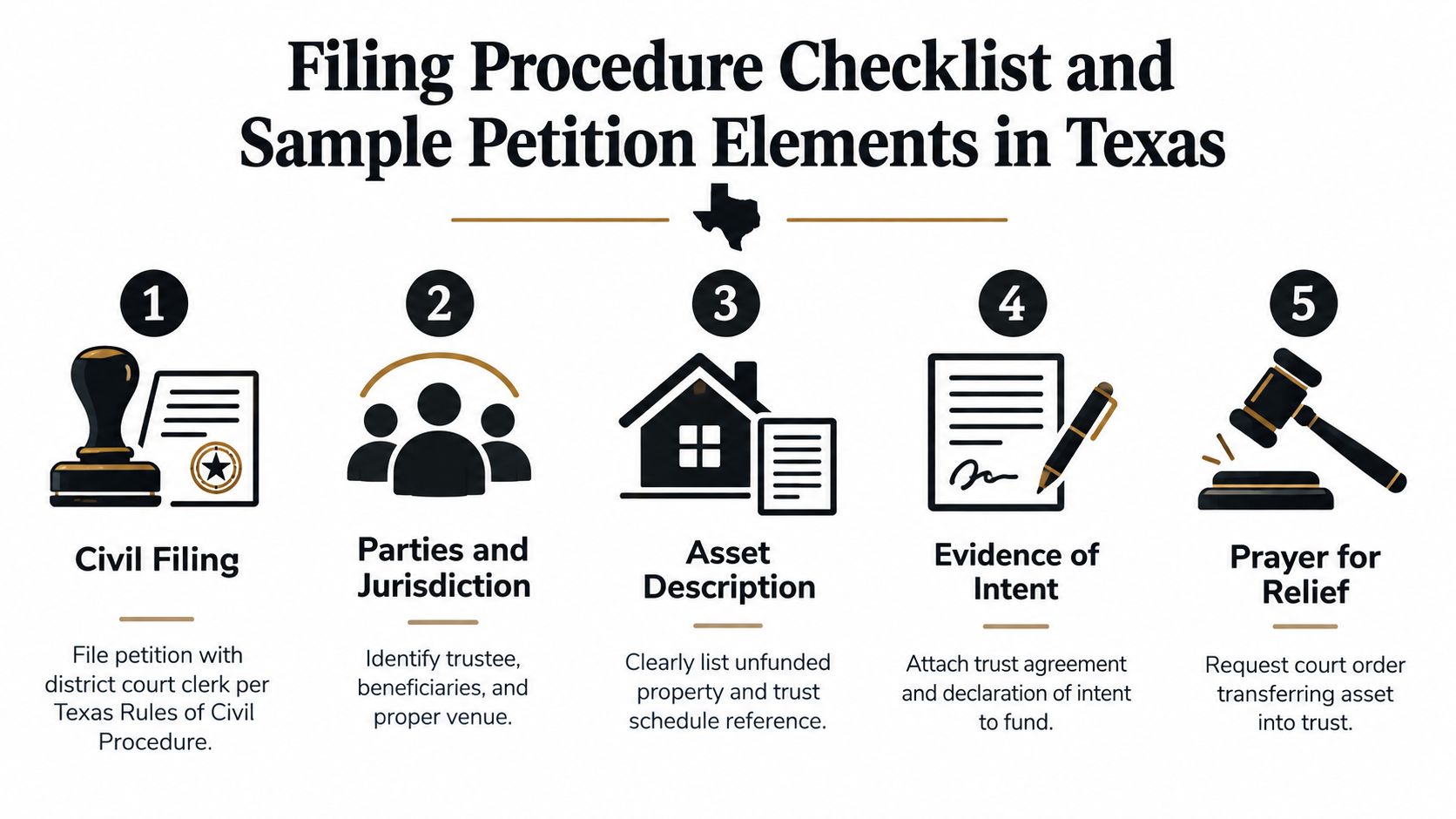
Step three is assembling the evidence
The supporting file should usually include the trust agreement, amendments, trust schedule, assignment or declaration of intent, the most recent deed or account statement, the death certificate, and relevant beneficiary notices. Title records and account statements can show what happened before and after the trust was created. Communications may help explain why the asset was left outside the trust.
Sample petition language should be treated as a drafting prompt, not a ready-to-file form. A petition might state that the settlor executed the trust, identified the asset as intended trust property, failed to complete a formal retitling step, and that the requested order is necessary for the successor trustee to administer the asset according to the trust. The prayer should request precise relief, not a broad declaration affecting unrelated property.
Step four is completing service and citation
Texas procedure requires proper service under the applicable civil rules. Beneficiaries and other interested parties may need formal citation, and an informal family email may not satisfy the legal requirement. The trustee should confirm who must be served, how service must occur, and whether the petition belongs in an existing probate docket.
Evidence Defenses and Risks Every Texas Fiduciary Should Know
The central dispute is usually intent. The trustee must connect the settlor's written plan to the specific asset, using contemporaneous trust documents, title records, account statements, assignments, and beneficiary notices. A court may also examine whether later documents contradict the earlier plan.
A schedule listing “the house” may be useful, but the court may need the deed, legal description, and title history to determine which property the settlor meant. An account statement may identify an account, but later withdrawals, closures, or beneficiary designations could create a competing explanation. The evidence should tell one consistent story.
Evidence matters: A court order is useful only when the petition gives the court a reliable basis to determine what the settlor intended.
Common defenses and risks include:
- No clear intent: The trust never identifies the asset, and no assignment or other writing connects it to the trust.
- Conflicting documents: A later deed, amendment, will, or account designation points away from trust ownership.
- Improper filing: The petition is filed in the wrong court, placed outside the relevant probate matter, or served incorrectly.
- Beneficiary objection: A beneficiary argues that the requested order changes their inheritance rather than correcting administration.
- Fiduciary conflict: The trustee promotes one beneficiary's position without fairly considering the others.
- Tax or transfer concerns: Retitling or distributing the asset may affect tax reporting, creditor issues, or other legal obligations.
If granted, the order can function as a corrective title or ownership instrument, allowing the trustee to administer or retitle the asset without a separate transfer by the decedent's estate. That result doesn't eliminate the need to record the order, present it to a financial institution, or address tax and title requirements. Each step should follow the language of the order and the asset custodian's procedures.
Moving Forward With Confidence and Trusted Texas Guidance
A Texas family searching for a Heggstad petition usually needs an answer to a more practical question: how to modify a trust in Texas or otherwise resolve an asset that wasn't properly funded. Texas has no direct Heggstad statute, but the Texas Trust Code, Texas Estates Code, civil procedure rules, and fiduciary principles may provide workable routes when the evidence supports the settlor's intent.
Start by preserving the trust and estate documents, securing the asset, confirming current title, and communicating carefully with beneficiaries. Don't retitle or distribute property because everyone believes the settlor intended a particular result. A Texas trust administration lawyer can evaluate the ownership record, the will, the trust, venue, notice, and the fiduciary duties in Texas before recommending a non-judicial correction or court filing.
Families may also need help with estate planning, probate, guardianship, or asset protection when the unfunded asset is part of a larger planning concern. The Law Office of Bryan Fagan, PLLC can help trustees, executors, beneficiaries, and families organize the facts and choose a Texas-based path forward.
If you're managing an unfunded trust asset, The Law Office of Bryan Fagan, PLLC offers guidance on trust administration, court petitions, probate coordination, fiduciary compliance, and beneficiary disputes. Schedule a free consultation by visiting Law Office of Bryan Fagan, PLLC so a Texas attorney can review your documents and help you take the next step with confidence.