Managing a loved one's trust can feel overwhelming, especially when every beneficiary is supposed to receive a share and one person has disappeared. You may have checked old address books, called relatives, and searched online, yet still have no reliable way to reach the missing beneficiary. As a successor trustee, you're right to pause before distributing the trust.
A trustee cannot locate a beneficiary in Texas situation isn't solved by dividing the missing person's share among the other beneficiaries. Your responsibility is to follow the trust document, protect trust property, and act with the care and loyalty required by Texas law. A careful search, proper notice, strong records, and court guidance when needed can protect the missing beneficiary and reduce your own risk.
When a Texas Trustee Cannot Find a Beneficiary
Consider a common family situation. A parent's trust is ready for distribution, but one adult child has moved several times, changed their surname, and hasn't spoken with the family for years. The other beneficiaries want the trustee to finish the administration. They may even suggest placing the missing person's share into their own distributions and dealing with the issue later.
That approach creates serious problems. A trustee generally can't treat silence as consent, assume the person has died, or redistribute the share informally. The trustee must first review the trust terms, identify the beneficiary's legal interest, and make a good-faith, diligent search that fits the circumstances.
The problem may also involve documents beyond the trust. Before deciding that a beneficiary is unreachable, the trustee should confirm the trust agreement, amendments, beneficiary schedules, related estate-planning documents, and any records showing a prior address or name. A resource on locating a deceased person's will and related estate documents can help families organize that initial document review.
Why patience protects the trustee
Texas trust administration is governed by the Texas Trust Code, the trust document, and fiduciary principles. Those rules require the trustee to manage property for the beneficiaries rather than for personal convenience. If the trustee distributes too soon, the missing person may later demand the share, and the other beneficiaries may be required to return money or property they already received.
The safest path is methodical:
- Read the distribution language and determine the missing beneficiary's interest.
- Search through increasingly thorough and proportionate methods.
- Preserve the share while the search continues.
- Keep a dated record of every effort.
- Seek court instructions if reasonable efforts have been exhausted.
Practical rule: A trustee doesn't have to find a person at any cost, but the trustee does need to show why the search was reasonable under the facts.
Success doesn't always mean locating the beneficiary personally. Sometimes success means creating a credible record that demonstrates diligent efforts, protecting the funds, and obtaining a court order that explains what happens next. That process may take longer than the family hoped, but it's far safer than making an unsupported distribution.
Understanding Your Fiduciary Duties Under Texas Law
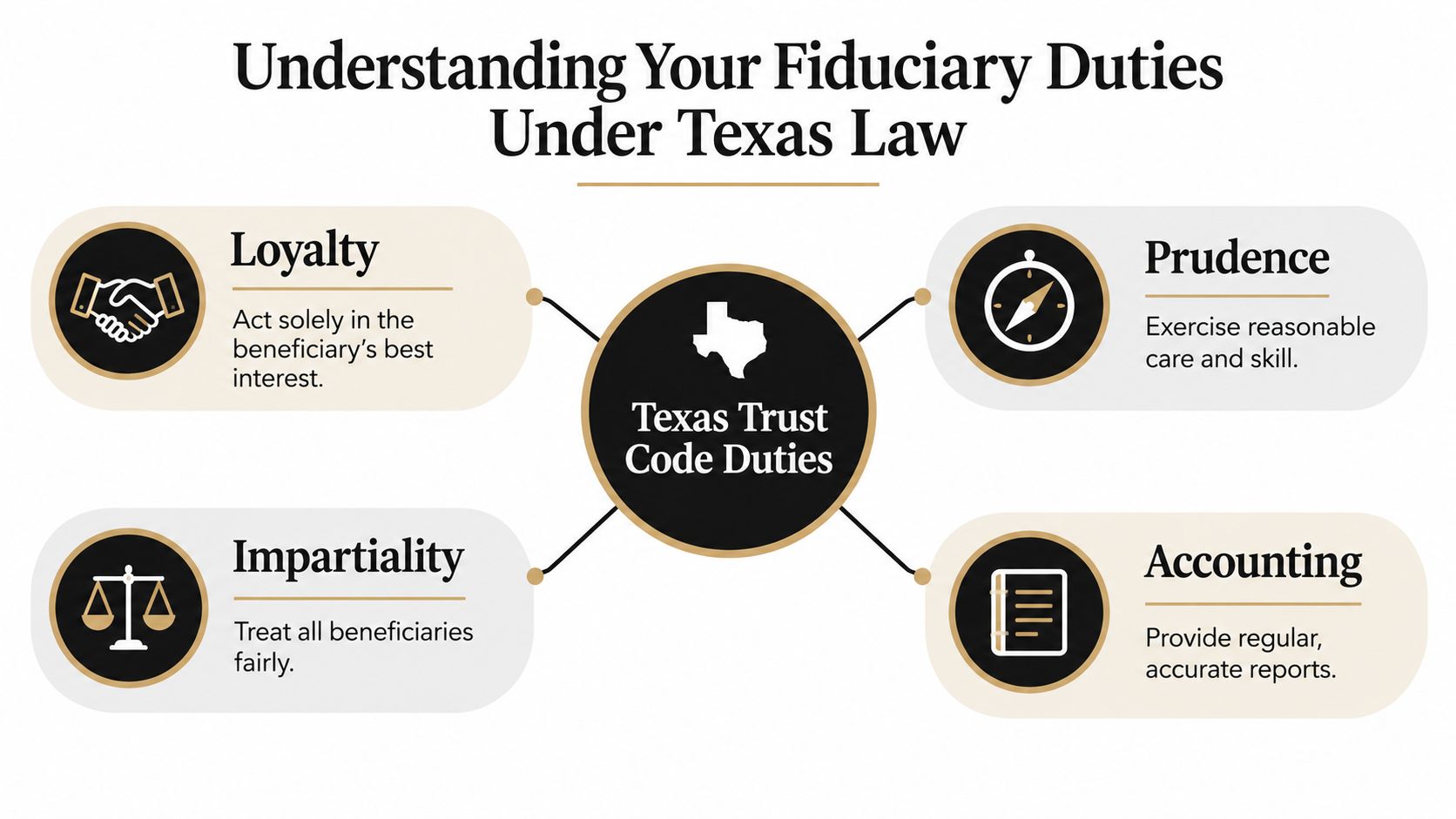
A trustee's fiduciary duties don't disappear because a beneficiary is difficult to find. They become more important. Under Texas trust principles, the trustee must administer the trust in good faith, follow its terms, protect trust property, and make decisions that respect the interests of all beneficiaries.
The principal duties include:
- Loyalty: Don't use trust property for personal benefit or favor one beneficiary without legal authority.
- Prudence: Investigate facts, protect assets, and make careful decisions rather than rushing to close the trust.
- Impartiality: Treat current, remainder, income, and missing beneficiaries fairly under the trust's terms.
- Accounting: Maintain accurate records showing trust assets, income, expenses, search costs, and distributions.
A trustee who is also a beneficiary must be especially careful. For example, suppose a surviving spouse serves as trustee and is entitled to receive trust property, while an adult child from an earlier marriage has lost contact with the family. The spouse can't treat the child's absence as permission to keep the child's share. The spouse must remain impartial and preserve the missing beneficiary's interest.
A fuller discussion of Texas Trust Code trustee duties can help clarify how the trust document and statutory principles work together. The core duties of loyalty, prudence, and impartiality are also summarized in The Fiduciary Duties of a Texas Trustee.
The probate notice and trust notice contrast
Many families assume that probate and trust administration impose identical notice obligations. They don't always operate the same way.
Texas probate law requires notice to beneficiaries whose identity and address are known or can be ascertained through reasonable diligence. A beneficiary discovered later must be notified as soon as possible under the applicable probate process. The Texas Estates Code provides the statutory framework for this notice obligation in Texas Estates Code Section 308.002.
Trust administration can create a blind spot. Texas trust materials explain that trustees generally aren't required to notify beneficiaries merely because a trust is created, becomes irrevocable, or a new trustee takes over. That difference can mean a missing beneficiary isn't already aware of the trust or the trustee's role.
The distinction matters because the legal question may not be only, “Where is the person?” It may also be:
- Was the beneficiary identified in a probate proceeding?
- Was the beneficiary's address reasonably ascertainable?
- Did the beneficiary already receive legally sufficient notice?
- Does the trust require a particular notice method?
- Has the person's interest vested, become payable, or remained subject to trustee discretion?
A Texas trust administration lawyer can help separate those questions before the trustee takes action.
How to Conduct a Diligent and Proportionate Search in Texas
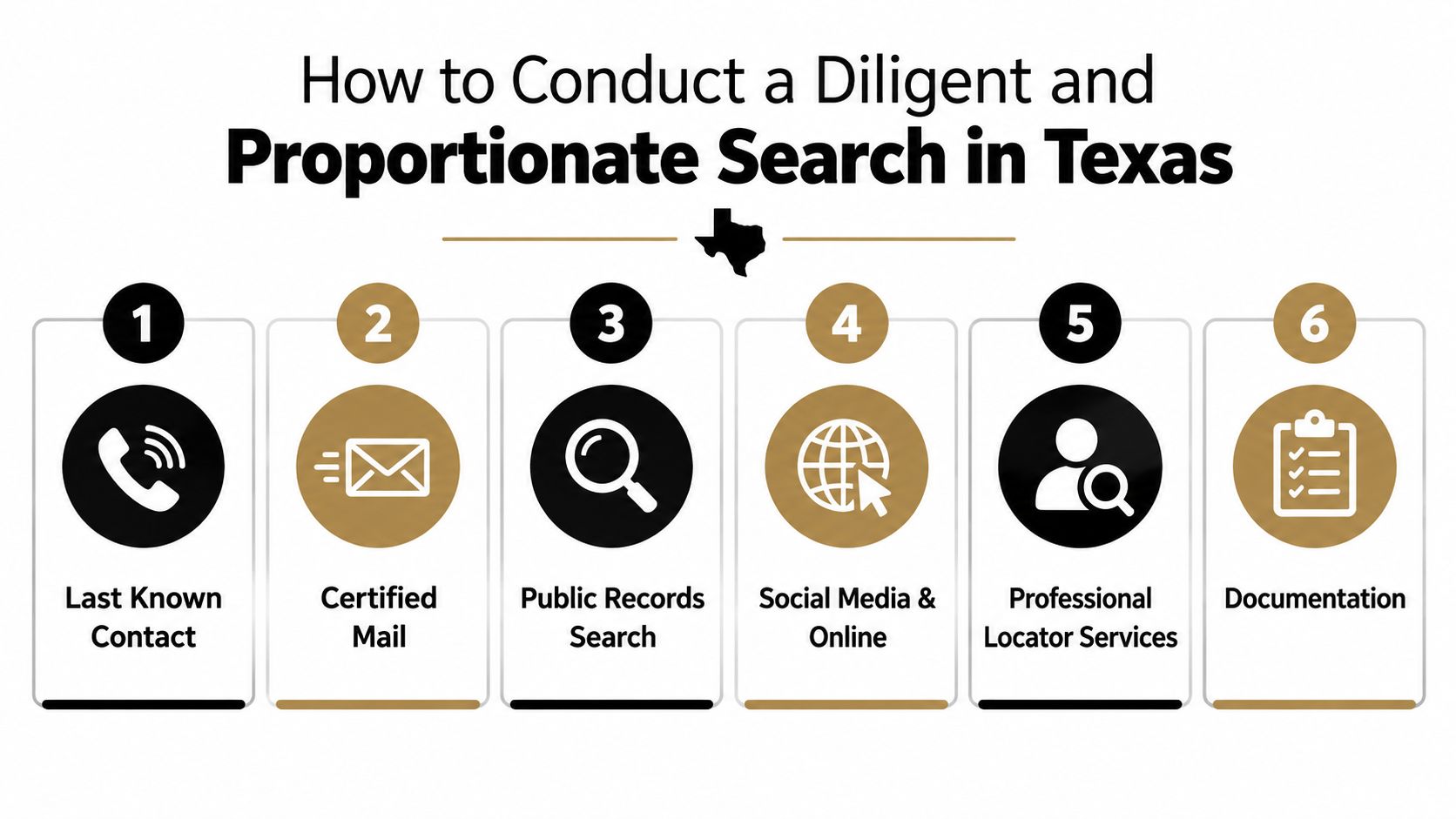
A diligent search should be layered. Start with practical, low-cost steps, then increase the effort when the earlier methods fail. The trustee should match the intensity of the search to the value and complexity of the missing beneficiary's interest.
Start with known information
Begin with the records already available to the trustee. Review the trust, amendments, prior correspondence, tax records, beneficiary forms, address books, emails, and contact information held by financial institutions. Note every name variation, including nicknames, maiden names, former surnames, common misspellings, and names used in earlier family records.
Then work outward:
- Call the last known number: Record the date, number used, whether the call connected, and any voicemail or text message.
- Mail the last known address: Use a trackable method and preserve the receipt, returned envelope, and delivery result.
- Contact relatives and friends: Ask for current contact information without disclosing unnecessary private details.
- Search public and online records: Review social media, people-search sites, property records, and relevant county records.
- Consider professional assistance: For a valuable share or complicated family history, evaluate a private investigator or heir-search service.
The Texas trust-administration guidance on missing beneficiaries recommends this type of escalating search. It also recognizes that a search for a small distribution may reasonably involve less expense than an investigation involving a substantial share. That proportionality principle doesn't excuse inaction. It helps the trustee decide which next step is reasonable.
Check unclaimed-property records carefully
Texas' official unclaimed-property system, ClaimItTexas, has returned more than $5 billion. The site's guidance says claimants should try name variants such as nicknames, common misspellings, and maiden names when searching for missing assets.
A useful sequence is:
- Search the beneficiary's last name.
- Try alternate spellings and known former names.
- Search prior counties of residence.
- Review whether the person may have lived in another state.
- Check adjacent asset categories, such as life insurance, pensions, mineral interests, and tax refunds.
- Follow the separate federal, state, and county resources identified by the official system.
Don't rely on one exact-name search. ClaimItTexas explains that results may depend on the owner name reported to the state. A beneficiary may have property listed under a former surname, a spelling variation, or a different reporting record.
A failed exact-name search is a reason to broaden the search, not a reason to conclude that no property exists.
Document each layer before escalating
Create a search log with the date, method, information used, result, and next action. Save screenshots, returned mail, call notes, online search results, invoices, and written communications. If a professional locator is hired, keep the engagement agreement and final report.
The trustee should also explain why the search stopped at a particular point. If the missing share is modest, the trust may not justify extensive investigative expense. If the share is substantial, a private investigator or heir-search service may be appropriate before requesting court instructions.
Notice Options and Protecting the Missing Share Before Court
Searching and protecting the beneficiary's interest are separate tasks. A trustee may continue looking while preserving the funds, sending appropriate communications, and creating evidence that the trustee acted responsibly.
Certified mail, publication, and holding the share each serve different purposes. The right combination depends on the trust language, the available address information, the amount involved, and whether a court proceeding is already pending.
| Option | Best When | Evidence It Creates | Limitation |
|---|---|---|---|
| Certified mail to the last known address | The trustee has a reasonably current or historically reliable address | Mailing receipt, delivery record, or returned envelope | It may not reach a person who moved or refuses delivery |
| Publication notice | Direct contact has failed and broader public notice may be appropriate | Proof of publication and the notice's wording | The missing beneficiary may never see the publication |
| Holding the share in trust | The trustee needs to preserve the person's property while searching | Account records, investment statements, and accounting entries | The trust remains open and administration continues |
| Segregated account or separate ledger | The trustee wants clear accounting for the missing share | A traceable record showing that funds weren't commingled | The trustee must still follow the trust terms and manage the funds prudently |
Publication shouldn't replace direct efforts when a reliable address or contact is reasonably available. Likewise, placing money in an account doesn't solve the legal issue by itself. The trustee should preserve the funds, avoid treating them as personal property, and track any income, expenses, or changes in value.
The ClaimItTexas search deserves careful treatment because it can uncover property connected to a beneficiary, but it isn't a universal locator. Search the last name, alternate spellings, nicknames, maiden names, and prior counties. Then broaden the inquiry to other states and separate sources for categories such as pensions, life insurance, mineral interests, and tax refunds, as the official Texas system directs.
Selecting an interim plan
A reasonable interim plan may include a written notice to the last known address, a documented online and public-record search, a separate accounting category for the missing share, and continued preservation of the funds. Publication may be considered when direct contact fails or when counsel recommends it based on the circumstances.
The trustee should also review whether the trust authorizes a distribution delay, reserve, or other protective step. If the trust language is unclear, the trustee shouldn't improvise. The share can remain protected while the trustee prepares a request for judicial guidance.
Petitioning the Court and Other Texas Remedies for Closure
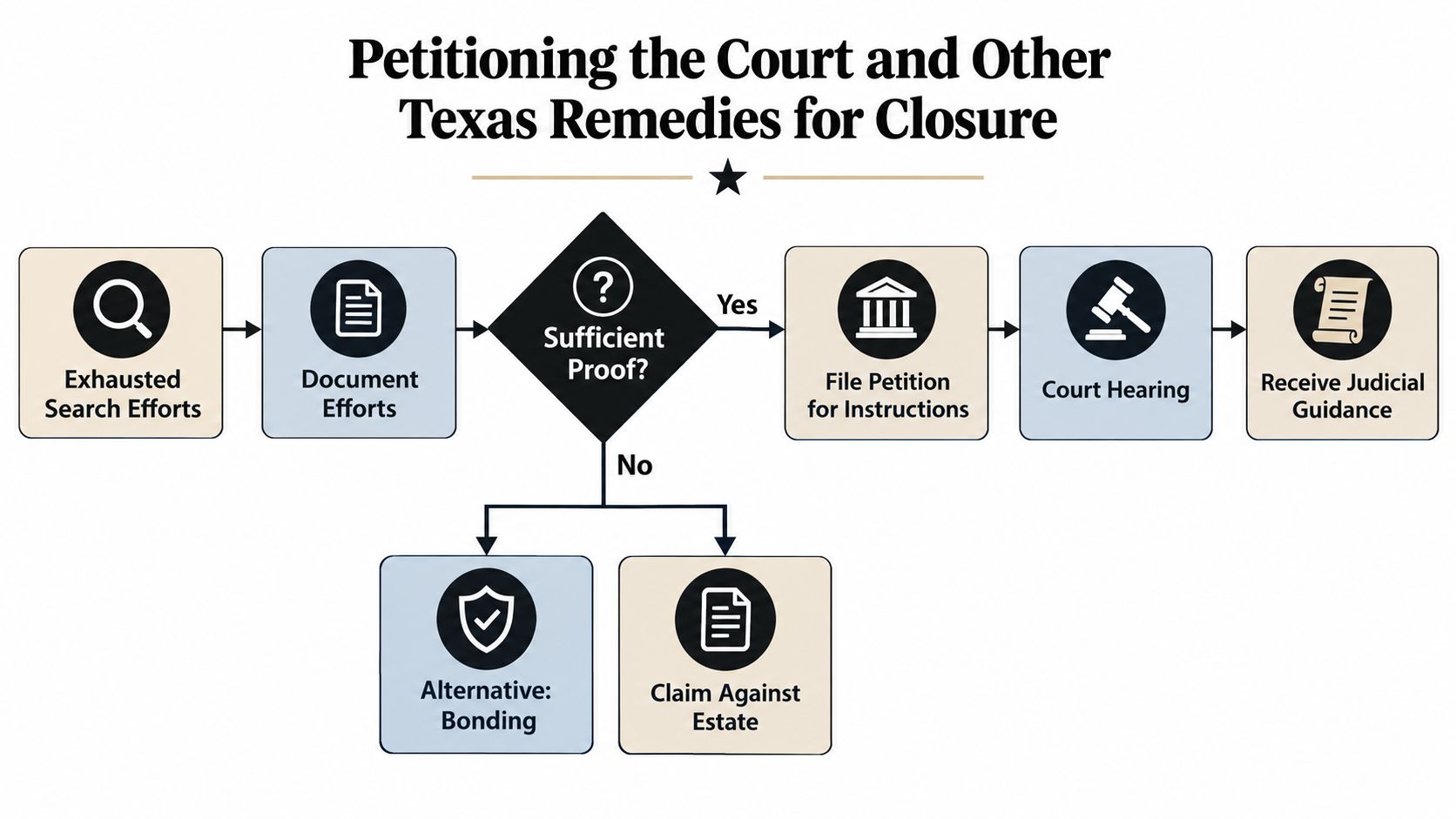
After proportionate search efforts are exhausted, court involvement may provide the safest path to finality. The trustee's request should show more than a statement that the beneficiary couldn't be found. It should present the trust terms, the beneficiary's interest, the search history, the notice efforts, the accounting, and a proposed plan for the funds.
What the court may be asked to decide
A trustee may seek instructions or declaratory relief concerning questions such as:
- Whether the search was sufficiently diligent.
- Whether additional notice or publication is appropriate.
- Whether the missing share should remain in trust.
- Whether funds should be deposited with the court registry.
- Whether a successor trustee or another fiduciary should take over.
- How the trustee should account for the property during the waiting period.
Texas trust materials explain that, after exhaustive efforts, a court may order the missing beneficiary's share held in trust for a defined period. That remedy reduces the risk of wrongful distribution, but it also delays closure. A court order doesn't necessarily locate the beneficiary. It tells the trustee how to proceed without guessing.
A trustee considering representation issues can review virtual representation under Texas Trust Code Section 114.086 with counsel. Whether that statute applies depends on the parties, the trust terms, and the specific proceeding.
What a well-supported filing contains
A practical court submission may include:
- The trust agreement and relevant amendments.
- A clear description of the missing beneficiary's interest.
- A chronological search log.
- Copies of returned mail and other notice evidence.
- Public-record and unclaimed-property search results.
- A current accounting and asset statement.
- The proposed method for holding, depositing, or distributing the share.
- Any request for further notice, hearing, or appointment.
Consider a trustee administering a trust with a significant missing share. The trustee calls the last known number, mails the last known address, contacts relatives, searches public records and online sources, checks property information, and hires a professional locator. The trustee then files the search record and accounting with a request to hold the share in trust for a defined period.
If the court grants that request, the trustee receives direction instead of relying on a private assumption. The trust may remain open longer, but the order can reduce the risk that the trustee will later be accused of giving away property that belonged to someone else.
Court remedies should be adapted to the facts. A deposit with the registry may be appropriate in some proceedings, while continued administration under judicial instructions may make more sense in others. A qualified attorney can help frame the request and avoid asking the court for relief that doesn't fit the trust document.
Staying Protected With Records Timelines and Trusted Guidance
A trustee's strongest protection is a clear record that answers three questions: What did you know, what did you do, and why was the next step reasonable? Keep one organized file for the trust document, asset records, communications, search activity, notices, expenses, and legal advice.
Your search timeline should be realistic. Trust administration may move quickly when assets and beneficiaries are straightforward, but a missing beneficiary, difficult-to-value property, tax work, or disagreement can extend the process. Don't promise a distribution date until the search, accounting, and legal review support it.
Maintain a practical trustee file
- Search log: Dates, contact methods, name variations, results, and follow-up steps.
- Mail file: Copies of notices, receipts, delivery confirmations, and returned envelopes.
- Digital file: Screenshots, URLs, public-record results, and social-media search notes.
- Financial file: Statements showing the missing share separately and documenting expenses.
- Decision notes: A short explanation for each escalation, delay, or court request.
Get legal advice promptly if another person claims to be the beneficiary, family members dispute the identity, the trust language is ambiguous, the missing share is substantial, or another beneficiary pressures you to distribute early. The Law Office of Bryan Fagan, PLLC also assists families with related estate planning, probate, guardianship, and asset protection concerns.
A Texas estate planning attorney can review future planning documents, while a Texas trust administration lawyer can help with search strategy, notices, accountings, court instructions, and disputes. If you're also researching how to modify a trust in Texas, don't assume that a missing beneficiary issue can be fixed through an informal amendment or family agreement. The trust terms and Texas law must be reviewed together.
If you're managing a trust and cannot locate a beneficiary, The Law Office of Bryan Fagan, PLLC can help document the search, protect the missing share, prepare notices, and pursue court guidance when needed. Visit Law Office of Bryan Fagan, PLLC to schedule a free consultation and receive Texas-based advice specific to the trust and family circumstances.