Managing a loved one's trust can feel overwhelming, especially when the family discovers missing signatures, unfunded assets, or language that may not work under Texas law. The question “who inherits if a trust is invalid in Texas?” doesn't have one automatic answer. The result depends on whether the entire trust fails, only part of it fails, how each asset was owned, and whether a court can preserve the settlor's plan.
A defective trust also doesn't always mean the family immediately loses the intended inheritance. Texas law provides private ordering through trusts and statutory backstops through intestacy. A careful review may reveal that some property remains governed by valid trust terms, a beneficiary designation, a will, or a court-approved remedy.
When a Texas Family Discovers the Trust Won't Hold
The Patel family in Houston believed their estate plan was settled. Their mother signed a trust in 2018, and their father died in 2024. Their son, named successor trustee, opened the family binder and found missing signatures, a life insurance policy never transferred to the trust, and a pour-over will that named the same trust now under question.
The family needed to answer one question first: Does the entire trust fail, or does only part of it fail?
That distinction shapes the result. If the trust is wholly invalid and no other valid document controls an asset, Texas default inheritance rules may send that property to the settlor's intestate heirs. In practical terms, the asset is treated as though the failed trust did not effectively dispose of it. A valid will, beneficiary designation, or ownership arrangement may produce a different result. The trust instrument may also state what should happen if the trust fails, terminates, or is revoked. Texas Property Code Chapter 112 recognizes that the instrument can direct the property's disposition, subject to applicable law.
Total invalidity and partial failure
A total failure means the trust cannot control the relevant property. The heirs are then identified under Texas descent-and-distribution law unless another valid arrangement governs that asset.
A partial failure leaves some part of the plan working. One account may never have been transferred to the trust, one beneficiary description may be unclear, or one provision may be unenforceable while the remaining terms remain valid. A court may preserve those workable terms, reform language to reflect the settlor's intended meaning, or impose a constructive trust when property should be held for the proper recipient. Those remedies can keep property from passing automatically to heirs.
Ownership also matters. Community property and separate property may follow different paths, and a life insurance policy or other nonprobate asset may be controlled by its beneficiary designation rather than by the trust. Each asset needs its own review.
Practical rule: Do not distribute property based on the first defect you find. Identify the document or ownership rule governing each asset.
The son should consult a Texas trust attorney before taking action. He must protect trust property, review the governing documents, and communicate appropriately with beneficiaries. A resource on trustee duties after death offers general background, but a Texas lawyer must apply those responsibilities to the actual trust, assets, and family structure.
What Makes a Texas Trust Invalid in the First Place
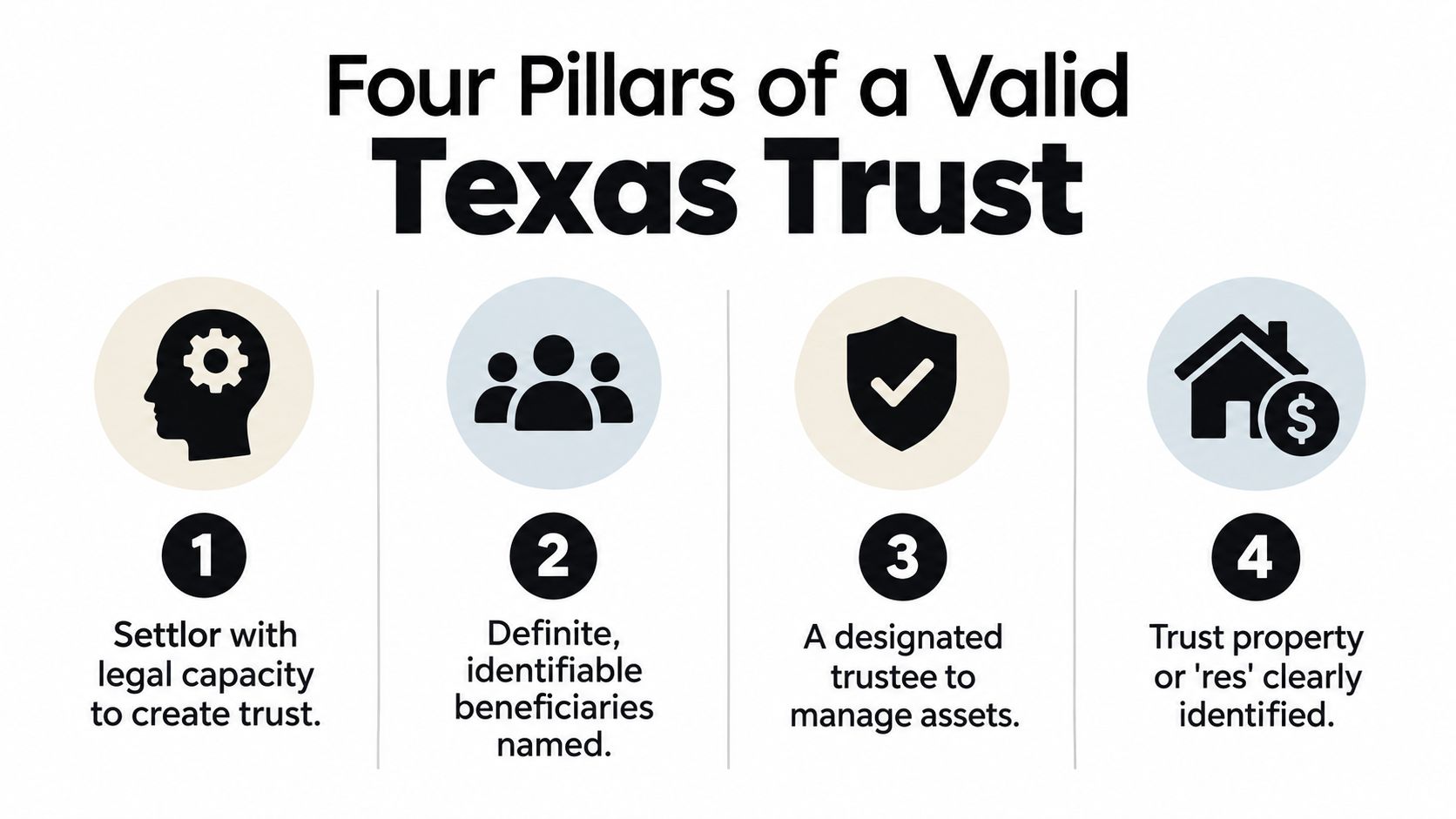
A Texas family may discover the problem when a bank rejects the trust, a deed was never completed, or the named trustee cannot identify property belonging to the arrangement. A document titled “trust” does not settle the question. The court must determine whether the settlor had legal capacity, intended to create a fiduciary relationship, identified beneficiaries, named a trustee, and placed property, called the res, under the trust. The purpose must also be lawful.
A useful comparison is a three-legged stool. Its legs are intent, funding, and formalities. A weak leg can make the trust unstable. If the trust has no property or lacks a required foundation, it may fail altogether. A defect in one clause, however, does not always destroy the entire plan.
Common points of failure
Intent and capacity are early questions. The settlor must knowingly create a fiduciary arrangement. An unsigned handwritten note may reveal wishes without creating an enforceable trust. A reference to “my future grandchildren” may also leave the beneficiary class too uncertain for the court to determine who qualifies.
Funding creates a separate risk. The trust document sets out the plan, while a deed, account registration, or assignment moves property into it. If the required deed was never executed, real estate may remain in the individual's name. A joint account can pass under its ownership terms, and an insurance policy can follow its beneficiary designation even when the family expected the trust to receive the proceeds.
These defects can produce different results. Total failure may leave an asset subject to another valid transfer method or Texas heirship rules. Partial failure may affect only one asset or provision. A court may preserve workable terms, correct language that fails to express the settlor's intent, or require property to be held for the proper recipient through a constructive trust. Those possibilities matter before anyone assumes the heirs receive everything.
A pour-over will may provide a route for property still owned individually, but it does not automatically cure an invalid trust. The will must be admitted to probate, and the intended transfer must still be legally workable.
For a plain-language discussion of how a revocable trust becomes irrevocable and is administered at death, see Administering a Revocable Living Trust After Death in Texas. Families dealing with real estate may also need to understand procedures involved in selling a home in probate.
How Texas Intestacy Decides Who Inherits Next
If no valid trust provision, will, or nonprobate transfer controls an asset, Texas intestacy law supplies the answer. Intestacy is the statutory system used when someone dies without a will, when a will doesn't dispose of all property, or when a will cannot be admitted to probate. In a trust-failure case, the relevant question is often who would have inherited under Texas intestacy law when the trust became irrevocable. Texas intestacy guidance from the State Law Library explains the basic heirship structure.
Consider a Hays County rancher who leaves a wife, two adult children from a first marriage, and a minor child from the second marriage. Assume there's no valid trust and no controlling will. The spouse and children don't necessarily receive every asset in the same way because Texas distinguishes community property from separate property.
For community property, the surviving spouse's rights can be substantial. Under the requested statutory example, the wife receives the community personal property, subject to the applicable intestacy rules, while the children's rights arise under the separate-property framework and other statutory provisions. Separate property can produce a different result, including the surviving spouse receiving one-third of the personal estate and a life estate in the homestead, with the children sharing the remaining interest as provided by law. The exact result requires classifying assets and reviewing the family tree under the Texas Estates Code.
The intestacy ladder
If there's no surviving spouse or descendants, Texas law moves to parents. If the parents aren't living, siblings may inherit, followed by more remote relatives. Representation rules matter. Per stirpes distribution allows a deceased child's descendants to take that child's share, while per capita at each generation divides property among qualifying heirs at the applicable generation under the statute.
| Heirs Surviving | Community Property Share | Separate Property Share |
|---|---|---|
| Surviving spouse and children of the decedent | Determined under Texas community-property intestacy rules and the ownership history | Spouse and children receive different statutory interests, including the spouse's one-third personal-property interest and homestead life estate described above |
| Surviving spouse, no children of the decedent | Spouse's share depends on whether the property is community or separate and on the family circumstances | Spouse may share separate real property with the decedent's parents or siblings under Texas law |
| No spouse or descendants | Parents, siblings, or more remote heirs may inherit under the statutory order | Parents, siblings, or more remote heirs may inherit under the statutory order |
For a broader explanation of the governing statute, families can review a compassionate guide to the Texas Estates Code. The important point is that intestacy is only the fallback. A court may still reform or preserve part of the plan before the statutory heirship rules control.
Community Property Separate Property and Nonprobate Transfers Compared
Property character often decides the outcome before anyone reaches the question of heirship. Community property generally includes property acquired during marriage that doesn't qualify as separate property, while separate property belongs to one spouse under the applicable ownership rules. A trust may fail, but that failure doesn't erase the property's character.
That distinction can change the surviving spouse's result. Community property and separate property follow different intestacy rules under the Texas Estates Code, including the statutory treatment described in Texas Estates Code Section 201.003. A surviving spouse may receive all or a substantial portion of community property in a particular family structure, while separate property may leave the spouse with only a statutory fraction and a homestead interest.
Nonprobate transfers create another path entirely. Life insurance, retirement accounts, payable-on-death accounts, transfer-on-death deeds, and properly structured joint ownership may pass according to a beneficiary designation or ownership agreement. Those assets may not be controlled by a defective trust or by intestacy.
A Houston household with mixed assets
Suppose a Houston couple owns a residence, a brokerage account, and an IRA. The residence is titled in the husband's name, the brokerage account is titled in the trust but the trust is later found defective, and the IRA names the wife as beneficiary.
The residence may require a property-character and title analysis. The brokerage account may fall into the estate or pass under another valid instrument, depending on the facts. The IRA generally follows its valid beneficiary designation rather than the failed pour-over trust. The family can't answer “who inherits?” until someone identifies how each asset was owned and transferred.
| Asset Type | Example | Heirs Under Intestacy | Why |
|---|---|---|---|
| Community property | Married couple's qualifying account | Depends on the surviving spouse and descendants | Texas community-property rules apply before a simple trust-failure conclusion |
| Separate real property | One spouse's separately owned land | Spouse, children, or other heirs under statutory rules | Separate-property intestacy differs from community-property intestacy |
| Trust-titled account | Brokerage account held by a defective trust | Estate heirs if no valid trust or alternate instrument controls | The court must determine whether the trust failed wholly or partially |
| Beneficiary-designated account | IRA naming a surviving spouse | Designated beneficiary | A valid nonprobate designation may operate outside the failed trust |
| Payable-on-death account | Bank account naming a child | Named beneficiary | The account contract may control instead of intestacy |
A careful review of nonprobate assets in Texas estate planning helps families avoid treating every asset as though it belongs to one probate estate. The surviving spouse, named beneficiary, trustee, executor, and heirs at law may each have rights over different property.
Legal Remedies That Can Save a Defective Trust
Texas courts don't always have to choose between enforcing every word of a trust and sending everything to intestate heirs. Several remedies can preserve the settlor's intent when the evidence and law support them.
Reformation can correct a drafting error, sometimes called a scrivener's error, when the written language doesn't reflect what the settlor intended. For example, a lawyer might have inserted the wrong beneficiary name even though the surrounding documents clearly identify the intended person. Reformation isn't a way to rewrite an inconvenient plan. It requires proof and careful judicial review.
Modification addresses a different problem. Texas law allows a trustee or beneficiary to ask a court to modify or terminate a trust when its purposes have been fulfilled, become illegal, or become impossible to fulfill. Changed circumstances may also justify modification when the requested order better carries out the settlor's intent. Administrative terms may be adjusted to prevent waste, avoid impairing administration, or achieve tax objectives without defeating the plan. Texas Property Code Section 112.054 describes these court-based options.
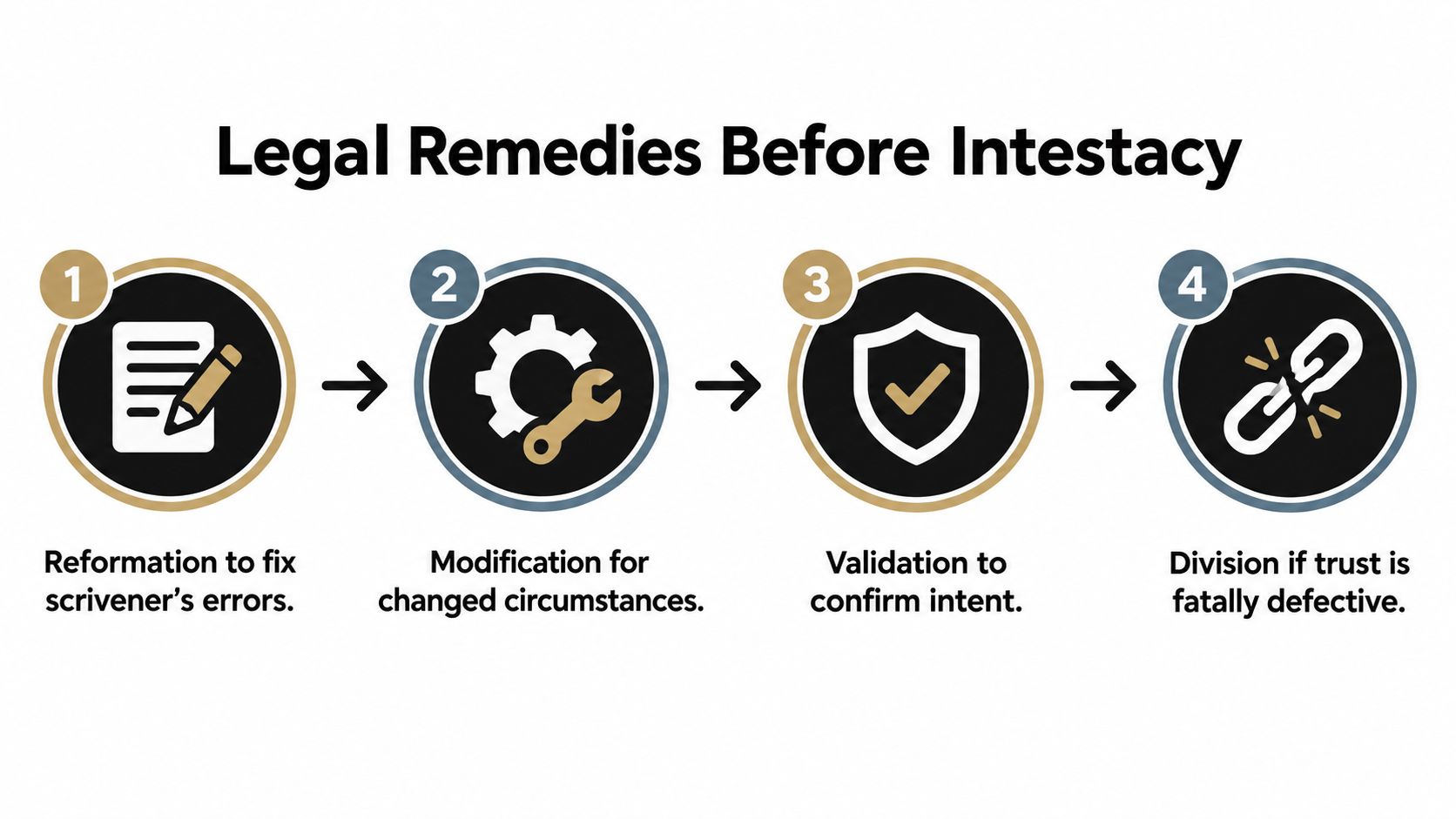
Equitable solutions
A constructive trust is an equitable remedy that can prevent unjust enrichment. If a person received property because of a promise connected to the estate plan, then later tries to keep it contrary to that promise, a court may consider imposing a constructive trust over the property. The remedy depends on the evidence and circumstances.
The cy pres doctrine may help when a charitable purpose can't be carried out exactly as written but a similar lawful purpose remains possible. A savings clause may also preserve testamentary intent by directing courts to interpret or sever provisions in a way that keeps the remaining plan effective.
Estoppel or promissory estoppel can sometimes matter when someone relied on a promise and changing position would be unfair. These doctrines are fact-specific and don't automatically bind heirs. A trustee who drained accounts before learning the trust was defective may face separate fiduciary issues, including the duty to act in good faith and follow the trust and Texas Trust Code. Families considering litigation can learn about the process through how to contest a trust.
Practical Next Steps for Trustees Beneficiaries and Heirs
A family should slow down before distributing anything. The trustee's first responsibility is preservation, not choosing winners. Texas fiduciary principles require a trustee to administer the trust in good faith according to its terms and the Texas Trust Code. Unless the governing documents change the rule, the trustee must also follow common-law duties and act impartially among beneficiaries.
A practical response plan
Secure the original trust document. Preserve every signed version, amendment, schedule, certification, and related correspondence. Don't mark, staple, or alter the originals.
Obtain certified death certificates. These may be needed for financial institutions, insurance companies, probate filings, and trustee notices.
Collect title and account records. Pull deeds, vehicle titles, bank statements, brokerage records, retirement-account beneficiary forms, insurance policies, and business documents.
Separate assets by transfer method. Create distinct categories for trust property, probate property, community property, separate property, and nonprobate assets. This prevents a defective trust from being treated as the answer for everything.
Notify qualified beneficiaries and prepare an accounting. Beneficiaries may have rights to information and written accountings during administration. The trustee should document receipts, expenses, distributions, and communications.
Pause disputed distributions. A trustee who distributes property before validity is resolved may create personal exposure and deepen family conflict.
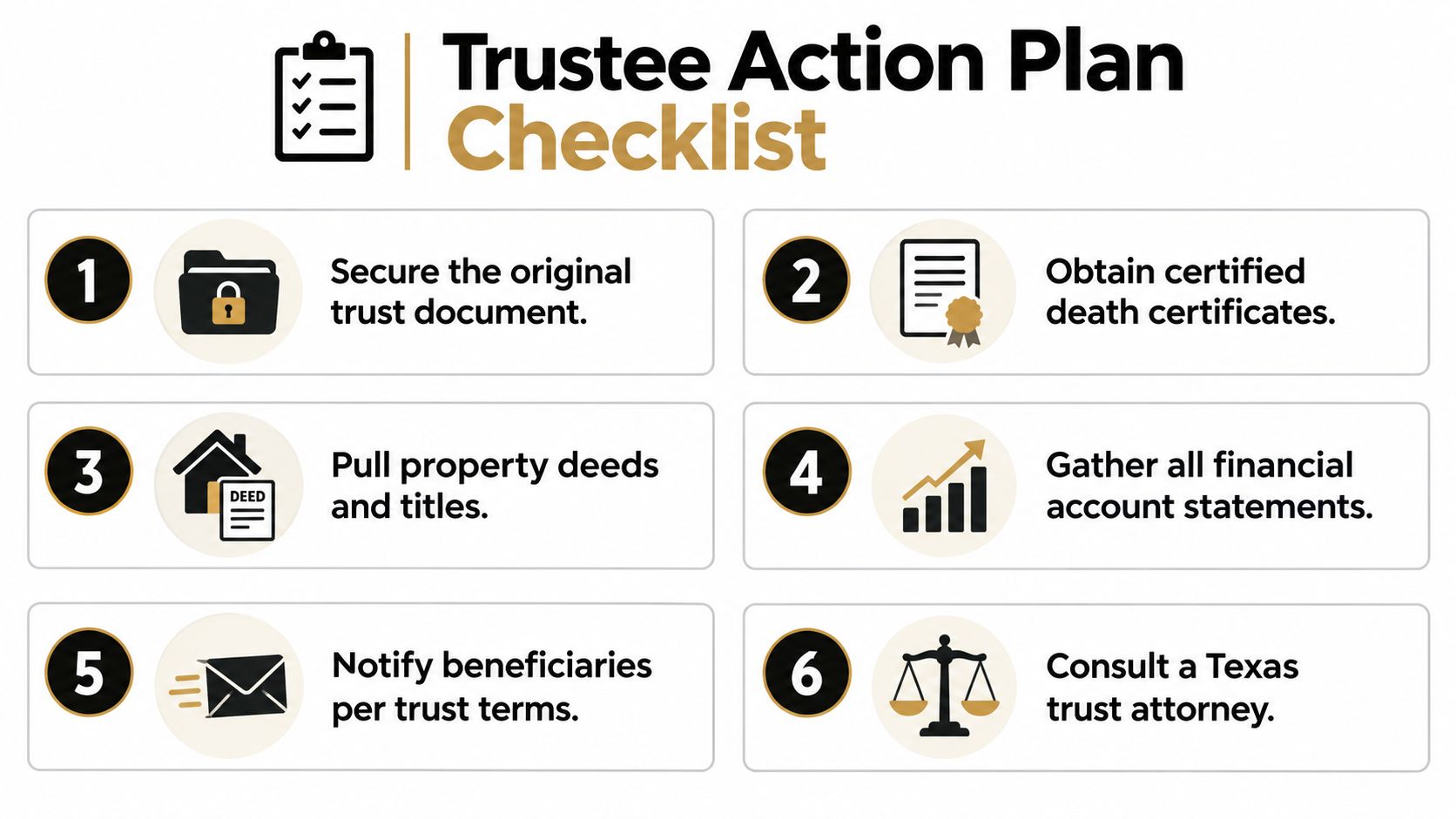
When court involvement becomes necessary
A trustee, beneficiary, or heir may need a declaratory judgment action asking the court to determine whether the trust is valid, which provisions remain effective, and who has authority to act. A temporary restraining order may be appropriate if someone threatens to sell, transfer, conceal, or drain disputed property.
Testamentary trusts create additional questions. Texas Estates Code provisions can treat people entitled to take property outright from a trust as distributees for administration purposes, even when the trust was created through a will. That issue may affect who can open probate, seek independent administration, or act before final distribution.
The Trust Code also contains a two-year non-claim period affecting creditor claims, so families shouldn't delay reviewing debts and notices. A Texas trust administration lawyer should be contacted promptly when the original document is missing, signatures are questioned, property is being sold, beneficiaries disagree, or a trustee has a conflict.
Finding Your Path Through Trust Problems in Texas
Trust failure is better understood as a branching path than as one automatic destination. Start by asking whether the defect affects the entire trust or only a provision, asset, or transfer. Then identify the legal character and transfer method for each asset before deciding that intestacy applies.
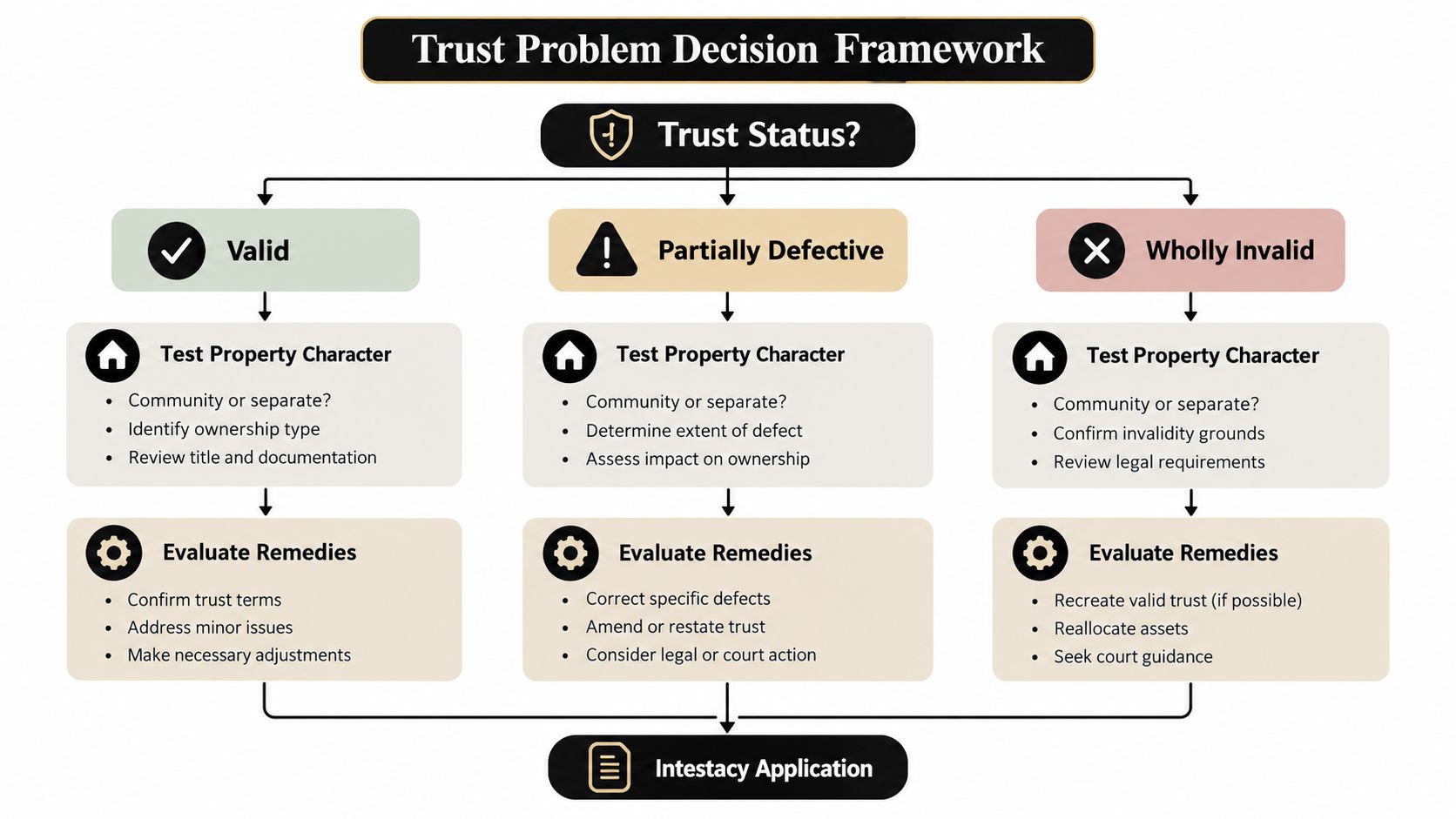
The decision points that matter
First, test the trust itself. Look for capacity, intent, identifiable beneficiaries, a trustee, lawful purpose, and trust property. A missing signature or defective execution may require a different analysis from a completely absent trust.
Next, test each asset. Ask whether the property was transferred into the trust. Review whether it was community or separate property. Confirm whether a beneficiary designation, payable-on-death instruction, joint ownership arrangement, or transfer-on-death deed controls outside probate.
Then, evaluate remedies. Reformation, modification, validation, severance, cy pres, constructive trust, or another equitable theory may preserve some or all of the intended plan. Texas law gives the settlor power to direct the result of trust failure in the instrument, and the court may need to interpret that language before applying intestacy.
Finally, identify the proper decision-maker. A trustee may administer valid trust property. An executor may handle probate assets. Heirs may have statutory interests, while beneficiaries may have information, accounting, or litigation rights. Testamentary trust beneficiaries may also have administration-related rights under the Estates Code.
Tax planning should be part of the review, not an afterthought. Asset classification, beneficiary designations, fiduciary accountings, and tax elections can affect the choices available to the family. A Texas estate planning attorney can coordinate the trust, will, ownership records, and tax strategy, while a trust litigation attorney can address contested validity or threatened transfers.
If you're managing a trust or planning your estate, contact The Law Office of Bryan Fagan, PLLC for a free consultation. The firm can review trust validity, asset funding, fiduciary duties, beneficiary rights, probate options, and potential remedies, then guide your family through the next step. Visit Law Office of Bryan Fagan, PLLC to request Texas trust and estate guidance before property is distributed or claims are released.