 Skip to content
Texas has no fixed trustee fee. Under Texas Property Code Section 114.061, compensation must be reasonable, so the total trust administration cost depends on the fee structure, asset complexity, and reimbursable expenses rather than one flat price.
Managing a loved one's trust can feel overwhelming, especially when you're grieving and suddenly responsible for bank accounts, real estate, tax filings, and beneficiary questions. A successor trustee may open the trust expecting a straightforward handoff, only to discover that a home needs to be maintained, an investment account needs review, or a family member wants a detailed accounting.
Consider a trustee who inherits responsibility for a trust holding a Texas residence and a brokerage account. The initial work may involve reviewing the trust, confirming ownership, securing the property, communicating with beneficiaries, and preparing for distribution. Those tasks create a different budget from a trust that owns rental property, business interests, or assets requiring professional valuation.
The most useful way to understand trust administration cost Texas families face is to separate expenses into three groups:
- Initial funding and transfer costs, such as deeds, title work, recording, and account retitling.
- Recurring administration costs, such as trustee compensation, accounting, tax preparation, insurance, and property management.
- Event-driven costs, such as appraisals, legal disputes, court proceedings, or complex tax work.
Texas law focuses on reasonableness, documentation, and fiduciary conduct. A Texas trust administration lawyer can help a trustee understand what the trust document permits, while a Texas estate planning attorney can help families coordinate trust administration with broader estate, tax, and asset-protection goals.
The Law Office of Bryan Fagan, PLLC approaches these issues in plain English, with attention to both the trustee carrying the legal responsibility and the beneficiaries who need transparency. The sections below explain the legal foundation, compare fee structures, identify commonly overlooked expenses, and show how families can budget without cutting corners.
Managing a Loved One's Trust Without Cost Surprises
A trustee often starts with a simple question: “What am I allowed to charge, and what will this trust cost?” The answer depends first on the trust agreement, then on the work required, the nature of the assets, and the legal rules governing fiduciary administration.
Suppose Maria becomes successor trustee after her father dies. The trust owns his home, a checking account, and investments. Maria isn't sure whether she should pay herself, hire a lawyer, or reimburse herself for travel and property expenses. Her brother, a beneficiary, wants records before any distribution occurs. None of these questions is unusual. Each can affect the final administration budget.
A careful trustee shouldn't treat every payment from the trust as a “fee.” Trustee compensation pays for the trustee's service. Reimbursement covers proper expenses advanced for the trust. Attorney, accounting, appraisal, insurance, maintenance, and recording charges are separate line items that may arise because of the assets or the work involved.
Start with the trust document
The trust agreement may establish a method for compensation, identify a corporate trustee, require consent before certain payments, or provide instructions about accounting and distributions. If the document is silent, Texas law supplies a reasonableness standard rather than a universal commission.
That distinction matters because a simple trust may require limited administration, while a trust with rental property or closely held business interests can demand regular management. A percentage that sounds modest may still produce a substantial bill when the trustee must coordinate tax compliance, beneficiary reporting, property repairs, and legal review.
Separate predictable and unexpected work
A useful budget identifies what you know now and what might happen later. Initial transfer work is usually different from annual administration, and neither category is the same as dispute-related work.
Practical rule: Before paying or approving an invoice, identify the service, the person who performed it, the trust authority for the payment, and whether the charge is compensation or reimbursement.
Families benefit from discussing expectations early. A trustee who keeps receipts, time records, account statements, and written explanations gives beneficiaries a clearer picture of how trust funds are being used. Early legal guidance can also prevent a misunderstanding from becoming a formal challenge.
The goal isn't to make administration free. The goal is to make the cost understandable, authorized, and connected to the trust's interests.
How Texas Law Shapes Trust Administration Costs
Texas trustees manage property for someone else's benefit. That role resembles a steward caring for a valuable collection. The steward may be paid for the work and may recover proper expenses, but cannot treat the collection as personal property or charge whatever amount seems convenient.
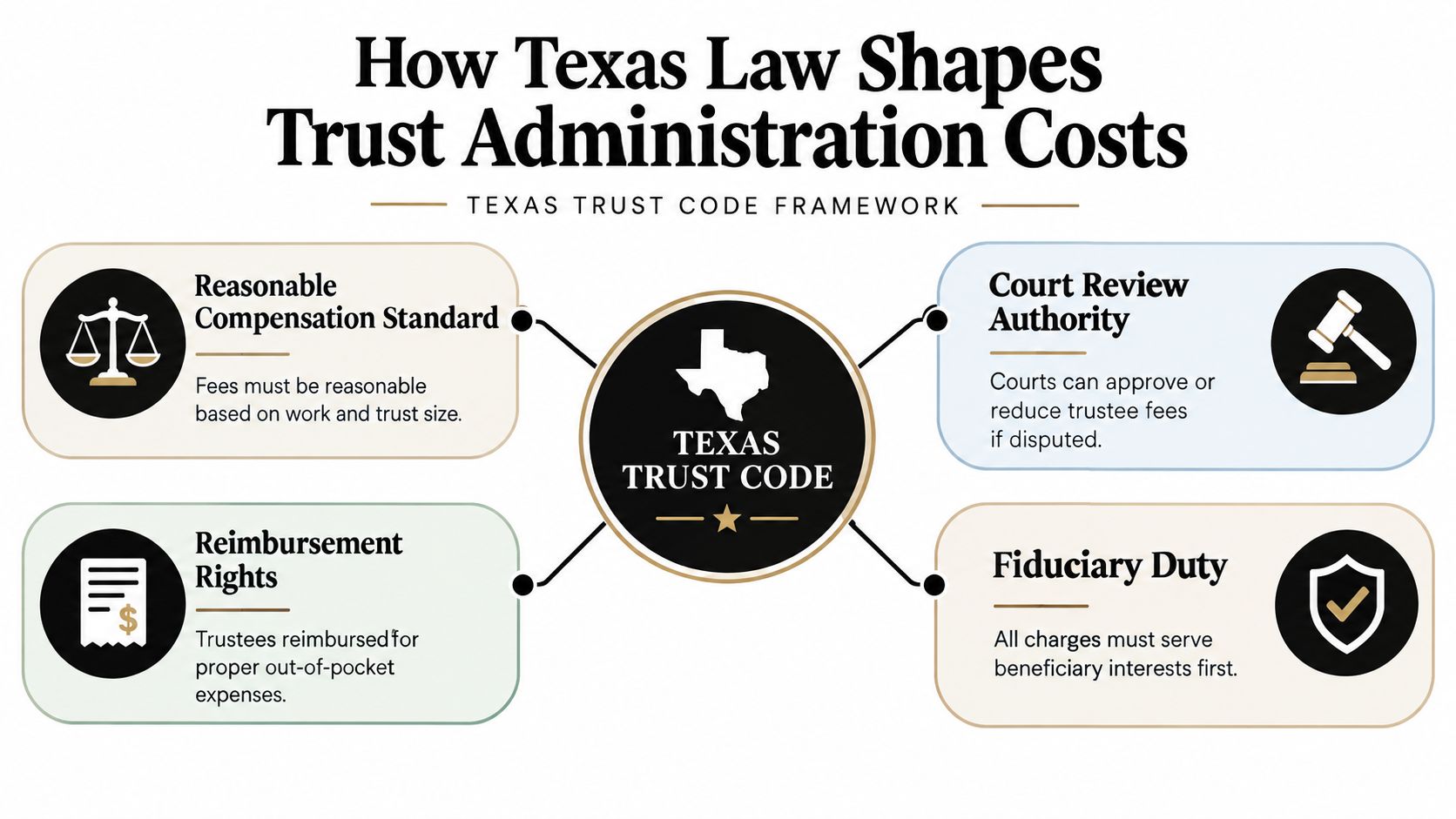
Texas Property Code Section 114.061 provides the starting point. A trustee is entitled to reasonable compensation from the trust unless the trust instrument says otherwise, as stated in the Texas statutory rule on trustee compensation. The statute doesn't establish one flat fee for every trust. The trust language, asset size, complexity, time involved, and quality of administration all matter.
Four legal questions guide the analysis
First, what does the trust document say? A clear compensation clause may control the method, subject to applicable fiduciary principles and court authority. A silent or vague document leaves more room for a fact-specific reasonableness review.
Second, was the work appropriate? Texas fiduciary duties require loyalty, prudence, and impartiality. The trustee should act for the beneficiaries' interests, follow the trust terms, avoid self-dealing, and make decisions with appropriate care. A plain-language overview of The Fiduciary Duties of a Texas Trustee identifies the core duties of loyalty, prudence, and impartiality under the Trust Code.
Third, can the charge be reviewed? Texas Property Code Section 115.001 gives Texas courts authority over trust matters, including disputes involving trustee administration and compensation. A beneficiary or trustee may seek court involvement when the parties cannot resolve a fee question through records and communication.
Fourth, is this compensation or reimbursement? Section 114.063 permits reimbursement from trust principal, income, or both for proper advances and expenses connected with administering or protecting trust property. The statute also provides a lien against trust property to secure reimbursement, as described in the Texas reimbursement provision for trustees.
Why records protect everyone
A trustee should maintain a separate administration file containing the trust agreement, asset inventory, statements, invoices, receipts, correspondence, tax records, and distribution history. Time entries should describe the task rather than only stating “trust work.” Beneficiaries should receive information in a form they can understand.
Texas law also addresses how certain expenses are allocated between income and principal. Under Property Code Section 116.201, one-half of regular trustee compensation is allocated to income by default, while certain expenses involving both income and remainder interests are also allocated partly to income unless a different fiduciary-consistent allocation is chosen. The Texas allocation rule can affect which beneficiaries economically bear the cost.
A reasonable fee isn't determined by a label alone. It should reflect authorized work, proper judgment, and reliable documentation.
Trustee and Professional Fee Structures You Will Encounter
Texas trust administration proposals can look very different even when lawyers, banks, or fiduciaries describe similar services. One provider may bill hourly, another may quote a flat fee, and a corporate trustee may use a tiered schedule based on trust assets. Comparing only the headline price can hide important exclusions.
The Texas trustee compensation resource can help readers examine how compensation questions arise in practice. The first task is to identify the billing model and then ask what services are included.
Compare the main approaches
| Fee Structure | How It Works | Best For | Watch Out For |
|---|---|---|---|
| Hourly billing | Charges are based on time spent by the trustee, attorney, accountant, or other professional. | Uncertain matters, disputes, or limited legal projects. | The final amount can rise as questions, revisions, or complications increase. |
| Flat fee | A defined scope is handled for an agreed amount. | Predictable work, such as a specific transfer, accounting review, or administration phase. | Confirm what happens if assets, beneficiaries, or legal issues fall outside the scope. |
| Percentage of trust assets | Compensation is calculated by reference to trust value. | Ongoing management where the trustee provides continuing oversight. | A low percentage may still create a significant charge, and separate professional expenses may apply. |
| Statutory or tiered schedule | A schedule sets compensation by asset levels or service categories, sometimes with minimums. | Corporate trustee relationships and continuing fiduciary management. | Minimum fees and separate legal, tax, or accounting charges can materially affect the total. |
A family trustee may receive reasonable compensation under the trust document or Texas law and may seek reimbursement for proper expenses. That arrangement differs from a corporate trustee, which may have an established schedule, administrative minimums, and additional charges for services performed by affiliated or outside professionals.
Use the trust's needs as the decision matrix
A family trustee may be practical when the trust holds straightforward assets and family communication is strong. A professional trustee may be more suitable when beneficiaries live far apart, the trust lasts for a long period, the trustee must make discretionary decisions, or conflict already exists.
A corporate arrangement can also create a clearer administrative process, but it doesn't automatically mean a lower all-in cost. Legal review, accounting, tax preparation, investment management, and property services may be billed separately.
Ask every proposed trustee or attorney:
- What is included? Confirm whether accountings, beneficiary communications, tax coordination, asset transfers, and distribution work are part of the quoted service.
- What is separate? Identify charges for attorneys, CPAs, appraisers, investment managers, property managers, and litigation counsel.
- What triggers a new charge? Ask how disputes, unusual assets, additional beneficiaries, and trust modifications will be handled.
- How are expenses allocated? Confirm whether the trust pays from income, principal, or both, and whether the agreement explains the method.
The right structure is the one that fits the trust's work, not merely the one with the smallest stated rate.
What Drives Your Total Bill From Legal Fees to Valuations
Trust administration costs usually grow from the number of tasks, not from one isolated professional invoice. A trust holding only financial accounts may need organization and distribution work. A trust holding real estate, rental income, or business interests requires more coordination and more records.
Recent Texas-facing guidance identifies broad setup ranges from about $1,500 to $5,000 or more, while also warning that recording, notarization, title transfer, annual accounting, and tax-preparation expenses may sit outside the first quoted legal fee, as discussed in this Texas trust cost overview. That range concerns setup guidance, not a universal cost for every administration.

The main line items
Attorney fees may cover trust interpretation, notices, asset transfers, beneficiary communication, accountings, tax coordination, or distribution documents. Straightforward questions may require limited involvement. Ambiguous language, competing beneficiary interests, or potential fiduciary claims can require substantially more legal work.
Accounting and tax preparation become relevant when the trust earns income, owns rental property, sells assets, or needs fiduciary tax filings. Texas-oriented trustee guidance notes that tax return preparation alone may add $500 to $2,000 or more annually, depending on the work required, as described in this Texas trustee expense guide.
Appraisals and valuations help establish a defensible value for real estate, business interests, valuable personal property, or assets involved in a distribution. The need for a professional opinion often depends on the asset, the trust terms, tax questions, and whether beneficiaries agree about value. The guide on how to value trust assets after death addresses why reliable valuation matters.
Property expenses can include insurance, maintenance, repairs, taxes, utilities, and management. A vacant home creates different work from a leased property with tenants, rent collection, and ongoing repairs.
Funding and transfer expenses may include deed preparation, notarization, county recording, title work, and account retitling. These are often one-time costs, but correcting an incomplete transfer can require additional legal review.
For a real estate transfer, a calculator such as estimate closing costs with APIs may help organize transaction-related questions, but it isn't a substitute for Texas legal advice about trust ownership, title, or fiduciary authority.
Court and dispute costs
A court proceeding may become necessary when beneficiaries challenge a trustee's conduct, the trust language is unclear, or the trustee needs judicial instructions. Court costs, attorney fees, appraisals, discovery, and expert work can then become event-driven expenses rather than predictable annual charges.
A trustee should disclose the anticipated scope before work begins and provide invoices that separate compensation, reimbursement, and third-party charges. That separation helps beneficiaries understand what the trust paid for and gives the trustee evidence supporting each decision.
Real World Cost Scenarios for Texas Families
The same Texas legal standard can produce very different budgets because trusts hold different assets and require different levels of attention. The following examples use qualitative cost comparisons rather than pretending that one price fits every family.
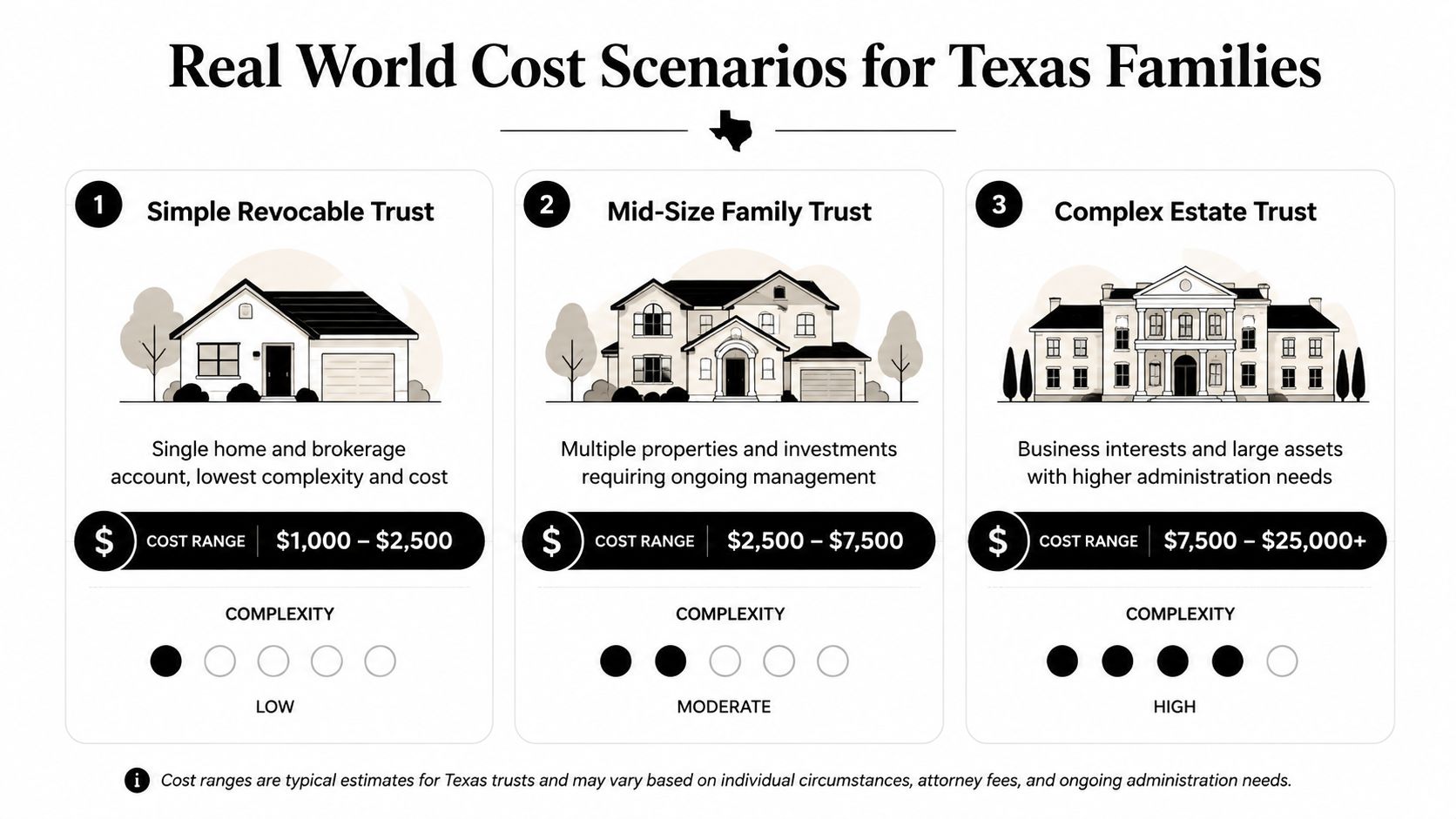
A simple trust with a home and investments
A revocable trust holding one Texas residence and a brokerage account may require document review, confirmation of ownership, beneficiary communication, account statements, property protection, and final distribution. Initial costs may center on title and transfer work. Recurring expenses may remain limited if the home is maintained without major issues and the investments don't require complex management.
The trustee still needs records. A simple asset profile doesn't eliminate fiduciary duties, and the trustee should avoid distributing property before confirming debts, expenses, and the trust's instructions.
A family trust with rental property
A trust owning rental property introduces continuing work. Someone must monitor leases, receive rent, pay property expenses, maintain insurance, coordinate repairs, and preserve records. The trust may also need accounting and tax-preparation support because income and expenses must be tracked accurately.
A percentage-based trustee fee can become only one part of the budget. A trustee may charge reasonable compensation, while the trust separately pays property management, tax preparation, legal review, and valuation expenses when needed.
A complex trust with business interests and conflict
A trust holding an ownership interest in a private business may require review of governing documents, valuation work, financial statements, and coordination with company managers. If beneficiaries disagree about a sale, distribution, or trustee decision, the trust may incur legal and expert costs connected with resolving the dispute.
The all-in expense can rise even if the trustee's stated rate appears modest. Frequent reporting, multiple professional advisers, contested decisions, and litigation support consume administrative time.
A useful budget asks not only, “What is the trustee's fee?” It also asks, “What must this trust do every month, every tax season, and whenever a beneficiary disagrees?”
For each scenario, divide the estimate into initial transfers, recurring administration, and event-driven work. That format gives trustees and beneficiaries a clearer basis for approving expenses and comparing proposals.
How to Control Costs and Choose the Right Help in Texas
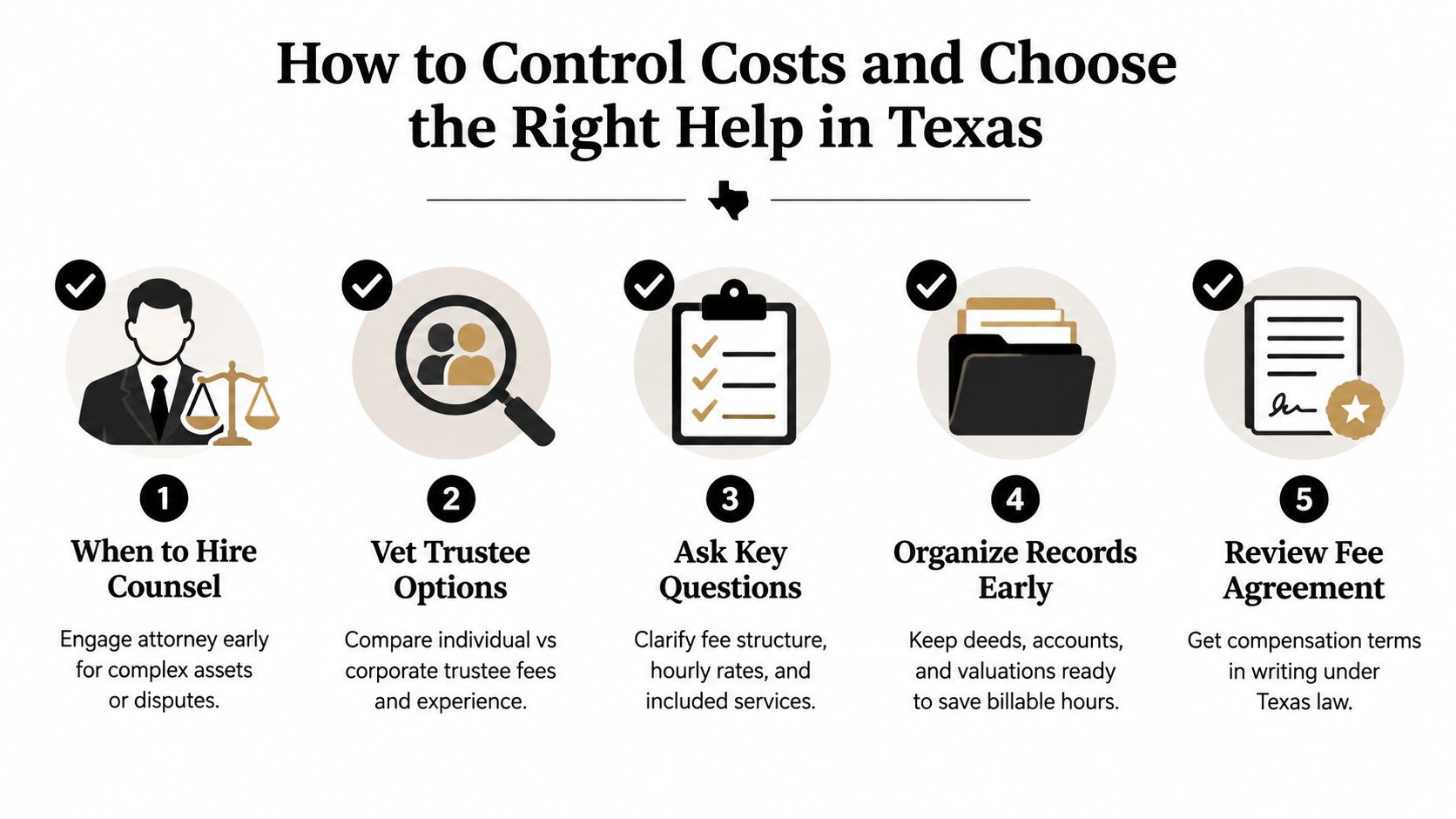
Cost control starts before the first invoice. A trustee can reduce avoidable work by organizing records, defining responsibilities, and getting compensation terms in writing. Saving money doesn't mean skipping necessary legal or tax advice. It means directing professional time toward decisions that require professional judgment.
Use a practical hiring checklist
Hire counsel early for complexity. Contact a Texas trust administration lawyer when the trust owns business interests, rental property, unusual assets, or when beneficiaries disagree. Early review can identify authority and ownership problems before a distribution creates a larger dispute. The guide on when to hire a trust administration attorney in Texas can help a trustee recognize common decision points.
Compare family and professional trustees. Ask whether a relative has the time, neutrality, financial organization, and willingness to provide records. Compare that option with a professional or corporate trustee's schedule, minimums, and separate service charges.
Request a written scope. The agreement should identify the billing model, rates, included services, third-party expenses, communication process, and treatment of unusual work. If administrative support is needed for document organization, families may also research virtual legal assistants companies, while ensuring that legal advice remains with a qualified attorney.
Organize the asset file. Gather deeds, account statements, insurance policies, leases, business records, tax documents, receipts, and prior accountings. A complete file can reduce duplicated requests and unnecessary billable research.
Review every invoice. Look for a description of the task, the person performing it, the trust authority, and whether the payment is compensation or reimbursement. Ask questions promptly rather than allowing uncertainty to build.
Watch modifications and reimbursements
Texas Property Code Section 112.087 limits how compensation terms may be changed when an authorized trustee uses trust modification powers. A trustee may not use those powers solely to change compensation terms. If one trust is divided into another, compensation arrangements may continue in the manner addressed by the statute, but the trustee may not receive a commission or other compensation for distributing a particular asset from the first trust to the second trust, as explained in the Texas trust modification compensation rule.
A trustee should also understand reimbursement rights before advancing personal funds. Proper expenses may be reimbursable, but records should show the amount, purpose, date, and connection to trust administration. Beneficiaries should receive enough detail to evaluate the charge without exposing unnecessary private information.
Take the Next Step With Trusted Texas Guidance
Texas trust administration costs are not governed by one universal trustee percentage. The controlling idea is reasonable compensation, shaped by the trust document, the trustee's work, the assets involved, fiduciary duties, and the expenses required to protect and administer trust property.
A useful budget separates one-time funding from recurring administration and event-driven work. It also compares family and professional trustee arrangements based on the trust's complexity, reporting needs, neutrality concerns, and likely need for legal, accounting, valuation, or property-management support.
Trustees can protect themselves by keeping detailed records and communicating clearly. Beneficiaries can protect their interests by asking focused questions and requesting understandable accountings. Families planning ahead can work with a Texas estate planning attorney on trust funding, beneficiary designations, asset protection, and the question of how to modify a trust in Texas.
For broader planning, families may also review estate planning services, probate services, guardianship services, and asset protection services. Early advice can clarify authority, reduce preventable delays, and give everyone a more reliable path forward.
If you're managing a trust or planning your estate, Law Office of Bryan Fagan, PLLC offers Texas guidance on trustee compensation, fiduciary accounting, tax coordination, beneficiary communication, asset distribution, and trust disputes. Schedule a free consultation to discuss your trust administration cost questions and move forward with clarity, confidence, and compassion.


