Managing a loved one's trust can feel overwhelming. You may be a sibling who was named successor trustee after a parent's death, holding a trust document, a house, several accounts, and a family expecting quick distributions. The natural assumption is that you only need to collect the assets and hand them over.
That assumption can create serious problems in Texas. A trustee must follow the trust terms, the Texas Trust Code, and common-law fiduciary duties. The question isn't, “Do you need a lawyer for trust administration in Texas?” It's whether the trust has reached a point where acting without counsel exposes you or the beneficiaries to avoidable risk.
When Texas Trusts Stop Being Simple
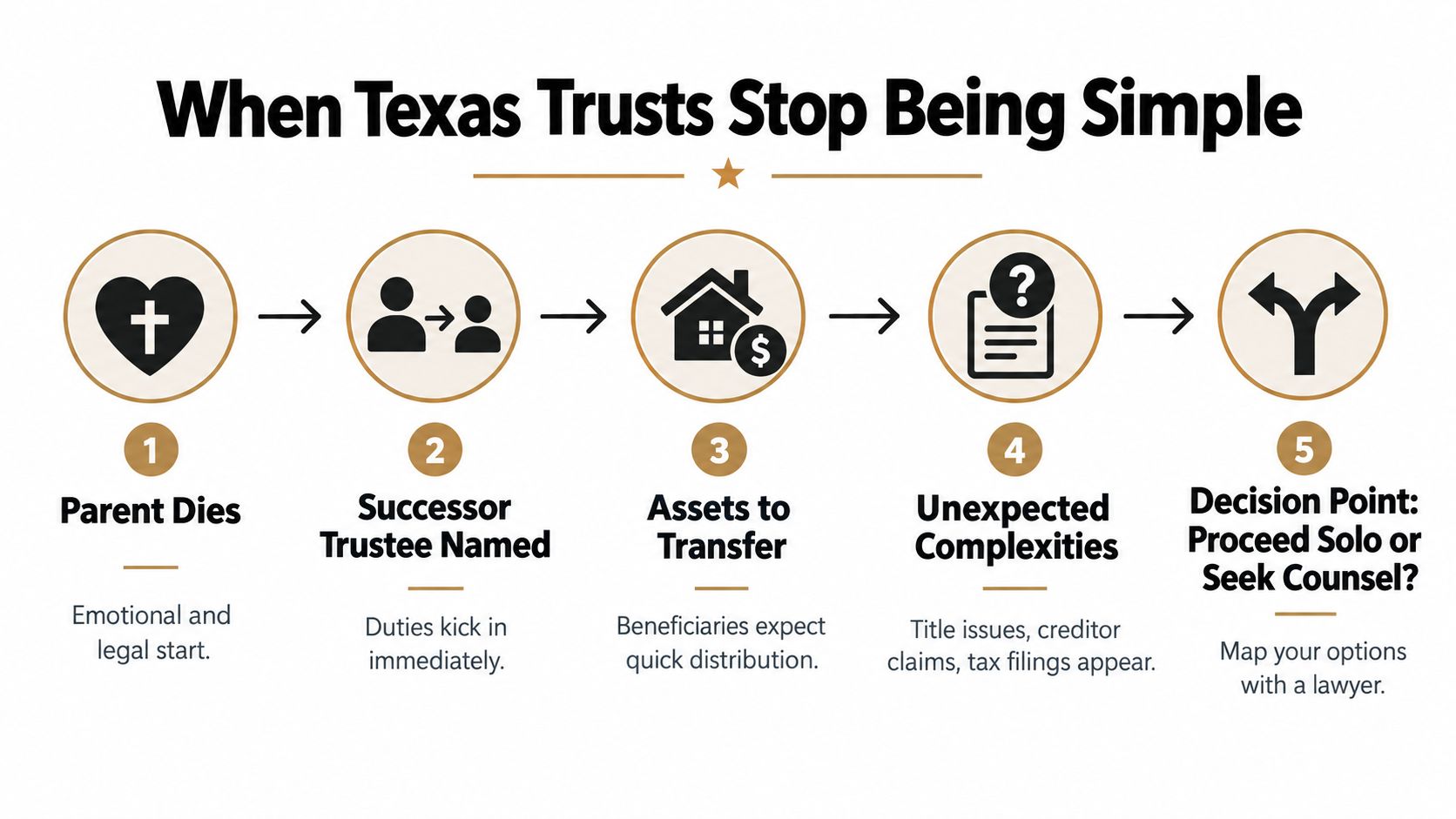
A sibling trustee often starts with good intentions. The parent has died, the successor trustee is named, and the beneficiaries want the house sold and the money divided. Then the trustee discovers that the home's title is unclear, one beneficiary challenges the distribution, an account wasn't properly transferred into the trust, or a business interest requires valuation.
That's the point where trust administration stops being a paperwork chore. Under Texas Property Code Section 113.051, the trustee must administer the trust in good faith, follow the trust's terms and the Texas Trust Code, and comply with common-law duties when the document doesn't answer a question. Texas law also permits a trustee to hire attorneys, accountants, agents, and brokers when reasonably necessary for administration.
The decision is practical:
- Start with the documents. Locate the trust, amendments, pour-over will, deeds, account statements, and beneficiary information.
- Identify the assets. Separate property held by the trust from property that may require probate or another transfer process.
- Look for conflict. A blended family, unequal distributions, a minor beneficiary, or a beneficiary with an incapacity issue raises the risk immediately.
- Check reporting duties. Notices, demands for information, and accounting requests create obligations that shouldn't be handled casually.
- Pause before distributing. Once property leaves the trust, recovering it can be difficult and expensive.
Practical rule: If beneficiaries disagree, the trust language is unclear, or you can't reconstruct the trust's financial history, speak with a Texas trust administration lawyer before making distributions.
A very small, fully documented, undisputed trust may proceed without ongoing legal representation. But the trustee should still understand the governing instrument and preserve complete records. Texas law doesn't treat family goodwill as a substitute for fiduciary compliance.
The important question is not whether a lawyer is required in every administration. It's whether a lawyer becomes the least expensive way to prevent a missed duty, a flawed accounting, or a personal claim against the trustee.
What Trust Administration Means in Texas
Trust administration is the active process of managing trust property after the settlor dies or becomes incapacitated. The trustee identifies and protects assets, pays appropriate debts and expenses, handles tax matters, communicates with beneficiaries, and distributes property according to the trust.
The primary rules appear in Chapters 111 through 117 of the Texas Property Code, known collectively as the Texas Trust Code. A testamentary trust may also involve the Texas Estates Code, especially when the trust is connected to a will or probate proceeding. The governing document matters, but it doesn't operate alone. Texas law supplies mandatory and default rules that can affect what a trustee may do.
Trust administration differs from probate:
- Probate uses a court process to validate a will, address debts, and transfer probate property.
- Trust administration is generally handled by the trustee under the trust document and applicable statutes.
- A funded revocable living trust may avoid probate for property properly transferred into it, but administration still requires careful legal and financial work after death.
A trustee who treats the process like a bank transfer can overlook beneficiary notices, asset-title problems, tax filings, and accounting obligations. The basic work usually includes:
- Locate and review the trust and related estate documents.
- Inventory property, debts, accounts, real estate, and business interests.
- Notify beneficiaries as required.
- Secure trust property and maintain appropriate insurance.
- Resolve legitimate debts, expenses, and tax matters.
- Manage investments prudently during administration.
- Keep separate records and preserve supporting documents.
- Prepare the final accounting and distribute property under the trust terms.
For a practical explanation of Administering a Revocable Living Trust After Death in Texas, the central issue is how a revocable trust becomes irrevocable and is administered at death. That change affects the trustee's responsibilities and the beneficiaries' rights.
The trustee may work with a CPA, financial institution, appraiser, real estate professional, or Texas estate planning attorney, depending on the assets and issues involved. The trustee remains responsible for decisions, however. Delegating a task doesn't eliminate the duty to supervise the administration carefully.
Trustee Duties Under the Texas Trust Code
Trustee duties are the reason legal guidance matters. The trustee isn't merely a person with signing authority. The trustee controls property for other people and can face personal exposure when the administration violates the trust or Texas law.
Loyalty and conflict avoidance
The duty of loyalty requires the trustee to act for the beneficiaries, not for personal advantage. A trustee shouldn't buy trust real estate at a below-market price, use trust funds to pay personal expenses, or favor a business in which the trustee has an undisclosed interest.
The trustee should identify conflicts before taking action. If the trustee wants to purchase trust property, approve compensation, or enter a transaction involving a related party, independent legal review is prudent.
Prudence and protection of assets
A trustee must manage trust property carefully. Speculative investments, commingling trust funds with personal money, failing to insure real property, or ignoring a deteriorating asset can create direct exposure.
Separate accounts and reliable records are basic safeguards. A trustee should be able to explain why an investment, sale, expense, or distribution served the trust's purposes.
Impartiality among beneficiaries
The trustee must treat beneficiaries fairly unless the trust clearly authorizes a different approach. That doesn't always mean equal treatment. It means the trustee must respect the interests created by the trust.
For example, spending the trust's only income-producing asset to provide immediate cash to one current beneficiary may damage a young beneficiary's remainder interest. The trustee must consider both interests instead of responding to whichever family member is most demanding.
Information and accounting
Beneficiaries may have rights to information and accountings. Under Texas Property Code Section 113.151, a beneficiary can make a written demand for an accounting, and the trustee generally has 90 days to provide the statement after a valid demand. The trustee generally doesn't have to account more often than once every 12 months unless a court orders otherwise, and the accounting must separately show principal and income receipts.
The accounting should be understandable, complete, and supported by records. A trustee who cannot explain transactions may look careless even when the original decisions were reasonable.
Enforcement and defense
A trustee may need to pursue money owed to the trust, defend trust property, respond to beneficiary claims, or address a contested interpretation. Texas courts can order remedies that affect the trustee personally, including repayment of losses, removal, or other relief.
A useful working resource on Texas Trust Code trustee duties can help identify the obligations that apply before a trustee acts.
The fiduciary standard is demanding because the trustee controls property that belongs beneficially to others. That's why contested, high-value, or poorly documented administrations shouldn't be handled by guesswork.
Situations Where a Lawyer Becomes Essential
A lawyer becomes essential when the trustee must interpret rights, choose between legally significant options, or defend a decision that could later be challenged. The trigger is complexity, not a particular account balance.
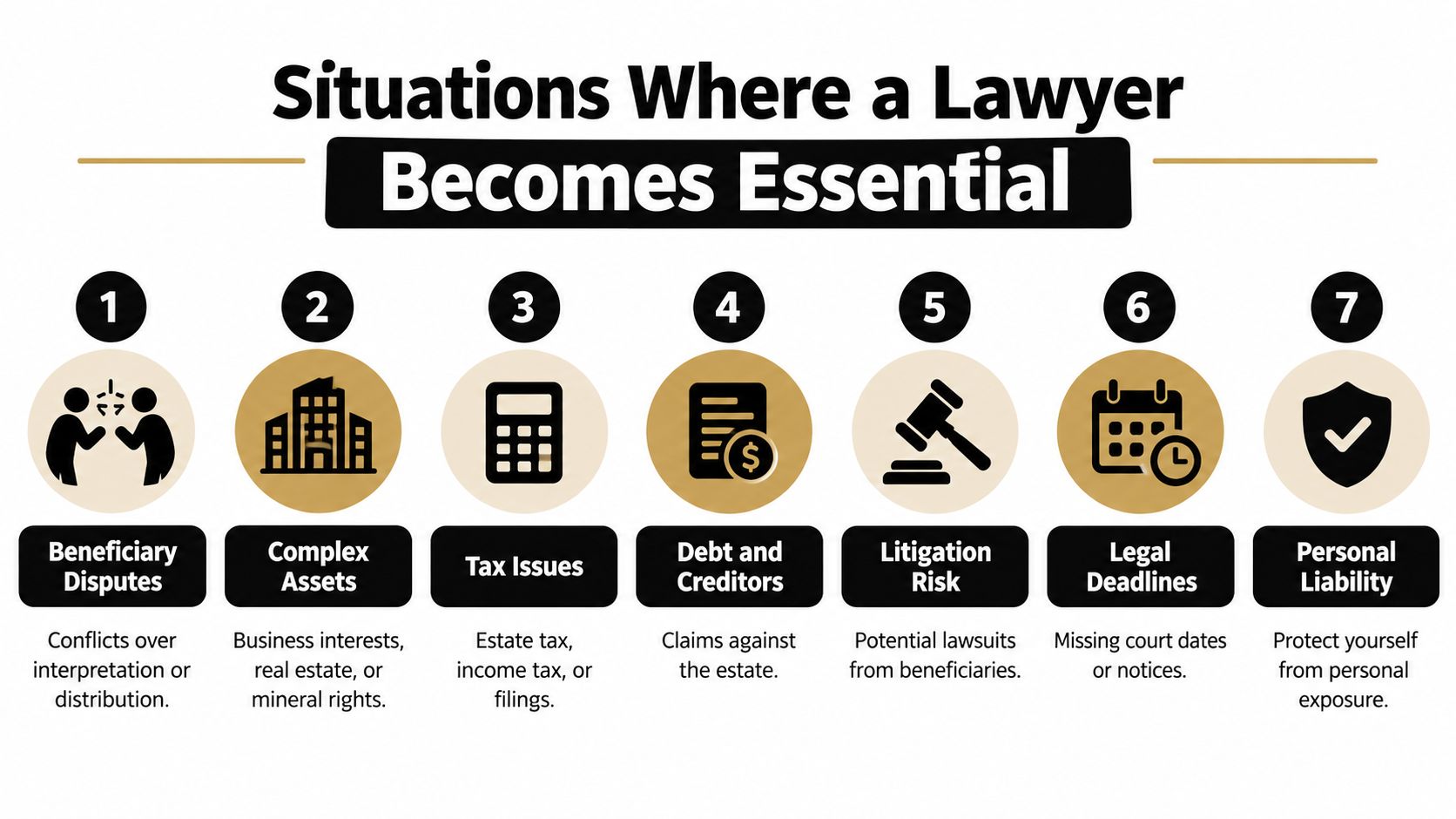
Beneficiary conflict
A beneficiary may claim that the trustee misunderstood the document, favored another family member, withheld information, or distributed property too soon. Once communication becomes hostile, informal explanations often make matters worse. Counsel can organize notices, preserve records, and establish a process that treats each beneficiary consistently.
Ambiguous or outdated language
Trusts sometimes contain provisions that don't fit current circumstances. The document may refer to property that no longer exists, fail to address a changed family situation, or conflict with another amendment. The trustee shouldn't choose the interpretation that feels most practical without analyzing the language and available remedies.
The 2023 Texas Trust Code amendments expanded flexibility involving judicial modification, purpose trusts, and trustee-party identification. Those changes make certain administrations more nuanced, particularly where modification, joinder, or trustee identity matters.
Tax and complex property
Business interests, mineral rights, real property, retirement accounts, and assets located in multiple counties require coordination. Tax filings may also involve income earned by the trust, estate tax questions, basis issues, or elections that affect beneficiaries.
A CPA may handle tax preparation, but a Texas trust lawyer should coordinate the legal consequences of ownership, distribution, and fiduciary authority.
Accounting demands and creditor claims
A written demand for an accounting creates a statutory response obligation. Creditor claims and disputed debts create another layer of risk because the trustee must distinguish valid trust expenses from claims that should be challenged or negotiated.
Families dealing with an aging parent should also treat financial protection as part of the broader planning picture. Guidance on how to prevent elder financial fraud can complement legal advice when relatives are concerned about exploitation or unusual transactions.
Modification or termination
Texas Property Code Section 112.054 permits a trustee or beneficiary to ask a court to modify a trust, change trustees, or terminate all or part of a trust when the purposes have been fulfilled, become illegal or impossible, or changed circumstances make modification necessary to further those purposes. The statute also addresses modifications intended to achieve tax objectives when they don't conflict with the settlor's intent.
That isn't a form-filing exercise. The trustee must understand who has standing, what notice is required, whether consent is available, and how the proposed change affects every beneficiary.
If any of these situations exists, hiring a Texas trust administration lawyer is risk management. Early advice can prevent the trustee from making a distribution, signing a release, or adopting an interpretation that becomes difficult to undo.
A Real Texas Family Scenario
Consider a composite Houston-area family. A parent created a trust for three children and named one sibling as trustee. The trust held a residence, investment accounts, and an interest in a closely held LLC. The trustee believed the administration would be completed by distributing cash and selling the house.
The trustee made informal payments to one branch of the family because that beneficiary needed immediate help. The trustee didn't prepare a formal accounting after a written request, and the trustee overlooked the fact that the LLC interest was titled inside the trust but required careful review of the operating agreement and transfer restrictions.
Those choices created separate problems. The informal payments raised an impartiality concern. The missing accounting made it difficult to show what the trust owned and how money had been spent. The LLC interest created questions about valuation, control, and whether the trustee had authority to transfer it as planned.
The family eventually filed litigation in Harris County probate court. The trustee faced personal exposure because the administration lacked consistent records and a defensible distribution process. The original goal, helping the family quickly, became harder to achieve after the dispute began.
A lawyer involved at the start could have reviewed the trust, identified the LLC issue, created a written inventory, established a communication schedule, and prepared an accounting supported by bank records. Counsel also could have coordinated tax advice and helped the trustee avoid preferential distributions while the administration remained open.
This is an illustration, not a prediction of what will happen in every trust. The lesson is concrete: a reasonable trustee can create liability without intending to act improperly.
What a Texas Trust Administration Lawyer Actually Does
A trust lawyer's value lies in the work product, not merely in attending a meeting. The lawyer analyzes the document, creates a defensible administration plan, and helps the trustee prove that each major action followed the law.
A typical engagement may include:
- Reviewing the trust, amendments, pour-over will, deeds, beneficiary designations, and related documents.
- Identifying whether property belongs to the trust or may require probate.
- Preparing beneficiary communications and required notices.
- Organizing an inventory of real estate, accounts, business interests, personal property, and debts.
- Coordinating retitling of real property in the Texas counties where it is located.
- Preparing accountings that separately address trust receipts, principal, income, disbursements, and distributions.
- Coordinating with a CPA on federal Form 1041, tax elections, and other tax matters.
- Helping the trustee obtain an employer identification number when appropriate.
- Addressing beneficiary releases, consents, objections, and settlement discussions.
- Filing or defending court proceedings involving modification, construction, removal, or termination.
The trustee still makes decisions. The lawyer provides legal analysis, documents the reasoning, and identifies choices that require consent or court involvement.
| Trust Administration Task | Trustee | Texas Trust Lawyer |
|---|---|---|
| Gather documents and assets | Collects records and provides access | Reviews ownership and identifies missing documents |
| Communicate with beneficiaries | Supplies factual updates and decisions | Drafts legally appropriate notices and responses |
| Manage trust property | Protects and oversees assets | Advises on authority, conflicts, sales, and risk |
| Prepare accounting | Maintains complete transaction records | Structures and reviews the formal accounting |
| Handle tax matters | Provides financial information | Coordinates with the CPA on legal issues and elections |
| Make distributions | Executes distributions under the trust | Confirms the proposed distribution follows the document and law |
| Address disputes | Avoids unilateral concessions | Negotiates, mediates, or litigates when necessary |
The right lawyer doesn't take control away from the trustee. The lawyer helps the trustee act with a clear record and a reliable legal foundation.
Understanding Trustee and Attorney Fees
Trustee compensation and attorney fees are separate issues. A trustee may be entitled to reasonable compensation under the Texas Trust Code, depending on the trust terms, the work performed, and the circumstances. The trustee shouldn't take money from trust accounts without reviewing the governing provisions and documenting the basis for payment.
Attorneys may charge hourly fees, a flat fee for a defined straightforward administration, or a hybrid arrangement. The structure should match the work. A simple administration with clean records may support a defined scope, while a trust involving litigation, business property, tax coordination, or court filings usually requires more flexible billing.
Common cost drivers include:
- Document complexity: Multiple amendments, unclear provisions, or conflicting documents require more analysis.
- Asset type: Real estate, closely held companies, mineral interests, and unusual investments require specialized coordination.
- Tax work: The need for returns, elections, valuations, or basis analysis increases professional involvement.
- Beneficiary conduct: Disputes, information demands, and objections expand the administration.
- Court involvement: Petitions, hearings, mediation, and litigation require additional preparation.
Expenses such as filing fees, appraisals, recording charges, and outside professional services may be payable from the trust when properly incurred for administration. The trustee's compensation is a separate matter and should be handled transparently.
| Fee Structure | Typical Range | Best For | Key Consideration |
|---|---|---|---|
| Hourly billing | Varies by attorney and task | Disputes, uncertain scope, and court matters | Ask how time is recorded and what work requires approval |
| Flat-fee package | Varies by trust complexity | Straightforward, well-documented administrations | Confirm exactly what the package includes and excludes |
| Hybrid arrangement | Combines defined and hourly work | Administrations with routine and unpredictable phases | Clarify when billing changes from flat to hourly |
A discussion of trust administration cost in Texas can help trustees prepare questions before hiring counsel. Compare value by asking whether the lawyer will reduce deadline risk, improve the accounting record, and protect the trustee from avoidable personal exposure.
Your Trustee Checklist and Next Steps
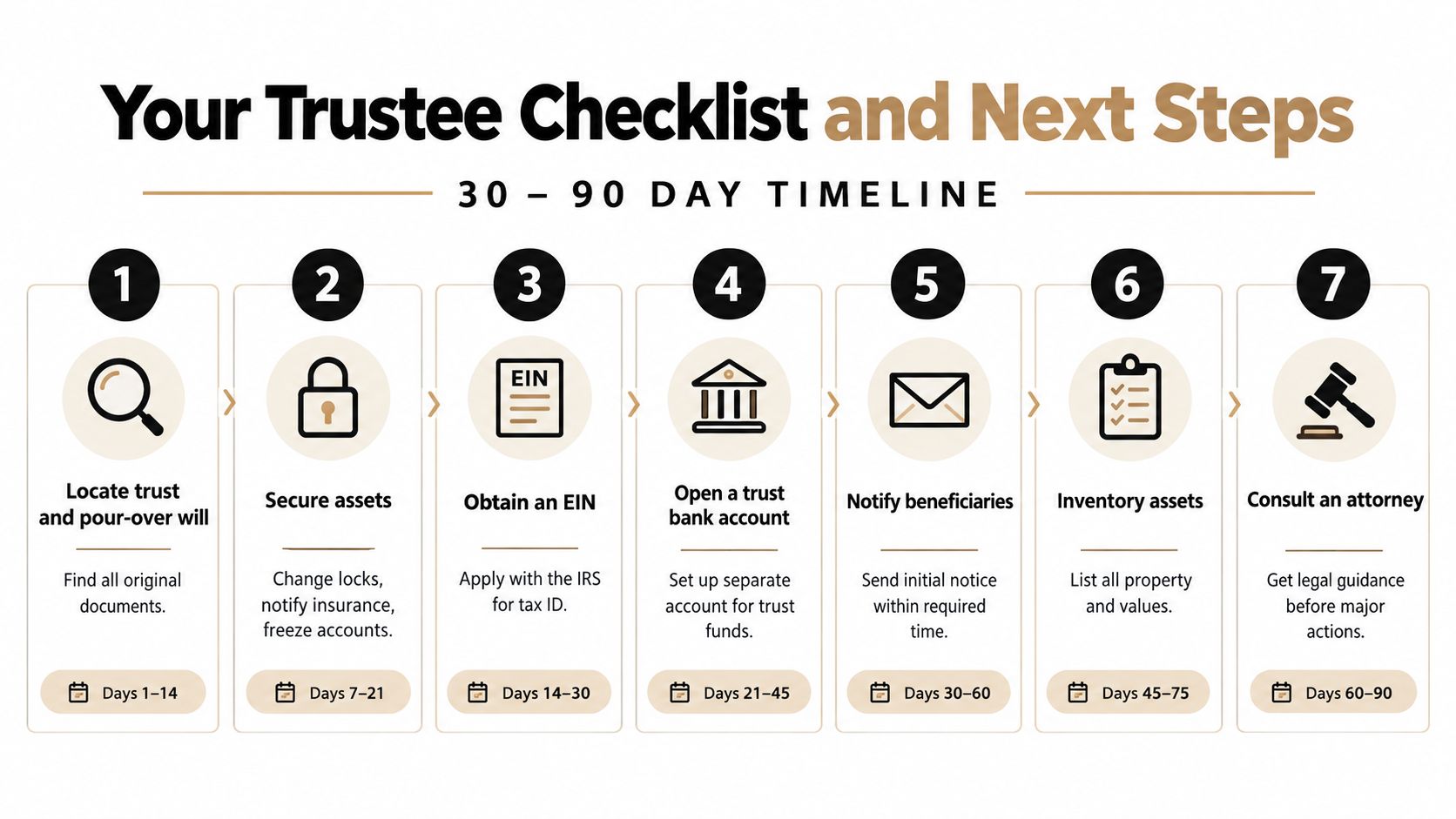
A trustee should create a written file before taking major action. The file can be electronic or paper, but it should preserve the original trust, amendments, statements, receipts, notices, appraisals, tax records, and communications.
The first phase
Start by locating the trust and any pour-over will. Confirm who died, who serves as trustee, whether the trust became irrevocable, and whether another person has authority over a related estate.
Secure property immediately. Protect the home, notify insurers, safeguard vehicles and valuables, and keep trust funds separate from personal funds. Obtain an employer identification number when needed and open a dedicated trust bank account.
The next phase
Build an inventory. List each asset, how it is titled, its approximate value, associated debt, and the document that proves ownership. Include real property, business interests, retirement accounts, insurance, digital property, and personal items.
Review beneficiary information and notice obligations with counsel. A trustee should also confirm whether any beneficiary has made a written request for information or an accounting. A written demand can trigger the 90-day accounting period under Texas law, so the trustee shouldn't wait until a dispute becomes formal to organize records.
Before distributions
Before distributing property, ask:
- Is the asset owned by the trust? If not, another legal process may apply.
- Are all debts and taxes addressed? Keep enough property available for legitimate obligations.
- Does the distribution treat beneficiaries consistently? Follow the trust, not family pressure.
- Can the trustee explain the transaction? Preserve the reason, valuation, and supporting documents.
- Does the trust need modification or court guidance? Don't guess when the document is unclear.
A practical trust administration checklist can help organize the early work, but it can't replace legal analysis for a disputed or complex trust.
The most efficient first move is often a consultation before distributions begin. Bring the trust, amendments, account statements, deeds, beneficiary list, and any written demands so the lawyer can identify the immediate risks and establish a defensible plan.
If you're managing a trust, facing beneficiary concerns, or planning for your family's future, the Law Office of Bryan Fagan, PLLC offers Texas-based guidance on trust administration, fiduciary accounting, estate planning, probate, guardianship, and asset protection. Schedule a free consultation to review your responsibilities, protect the trust property, and decide what should happen next.