Managing a loved one's trust can feel overwhelming, especially when the beneficiary is a child and you're trying to make decisions that protect both the money and the child's future. A trustee may be asking whether funds should go to a parent, a guardian, a caregiver, a UTMA custodian, or directly toward school and medical needs.
Texas law doesn't force every family into one payment method. Instead, it provides several paths and treats a minor's distribution differently from an adult beneficiary's outright inheritance. The most important planning points are the six statutory distribution methods, the difference between control at age 18 and possible trust continuation until age 25, and the trustee's duty to document every decision carefully.
Managing a Loved Ones Trust When the Beneficiary Is Under 18
A family trustee might receive a request for school tuition, medical care, clothing, transportation, or ordinary household support. The trustee may also be holding a larger inheritance that the child should not control immediately. These situations can feel personal, but the trustee's job isn't to approve or deny a parent's request. The trustee must apply the trust terms and Texas fiduciary principles while acting for the minor's benefit.
Consider a common situation. A grandparent's trust leaves property for a grandchild who is still a minor. The child lives with a parent, has no court-appointed guardian, and needs funds for education. The trustee could pay an appropriate expense directly, use another statutory method, or preserve the property under a longer trust arrangement. The right answer depends on the trust document, the child's legal circumstances, and the purpose of the requested funds.
Texas law gives trustees six explicit methods for distributing trust property to a beneficiary who is a minor or incapacitated person. Those methods include paying the beneficiary directly, paying a guardian, using funds for health, support, maintenance, or education, transferring property to a UTMA custodian, reimbursing the actual caregiver, or holding the funds in a separate fund that remains subject to the beneficiary's continuing withdrawal right. The statutory framework appears in Texas Property Code Section 113.021.
Practical rule: A child turning 18 doesn't automatically answer every trust question. The trust terms and the distribution method determine when control changes.
This article explains how those paths work, why UTMA property generally transfers at 18, how court-created trusts can continue until 25, and what a trustee should document. If you're serving as trustee, you don't have to solve the issue by guesswork. A careful review of the trust and the applicable Texas statutes can protect the beneficiary and reduce conflict within the family.
How Texas Law Governs Trust Distributions for Minors
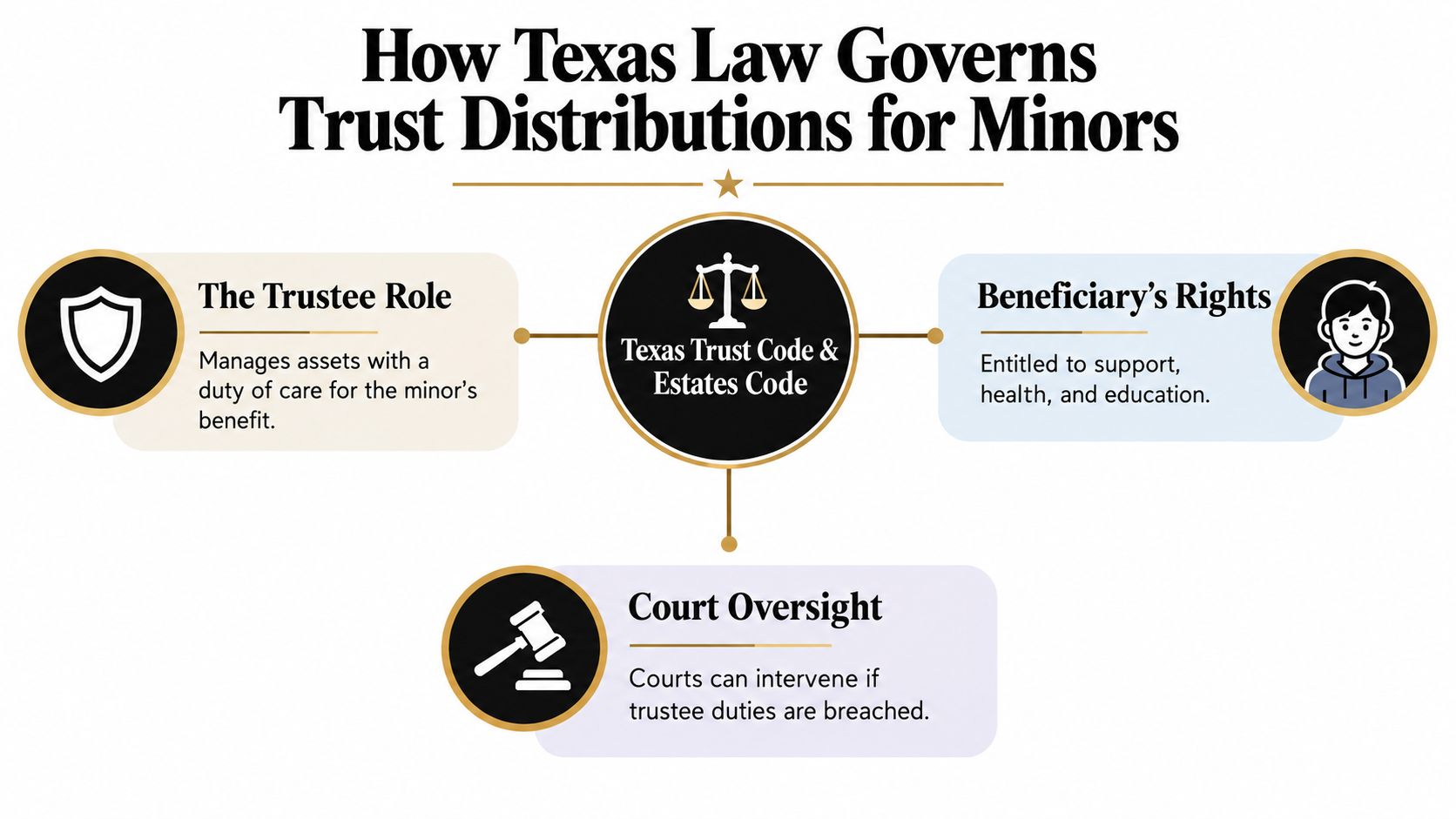
Texas trust administration begins with the trust document, but the document operates within the Texas Trust Code and related provisions of the Texas Estates Code. A trustee holds legal title to trust assets and manages them for the beneficiary. The trustee isn't the owner in the personal sense. The trustee is a steward with duties of loyalty, prudence, impartiality, and proper administration.
Minority triggers special protective procedures because a child usually can't manage inherited property independently. Texas Property Code Section 113.021 specifically addresses distributions for minors and people incapacitated by illness or infirmity. The statute's focus on health, support, maintenance, and education gives trustees a practical framework for using funds while preserving the beneficiary's interests.
A useful analogy is a trustee as a careful financial steward. A steward doesn't spend money because a family member asks, and doesn't refuse every request out of fear. The steward checks the governing instructions, confirms the expense serves the beneficiary, keeps records, and chooses a payment route that fits the child's situation.
The legal foundation
The Texas Trust Code supplies the trustee's operating rules. The trust instrument may grant broad discretion, require distributions under an ascertainable standard, or delay control until a stated age. The trustee still has to exercise that authority in good faith and for the purposes stated in the trust.
The Texas Estates Code becomes especially important when a court-created trust, guardianship, or management trust is involved. Court oversight can affect who controls the property, what reports must be filed, and how the trust eventually ends. Texas law also requires notice to a parent when the beneficiary is a minor and no guardian or conservator has been appointed, as described in Texas Property Code Section 112.074.
Families often confuse trust administration with probate. Texas Trust Administration: A Trustee's Guide describes what trust administration involves and how it differs from probate. The distinction matters because a trustee may need to manage assets privately under the trust document, while a court-created arrangement may require more direct judicial involvement.
Six Legal Ways to Distribute Trust Assets to a Minor in Texas
Texas Property Code Section 113.021 gives trustees flexibility rather than requiring one mandatory payment route. A trustee can match the distribution method to the beneficiary's age, guardianship status, household circumstances, and actual needs.
| Distribution Method | Best When | Control and Oversight |
|---|---|---|
| Directly to the beneficiary | The trust and circumstances permit direct receipt | The minor receives the property, so the trustee should consider whether direct control is legally and practically appropriate |
| To a guardian | A court-appointed guardian or suitable legal representative manages the child's property | The guardian receives and manages the funds under applicable fiduciary rules |
| For health, support, maintenance, or education | The child has a clear need, such as tuition, treatment, or support | The trustee can pay for the beneficiary's needs without placing unrestricted funds in the child's hands |
| To a UTMA custodian | The trust or distribution plan uses custodial property management | The custodian manages the property under Texas UTMA rules until the statutory transfer point |
| Reimbursement to the actual caregiver | A person has already paid a legitimate expense for the child | The trustee reimburses the actual caregiver rather than making an unnecessary payment through another person |
| Separate fund with continuing withdrawal rights | The trustee wants to preserve management while keeping the beneficiary's withdrawal right recognized | The amount remains separately held and subject to the beneficiary's continuing right to withdraw it |
Matching the method to the child's circumstances
Direct payment may be appropriate in limited circumstances, but a trustee should not assume that an under-18 beneficiary can safely receive a large outright payment. The trust language and the child's legal capacity must be reviewed first.
Payment to a guardian can work when a court-appointed guardian is responsible for the child or the child's estate. A parent may care for the child without being the formal guardian of the child's property, so the trustee should confirm the legal status before using this route.
Direct payment for needs often provides the cleanest practical solution for education, health care, support, or maintenance. The trustee may pay a school, medical provider, landlord, or other service provider instead of transferring cash to the child.
A UTMA custodianship places property under a custodian's management, but it also carries an important age consequence. Texas UTMA property generally transfers to the beneficiary at 18, as explained in the Texas Uniform Transfers to Minors Act.
Caregiver reimbursement recognizes the person who paid the child's expense. The trustee should request receipts or other reliable records and confirm that the expense benefited the minor.
A separate fund can preserve an orderly account while allowing the beneficiary's continuing withdrawal right. This option requires careful reading of the trust terms and precise accounting.
For trustees evaluating whether a distribution standard is limited to health, education, maintenance, and support, this explanation of an ascertainable standard trust may provide useful background. A Texas trust administration lawyer can help determine which statutory route fits the document and the child's needs.
Understanding Age Milestones and When Control Transfers
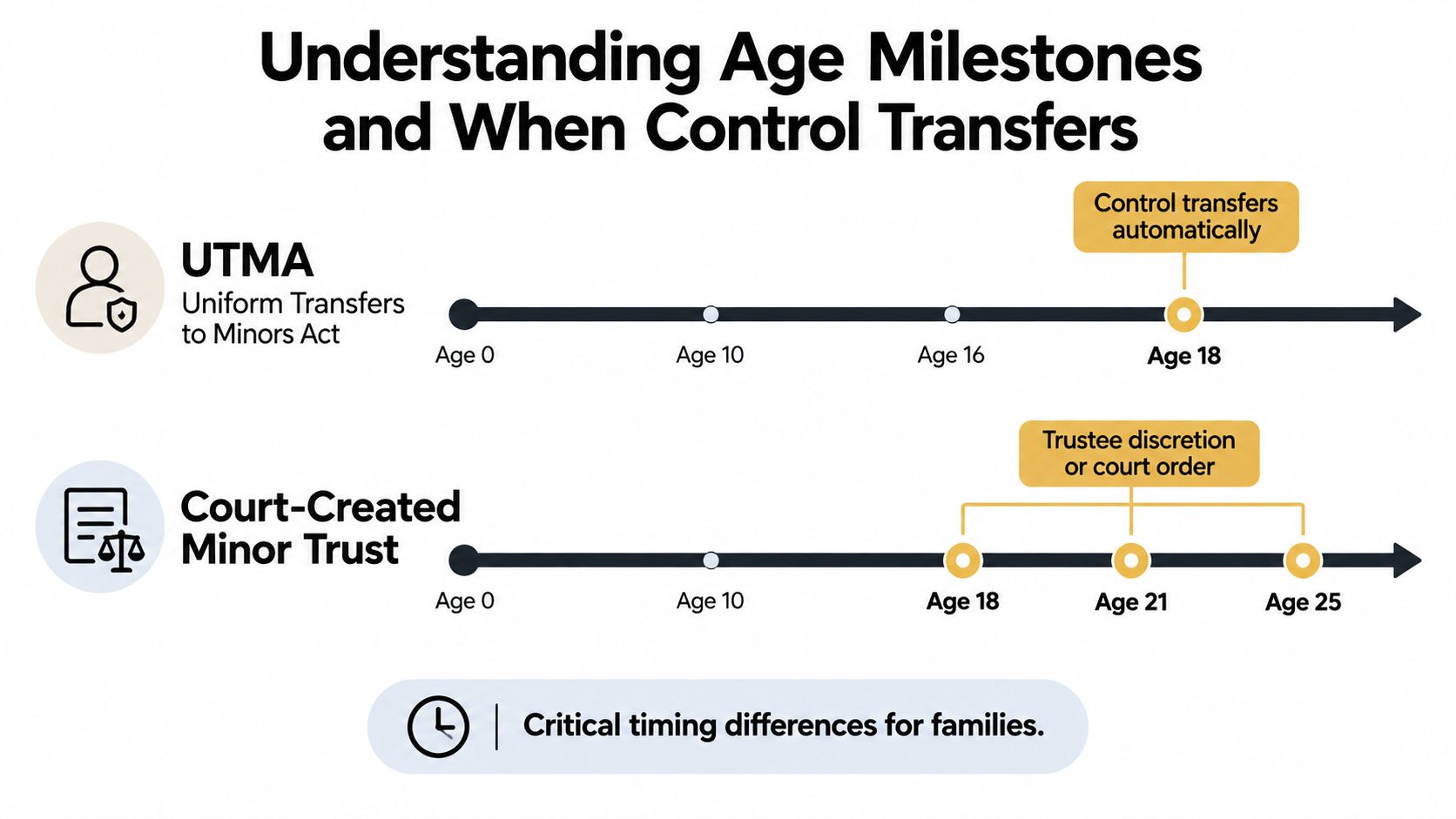
The biggest source of confusion is the assumption that every trust for a child ends automatically at 18. That assumption is accurate for a Texas UTMA custodianship unless the law or governing arrangement provides an earlier date, but it doesn't describe every trust structure.
Under Texas UTMA rules, custodial property must be transferred to the beneficiary when the beneficiary attains 18 years of age, unless an earlier date is set under the statute. At that point, the custodian's management role ends and the beneficiary gains control of the remaining custodial property.
Court-created trusts follow a different framework. Texas authority recognizes that a court may set termination as late as the ward's 25th birthday. If the trust is silent about duration, a cited Texas authority explains that it ends at the earlier of the minor's death or 18th birthday. These milestones make the wording of the trust or court order critical.
Comparing the pathways
A UTMA transfer is designed around a bright-line age milestone. The custodian manages the property during the custodianship, but the beneficiary's adult control begins at 18 unless an earlier statutory date applies.
A court-created minor trust can provide longer protection. Under the cited Texas framework, the trustee may distribute principal and income in the trustee's sole discretion as reasonably necessary for the beneficiary's health, education, support, or maintenance. Undistributed income is added to principal, and the trust may continue until a specified age, including 25 where the statutory framework permits it.
A management trust may involve continued court supervision rather than a simple automatic transfer. The court order, trust terms, and applicable Estates Code provisions determine how the assets are administered and when they move to the ward, a successor trustee, or an estate representative.
The practical lesson is direct. If a parent or grandparent wants management to continue beyond 18, the planning documents must say so through an appropriate trust structure. A trustee shouldn't assume that a UTMA account can provide the same extended control as a court-created or privately drafted trust.
Before funding an account, families should identify the intended control point, the person who will manage the assets, and the expenses the trust should cover. Those choices affect drafting, administration, and the beneficiary's transition into adult financial responsibility.
Trustee Duties Documentation and Court Oversight in Texas
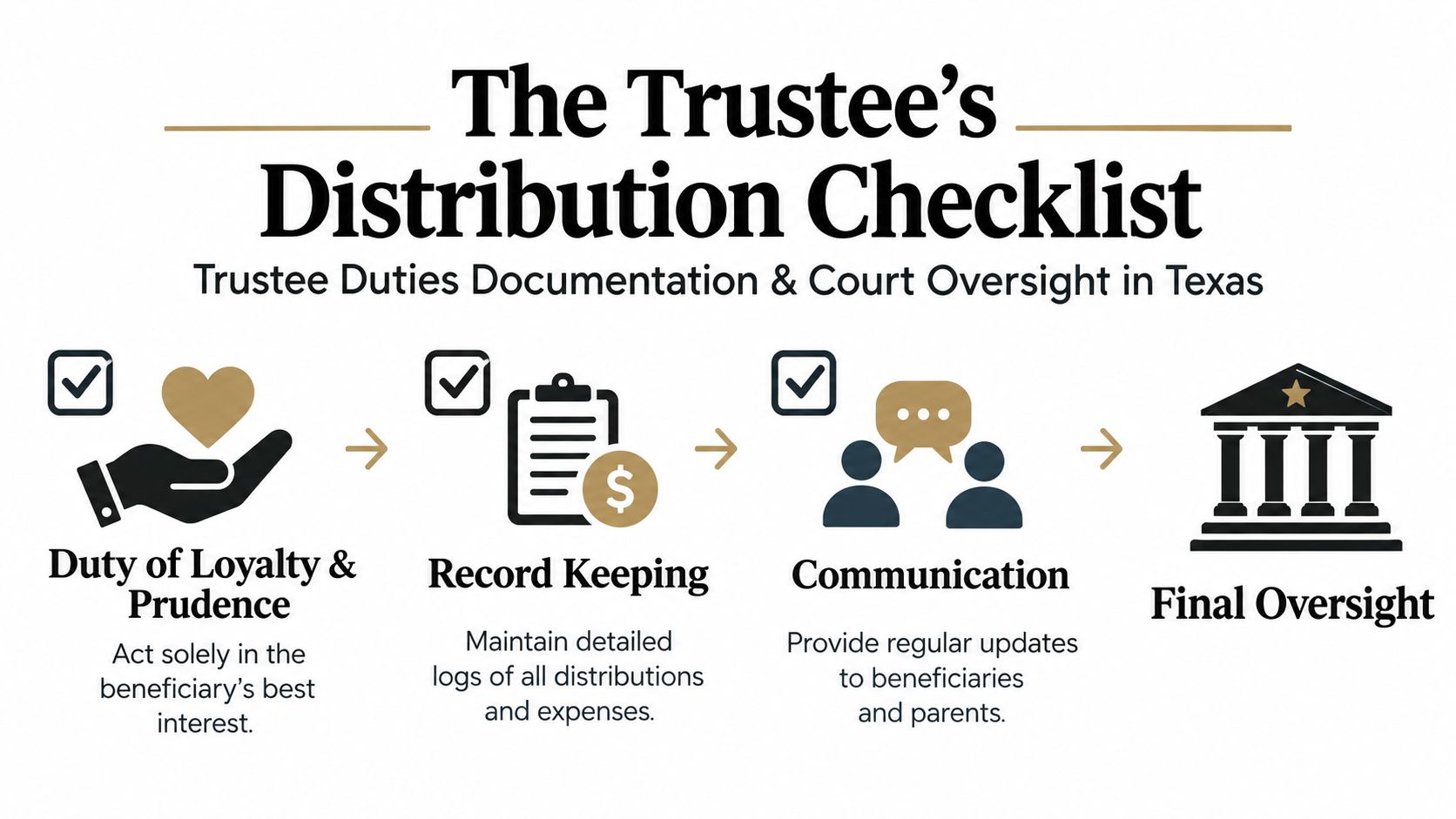
A trustee's decision is only as strong as the record supporting it. When a trustee distributes money for a minor, the file should show what the expense was, why it benefited the child, which trust provision authorized it, and how the trustee selected the payment method.
A practical administration sequence
Read the governing documents. Identify the beneficiary's status, the distribution standard, any age restrictions, and any instructions about guardians, custodians, or separate funds.
Confirm legal relationships. Determine whether a parent, guardian, conservator, custodian, or caregiver is involved. Texas law requires notice to a parent when a minor has no appointed guardian or conservator, so the trustee should address that requirement before proceeding.
Evaluate the request. Separate a child's health, education, support, and maintenance needs from expenses that benefit someone else. A parent's request may be legitimate, but the trustee still needs a beneficiary-centered explanation.
Preserve the accounting trail. Keep invoices, receipts, approvals, payment records, account statements, and written communications. Records help show that the trustee acted prudently and consistently.
Fiduciary conduct and court accounting
Fiduciary duties in Texas require more than following a family member's instructions. The trustee must act loyally for the beneficiary, manage property prudently, avoid self-dealing, and treat beneficiaries fairly when the trust has competing interests.
Communication also matters. A trustee should give appropriate information to the beneficiary's representatives and parent, while avoiding disclosures that the trust document or law does not require. Clear communication can prevent a routine education payment from becoming a larger family dispute.
For a management trust, Texas Estates Code Section 1301.204 requires the trustee, with court approval, to prepare a final account in the same form used by a guardian. The trustee then distributes principal and undistributed income to the ward, a successor trustee, or the representative of the deceased ward's estate, as applicable. The statute demonstrates why fiduciary accounting remains central when a minor or incapacitated beneficiary is involved. See Texas Estates Code Section 1301.204.
Trustees who need to address representation, notice, and administration mechanics can review virtual representation under Texas Trust Code Section 114.086. If a dispute arises, records give the trustee, beneficiary, and court a reliable account of what happened.
Drafting Options That Prevent Problems Before Age 18
Good planning starts before a distribution request arrives. A trust should identify not only who receives the property, but also who controls it, which expenses may be paid, and whether the beneficiary should receive unrestricted control at 18 or later.
Choosing between a UTMA account and a trust
A UTMA arrangement can be straightforward for property intended to transfer at 18. It may be less suitable when the family wants a trustee to continue managing assets after the beneficiary becomes an adult.
A privately drafted trust can use discretionary distributions for health, education, support, and maintenance while preserving principal for later needs. The trust may also use staged distributions, such as one portion at a stated age and another portion later, if the drafting complies with applicable law and the grantor's goals.
Planning insight: The best distribution design is not the one with the fewest words. It's the one that clearly answers who controls the money, what the money can fund, and when the beneficiary gains control.
Building flexibility into the plan
A family may want tuition paid directly to a school, therapy paid to a provider, and living expenses handled through a trustee. Another family may prefer a guardian or custodian to manage routine costs. The trust can be drafted to give the trustee room to respond to those needs without requiring an outright transfer.
Families should also consider whether the beneficiary is incapacitated or receives needs-based public benefits. A direct inheritance can create complications in some circumstances, so the trust plan should coordinate with guardianship, benefit planning, and the beneficiary's broader care needs.
A court-managed alternative may be appropriate when a court is already supervising the child's property or when the trust arises through a court proceeding. Court oversight can provide structure, but it also adds procedural requirements and accounting responsibilities.
The planning process should coordinate the trust with wills, beneficiary designations, guardianship nominations, and asset protection goals. A guide to setting up a trust for a child can help families identify the questions they need to answer before meeting with counsel.

Reviewing an existing trust
If an existing document directs property to a child at 18, the family should not assume that informal arrangements can extend the trust. Ask a Texas estate planning attorney to review whether modification, court approval, or a different administration method is legally available. Families also benefit from coordinating the trust with a Texas guardianship attorney and reviewing related asset protection planning when appropriate.
Next Steps for Trustees and Families Seeking Trusted Guidance
A trustee handling trust fund distribution to beneficiaries under 18 in Texas should make three decisions early. First, identify the distribution path that fits the child's legal status and immediate needs. Second, confirm whether the governing arrangement transfers control at 18 or permits continued management toward 25. Third, document the facts, payments, notices, and reasoning behind each action.
Families should gather the trust instrument, amendments, account statements, beneficiary information, guardianship or conservatorship documents, and records supporting requested expenses. A trustee should also avoid commingling trust assets, making undocumented loans, or treating the child's funds as a substitute for the trustee's personal obligations.
Legal guidance can be useful before a dispute develops. A Texas trust administration lawyer can help with trustee duties, fiduciary accounting, beneficiary communication, trust modification, and court-supervised administration. A Texas estate planning attorney can also coordinate wills, guardianship planning, tax considerations, and long-term asset protection.
The Law Office of Bryan Fagan, PLLC helps Texas families and fiduciaries address trust creation, administration, modification, termination, probate, guardianship, asset protection, and trust disputes. The firm serves families and trustees throughout Houston, Dallas-Fort Worth, Austin, San Antonio, The Woodlands, and surrounding communities.
If you're managing a trust for a minor, The Law Office of Bryan Fagan, PLLC can review the trust terms, explain the available Texas distribution paths, and help you document each fiduciary decision. Visit Law Office of Bryan Fagan, PLLC to schedule a free consultation for Texas-based guidance.