Managing a loved one's trust can feel overwhelming, especially when you discover a major change years after the person's death. A daughter may learn that her father amended his trust shortly before he passed, leaving most of the estate to a stepson she barely knows. Her first question is often simple but urgent: How long do I have to contest a trust in Texas?
Texas doesn't use one universal deadline labeled the “trust contest statute of limitations.” The answer depends on the legal claim, the facts supporting it, and when the law treats the injury as discovered. A Texas trust administration lawyer can help identify the correct deadline before a potentially valid claim is lost.
Why Timing Matters When You Contest a Trust in Texas
A trust dispute can involve several different complaints. A beneficiary may question whether the settlor had capacity, whether someone exerted undue influence, whether the trustee breached fiduciary duties, or whether assets were concealed. Those claims may arise from the same family events, but the timing analysis can differ.
Suppose the daughter learns about the amendment three years after her father's death. If she investigates promptly, gathers the trust documents, and files a claim within the applicable limitations period, the trustee may have to defend the trust's validity and administration. If she waits until after the deadline, the trustee may raise limitations as an affirmative defense, asking the court to dismiss the claim even if the alleged conduct was wrongful.
Practical rule: Don't calculate the deadline from the date a family member first tells you something feels unfair. Identify the specific legal injury and determine when you knew, or reasonably should have known, about it.
Texas limitations law can also start the clock earlier than a beneficiary expects. Receiving a trust statement, learning about a distribution, seeing a recorded transfer, or discovering a conflict may create inquiry notice. Inquiry notice means the available information was enough to require a reasonable person to investigate further.
Why a late discovery can still require immediate action
A delayed discovery doesn't automatically make a claim timely. Courts examine what the beneficiary knew, what information the trustee provided, what warning signs existed, and whether the beneficiary acted reasonably after those warning signs appeared.
The safest first steps are practical:
- Collect the trust instrument and every amendment.
- Write down the dates of death, distributions, accountings, and discoveries.
- Preserve communications and financial records.
- Avoid signing a release or settlement before receiving legal advice.
- Have a Texas attorney evaluate each possible cause of action separately.
The central lesson is straightforward. Texas trust litigation often turns on the trigger date, not merely the date of death. A family that treats the issue as a general inheritance disagreement may lose time that a careful legal review could have protected.
The Four-Year Framework That Governs Texas Trust Contests
Texas doesn't have a single statute titled the “trust contest statute of limitations.” Many trust challenges are analyzed under the four-year residual limitations period in Texas Civil Practice and Remedies Code section 16.051, together with the four-year period for fraud-related claims in section 16.004. The practical framework is explained in Texas limitations law for trust and fiduciary disputes.
This doesn't mean every trust-related claim automatically receives four years. The claim's legal character matters. A fraud claim, breach of fiduciary duty claim, validity challenge, accounting demand, or real-property dispute may have different rules concerning the deadline and the date the clock begins.
Consider a beneficiary who sues a trustee for a wrongful distribution. If the beneficiary files four years and one month after the distribution, the trustee may argue that the claim is barred under the applicable limitations period. Whether that defense succeeds can depend on discovery, concealment, the trust's terms, and facts showing why the beneficiary couldn't reasonably have known about the injury sooner.
Core Texas limitations periods for trust contests
| Statute | Period | Trust-related application |
|---|---|---|
| Texas Civil Practice and Remedies Code § 16.051 | Four years | Often used for trust disputes that don't have a more specific limitations provision |
| Texas Civil Practice and Remedies Code § 16.004 | Four years | Applies to fraud-related claims, subject to discovery and other factual issues |
A trustee who has just taken office should organize records and identify immediate responsibilities. The practical resource First Steps for a Successor Trustee in Texas addresses what to do immediately after stepping into the trustee role.
Why the claim's label matters
Courts look at the substance of the complaint, not only the title placed on a pleading. A beneficiary may describe a dispute as a “trust contest,” but the court may analyze separate claims for breach of fiduciary duty, fraud, undue influence, declaratory relief, or an accounting.
That distinction affects more than filing dates. It can affect the evidence required, the available remedies, the party who must prove each element, and whether a discovery rule may apply. A trustee or beneficiary shouldn't assume that one deadline governs every issue because the dispute involves one trust.
How Deadlines Differ by Cause of Action
The phrase trust contest statute of limitations Texas can hide the most important issue, which is the legal theory behind the challenge. A beneficiary should separate the claims instead of placing every complaint under one deadline.
| Cause of action | Typical deadline | When the clock starts |
|---|---|---|
| Trust validity challenge | Often analyzed under a four-year framework | May depend on the challenged act, the settlor's death, the transfer, or when the beneficiary knew or should have known of the alleged defect |
| Breach of fiduciary duty | Often four years under § 16.051 | Commonly measured from the wrongful act or from discovery when the facts support delayed discovery |
| Fraud or constructive fraud | Four years under § 16.004 | Generally tied to discovery of the fraudulent conduct or when it reasonably should have been discovered |
| Undue influence as a standalone theory | Often analyzed with fraud-related principles | Depends on when the influence and resulting injury became discoverable |
| Accounting and related equitable relief | Fact-specific | May be measured from when an accounting or material information should have been provided |
Validity, capacity, and undue influence
A validity challenge may allege that the settlor lacked capacity, acted under duress, or signed because of undue influence. The timing may depend on the document being challenged and the facts showing when the beneficiary could reasonably have learned about the problem.
Undue influence can also appear as part of a fraud-based theory. The legal analysis shouldn't assume that naming undue influence automatically creates a separate, unlimited period. The claim must be matched to the facts and the relief requested.
Trustee misconduct and accounting failures
A trustee's wrongful sale, self-dealing transaction, improper distribution, or failure to protect trust property may support a breach of fiduciary duty claim. Texas law requires a trustee to administer the trust in good faith, follow the trust's terms and the Texas Trust Code, and follow common-law fiduciary duties when the trust and Code don't answer the issue, as provided by Texas Property Code section 113.051.
A missing accounting may create a separate timing question. Beneficiaries may need to examine when information should have been furnished, whether the trustee responded to reasonable requests, and whether the failure prevented discovery of the injury. A useful overview of the practical analysis appears in this guide to the chances of successfully contesting a trust.
The same conduct can support multiple claims. A trustee who conceals a self-dealing transaction may face a fiduciary-duty claim and a fraud-related claim, with different arguments about when each clock began.
Discovery, Concealment, and Tolling Under Texas Law
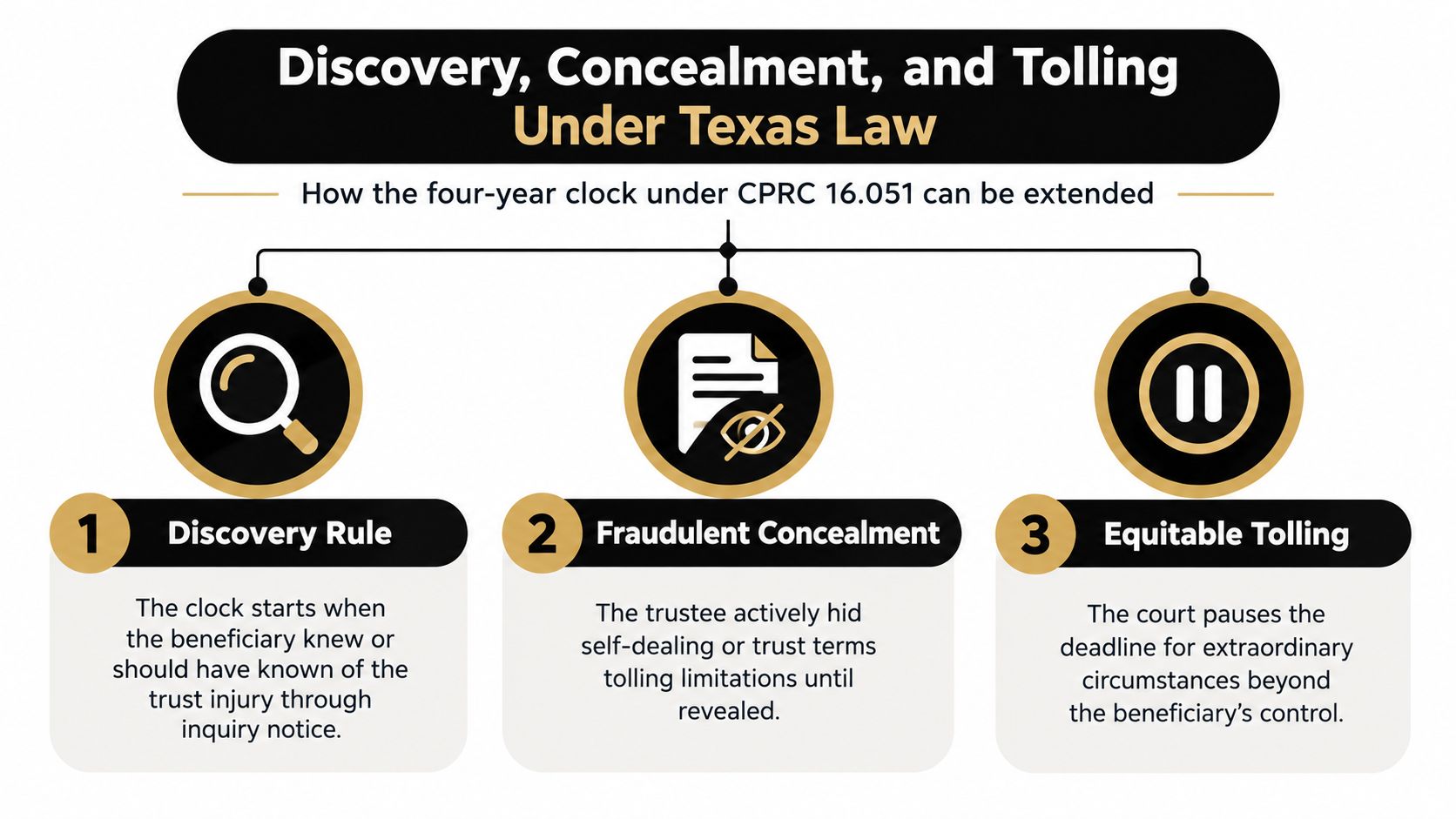
Texas law may delay the start of a limitations period when the injury is undiscoverable and the beneficiary couldn't reasonably have found it earlier. That is the discovery rule. It isn't a general excuse for waiting. The beneficiary must show why the facts remained hidden despite reasonable investigation.
Fraudulent concealment is more demanding. A beneficiary generally needs evidence that the trustee engaged in deceptive conduct designed to hide the wrongdoing. Silence alone may not prove fraudulent concealment, although a trustee's failure to provide required information can become important when combined with misleading statements, withheld records, or a fiduciary relationship.
How inquiry notice changes the analysis
Suppose a trustee never sends statements, refuses reasonable requests, or tells a beneficiary that no trust assets exist when bank records later show otherwise. Those facts may support an argument that the beneficiary lacked meaningful notice. But once the beneficiary receives warning signs, a court may ask whether the investigation was prompt and reasonable.
Texas courts have treated discovery and concealment as fact-intensive issues. In S.V. v. R.V., 921 S.W.2d 446 (Tex. App. Houston [14th Dist.] 1996), the court's analysis illustrates why the precise facts surrounding discovery and concealment matter.
The law also recognizes limited tolling situations involving minority, mental incapacity, or the death of a party. The effect depends on the parties, the claim, and the governing statute. A beneficiary shouldn't assume that a family member's incapacity automatically pauses every deadline.
For a broader comparison of how trust and estate disputes are handled in another jurisdiction, readers may find this discussion of the estate dispute process in Utah useful. Texas law still controls a Texas trust, but comparing procedures can clarify why jurisdiction and legal instrument matter.
The embedded discussion below offers additional context on limitations issues.
Trust Contests vs Will Contests in Texas
Families often confuse trust contests with will contests because both may follow a death and involve the same relatives, witnesses, and assets. The legal instruments are different, however, and Texas gives will contests a specific statutory deadline.
Under Texas Estates Code section 256.204(a), an interested person generally has two years after a will is admitted to probate to bring a will contest. Texas trust disputes don't have the same clear, universal two-year trust-contest deadline in the statute. They are commonly analyzed under the broader four-year framework discussed earlier, including sections 16.051 and 16.004, as explained in this overview of contesting a trust in Texas.
| Issue | Trust contest | Will contest |
|---|---|---|
| Main governing framework | Texas Trust Code and general limitations law | Texas Estates Code |
| Common limitations framework | Four years for many claims | Two years after probate admission |
| Court setting | Often district court litigation | Probate proceeding or court handling the estate |
| Effect of a successful challenge | May affect trust validity, administration, or trustee conduct | May invalidate or alter the probate instrument |
| Relationship between documents | Trust validity is analyzed separately | Probate of a will doesn't validate a related trust |
Why challenging one document may not challenge the other
A will admitted to probate doesn't automatically validate a related trust. Likewise, a successful will contest doesn't automatically void a trust that was created or funded separately.
That creates three practical choices for a family. The heirs may challenge the will, challenge the trust, or pursue both. Each route requires separate deadlines, evidence, and requested remedies. A useful additional perspective is available in this 2026 trust contest guide, but a Texas attorney must apply Texas law to the actual documents and events.
The shorter will-contest period can require heirs to investigate quickly. Trustees also need to preserve records because a trust-related claim may remain governed by a different limitations analysis.
A Real-World Texas Trust Timeline
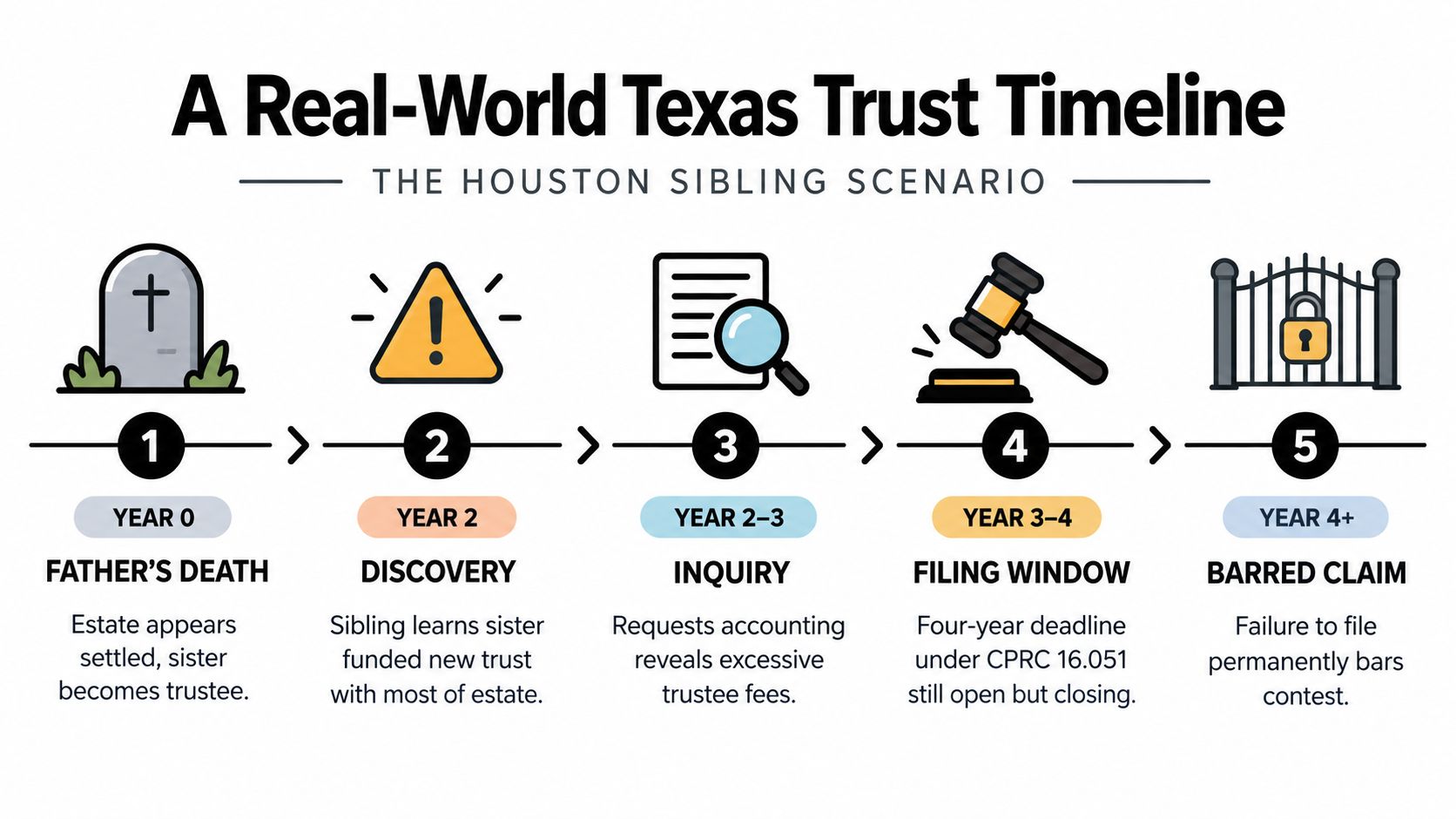
Consider a representative Houston-area family. A father dies, and his sister becomes trustee. For a time, the family believes the estate has been handled. Two years after the father's death, one sibling learns that the trustee funded a new trust with most of the estate, paid herself fees, and hasn't distributed anything.
The discovery doesn't answer every limitations question. It identifies a critical investigation point. The sibling must determine what happened, when the trustee acted, what information was provided, and whether the conduct supports validity, fiduciary-duty, fraud, or undue-influence theories.
Mapping the competing clocks
- Year zero: The father dies. The sister begins acting as trustee, and the family assumes administration is moving forward.
- Year two: The sibling learns about the new trust and the transfer of estate assets. This may create a discovery date for claims that were not reasonably knowable earlier.
- Year two to year three: The sibling sends a written accounting request, asks for the trust instrument and amendments, and reviews evidence of trustee fees and distributions.
- Year three to year four: The four-year framework may remain open for some claims, but the filing window is closing. A demand letter doesn't replace filing a lawsuit when litigation is necessary.
- Year four and beyond: The trustee may assert limitations. If the court finds the claim accrued earlier and no tolling doctrine applies, relief may be barred.
A routine accounting request can be important because it creates a dated record of what the beneficiary asked for and what the trustee disclosed. Texas practitioners also explain that trustees generally aren't required to account more than once every twelve months unless the trust provides otherwise, while beneficiaries may still be entitled to material information needed to protect their interests, as discussed in Texas trustee accounting guidance.
The sibling shouldn't rely on family conversations, wait for the next accounting, or assume silence is harmless. The Texas trust contest timeline after death can help organize the chronology, but legal advice is needed to determine the filing deadline and available remedies, including a possible surcharge against the trustee or non-probate claims.
What Beneficiaries and Trustees Should Do Right Now
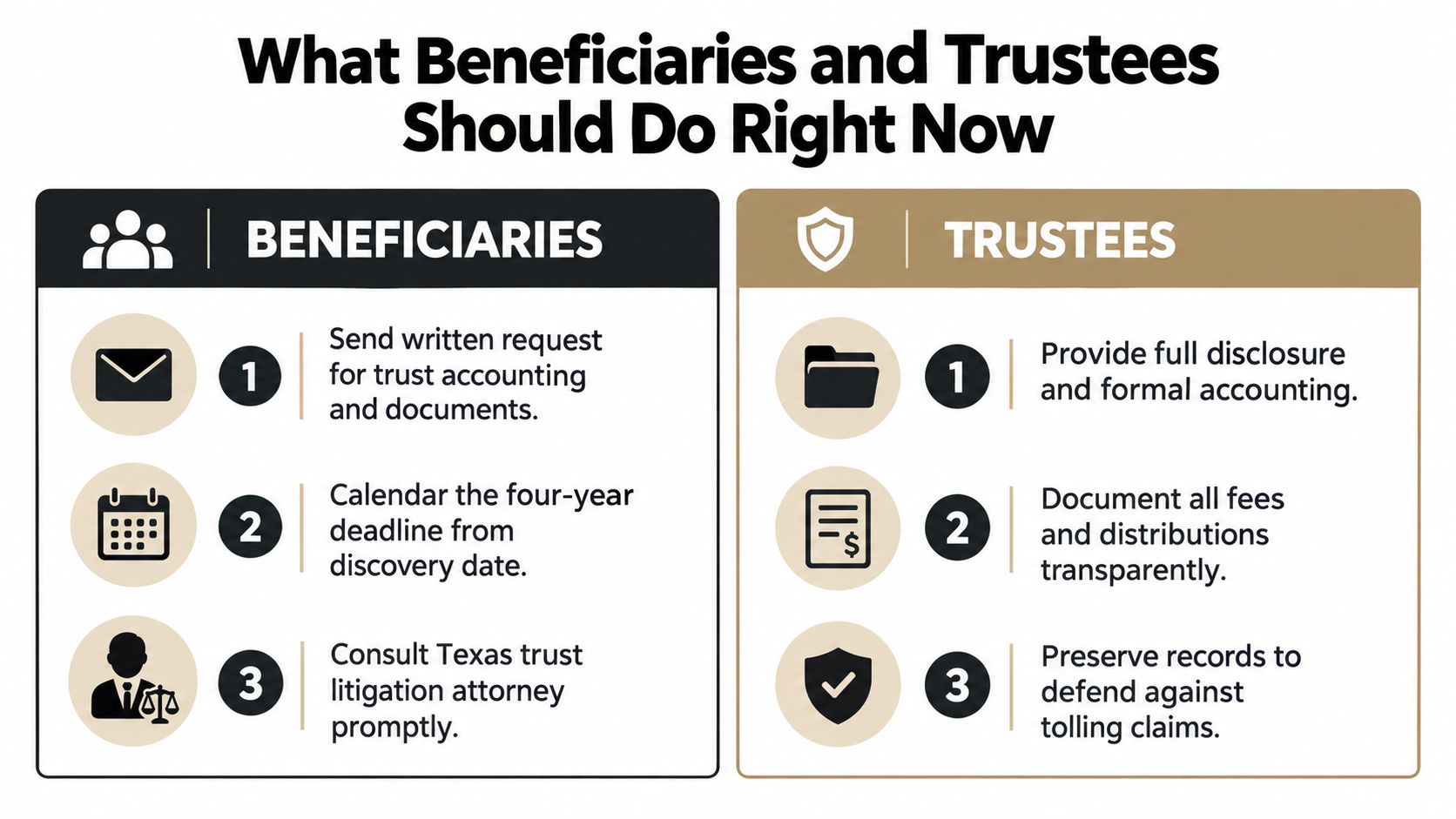
A beneficiary and a trustee have different responsibilities, but both should treat dates and documents as urgent. Early organization can preserve evidence, clarify the dispute, and reveal whether a limitations defense may apply.
Steps for beneficiaries
- Send a written request. Ask for the trust instrument, amendments, an accounting, asset information, distributions, and explanations for material transactions. Keep proof of delivery.
- Build a chronology. Record the settlor's death, document-signing dates, transfers, accountings, disclosures, conversations, and the date you first learned each important fact.
- Preserve evidence. Save emails, bank statements, text messages, letters, medical records, and property records in their original form.
- Don't sign a release casually. A receipt, waiver, settlement, or beneficiary acknowledgment may affect later claims. Have a Texas trust litigation attorney review it first.
- Act before the analysis is complete. An attorney may need time to investigate and file suit while preserving arguments about discovery or concealment.
Steps for trustees
Trustees should follow the trust terms and Texas Trust Code, document decisions, disclose conflicts, and keep full, clear, and accurate records. They should also provide beneficiaries with complete and accurate information at reasonable times when the information is material to protecting beneficiary interests.
A trustee facing accusations shouldn't destroy records, make informal promises, or distribute disputed assets without advice. Independent counsel can help the trustee respond consistently, evaluate potential claims, and protect the administration from avoidable errors.
Beneficiaries should also examine whether the trust contains a no-contest clause and how Texas law may treat it. The no-contest clause in a Texas trust is a separate issue from limitations, but it can affect litigation strategy and risk.
Getting Clear Answers on Your Texas Trust Deadline
A trust dispute rarely turns on one calendar date alone. The careful analysis identifies the cause of action, determines when the injury occurred or was discovered, evaluates discovery and concealment arguments, and compares the result with any separate will-contest deadline.
The most important questions are practical:
- What document is being challenged?
- What specific conduct caused the legal injury?
- When did the beneficiary know, or reasonably have reason to know, about it?
- Did the trustee provide records and material information?
- Is there evidence of active concealment?
- Does the trust include a release or no-contest provision?
- Should the family challenge the trust, the will, or both?
A missed four-year framework under Texas Civil Practice and Remedies Code section 16.051 can leave a claim vulnerable to dismissal. A fraud-related claim may require separate analysis under section 16.004, while a will contest generally follows the two-year deadline after probate admission under Texas Estates Code section 256.204(a), with a fraud or forgery discovery exception described in this Texas fiduciary litigation update.
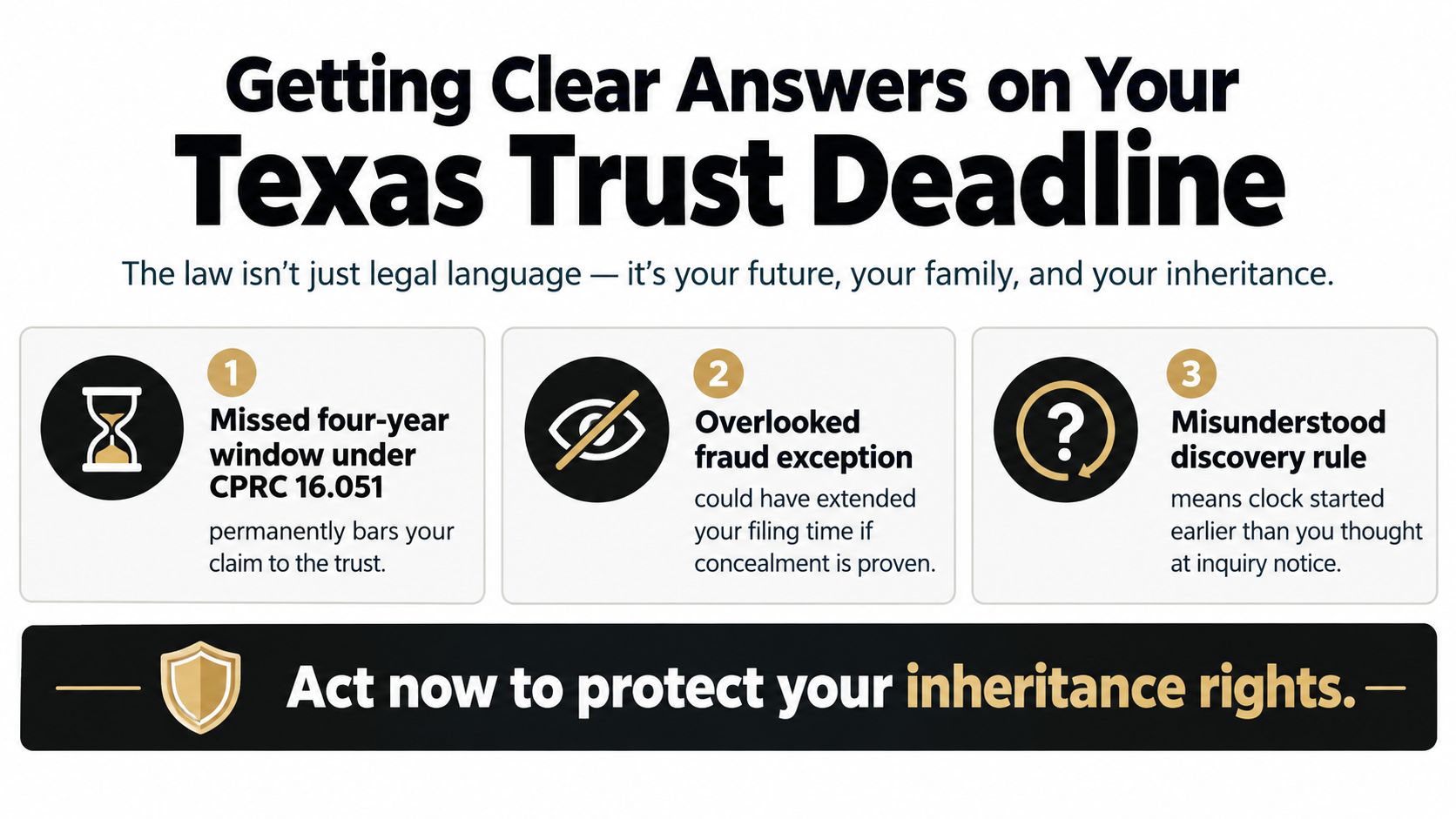
Every trust dispute is fact-specific. A written timeline, complete trust file, and prompt legal review can help a family understand its options before the trustee raises limitations as a defense. Trustees also benefit from early advice when a beneficiary questions distributions, fees, amendments, or administration.
If you're managing a trust or planning your estate, Law Office of Bryan Fagan, PLLC offers Texas guidance on trust administration, fiduciary duties, estate planning, probate, guardianship, asset protection, and trust disputes. Schedule a free consultation so an attorney can review your documents, identify the likely trigger dates, and help you protect your legal position.