Managing a loved one's trust can feel overwhelming, especially when you're suddenly the person everyone expects to keep records, answer questions, and make decisions the right way. If you've just stepped into that role, the good news is that Texas law gives you a clear framework. A trustee in Texas is not expected to guess, and the job is not based on vague good intentions alone. It runs through the trust document, the Texas Trust Code, and common-law fiduciary principles that together define fiduciary duties in Texas and set the baseline for nearly every trust administration task.
For a first-time trustee, the first question is usually simple, even if the answer has layers. What exactly do I have to do, and how careful do I need to be? Under Texas Property Code § 113.051, a trustee must administer the trust in good faith according to the trust's terms and the Texas Trust Code, and if the document doesn't change the rule, common-law duties still apply. That means trustee conduct is judged against a legal standard, not a family hunch.
A useful way to think about it is this. The trust instrument is the starting point, the Texas Trust Code fills gaps, and common-law fiduciary duties control what's left. If you're comparing trust administration rules with other systems, even resources such as tax planning with Australian trusts can help you see how much the governing document matters, but Texas trustee duties have their own statutory structure and expectations. For Texas families, that structure gives beneficiaries enforceable rights even when the trust is quiet on day-to-day administration.
When a Loved One Names You as Trustee in Texas
A daughter opens the trust paperwork after her father's funeral and sees her own name listed as successor trustee. She didn't ask for the job, but now she's the one who has to locate the accounts, speak with beneficiaries, and make sure the trust property is handled properly. That's a common Texas family situation, and it's exactly where confusion starts if no one explains the rules in plain English.
Start with the hierarchy of authority
Texas trustee duties come from three layers. First is the trust instrument, meaning the written trust terms. Second is the Texas Trust Code, which supplies default rules. Third are common-law fiduciary principles, which still matter when the document and the statute are silent.
That hierarchy matters because it tells you what to do when the trust is unclear. Texas law says the trustee must perform the duties imposed by common law unless the trust instrument or the Code says otherwise, so the law doesn't leave a trustee adrift. In practice, that means a trustee should read the trust first, then check the Code, then rely on fiduciary basics like care, loyalty, and impartiality when needed.
Practical rule: if the trust says nothing about a task, assume you still have a duty to act carefully, document your choices, and keep beneficiaries reasonably informed.
A first-time trustee should spend the first few days gathering the trust, death certificate, asset statements, and contact information for beneficiaries. If you want a structured starting point, the firm's guide, First Steps for a Successor Trustee in Texas, fits naturally into that early checklist. A Texas trust administration lawyer can also help sort out what authority the trustee has on day one, especially when real estate, retirement accounts, or family conflict are already in the mix.
The key takeaway is simple. Being named trustee is not a ceremonial title. It's a legal role with real duties, and Texas law gives beneficiaries a way to enforce those duties if the trustee drifts off course.
The Three Core Fiduciary Duties Every Texas Trustee Must Understand
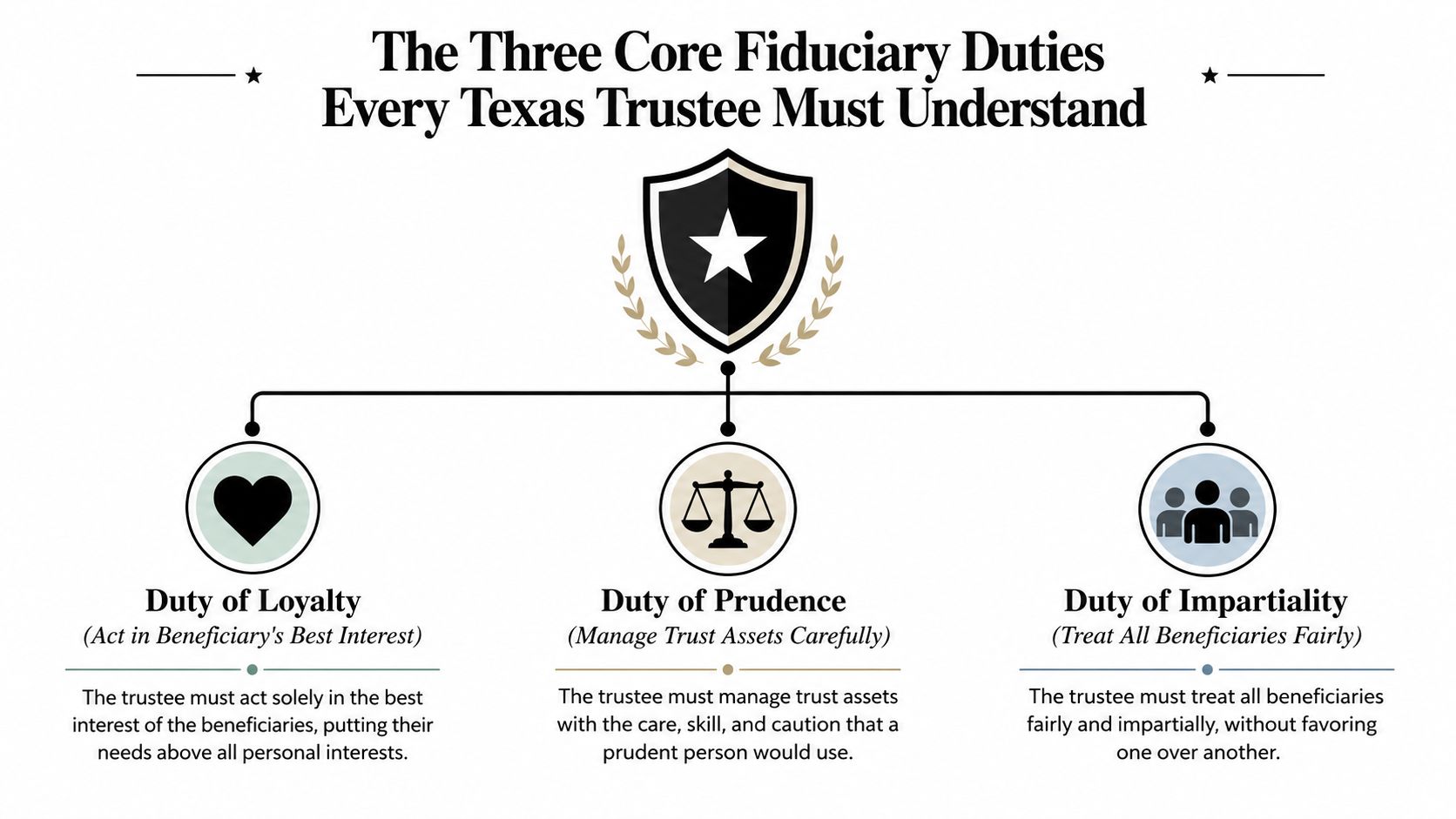
The heart of texas trust code trustee duties is easy to describe and hard to fake. A trustee must act for the beneficiaries, manage trust property carefully, and stay fair when more than one person has a stake in the outcome. Texas Trust Code section 117.007 captures the duty to invest with beneficiary interests first, and section 117.008 requires impartiality when there are two or more beneficiaries. Those two provisions give courts a strong statutory anchor when a trustee's behavior is challenged.
Loyalty means the trust comes first
Loyalty means the trustee can't use the trust like a personal side account. If a trustee owns a company and wants the trust to buy property from that company, the conflict is obvious. The question becomes whether the trustee is acting for the beneficiaries' benefit or trying to help the trustee's own pocket.
Texas law's accountability rule reinforces that point. Under Property Code § 114.001, a trustee is accountable to the beneficiary for trust property and for any profit made through or arising out of trust administration, even if that profit didn't come from a breach. That is why undisclosed self-dealing is such a serious problem in trust litigation.
Prudence means you manage, not improvise
Prudence is the care a careful person would use with important property. A trustee doesn't have to predict the market, but the trustee does have to pay attention, compare choices, and avoid careless decisions that put trust assets at risk. If there are brokerage assets, rental property, or a closely held business, prudence means the trustee documents why a decision was made, not just what happened.
The Fiduciary Duties of a Texas Trustee describes the core duties of loyalty, prudence, and impartiality under the Trust Code, and that's exactly the framework courts rely on when they test conduct.
Impartiality means no beneficiary gets the whole story
If one beneficiary wants immediate income and another is supposed to receive what remains later, the trustee can't favor one side just because that person is louder or easier to deal with. Texas Trust Code § 117.008 requires impartiality, which means the trustee must manage the trust as a whole. The trustee is not a family peacemaker, but the trustee is a neutral decision-maker.
The plain-English test is straightforward. If your decision helps one beneficiary but harms another without a recognized legal reason, stop and look again. A trustee who follows that habit usually avoids the kind of trouble that leads to litigation.
Duty to Administer the Trust and Duty to Inform and Account
A trustee can mean well and still get in trouble by keeping poor records or going quiet. Texas Property Code § 113.051 sets the starting rule, the trustee must administer the trust in good faith according to the trust's terms and the Code, and common-law duties still apply unless changed. That's why good administration is more than a mindset. It's a paper trail.
What a beneficiary can reasonably expect
Texas law does not create a universal rule that every trust must produce periodic accountings. If the trust instrument doesn't require regular reports, the trustee is not automatically on a fixed annual schedule. Even so, trustees still must keep beneficiaries reasonably informed of material facts, provide information on request, and allow inspection of non-privileged books and records on a reasonable basis.
Texas law also requires a written statement of account upon written demand. The accounting content is specific enough to let a beneficiary reconcile what happened in the trust. Under the statutory framework, that means trust property acquired since the last inventory, receipts, disbursements, and other account components that show the trust's activity. A useful overview is available in what is trust accounting, especially for trustees who need to understand how formal reporting and records fit together.
A trustee who can't explain the money trail is usually a trustee who should expect questions.
A simple table for written accountings
| Required Element | What It Shows the Beneficiary |
|---|---|
| Trust property acquired since the last inventory | What assets came into the trust |
| Receipts | What money or value came in |
| Disbursements | What money went out |
| Other account components | How the trust's balance changed over time |
A Texas-family example
A trustee receives a written demand from an adult beneficiary who wants to understand why a rental property repair bill was paid from the trust. The right response is not silence or a defensive phone call. The right response is to gather the invoices, ledger entries, and supporting records, then provide a formal accounting within the statutory framework.
That response protects everyone. The beneficiary gets information, and the trustee creates a record showing the decision was documented, traceable, and made in good faith.
A Realistic Timeline for Trustee Compliance in the First Year
The first year is where many trustees either build good habits or create avoidable problems. Consider a family trust with a house, a brokerage account, and two adult beneficiaries. One beneficiary wants quick distributions, the other wants to preserve the assets for long-term value. The trustee's job is to slow down, organize the records, and keep the process visible.
Month one is about control, not speed
The trustee should identify the assets, confirm title, collect statements, and set up separate trust records. If the trust owns real estate, the trustee should track taxes, insurance, maintenance, and any repairs in the same file. If the trust holds market investments, the trustee should document who is handling the account and what instructions were given.
Months two through six should build the record
This is the rhythm that keeps trouble down. Major decisions should be written down, invoices should be stored, and beneficiary communications should be saved. If a beneficiary asks a question, the trustee should answer in writing when the issue affects administration or rights.
A clean monthly habit is better than a scramble later. The trustee should reconcile account activity, keep copies of vendor bills, and note when distributions are made. That kind of recordkeeping matters because it gives the trustee a defensible story if a later dispute develops.
When the accounting demand arrives
If a beneficiary sends a written demand for an accounting, the trustee should treat it as a compliance trigger, not a nuisance. Pull the ledger, compile the required account details, and review whether the trust instrument requires any more specific reporting. If the beneficiary later asks to inspect non-privileged books and records, a reasonable response usually includes organized access, not a delay that makes the request harder to satisfy.
Consistency beats improvisation here. If the trustee has already kept the records in order, the accounting process is much less stressful and much less expensive than trying to recreate months of activity after the fact.
Delegating to Professionals Without Losing the Fiduciary Role
Few trustees can handle tax filings, deed issues, business records, and investment questions alone. Texas law recognizes that reality. Property Code § 113.018 expressly authorizes a trustee to hire outside help, including attorneys, accountants, agents, investment agents, and brokers, when reasonably necessary to administer the trust estate. That authority is practical, not optional.
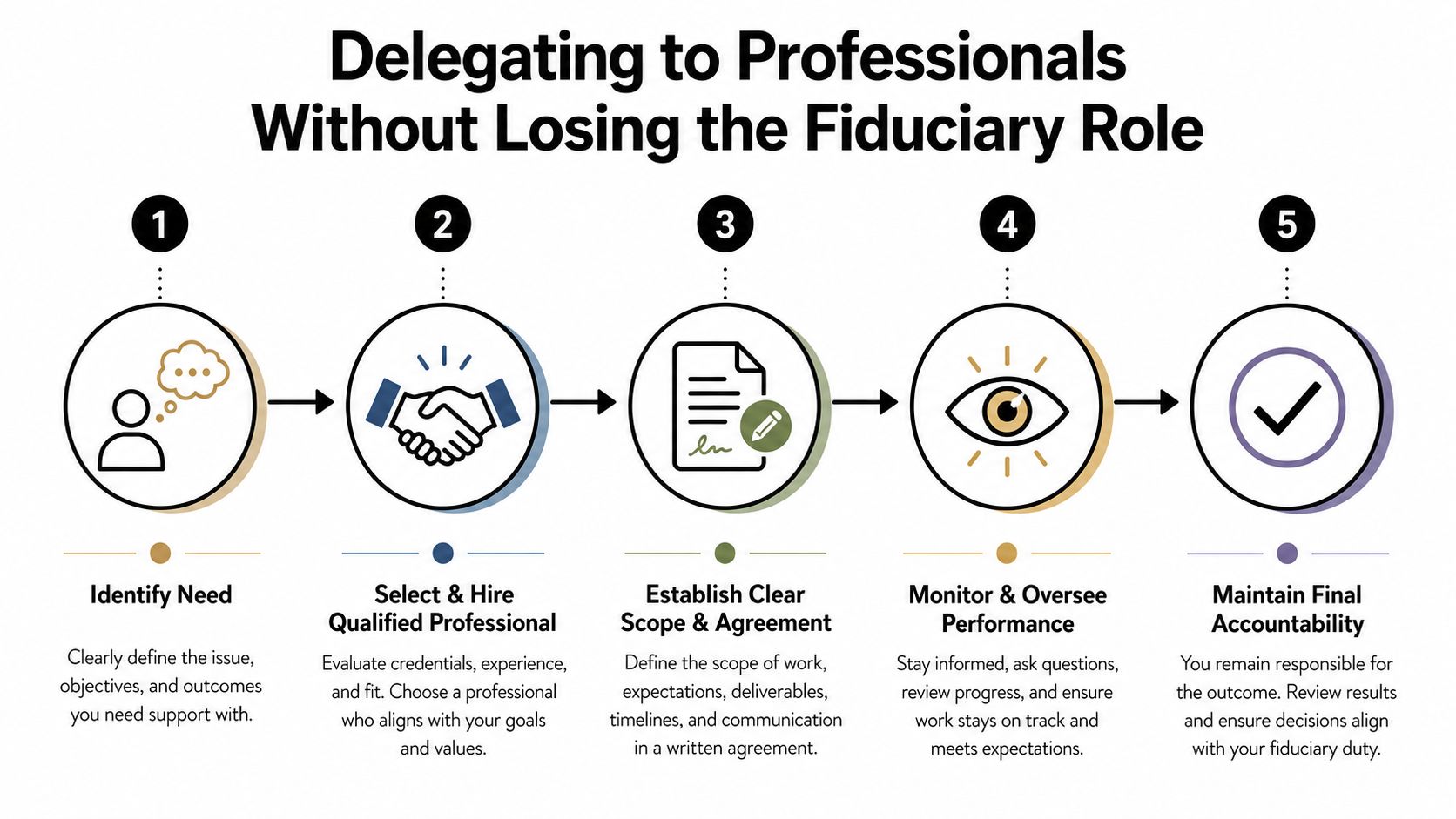
The mistake many trustees make is assuming delegation erases responsibility. It doesn't. The trustee still holds the fiduciary role, still must act in good faith, and still remains accountable for the overall administration. Delegation is a tool, not a shield.
A careful trustee starts by identifying the task that needs outside expertise. Then the trustee selects a qualified professional, sets a clear scope, and keeps records of the work performed. If a CPA handles trust tax issues, the trustee should keep the engagement letter, billing records, and the final filings. If an investment agent manages a portfolio, the trustee should document how that person was chosen and what oversight the trustee performed.
Real-world point: hiring a professional helps most when the trustee can show supervision, not just hiring.
This is also where a Texas estate planning attorney can be useful before a dispute starts. A lawyer can help a trustee decide whether a real estate sale, distribution plan, or beneficiary request fits the trust terms. The same careful approach applies when a trustee needs help in related areas such as estate planning, probate, guardianship, or asset protection, because each of those topics can affect how a trust is administered and defended.
The main idea is simple. A trustee can delegate work, but not judgment. The trustee has to know what the professional is doing, why it matters, and how it supports the trust's best interests.
What Beneficiaries Can Do When a Trustee Crosses the Line
When a trustee mishandles trust property, Texas law gives beneficiaries real remedies. The most important one is accountability. Under Property Code § 114.001, a trustee can be required to account for trust property and for any profit made through administration, even if the profit didn't come from a breach. That rule is one reason beneficiaries take records so seriously.
The main remedies in plain English
If a trustee uses trust money to pay a personal expense, a court can order repayment or other relief tied to the improper use. If a trustee refuses to respond to a written accounting demand, a beneficiary can seek a court order compelling disclosure. If the trustee keeps favoring one child over another or refuses to follow the trust terms, removal becomes a real possibility. Injunctive relief can also stop conduct that would cause more harm while the dispute is pending.
A useful resource for families dealing with a dispute is beneficiary suing trustee Texas, because it frames the kinds of issues that often move from frustration into litigation.
A few fact patterns courts care about
A trustee who buys groceries with trust funds for personal use is not just making a bad decision, the trustee is inviting a surcharge claim. A trustee who ignores repeated written requests for an accounting is creating a record problem that can lead to court intervention. A trustee who distributes trust property to one beneficiary while leaving another out, without a legal basis, risks a claim for breach of impartiality.
The court usually looks for the same things across these disputes. Was the decision documented? Did the trustee follow the trust terms? Did the trustee keep beneficiaries reasonably informed? Did the trustee profit from the administration in a way the law does not allow?
Documentation often decides the tone of the case. A trustee with clean records can explain a hard decision. A trustee with no paper trail usually has a much harder time.
Common Trustee Pitfalls and When to Call a Texas Trust Lawyer
The most common trustee mistakes are usually ordinary, not dramatic. A trustee commingles personal and trust money, fails to answer document requests, leaves a self-dealing transaction undisclosed, or lets records get messy until no one can tell what happened. Each one raises the risk of surcharge, removal, or a fight over whether the trustee acted in good faith.
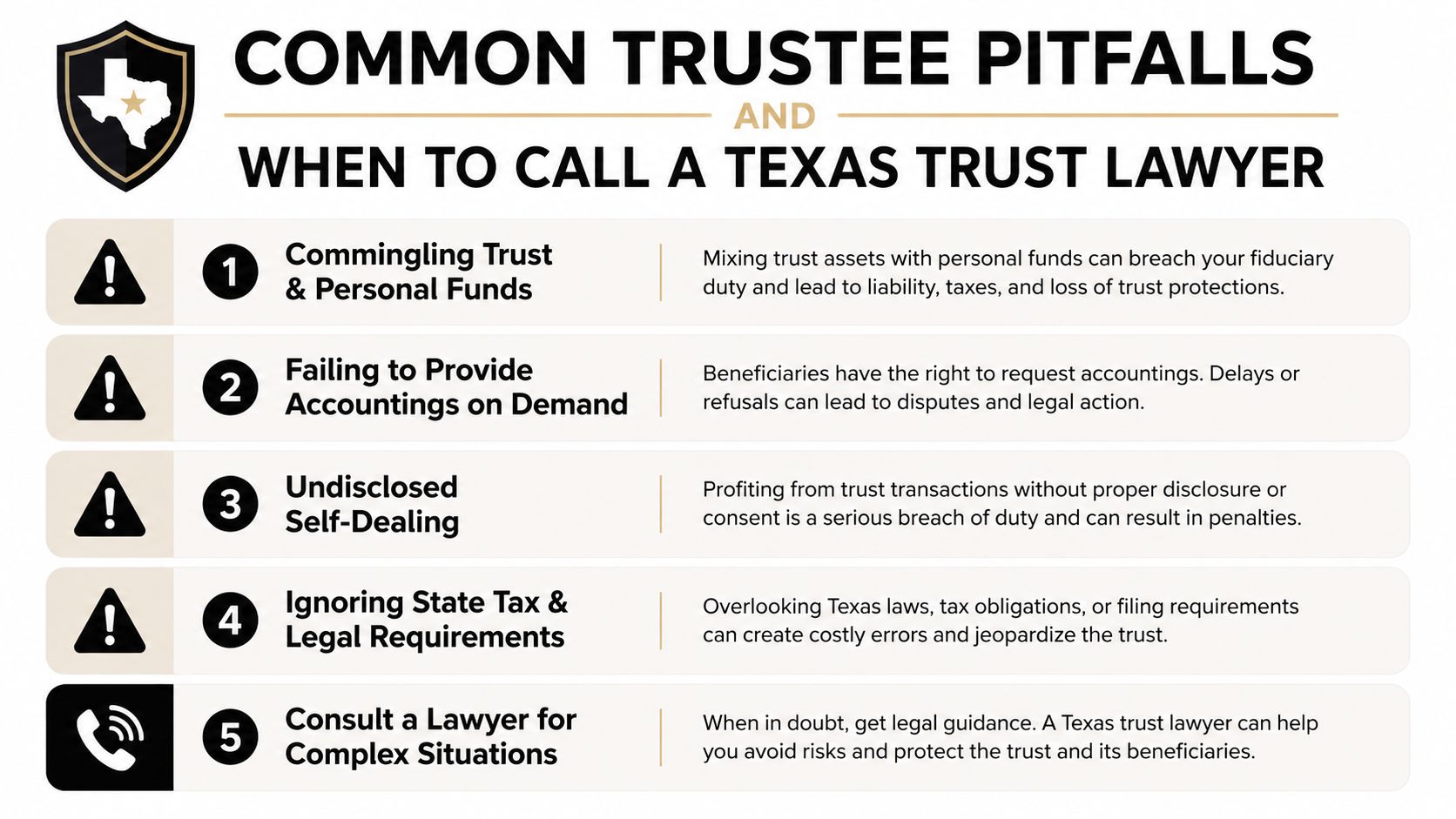
A trustee should call a lawyer sooner, not later, when the trust instrument is silent on an important issue, when the beneficiaries are asking for records, or when a tax or property question is more complicated than a routine distribution. That is especially true if a sale, division, or family disagreement could become a dispute. A calm review at the start is usually cheaper than trying to fix a mistake after emotions harden.
The right lawyer is not there to make the trustee defensive. The lawyer is there to translate the trust terms, the Texas Trust Code, and the practical consequences into a plan the trustee can follow. That is where a Texas trust administration lawyer becomes useful, because the trustee gets guidance before a problem turns into a claim.
If you are also trying to understand broader fiduciary duties in Texas, a trust lawyer can help explain where the trustee's obligations end and where professional judgment begins. In many families, that same conversation overlaps with probate or long-term estate planning, which is why early advice often protects both the trustee and the beneficiaries.
Putting It All Together and Getting Trusted Texas Guidance
A Texas trustee does not need to master every legal doctrine on day one. The job gets manageable when you follow the same pattern every time, read the trust, follow the Texas Trust Code, rely on common-law fiduciary duties where needed, document decisions, and keep beneficiaries reasonably informed. Once those habits are in place, trust administration becomes less intimidating and much easier to defend.
If you're serving as a trustee, or you're a beneficiary trying to understand whether a trustee is meeting the standard, a Texas-based lawyer can help you sort out the facts and the next step. The right guidance can also prevent small problems from becoming trust disputes, especially when the trust holds real estate, business interests, or assets that need careful tax planning.
If you're managing a trust or planning your estate, contact The Law Office of Bryan Fagan, PLLC for a free consultation. Our attorneys provide trusted, Texas-based guidance for every step of the process, including trust administration, fiduciary disputes, and related estate planning concerns. Visit Law Office of Bryan Fagan, PLLC to get clear next-step advice for your situation.