Under Texas Property Code Section 115.001, district courts have original and exclusive jurisdiction over most trust proceedings unless a specific statute assigns authority elsewhere. That rule makes the district court the default statewide forum for core Texas trust disputes.
Managing a loved one's trust can feel overwhelming, especially when a beneficiary demands an accounting, a trustee refuses to act, or a family dispute involves both a trust and an estate. The first question often sounds simple, but it has two parts: which court has jurisdiction, and which county is the proper venue?
Those questions are different. Jurisdiction concerns the court's legal power to hear the dispute. Venue concerns the proper location for filing. Understanding both helps trustees, executors, beneficiaries, and families avoid procedural mistakes while protecting fiduciary rights and trust assets.
Understanding District Court Jurisdiction Over Texas Trusts 115.001
Texas Property Code Section 115.001 establishes a broad rule. A Texas district court has “original and exclusive jurisdiction” over proceedings by or against a trustee and proceedings concerning trusts. The statute identifies examples such as interpreting a trust, appointing or removing a trustee, determining trustee liability, requiring an accounting, and surcharging a trustee. The full text of Section 115.001 also states that the listed proceedings aren't exhaustive.
That structure makes a district court the default forum for a trust controversy unless another law creates an exception. The court may also exercise the powers of a court of equity in trust matters. In practical terms, a judge may address equitable remedies alongside statutory claims, depending on the facts and the relief requested.
Why the rule matters
Suppose a beneficiary believes the trustee sold trust property below market value and refuses to explain the transaction. The beneficiary may seek an accounting, ask the court to determine whether the trustee breached fiduciary duties in Texas, and request a surcharge for losses caused by the breach. Those requests concern trust administration and trustee obligations, so Section 115.001 provides the starting point for identifying the court with authority.
A trustee faces a different concern. A beneficiary may label a dispute as a trust case even when the requested relief concerns an unrelated personal injury or business dispute. Texas courts have used the statute to distinguish claims that directly concern trust administration from tort claims that merely involve a trustee as a party. The central question is often whether the requested relief affects trust administration, distribution, or trustee obligations.
Practical rule: Start with the relief requested, not just the names of the parties. A case involving a trustee isn't automatically a trust proceeding.
A jurisdiction checklist
Before filing, identify:
- The legal claim: Is the request for an accounting, trustee removal, construction, instructions, liability findings, or another trust-related remedy?
- The source of authority: Does Section 115.001 apply, or does another statute give a probate or specialized court concurrent authority?
- The requested remedy: Would the order change trust administration, distributions, or fiduciary conduct?
- The possible exception: Is the dispute connected to an estate proceeding in a county with a statutory probate court?
A Texas trust administration lawyer can help separate subject-matter jurisdiction from the merits of the dispute. The court must have authority before it can decide whether the trustee acted properly.
The Ten Enumerated Proceedings and Beyond
Section 115.001 identifies 10 categories of trust proceedings, while expressly stating that the list isn't exhaustive. The statute's design gives readers useful examples without limiting district-court authority to a fixed checklist. The Texas Supreme Court's discussion of the statute describes district courts as having original and exclusive jurisdiction over proceedings concerning trusts and identifies several of the listed matters.
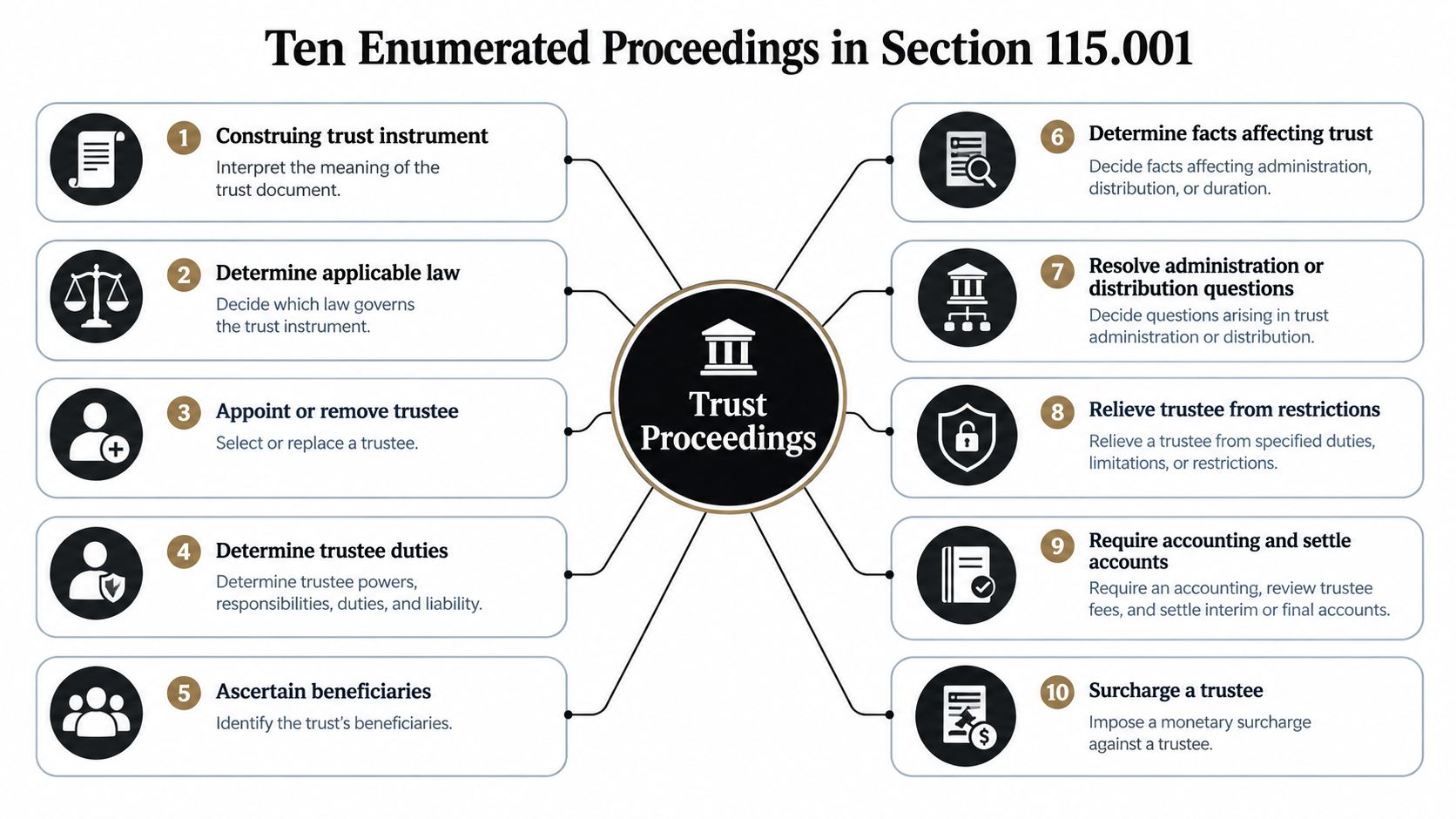
The categories include:
- Construing a trust instrument, which means asking the court to interpret unclear language.
- Determining the validity of a trust, when someone questions whether the trust was properly created.
- Determining the validity of a provision, when a particular clause is challenged.
- Determining the powers, responsibilities, duties, or liability of a trustee, including whether fiduciary obligations were breached.
- Ascertaining beneficiaries, when the parties disagree about who is entitled to receive benefits.
- Determining a trustee's compensation, when compensation is disputed.
- Appointing a trustee, when the trust lacks a functioning trustee.
- Removing a trustee, when the trustee's conduct, incapacity, or conflict supports removal.
- Requiring or reviewing an accounting, when beneficiaries need information about trust property and transactions.
- Surcharging a trustee, when the court is asked to impose financial responsibility for a loss.
Why “not exhaustive” changes the analysis
The non-exhaustive language means a dispute doesn't fall outside district-court authority merely because it doesn't match one label. A beneficiary might seek instructions about a proposed distribution, challenge the way a trustee applies a discretionary standard, or ask for relief concerning trust administration that combines several issues.
The court still must analyze the actual claim. A pleading that mentions a trust doesn't automatically transform every related dispute into a proceeding concerning a trust. The requested relief and the connection to fiduciary administration remain important.
A successor trustee who has just accepted the role may need immediate help identifying records, securing assets, and understanding ongoing duties. The resource First Steps for a Successor Trustee in Texas addresses what to do immediately after stepping into the trustee role.
An accounting request illustrates the practical effect of the statute. A beneficiary may ask the court to require records, while the trustee may need to explain investments, distributions, expenses, and communications. A petition for an accounting in a Texas trust should match the requested relief to the governing trust documents and applicable law.
The district court's authority therefore reaches beyond the ten examples. It provides a forum for core trust controversies while leaving room for courts to address new or differently framed administration disputes.
District Courts vs Probate Courts in Trust Disputes
While Section 115.001 establishes district courts as the default forum for many trust proceedings, Texas law recognizes an important exception. A statutory probate court may share authority over certain trust matters. Texas Estates Code Section 32.007 gives that court concurrent jurisdiction with the district court over an action by or against a trustee and an action involving an inter vivos, testamentary, or charitable trust. The Texas Estates Code provision on trust jurisdiction matters especially when trust questions arise alongside estate administration.
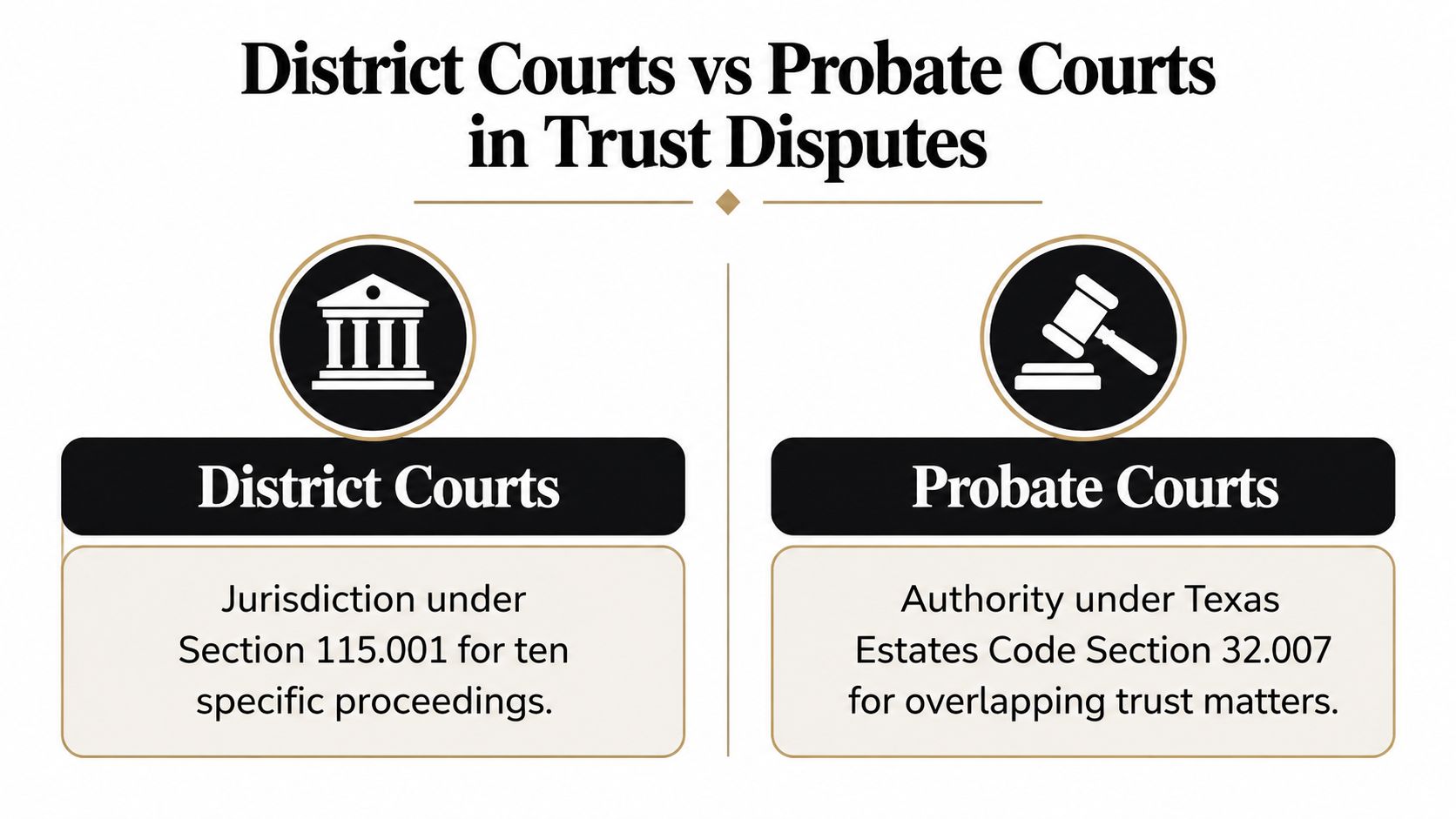
The two forums can be compared as follows:
| District court | Statutory probate court |
|---|---|
| Section 115.001 provides the general rule of original and exclusive jurisdiction. | Section 32.007 may provide concurrent authority over trust matters. |
| It commonly handles core trust litigation when no statutory exception applies. | It may hear trust disputes connected to probate or other matters within its statutory jurisdiction. |
| The case may focus on trustee conduct, trust interpretation, or administration. | The case may combine estate, will, executor, and trust issues. |
When the probate court may matter
Suppose a decedent's will directs assets into a revocable trust. A beneficiary challenges the executor's administration and also alleges that the trustee mishandled the assets after transfer. If the probate court has statutory authority, filing there may allow the related issues to proceed together rather than in separate forums.
A contested estate can create a similar overlap when a statutory probate judge is already handling related matters that include trust claims. The trust's existence does not by itself remove probate-court authority where the Estates Code grants concurrent jurisdiction.
The term “probate court” can cause confusion. It may refer informally to a county court handling estate matters, but the label alone does not establish jurisdiction. The relevant question is whether the particular court has the statutory status and authority required by law.
A practical comparison
A stand-alone accounting dispute involving a living trust may point first to Section 115.001 and district court jurisdiction. If the same trust is connected to an active estate administration, the filing analysis should also examine Section 32.007, the county's court structure, and how the claims relate to one another.
Court selection depends on the statutes and the case's connection to estate administration. Do not assume that a trust label alone answers the question.
Trustees and beneficiaries should identify every related estate, probate, and trust proceeding before filing. Guidance on trust versus probate in Texas can help clarify whether the dispute belongs in district court, probate court, or a court with overlapping authority.
Mandatory Venue Rules and Filing Strategy
A trust dispute can clear the jurisdiction question and still begin in the wrong county. Jurisdiction asks whether a court has authority to hear the case. Venue asks which county is the proper place to file it. The two questions work like separate gates, and a filing must pass through both.
Texas venue analysis starts with the trust's place of administration and the trustee structure. Under Section 115.002, a case involving one noncorporate trustee must generally be filed in the county where that trustee resides or has resided at any time during the four years before filing. The Texas venue statute for trust proceedings supplies the governing text.
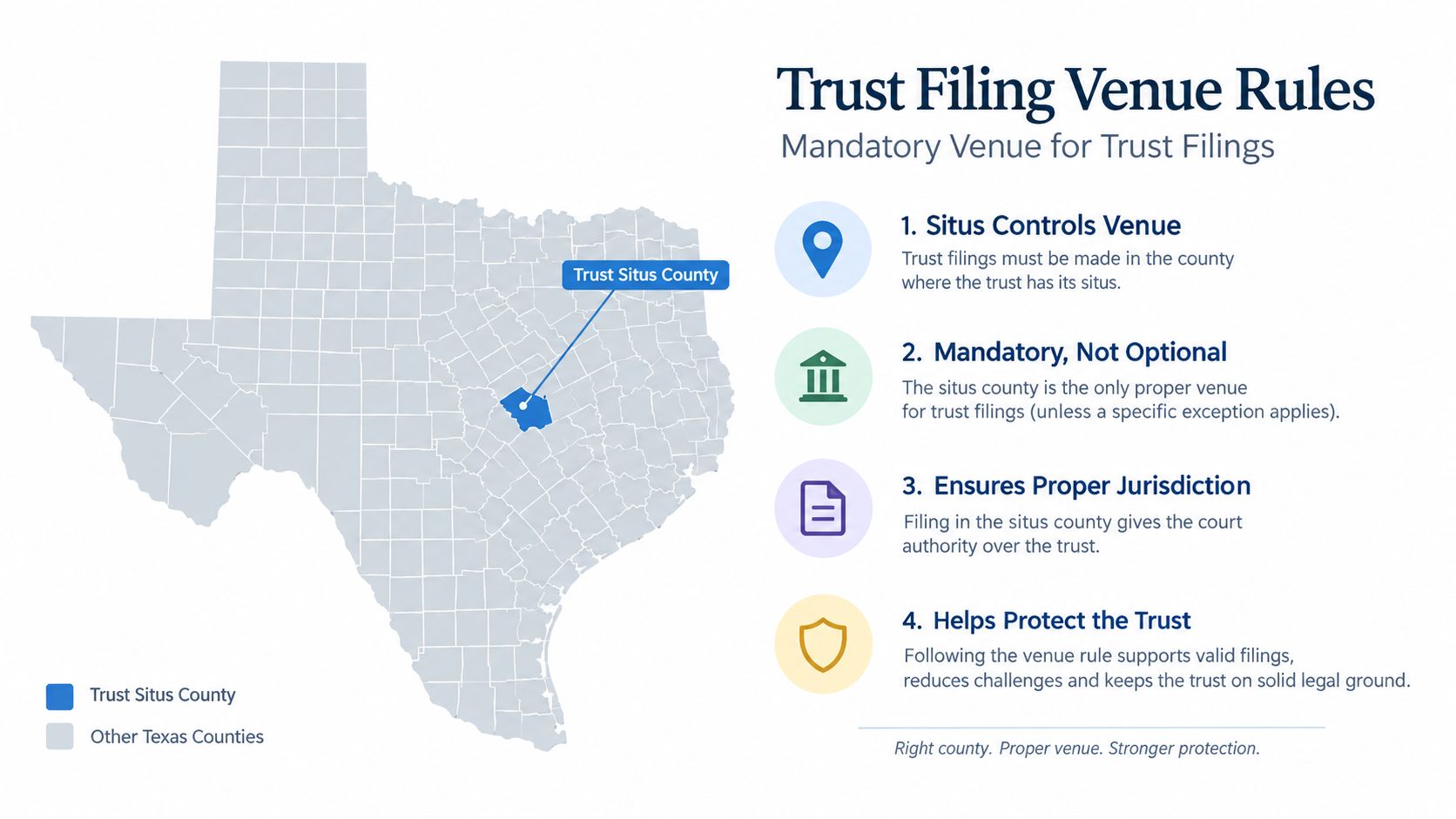
Use this filing sequence
- Read the trust document. Find the stated place of administration, trustee provisions, governing-law language, and any situs clause.
- Identify every trustee. Determine whether the fiduciary is an individual, a corporate trustee, or one of several co-trustees.
- Document residence history. For one noncorporate trustee, verify the current residence and any qualifying prior residence during the statutory period.
- Analyze co-trustees. With multiple trustees, venue is generally proper in a county where at least one trustee resides or has resided during that period.
- Check related proceedings. Review any estate case, statutory probate court proceeding, or other trust action that may affect where the dispute should be filed.
- Confirm the requested relief. The petition should describe a genuine trust-administration dispute, not merely an unrelated claim involving a trustee.
Venue defects commonly result in transfer rather than dismissal. A jurisdictional defect raises a different problem because it concerns the court's power to decide the case. That distinction can affect deadlines, litigation expense, and the response to a venue or jurisdiction challenge.
Before filing, preserve records supporting the selected county. These may include administrative records, trustee appointment documents, residence information, estate filings, and communications showing where administration occurs. A careful filing strategy connects the district court's authority with the probate court's possible role, then places the case in the county required by the venue statute.
Real-World Trust Dispute Scenarios
A beneficiary receives incomplete financial records after asking the trustee to explain distributions. The trustee says the trust allows discretion and refuses to provide more information. The beneficiary's proposed case seeks an accounting and a determination of trustee duties. Those requested remedies fit the core trust proceedings described by Section 115.001, so the district court is the natural starting point, subject to any statutory exception.
The beneficiary still must address venue. If the trust has one individual trustee, the filing team should verify the trustee's residence and qualifying residence history before selecting the county. Filing in a county connected to the beneficiary, rather than the trustee or trust administration, may invite a venue challenge.
A removal dispute
A co-trustee uses trust funds for personal expenses and stops communicating with beneficiaries. The beneficiaries seek removal, a liability determination, and a surcharge. These claims may arise together because the court can address who should serve, whether the trustee violated fiduciary duties in Texas, and whether the trust suffered a loss.
The pleadings should separate each requested remedy. A removal request concerns the trustee's role. An accounting request concerns transparency and records. A surcharge request concerns financial responsibility. Clear drafting helps the judge understand both the trust controversy and the relief sought.
A combined estate and trust conflict
An executor and trustee disagree about whether assets belong to an estate or an inter vivos trust. Beneficiaries challenge estate documents while also disputing trust transactions. Because the conflict involves both estate administration and trust activity, counsel should examine whether a statutory probate court has concurrent jurisdiction under Estates Code Section 32.007.
The family shouldn't choose a court based only on convenience or the title of the lawsuit. The court structure, the related probate proceeding, the trust documents, and the requested orders all matter. A coordinated filing strategy can reduce inconsistent rulings and duplicated proceedings.
These examples also show why jurisdiction isn't a substitute for careful administration. Trustees should preserve records, communicate appropriately, and avoid transactions that create avoidable conflicts. Beneficiaries should identify the specific information or remedy they need instead of relying on broad accusations.
Practical Guidance for Trustees and Beneficiaries
The safest approach is to create a written jurisdiction and venue file before anyone files a petition. That file should connect the trust document, the trustee structure, the requested remedies, and the possible court options.
For trustees
- Secure the governing records: Keep the trust instrument, amendments, account statements, deeds, tax records, distribution history, and trustee communications together.
- Separate trust and personal property: Maintain clear records showing which assets belong to the trust and which belong to the trustee individually.
- Explain decisions carefully: When exercising discretion, record the purpose of the distribution, the information considered, and the connection to the trust terms.
- Respond to concerns promptly: A beneficiary's request may identify an administration problem before it becomes litigation.
- Review the filing location: Confirm the trustee's residence history, co-trustee structure, trust situs, and any related probate case.
For beneficiaries
- Define the problem: Decide whether you need an accounting, instructions, trustee removal, construction of the trust, or another remedy.
- Gather documents: Preserve statements, letters, texts, notices, and records showing what the trustee did or failed to do.
- Identify all interested parties: A court may need notice to trustees, beneficiaries, executors, or other people affected by the requested order.
- Check for an estate case: Search for related probate filings and determine whether a statutory probate court may have concurrent authority.
- Avoid premature allegations: State the facts, identify the trust provision involved, and connect the requested remedy to those facts.
A Texas estate planning attorney can also help families reduce future uncertainty through trust design, beneficiary planning, tax planning, and asset protection. During administration, counsel may coordinate with accountants and financial advisors so fiduciary decisions, tax filings, distributions, and records support one consistent plan.
Trust disputes don't always require immediate litigation. A structured request for information, a trustee meeting, mediation, or a negotiated interpretation may resolve the issue. If court action is necessary, early analysis gives the trustee or beneficiary a clearer path.
When to Seek Legal Counsel and Next Steps
Trustees should seek advice before making a disputed distribution, declining an accounting request, or accepting a new fiduciary role. Beneficiaries should seek advice when records are missing, trust language is unclear, assets may be at risk, or a related probate case exists. The guide on when to hire a trust administration attorney in Texas can help you evaluate timing.
If you're managing a trust or planning your estate, contact The Law Office of Bryan Fagan, PLLC for a free consultation. Our attorneys provide trusted, Texas-based guidance for every step of the process.
The Law Office of Bryan Fagan, PLLC helps trustees, beneficiaries, executors, and families evaluate jurisdiction, venue, fiduciary duties, trust administration, probate, estate planning, guardianship, and asset protection concerns. Visit Law Office of Bryan Fagan, PLLC to schedule a free consultation and discuss the facts of your Texas trust or estate matter.