Managing a loved one's trust can feel overwhelming. You may have noticed that an expected distribution never arrived, or you may be a successor trustee trying to understand transactions made before you took over. When money, real estate, or family relationships are involved, uncertainty can quickly become fear.
Texas law gives beneficiaries and trustees a structured way forward. Texas Property Code § 114.008 provides a broad set of remedies for an actual or threatened breach of trust, including court orders that prevent further harm and remedies that restore trust property after a loss. Understanding the difference can help you act promptly without assuming the worst.
When a Texas Trust Goes Wrong and What Remedies Mean
Consider a family trust holding a Texas home, investment accounts, and proceeds from a business sale. The trustee tells one beneficiary that the trust has “administrative issues” and delays a distribution. Later, the beneficiary learns that trust property may have been transferred without a clear explanation. A successor trustee then discovers incomplete records and isn't sure whether the earlier trustee followed the trust document.
That situation doesn't automatically prove misconduct. A trustee may have made a reasonable decision, encountered a legitimate delay, or misunderstood an administrative duty. But beneficiaries aren't required to wait until trust assets disappear before asking a court to protect them.
A breach of trust occurs when a trustee fails to perform duties imposed by the trust document, the Texas Trust Code, or fiduciary principles. Those duties commonly include loyalty, prudent administration, impartial treatment of beneficiaries, and appropriate disclosure. The Texas Estates Code may also become relevant when trust issues overlap with a decedent's estate, probate administration, or an executor's conduct.
Threatened and completed breaches
A completed breach might involve an unauthorized transfer, an improper distribution, or a loss caused by careless administration. A threatened breach is different. It may involve a trustee preparing to sell property, move funds, or take an action that could violate fiduciary duties.
Section 114.008 addresses both situations. Its preventive language allows a beneficiary to seek relief when a breach “has occurred or might occur” under Texas Property Code § 114.008. That gives courts a way to act before further damage occurs.
The remedy depends on what happened and what can still be recovered. An injunction may be appropriate when misconduct is imminent. An accounting may be the first practical step when the records are unclear. If property remains identifiable, restoration or voiding a transaction may be stronger than a claim for money alone. If property was sold or mixed with other funds, tracing and a constructive trust may become more important.
This guide focuses on the remedies for breach of trust in Texas under Section 114.008, how courts use them, and what beneficiaries and trustees should do before a dispute becomes harder to resolve.
Understanding Texas Property Code Section 114.008 in Plain English
A trustee is preparing to sell trust real estate, and the beneficiary learns that the sale may violate the trust. Section 114.008 gives the court a way to respond before the proceeds disappear. It also provides remedies after a breach has caused harm. The statute lists 10 separate court remedies, rather than limiting a beneficiary to one form of relief (Texas Property Code § 114.008).
Preventive standard: A beneficiary may seek court relief when a breach “has occurred or might occur,” not only after a completed loss.
That timing can determine which remedy works. If trust property is still in the trustee's control, an injunction or other protective order may help preserve it while the court reviews the evidence. If money or property has already moved, restoration, tracing, or a constructive trust may be more useful. The key question is whether the asset, or its proceeds, can still be identified.
What the statute lets a court do
The statute covers several goals:
- Control conduct: The court may compel the trustee to perform a duty or enjoin conduct that violates the trust.
- Create transparency: The court may order an accounting showing receipts, payments, assets, liabilities, and compensation.
- Protect administration: The court may appoint a receiver or suspend or remove the trustee.
- Address compensation: The court may reduce or deny trustee compensation.
- Restore trust value: The court may void a trustee's act, impose a lien or constructive trust, trace wrongfully disposed property, or order other appropriate relief.
These remedies correspond to common fiduciary failures. A trustee who acts for personal benefit may breach the duty of loyalty. Careless asset management may violate the duty of prudence. Withholding important information may create a disclosure problem. Section 114.008 lets the court choose a response suited to the conduct, the urgency, and the property still available.
For readers learning how administration works and how it differs from probate, Texas Trust Administration: A Trustee's Guide offers a separate overview of those processes.
Protection for innocent outsiders
A beneficiary's remedy against a trustee does not automatically undo every transaction with another person. Section 114.008(b) protects a nonbeneficiary who, without knowledge of the trustee's overreach, in good faith assists the trustee or deals with the trustee for value. The law treats that person as though the trustee properly exercised the power.
Banks, title companies, buyers, and business counterparties may rely on this protection when they lack knowledge of the misconduct. A beneficiary may therefore have a claim against the trustee while an innocent third party keeps the benefit of the transaction.
Available Remedies for Breach of Trust Under Texas Law
Section 114.008 works as a toolkit. The right remedy depends on whether the problem concerns future conduct, missing information, trustee control, or property that needs to be restored. Courts may also combine remedies when one order alone won't protect the trust.
| Remedy | Purpose | When It Helps Most |
|---|---|---|
| Compel performance | Require the trustee to perform a trust duty | The trustee refuses to make a required decision, payment, or transfer |
| Enjoin misconduct | Stop or prevent improper conduct | Trust property is at immediate risk of unauthorized transfer or misuse |
| Order an accounting | Require financial disclosure | Beneficiaries can't determine what the trust owns or how funds were used |
| Appoint a receiver | Place trust property under court-supervised administration | Ongoing misconduct or disclosure failures threaten trust management |
| Suspend or remove the trustee | Change who controls administration | The trustee can't safely or effectively continue serving |
| Reduce or deny compensation | Address improper or unsupported fees | The trustee breached duties or failed to provide adequate administration |
| Void a trustee act | Undo an unauthorized transaction | A transfer violates the trust or fiduciary duties and remains legally challengeable |
| Impose a lien or constructive trust | Secure or recover value connected to misconduct | Trust assets or proceeds can be identified in another person's hands |
| Trace wrongfully disposed property | Follow property or its proceeds | Trust property was sold, transferred, or commingled |
| Grant other appropriate relief | Provide a remedy suited to the circumstances | The listed remedies don't fully address the harm |
Restoration and money damages
A beneficiary may need to choose between money damages and restoration of specific property. The Texas Supreme Court has recognized that when trust property remains in the trust, a beneficiary may elect between damages and restoration of the property itself, and it cited Section 114.008(a)(3) for the trustee's obligation to pay money or restore property (Texas Supreme Court opinion).
That distinction is practical. If a trustee improperly transfers a house and the house can still be identified, restoring the house or voiding the transfer may protect the trust better than assigning a value to it. If the house was sold and the proceeds were moved through multiple accounts, tracing and a constructive trust may offer the better route.
Receivership as a control-shift remedy
Texas appellate authority describes receivership under Section 114.008(a)(5) as a specialized trust remedy. It may operate outside the ordinary “danger of loss or injury” framework used in some other receivership disputes (Texas appellate authority on trust receivership).
A receiver can take possession of trust property and administer it while the dispute continues. That doesn't mean receivership is routine. It's a significant intervention, and the requesting party must present facts showing why ordinary oversight isn't enough.
If a trustee refuses a required distribution, beneficiaries may also review this discussion of remedies when a trustee won't pay out as part of evaluating the dispute.
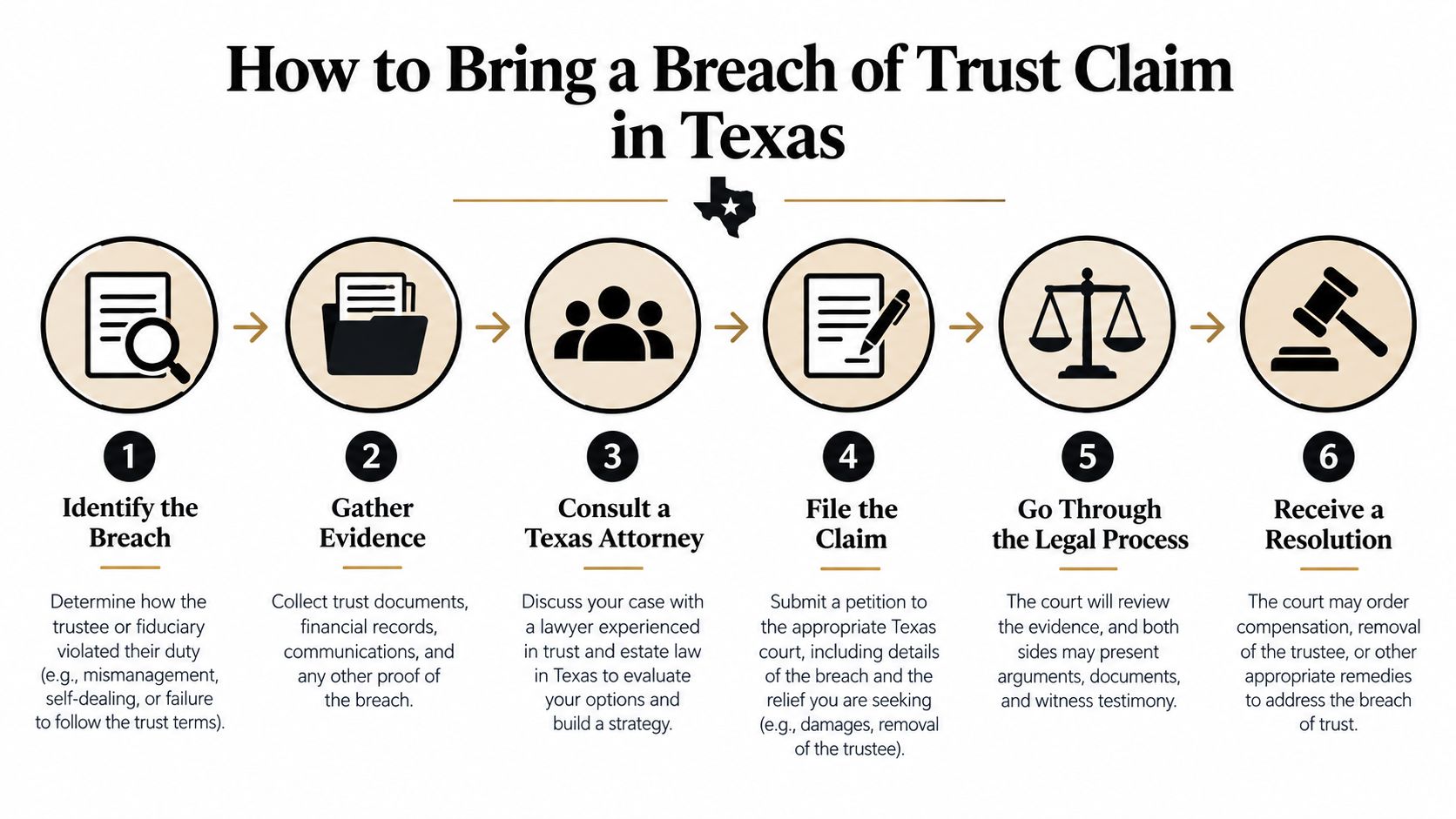
How to Bring a Breach of Trust Claim in Texas
A strong claim usually begins with organized facts, not accusations. Beneficiaries should preserve documents and identify the specific relief needed before filing. Trustees should take the same preparation seriously because a clear record can show that a disputed decision followed the trust terms and fiduciary duties.
Step 1, review the governing documents
Obtain the trust instrument, amendments, schedules of property, deeds, account statements, tax records, and prior accountings. Read the provisions addressing distributions, trustee powers, successor trustees, compensation, reporting, and dispute resolution.
Also identify whether the dispute overlaps with probate or an estate representative's conduct. An executor operates under the Texas Estates Code, while a trustee operates under the Texas Trust Code and the trust instrument. The roles can overlap in a family administration, but they aren't identical.
Step 2, make a focused written request
A beneficiary may begin with a written request for information or an accounting. Keep the request specific. Identify the trust, explain the requester's interest, describe the records sought, and preserve proof that the trustee received it.
A trustee who needs time to gather records should communicate clearly rather than remain silent. A partial response may not answer the key questions, especially if it shows balances but doesn't explain distributions, fees, transfers, or assets still held.
Step 3, match the pleading to the risk
A court petition should identify the alleged breach, the facts supporting it, and the remedies requested under Section 114.008. If assets may be transferred, ask counsel whether temporary injunctive relief is appropriate. If administration is failing, consider whether suspension, removal, or receivership fits the facts.
A beneficiary shouldn't wait for a final loss when evidence shows that property is at immediate risk. Preventive relief can preserve the trust while the court determines what happened.
Step 4, gather proof of causation and value
Bank records, deeds, closing statements, emails, tax documents, investment reports, and trustee communications may show what the trustee did. The claim must connect the conduct to the requested relief. For example, an unexplained payment may support an accounting request, but a surcharge claim generally requires evidence that the payment caused or reflects a loss to the trust.
Co-trustees and successor trustees may need to be included when their duties or access to records affect the court's ability to grant complete relief.
Step 5, prepare for hearing or settlement
Some disputes resolve after a formal demand and document exchange. Others require temporary orders, discovery, witness testimony, or trial. Attorney's fees and costs depend on the claims, the trust terms, the court's authority, and the facts. They should be evaluated as part of the litigation strategy, not assumed.
For a practical discussion of filing and pursuing claims against a trustee, beneficiaries can review this guide to suing a trustee in Texas.
Defenses Limitations and Protections for Third Parties
A transaction that seems unfair does not, by itself, decide a trust dispute. The court may examine the trust document, the beneficiary's conduct, the timing of the claim, and what each person knew. Clear records often show whether the trustee had authority, whether a beneficiary approved the conduct, and when the problem became apparent.
Defenses a trustee may raise
A trustee may argue that the trust instrument authorized the challenged action. The trustee may also claim that the beneficiary consented to, approved, or later ratified the conduct. Each defense requires a close review of the trust terms and the surrounding facts. Broad discretion does not automatically excuse self-dealing, concealment, or failure to perform a mandatory duty.
Delay can create another defense. Laches or a statute of limitations may limit a claim, depending on the type of claim and the facts. Beneficiaries should not assume that a dispute remains open forever. Trustees should preserve relevant records even when no claim appears active.
A written record can weaken an inaccurate defense. Emails approving a transaction, notices describing a proposed sale, accountings listing a fee, and documents explaining the trustee's decision may help establish what happened. They may also show whether early court relief could have protected identifiable trust property before it was sold or transferred.
The third-party shield
Section 114.008(b) can protect a nonbeneficiary who deals with a trustee for value, in good faith, and without knowledge of the trustee's overreach under Texas Property Code § 114.008(b). For example, a title company that processes a transaction without knowing about misconduct, or a buyer who pays value without reason to question the trustee's authority, may receive statutory protection.
The rule helps preserve ordinary transactions while a beneficiary pursues the trustee. A beneficiary may still seek personal relief against the trustee or pursue identifiable proceeds through restoration or tracing. Relief against an innocent outsider, however, may be limited.
Practical rule: Examine what the third party knew, what value changed hands, and whether the transaction documents gave a reason to question the trustee's authority.
A trustee who relies on an exculpation clause must still examine its limits. This explanation of Texas Trust Code Section 114.007 explains why protective language must be read with fiduciary duties and the facts of administration.

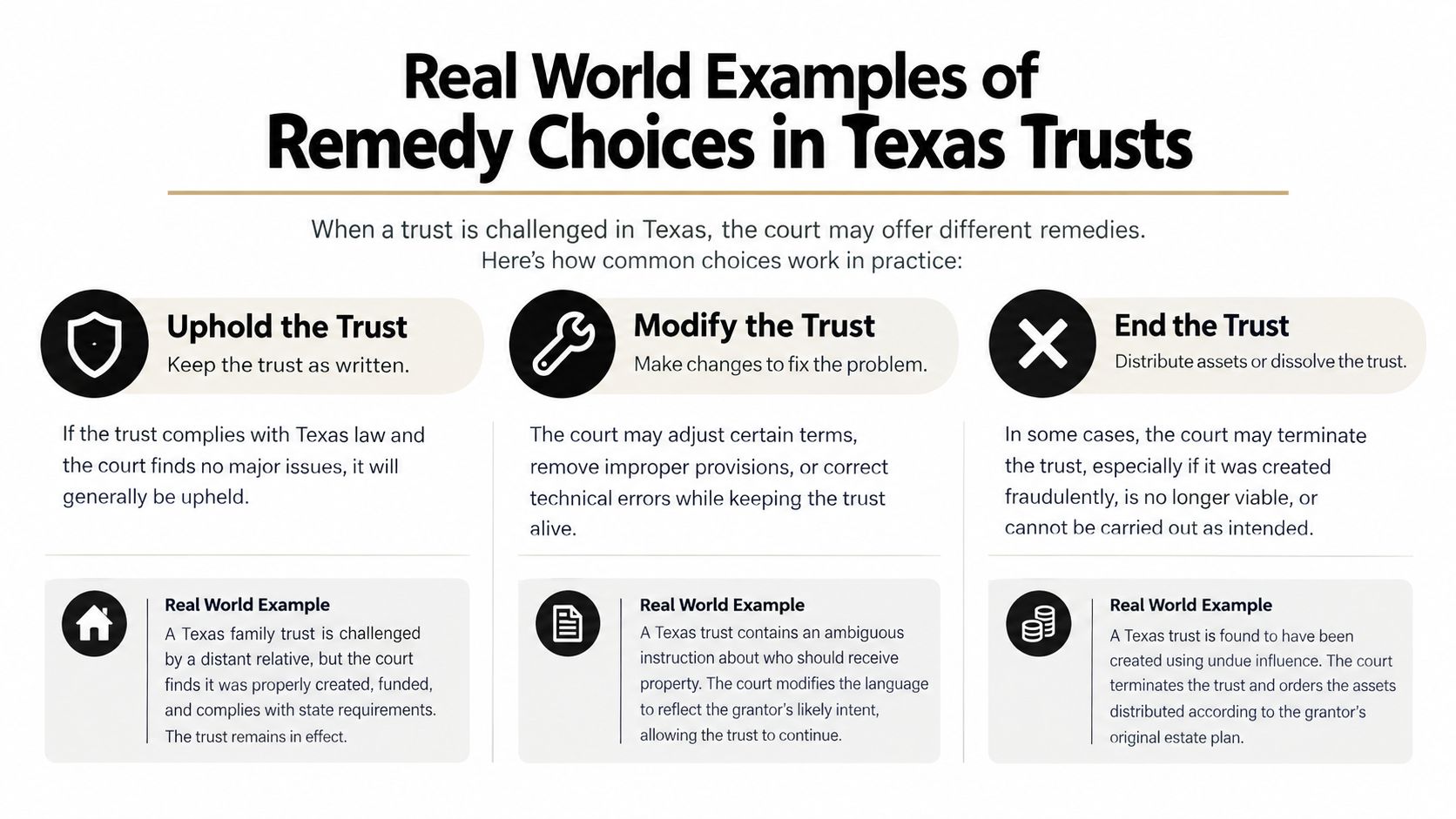
Real World Examples of Remedy Choices in Texas Trusts
Remedy selection often turns on one question: Can the trust property still be identified and recovered? The answer may determine whether restoration, voiding, tracing, or monetary relief makes the most sense.
Identifiable real property
A Dallas family trust owns a rental house. The trustee signs a deed transferring the property to a business connected to the trustee, and the beneficiary learns about the transaction before the property changes hands again. The beneficiary may seek an injunction to stop further transfer, an accounting to establish the transaction's history, and an order voiding the trustee's act if the evidence supports that relief.
Because the house remains identifiable, restoration may be stronger than a money award. The beneficiary could also seek suspension or removal if the transfer reflects an ongoing risk to trust administration.
Sold and commingled proceeds
A Houston trust owns investment property that the trustee sells. The sale proceeds move through an account that also contains personal funds, and some money is later used to purchase another asset. The original property no longer exists in the trust, but the proceeds and replacement asset may still be traceable.
In that setting, a court may consider tracing and a constructive trust, potentially paired with compelled restoration. The goal is to follow trust value through later transactions rather than stop at the original sale.
The beneficiary's choice between damages and restoration matters when property remains recoverable. Courts may permit an election based on asset status, while innocent third parties who dealt with the trustee without knowledge may receive statutory protection.
Next Steps for Trustees and Beneficiaries Seeking Guidance
A trustee notices unexplained withdrawals, or a beneficiary sees trust property about to be sold. The response should match the risk. Early injunctive relief can protect an identifiable asset, while restoration or tracing may address value already transferred or mixed with other funds.
Beneficiaries should preserve and organize
Gather the trust instrument, amendments, account statements, deeds, correspondence, distribution records, and a dated timeline. Put focused questions in writing and keep copies of every response. If property may be transferred or spent, seek prompt advice about an injunction rather than waiting until the loss is complete.
Trustees should demonstrate careful administration
Maintain separate trust records, document significant decisions, explain distributions, and support expenses and compensation with clear records. A successor trustee who receives incomplete files should record what is missing and request information from prior fiduciaries, financial institutions, and professional advisers.
Families should coordinate related planning
Trust disputes may overlap with probate, incapacity, guardianship, tax planning, and asset protection. A Texas estate planning attorney can help review or prepare planning documents, while a Texas trust administration lawyer can address fiduciary duties and disputes. Questions about modifying a Texas trust should be considered with the trust terms, beneficiary interests, court authority, and tax consequences in view.
The Law Office of Bryan Fagan, PLLC assists with trust creation, administration, modification, termination, probate, guardianship, fiduciary accounting, and asset protection. A review of the records can clarify whether the next step is an accounting demand, negotiated resolution, injunction, restoration claim, tracing, or trustee replacement.
If you are managing a trust or planning an estate, contact the Law Office of Bryan Fagan, PLLC to discuss fiduciary duties, accounting concerns, and remedies under Texas law. Bring the trust documents and records that show what happened so counsel can assess the available options.