Managing a loved one's trust can feel overwhelming, especially when a trustee discovers an error and finds an exculpation clause that appears to eliminate personal liability. A Houston trustee may believe the document settles the issue, only to receive a demand from a beneficiary who argues that the trustee's conduct falls outside the protection Texas law allows. A beneficiary may face the opposite problem, seeing broad language in a trust and wondering whether it prevents accountability.
Texas Property Code §114.007 provides the answer in part. It permits trust instruments to limit liability in some circumstances, but it preserves a mandatory boundary for conduct involving bad faith, intentional wrongdoing, reckless indifference to a beneficiary's interests, or profit from a breach. Texas Property Code §111.0035 also preserves §114.007's application, so a trust can't write around these protections. Texas Property Code §114.007 is therefore both a drafting rule and a practical checklist for trustees and beneficiaries.
When an Exculpation Clause Is Not Enough in Texas
A trustee in Houston opens a routine account file and finds a bookkeeping error. The problem first appears manageable. Then a beneficiary's attorney sends a demand alleging that trust funds were mishandled and points to a significant financial loss. The trustee turns to the trust instrument, finds an exculpation clause, and assumes the language prevents a personal claim.
That assumption may be wrong.
An exculpation clause is a trust provision designed to reduce or eliminate a trustee's liability for certain acts or omissions. Settlors often include these provisions because trustees need room to make judgment calls. Investing, selling property, approving distributions, hiring professionals, and handling tax matters can involve uncertainty. A trustee shouldn't necessarily face personal liability every time a reasonable decision produces an unfavorable result.
Texas law respects that purpose, but it doesn't allow a clause to protect every type of conduct. Section 114.007 operates as a backstop to private drafting. The settlor can define duties and allocate risk, but the trust instrument can't excuse a trustee from liability for every serious breach.
Practical rule: A broad clause may protect an honest mistake, but its wording doesn't control when the trustee's conduct reaches a statutory exception.
The statute draws attention to the trustee's state of mind and the effect of the conduct. A trustee who makes a documented decision in good faith stands in a different position from one who knowingly conceals a transaction or consciously ignores an obvious risk to beneficiaries. The clause may also fail to protect profits derived from a breach.
Trustees and beneficiaries often need a focused review rather than a general reading of the document. The trust language, account records, communications, professional advice, and surrounding circumstances can all matter. A Texas trustee personal liability analysis can help identify whether the clause covers the disputed conduct or whether §114.007 overrides it.
Reading Texas Trust Code Section 114.007 in Plain English
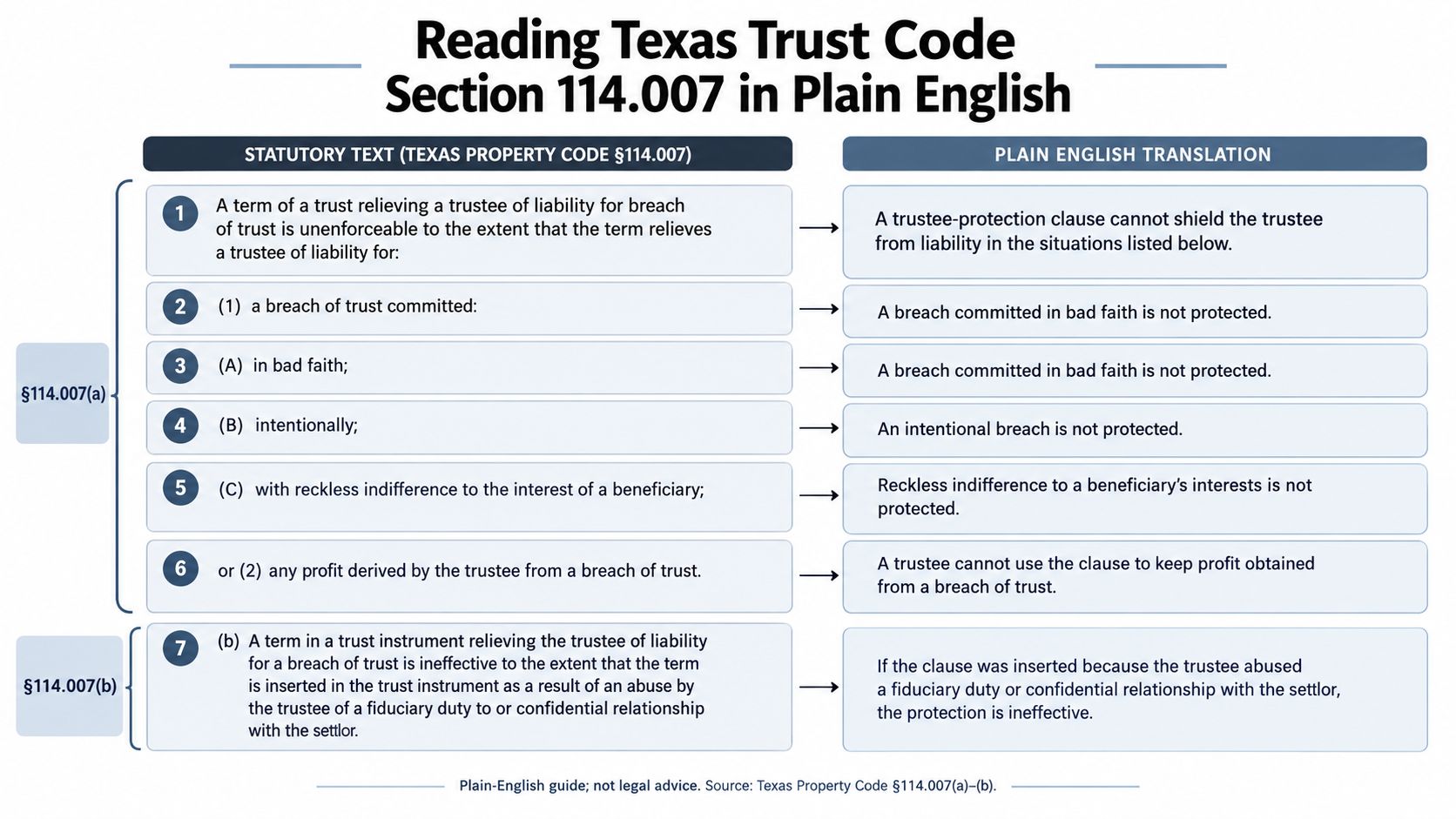
Section 114.007 starts with a general permission. A trust term may relieve a trustee from liability for a breach of trust, but the statute immediately limits that permission. The protection applies only to the extent the clause doesn't reach conduct the law excludes.
The three conduct limits
The first statutory phrase addresses a breach committed “in bad faith.” In plain English, a trustee can't rely on the clause when the trustee acts with a wrongful purpose or consciously disregards the trustee's obligation to administer the trust properly.
The second exception covers a breach committed “intentionally.” This doesn't describe an accidental failure, such as entering the wrong figure in a ledger. It addresses conduct the trustee chose to carry out, where the wrongful act itself was deliberate.
The third exception applies to a breach committed with “reckless indifference to the interest of the beneficiary.” That language reaches conduct more serious than ordinary carelessness. It concerns a trustee who recognizes a substantial risk to a beneficiary and proceeds without proper regard for that risk.
Section 114.007 also prevents a clause from protecting “any profit derived by the trustee from a breach of trust.” A trustee can't keep an improper personal gain because the trust instrument contains broad release language.
Formation matters too
The statute also addresses a clause inserted because the trustee abused a fiduciary or confidential relationship with the settlor. That rule targets overreaching during trust formation. If a trustee used a position of trust to obtain unusually favorable protection from the settlor, the clause can be vulnerable even before a later dispute about administration arises.
Section 114.007 isn't a general statement that every fiduciary duty disappears. It deals with the enforceability of exculpation for specified breaches. The broader framework still includes the trust instrument, the Texas Trust Code, common-law fiduciary principles, and duties such as loyalty, prudence, and impartiality. A plain-language overview of The Fiduciary Duties of a Texas Trustee describes those core duties under the Trust Code.
Texas Property Code §111.0035 makes §114.007 a mandatory limit. The trust's terms generally matter greatly in Texas, but they can't remove §114.007 from the analysis. That's why the phrase exculpation clause limits Texas trust 114.007 is more than an SEO expression. It identifies the central legal question: what did the clause attempt to protect, and does the statute permit that protection?
How Courts Distinguish Bad Faith Intent and Reckless Indifference
The three exceptions aren't interchangeable. A beneficiary must connect the trustee's conduct to the facts supporting bad faith, intentional misconduct, or reckless indifference. A trustee, in turn, may defend the claim by showing that the decision was made with a reasonable process and without an improper purpose.
Bad faith and intentional conduct
Bad faith generally concerns a conscious wrongful purpose. A court may examine concealment, misleading communications, self-dealing, or a refusal to correct a known problem. The question isn't whether the trustee made a poor choice. It's whether the trustee acted in a way that disregarded the trustee's obligation to the trust.
Intentional misconduct focuses on what the trustee deliberately did. A trustee who receives inaccurate information and makes a decision based on it may have made a negligent mistake. A trustee who knowingly transfers trust property for personal benefit presents a different issue. The written record often becomes important because emails, account statements, approvals, and meeting notes can show what the trustee knew and when the trustee knew it.
Reckless indifference
Reckless indifference falls between ordinary negligence and deliberate wrongdoing, but it remains a serious statutory exception. The central concern is a substantial and unjustifiable risk of harm that the trustee consciously disregarded.
Examples may include signing checks without reviewing the underlying transactions, ignoring account statements that reveal unusual activity, or handing important trust responsibilities to an unqualified relative while refusing to monitor the work. No single fact automatically decides the issue. Courts examine the full pattern, including the trustee's knowledge, the seriousness of the risk, the available safeguards, and the trustee's response.
The distinction is practical. One missed entry in an otherwise careful accounting may remain within the clause's protected zone. A repeated failure to review records after receiving warnings may support a claim that the trustee's inattention was systemic rather than accidental. Readers evaluating self-dealing versus an honest mistake in a fiduciary duty claim should focus on evidence, not labels.
| Conduct Category | Statutory Exception Triggered? | Typical Texas Outcome |
|---|---|---|
| Good-faith judgment about an investment or distribution | Usually no | Clause may protect the trustee, depending on its wording |
| Negligent recordkeeping without dishonest purpose | Usually no | Clause may apply, while corrective administration may still be needed |
| Knowing concealment or self-dealing | Potentially bad faith or intentional misconduct | Clause is unenforceable to that extent |
| Conscious disregard of a serious risk to a beneficiary | Potentially reckless indifference | Clause may not protect the trustee |
| Personal profit from a breach | Yes, as to the profit | Trustee can't use the clause to retain the improper gain |
Real World Fact Patterns Under Texas Trust 114.007
Consider a corporate trustee administering a trust that owns conservative investments. The trustee places assets in insured certificates of deposit, makes timely K-1 distributions, and keeps written records explaining each decision. A beneficiary complains that the trust earned less than other investments might have produced.
That complaint alone doesn't establish bad faith, intent, or reckless indifference. The trustee made a documented investment choice consistent with the trust's objectives. If the exculpation clause covers good-faith judgment and ordinary administrative conduct, §114.007 may not displace it.
Pattern A protects reasonable judgment
The beneficiary may still request information or challenge the investment under the trust's terms and applicable fiduciary standards. But an unfavorable result isn't the same as an intentional breach. The trustee's process, records, and consistency with the trust's purposes help show why the clause may remain effective.
Now change the facts. The same trustee commingles trust funds with operating accounts, ignores repeated demands for an accounting, and conceals a $200,000 loan to a relative. Those facts raise a different question. The transaction involves a personal relationship and concealment, while the refusal to respond may show conscious disregard for beneficiary interests.
Under Texas Trust Code §114.007(b)(2), intentional breaches and conscious indifference can defeat exculpation. The trustee may face personal liability to the extent the clause attempts to shield those breaches, and the trustee can't rely on the clause to protect profit derived from the misconduct.
Pattern B crosses the statutory line
A third pattern is less dramatic. A trustee maintains incomplete files, mislabels several expenses, and delays correcting the records after discovering the problem. There's no evidence of dishonest intent, personal benefit, or conscious disregard of a serious known risk. The clause may protect the trustee from personal liability for the negligent administrative error, although the trustee still should repair the records and provide accurate information.
| Fact Pattern | Trustee Conduct | §114.007 Trigger | Clause Outcome |
|---|---|---|---|
| Conservative investment administration | Uses insured CDs, documents decisions, and makes distributions | No clear statutory exception | May protect good-faith judgment |
| Concealed related-party loan | Commingles funds, ignores accounting demands, and conceals a loan | Intentional conduct, bad faith, reckless indifference, and trustee profit may be implicated | Unenforceable to the protected extent |
| Incomplete bookkeeping | Makes careless recordkeeping errors without dishonest purpose | No clear statutory exception on these facts | May protect ordinary negligence, subject to the clause |
The same document can produce different outcomes because §114.007 evaluates the conduct, not just the existence of the clause. Beneficiaries should preserve the surrounding evidence, and trustees should avoid treating the clause as permission to stop following fiduciary procedures.
Drafting an Exculpation Clause That Holds Up in Texas
A well-drafted clause should allocate risk without suggesting that the trustee's fiduciary duties have disappeared. Settlors and attorneys can make that intention clearer by pairing the exculpation language with procedures that promote careful administration.
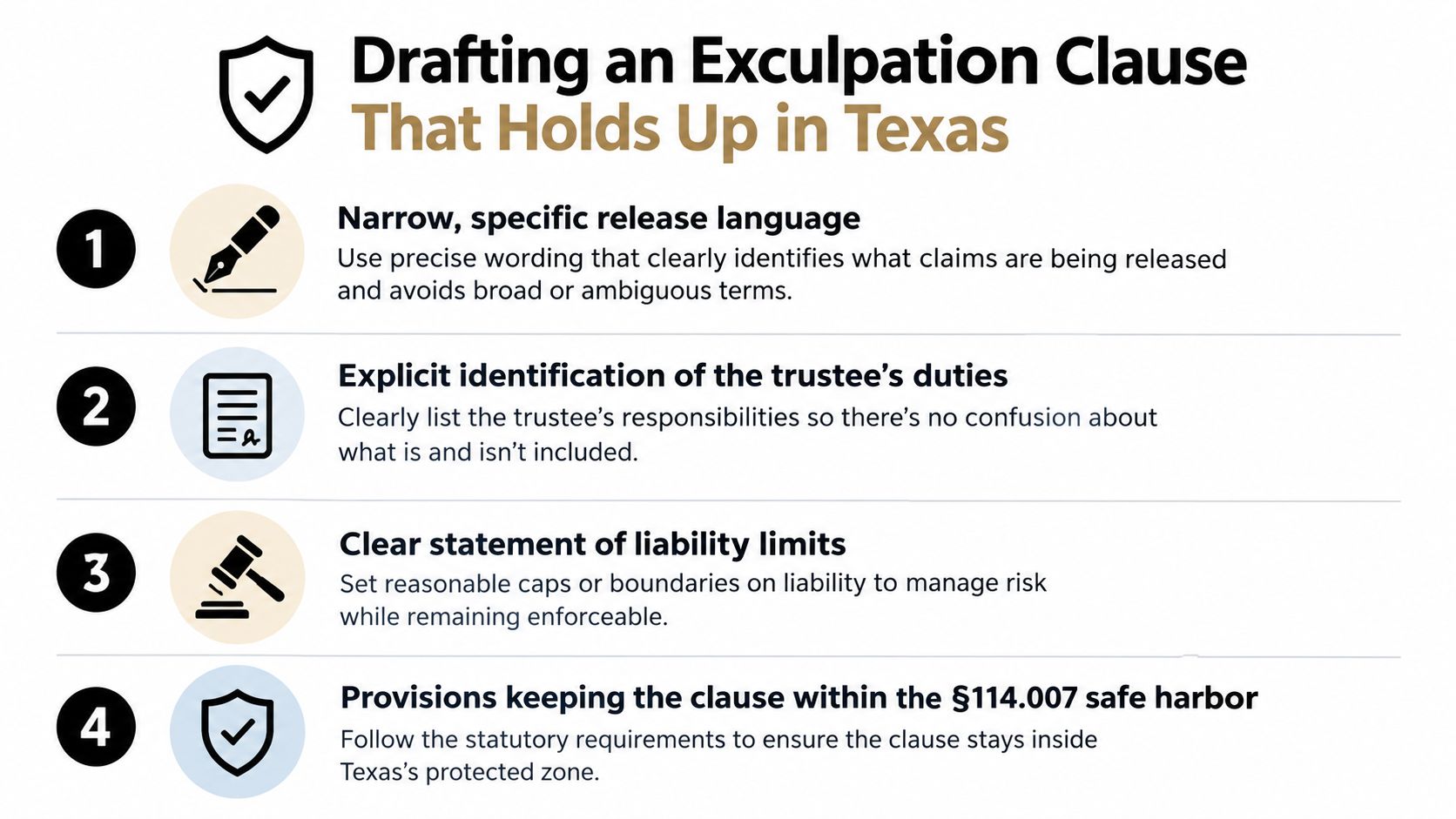
Use narrow language
A clause should identify the conduct it intends to protect, such as good-faith errors in judgment, reasonable investment decisions, and ordinary administrative acts. A single sentence attempting to excuse “all liability for any breach” creates avoidable problems because it may conflict with the mandatory limits in §114.007.
The document should also identify retained duties. The trustee still needs to understand the duty of loyalty, the prohibition against self-dealing, the obligation to keep trust property separate, and required tax and reporting responsibilities. Clear drafting helps the trustee distinguish protected discretion from conduct that remains outside the clause.
Add administration safeguards
The trust can require contemporaneous records, periodic account reviews, defined reporting timelines, and a process for handling beneficiary questions. A mediation provision or non-binding trustee consultation may help resolve disagreements before they become litigation, although those procedures shouldn't block mandatory legal rights.
An independent trustee or trust protector can provide oversight where family relationships create tension. The document may also include prudent-person investment language that works with Texas Property Code §117.004 rather than attempting to replace prudent administration altogether.
Drafting principle: The strongest clause complements fiduciary duties. It doesn't turn a trustee's discretion into immunity.
A Texas estate planning attorney should review the clause with the rest of the plan. The settlor's goals, the identity of the trustee, the trust's assets, beneficiary relationships, tax planning needs, and expected administration all affect the appropriate language. A trustee who wants practical guidance on reducing exposure can also review ways to protect against trustee liability in Texas.
A short video can provide general background, but it can't determine whether a specific clause applies to disputed conduct.
Drafting should also account for future administration. If the trust may need modification, termination, tax planning changes, or a different trustee structure, the document should preserve enough flexibility to address those issues without undermining the mandatory limits of Texas law.
Beneficiary Claims and Trustee Defenses Under Section 114.007
A beneficiary who believes §114.007 applies may pursue more than a declaration that the exculpation clause is ineffective. Depending on the facts, the beneficiary may seek an accounting, damages for breach of fiduciary duty, disgorgement of improper profits, removal of the trustee, injunctive relief, or other remedies available under the Texas Trust Code. A claim normally requires evidence connecting the trustee's conduct to a breach and a legally recognized injury or remedy.
The trustee's defense also depends on evidence. The trustee may show good-faith reliance on professional advice, careful review of available information, beneficiary consent or ratification, or a reasonable business judgment in a genuine dispute. The trustee may argue that the alleged error falls within the clause's protected area and doesn't involve one of the statutory exceptions.
Evidence usually drives the dispute
Trust records can matter more than arguments about intent. Account statements, investment reviews, distribution calculations, tax filings, written requests, responses, and meeting notes may show whether the trustee followed a reliable process. A missing record doesn't automatically prove bad faith, but a pattern of unexplained decisions can make the trustee's position harder to defend.
Beneficiaries should also distinguish dissatisfaction from a statutory claim. A lower return, delayed communication, or administrative mistake may justify questions and correction without proving intentional misconduct. The issue becomes more serious when the records suggest concealment, self-benefit, repeated disregard of warnings, or profit from a breach.
| Party | Claim or Defense | Required Proof |
|---|---|---|
| Beneficiary | Breach of fiduciary duty | Trust duty, breach, and facts supporting a remedy |
| Beneficiary | Accounting or information request | Proper demand and failure or inadequate response, where applicable |
| Beneficiary | Disgorgement or surcharge | Improper profit or financial harm connected to the breach |
| Beneficiary | Trustee removal or injunction | Facts supporting statutory or equitable intervention |
| Trustee | Good-faith administration | Records showing a reasonable decision-making process |
| Trustee | Reliance on professional advice | Scope of advice, information provided, and reasonable reliance |
| Trustee | Exculpation defense | Clause language and proof that no §114.007 exception applies |
Trust administration also intersects with the Texas Estates Code when a trust dispute arises in a statutory probate court or alongside probate, guardianship, or estate proceedings. A lawyer should evaluate the trust, related will, court, and procedural posture together rather than treating §114.007 in isolation.
Practical Next Steps Trustees and Beneficiaries Can Take Today
A trustee facing a complaint should start with documents, not defensiveness. Locate the signed trust instrument and every amendment, identify the exculpation language, and review any indemnification or fee provisions alongside §114.007. Then preserve account statements, correspondence, tax records, distribution approvals, investment reviews, and notes showing why decisions were made.
A trustee's immediate checklist
- Read the exact clause: Identify which acts the provision covers and whether it uses broad or narrow language.
- Separate trust property: Confirm that trust accounts and assets remain distinct from personal or business funds.
- Create a decision record: Write down the information reviewed, advice received, alternatives considered, and reason for the decision.
- Respond carefully: Don't destroy records, make informal admissions, or distribute disputed property before obtaining advice.
- Address accounting requests: Review the request under the applicable Texas Trust Code procedures and provide an accurate response when required.
Beneficiaries should take a different but equally organized approach. Put requests for information or an accounting in writing, preserve emails and letters, compare statements with known transactions, and identify facts that may suggest concealment, self-dealing, or conscious disregard of a serious risk. A beneficiary doesn't need to decide the final legal conclusion alone. The goal is to give counsel a clear factual record.
Questions for an initial consultation
- What does the trust's exculpation clause cover?
- Does the disputed conduct suggest bad faith, intentional action, reckless indifference, or trustee profit?
- What records are missing, and what accounting can be requested?
- Are there related probate, guardianship, estate planning, or tax issues?
- Could modification, mediation, trustee replacement, or court involvement resolve the problem?
- Are any deadlines, notice requirements, or procedural rules affecting the claim?
Texas imposes procedural requirements and potentially strict deadlines on fiduciary disputes. Trustees and beneficiaries shouldn't delay while records disappear or positions harden. The Law Office of Bryan Fagan, PLLC can help families evaluate trust administration, fiduciary duties, probate connections, guardianship concerns, estate planning, and asset protection questions with a practical focus on the facts.
If you're managing a trust or planning your estate, contact The Law Office of Bryan Fagan, PLLC for a free consultation. Our attorneys provide trusted, Texas-based guidance for every step of the process.
A focused review can clarify whether an exculpation clause protects a trustee's conduct or whether Texas Property Code §114.007 preserves a beneficiary's claim. Visit Law Office of Bryan Fagan, PLLC to discuss trust administration, trustee liability, beneficiary rights, estate planning, and related Texas legal concerns with an attorney.