Managing a loved one's trust can feel overwhelming, especially when the document seems clear until Texas law says otherwise. That's where many families get stuck. A settlor thinks, “I wrote the rule, so the trustee has to follow it,” and a beneficiary thinks, “The trust says I don't get information, so I'm out of luck.”
Sometimes that's true. Often it isn't.
If you're dealing with Texas Trust Code 111.0035 default vs mandatory provisions, the question is simple: which trust terms can the settlor change, and which ones Texas refuses to let anyone waive? That distinction controls how a trust is administered, how much discretion a trustee has, what a beneficiary can demand, and whether a clause will hold up when a dispute lands in court.
Why Default vs Mandatory Provisions Matter in Your Texas Trust
A settlor sits down to sign a trust and wants three things. She wants her sister, as trustee, to serve without fuss. She wants fewer formal accountings. She wants broad investment freedom because the family owns land, mineral interests, and a closely held business, not just marketable securities.
Those are normal Texas goals. They're also exactly where people run into trouble.
Some trust rules are default rules. That means the Texas Trust Code supplies them unless the trust instrument changes them. Other rules are mandatory rules. Those are the Legislature's nonnegotiable floor. A settlor can draft around many administrative details, but can't draft away core fiduciary safeguards.
A trust can read one way and operate another
This is the mistake I see most often. A trust document says the trustee doesn't have to do X, but Texas law says that clause won't be enforced as written. The family then assumes the trustee is protected when the trustee isn't. Or the beneficiary assumes there's no remedy when there is one.
That disconnect matters in real life:
- For settlors: You need to know whether your drafting choices work.
- For trustees: You need to know which clauses you can rely on and which ones could expose you to liability.
- For beneficiaries: You need to know whether “the trust says so” is the end of the conversation, or just the beginning.
Practical rule: A trust clause isn't effective just because it's in the document. It has to survive Section 111.0035.
The issue reaches far beyond accounting language
This isn't just a technical drafting debate. The default-versus-mandatory split affects who controls distributions, how cotrustees vote, what disclosures must be made, whether trustee conduct can be excused, and when a court can step in.
Texas Property Code § 111.0035 creates that framework. Under the statute, Subtitle B generally governs trustee duties and powers, relations among trustees, and beneficiary rights unless the trust says otherwise, but the settlor can override most of those rules in the trust document, which makes the statute a major drafting lever for customizing administration terms, as reflected in the text of Texas Property Code Section 111.0035.
My advice at the drafting table
Start with this mindset: customize the administration, not the conscience. You can often tailor process, timing, voting rules, and administrative mechanics. You should not assume you can erase loyalty, good faith, or court supervision just because aggressive language appears in a form document.
That's why this topic matters so much in estate planning, probate disputes, asset protection planning, and even guardianship-related family planning. If the trust crosses the line, the fight gets expensive fast.
Reading Section 111.0035 Without the Legal Jargon
Texas did not always organize this issue as clearly as it does now. Section 111.0035 was added in 2005 by House Bill 1190, which reorganized the trust-code rules into express default and mandatory categories, and the legislative analysis explains that subsection (a) makes the subtitle govern trustee duties, relations among trustees, and beneficiary rights unless the trust terms provide otherwise, while subsection (b) bars a trust from overriding specific statutory protections, as described in the House Bill 1190 legislative analysis.
That reorganization was a smart move. Before you can draft a trust well, you need to know which parts of the code are movable and which parts are load-bearing.
Section 111.0035 at a glance
| Subsection | What It Does | Key Effect |
|---|---|---|
| (a) | Supplies the baseline rules for trust administration unless the trust changes them | Gives the settlor broad drafting flexibility |
| (b) | Preserves a core set of protections that trust language can't override | Stops overreaching clauses from gutting fiduciary accountability |
Subsection (a) is the drafting lever
Subsection (a) is the part trust lawyers use constantly. It tells you the code's baseline rules apply unless the trust instrument says otherwise. So if a settlor wants cotrustees to act by majority instead of unanimity, wants a narrower notice procedure, or wants to expand a trustee's express powers, this is usually where that authority starts.
That's why I tell clients not to treat the trust code like a fixed operating manual. In many places, it's really a starting template.
A useful plain-English overview of how trust administration works, and how it differs from probate, appears in Texas Trust Administration: A Trustee's Guide. And if you want a broader discussion of where state law departs from uniform drafting assumptions, this comparison of UTC vs. Texas Trust Code where Texas departs from the uniform code is worth reading.
Subsection (b) is the wall you can't draft through
Subsection (b) is where flexibility stops. The legislative history shows the statute was modeled on Section 105 of the Uniform Trust Code and added in 2005 to separate default rules from mandatory rules, while also moving earlier provisions into one section for clarity; the substitute bill also changed the effective date of the new provisions to September 1, 2006, according to the House Bill 1190 history and bill analysis.
In plain English, subsection (b) says a trust can't override certain protections the Legislature decided were too important to bargain away. Those include improper-purpose rules, limits on exculpation, limitation-period rules, accounting rights for certain beneficiaries of irrevocable trusts, and court powers to modify, reform, terminate, or order remedies in the interest of justice.
The cleanest way to read Section 111.0035 is this. Subsection (a) gives you room to draft. Subsection (b) tells you where Texas stops you.
Default vs Mandatory Provisions at a Glance
Here's the practical version. If a trust provision deals with how the trustee carries out the job, there's a fair chance the settlor can modify it. If the clause tries to erase basic fiduciary accountability, it's much more likely to fail.
Default vs Mandatory common Texas trust provisions
| Default (Settlor May Modify) | Mandatory (Cannot Be Waived) |
|---|---|
| Cotrustee voting mechanics | Duty to act in good faith and in line with the trust's purposes |
| Administrative notice procedures | Core protections against improper purposes |
| Express trustee powers and internal procedures | Limits on exculpation for serious misconduct |
| Allocation mechanics if drafted clearly | Accounting rights preserved for qualifying beneficiaries of irrevocable trusts |
| Information flow beyond the statutory floor | Court authority to modify, reform, terminate, or adjust compensation in the interest of justice |
The easiest way to think about the split
A trustee's job has two layers.
The first layer is administration. That includes mechanics such as who signs, how often reports go out, whether cotrustees act jointly or by majority, and how discretionary powers are described. Those items are often open to drafting changes.
The second layer is fiduciary character. That includes good faith, loyalty, and the prohibition on using trust powers for improper purposes. Texas protects that layer far more aggressively.
A good example is beneficiary information. A settlor may be able to shape parts of the reporting process, but later materials still describe Section 111.0035 as allowing opt-outs from many default rules while preserving key safeguards, including the mandatory rule that a trust may not limit the duty to respond to an accounting demand from qualifying beneficiaries of an irrevocable trust, may not limit the duty to keep certain beneficiaries age 25 or older informed in specified circumstances, and may not restrict the trustee's duty to act in good faith and in accordance with the trust's purposes, as noted in the 2019 Texas Trust Code update from Baylor Law materials.
A real drafting example
Suppose a settlor says, “My trustee doesn't have to treat my children equally. One child has special needs, one owns a business, and one is financially reckless.” That kind of discretion may be drafted if it's done carefully and tied to the trust's purpose.
Now change the clause to this: “My trustee may favor herself, ignore beneficiary concerns, refuse all information, and never be sued for any decision.” That's not customization. That's an attempted escape hatch from fiduciary law, and it's exactly the kind of language that invites a challenge.
- Reasonable customization: Majority-rule cotrustee clauses, targeted distribution standards, purpose-built administrative powers.
- Danger zone: Blanket waivers of loyalty, broad shields for bad-faith conduct, or language that tries to block statutory beneficiary rights.
- Smart drafting move: State the flexibility clearly, then expressly preserve the trustee's duties of good faith and compliance with the trust's purposes.
A Texas trust administration lawyer earns the fee. Good drafting reduces ambiguity. Bad drafting turns family administration into litigation.
Drafting Trust Clauses That Respect the Mandatory Core
If you want a trust clause to hold up, draft it like a surgeon, not like a salesman. Broad, swaggering language usually backfires. Precision works.
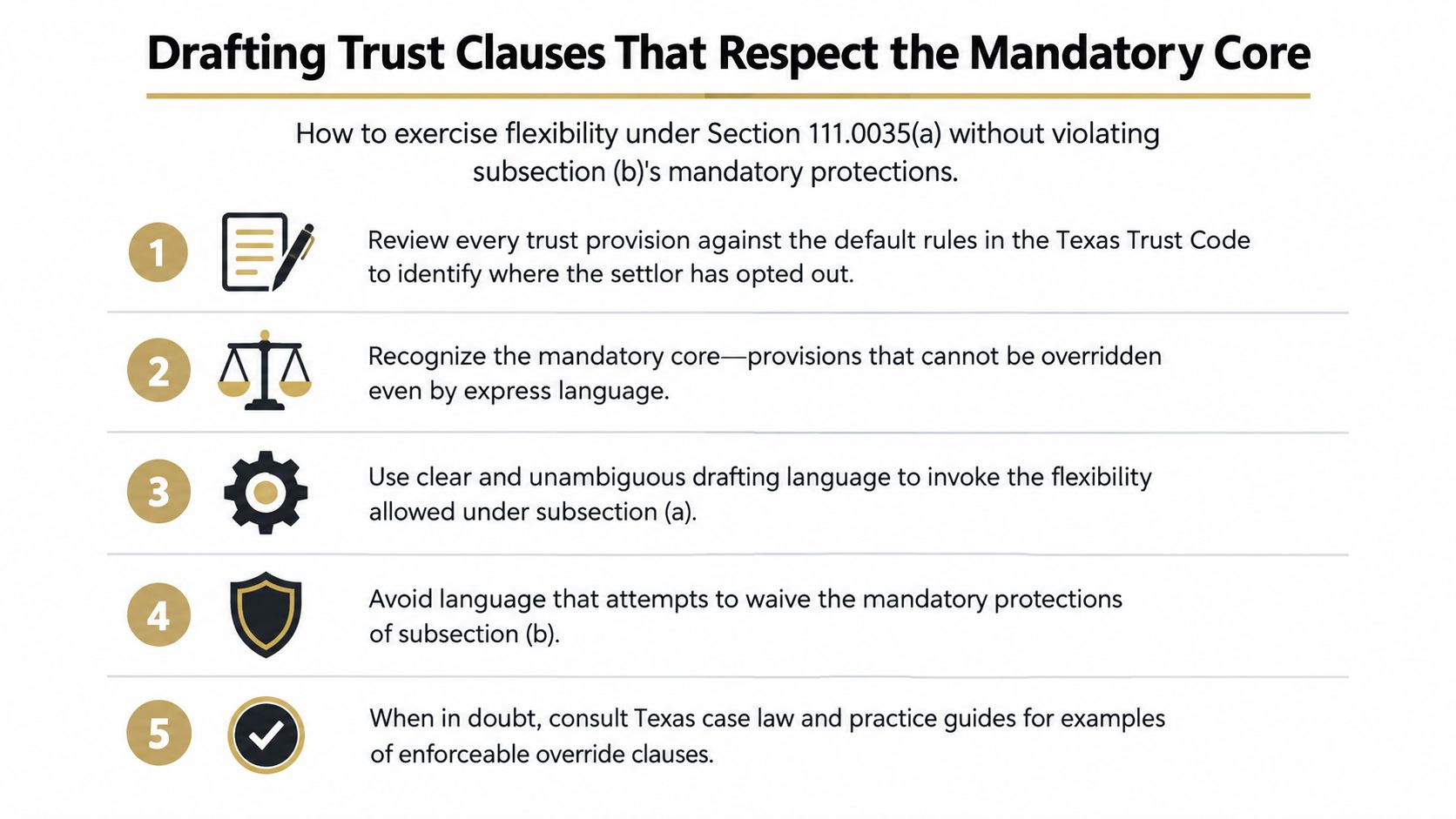
Draft the override expressly
Don't rely on implication. If the settlor wants cotrustees to act by majority vote, say that. If the settlor wants one trustee to handle investment decisions and another to handle distributions, say that too.
Vague language creates arguments over whether the trust displaced the default rule.
Narrow exculpation clauses carefully
An exculpation clause can be useful. It should protect a trustee from hindsight attacks over ordinary judgment calls. It should not try to excuse bad faith, intentional misconduct, or conduct that violates mandatory protections.
A workable clause usually does two things:
- Defines the protection narrowly: It shields ordinary discretionary decisions made in good faith and within authority.
- Builds in the carveouts: It preserves claims based on serious misconduct and mandatory statutory duties.
Drafting advice: If an exculpation clause sounds like “the trustee is never liable for anything,” rewrite it. Courts don't like that language, and they shouldn't.
Customize mechanics, not fiduciary identity
You can often tailor procedural points such as notice timing, delegation language, trustee succession mechanics, and standards for resolving cotrustee deadlock. A trust protector may also help with limited oversight or amendment powers if drafted to fit Texas law, and this discussion of trust protector powers is a useful starting point.
But don't confuse flexibility with immunity. A trustee still occupies a fiduciary role. The title itself carries obligations that drafting can't erase.
Sample approaches that usually make sense
Here are examples of the kind of clauses I generally favor:
Cotrustee authority clause
Let cotrustees act by majority or divide responsibility by function.Investment flexibility clause
Authorize retention of closely held business interests, ranch property, or concentrated family assets if consistent with the trust's purpose.Accounting procedure clause
Clarify delivery method, timing, and designated recipients, while preserving statutory rights that can't be waived.Distribution discretion clause
Give the trustee a clear standard tied to support, health, education, maintenance, family needs, or a stated legacy goal.
The cleanest drafting always does one more thing. It states, in plain language, that the trustee must still act in good faith, for proper purposes, and consistently with the trust's design.
If you're working with a Texas estate planning attorney, insist on that level of clarity.
Texas Case Law and Common Drafting Pitfalls
Texas courts don't reward clever overreach. When a trust tries too hard to insulate a trustee, judges tend to focus on purpose, fiduciary structure, and whether the clause collides with statutory limits.
You don't need a stack of reported opinions to understand the pattern. The disputes usually look familiar.
The four mistakes that trigger avoidable trust fights
- Blanket fiduciary waivers: A clause says the trustee owes no duty except what the trustee chooses to honor. That's asking for a challenge.
- Sloppy exculpation language: The drafter copies a broad release provision but fails to carve out bad-faith or improper conduct.
- Poor beneficiary definitions: The trust changes notice rules but never clearly states who qualifies to receive information.
- Imported language from other states: Someone borrows Delaware-style or offshore-style trust protector language without checking Texas limits.
That last problem is common. Form libraries can be useful, but Texas law is its own ecosystem. If the clause assumes powers or liability shields that conflict with Texas's mandatory core, the clause may create more risk than protection.
A conference-room example
A parent signs a trust that says the trustee “shall not be required to account to any beneficiary unless the trustee deems it appropriate.” The trustee reads that sentence as total freedom. The beneficiary reads it as stonewalling. Litigation follows.
The problem usually isn't just family tension. It's drafting that ignored the statutory floor.
Trust disputes often start with one overbroad sentence in an otherwise decent document.
What trustees should hear plainly
If you're serving as trustee, don't assume every favorable clause will save you. Read the instrument, then read it against the code. If the clause seems too good for the trustee, it probably deserves a second look.
That's especially important when the trust affects probate administration, family settlement talks, or long-term planning around incapacity and guardianship. A trustee who leans too heavily on an invalid override can turn a manageable administration problem into a breach-of-duty claim.
What beneficiaries should watch for
Beneficiaries should be skeptical of phrases like:
- “Sole and absolute discretion” when paired with no explanation of purpose
- “No duty to inform” in an irrevocable trust setting
- “No liability under any circumstances”
- “Trust protector decisions are final and unreviewable” without any guardrails
Those clauses don't automatically fail. But they deserve scrutiny. If the trust's language appears to wipe out accountability rather than define authority, that's where a challenge often starts.
What You Can and Cannot Override in a Texas Trust
Most trust drafting questions come down to one chart. If the term adjusts administration, you may be able to override the default rule. If the term attacks the fiduciary floor, you probably can't.
Default vs Mandatory provisions under Texas Trust Code 111.0035
| Can Override (Default) | Cannot Override (Mandatory) |
|---|---|
| Cotrustee decision procedures | Trustee duty to act in good faith |
| Certain notice and communication mechanics | Rules barring improper purposes |
| Scope of specific administrative powers | Limits on exculpation for serious wrongdoing |
| Allocation and internal management provisions | Preserved accounting rights for qualifying irrevocable-trust beneficiaries |
| Trustee process for routine administration | Court authority to grant equitable relief and supervise trust issues |
The clean answer I give clients
Yes, a Texas settlor has real flexibility. No, that flexibility is not unlimited.
You can often rewrite the operating details of the trust. You usually can't rewrite the minimum standard of fiduciary behavior. That's the heart of Texas Trust Code 111.0035 default vs mandatory provisions.
For families doing estate planning or asset protection, that distinction matters early. For trustees in active administration, it matters every time they make a distribution, answer a beneficiary, or rely on a protective clause. For beneficiaries, it matters when the trustee says, “The document lets me do this.”
If the clause changes process, maybe. If it tries to erase accountability, be skeptical.
Practical Next Steps for Trustees, Settlors, and Beneficiaries
Theory turns into action. Whether you're drafting, administering, or reviewing a trust, don't stare at Section 111.0035 in the abstract. Use it like a checklist.
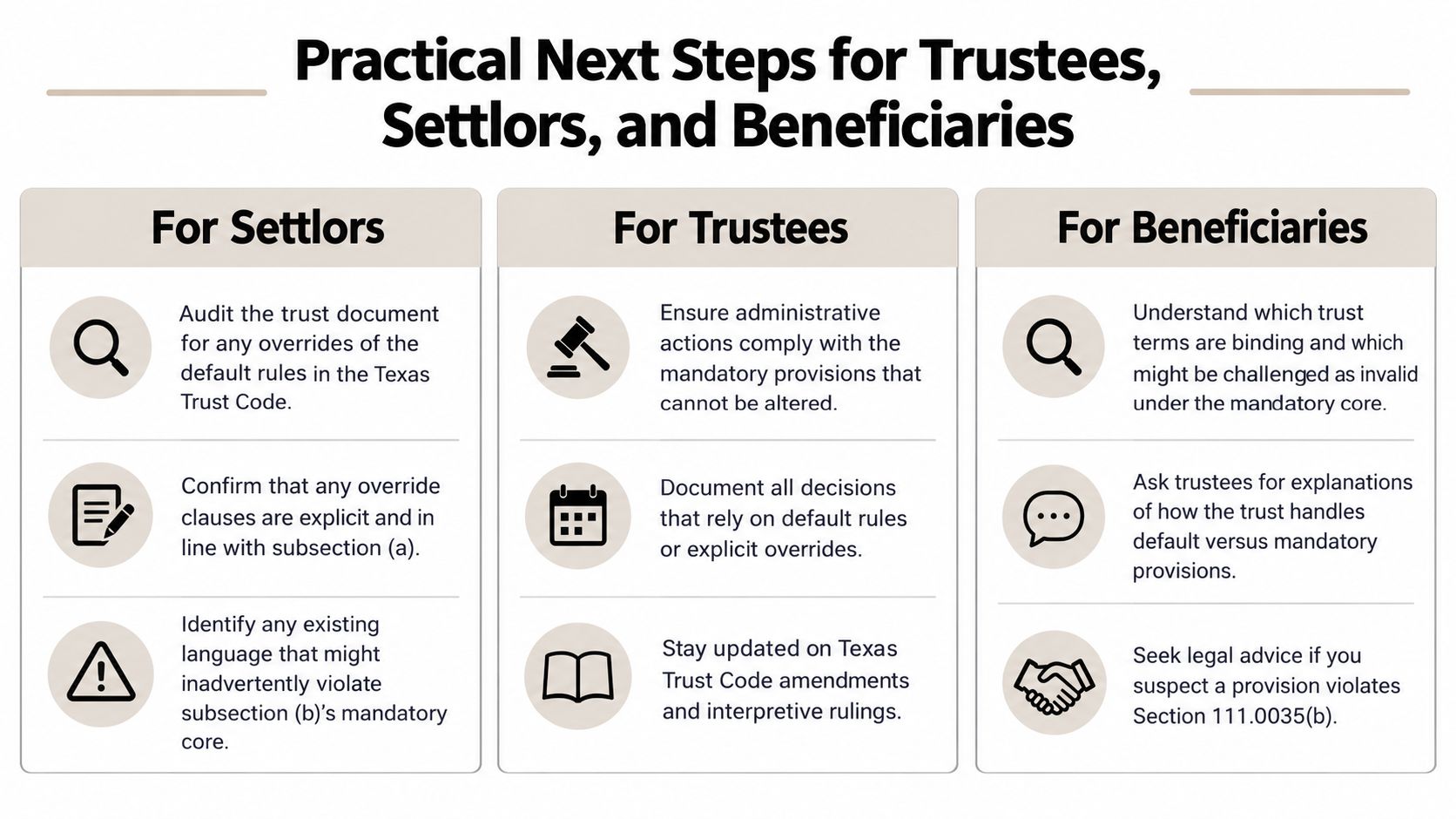
For settlors
Read the trust line by line and mark every clause that changes a default rule. Then ask whether the clause merely customizes administration or tries to waive a core safeguard.
Pay close attention to trustee compensation, exculpation, notice language, and discretion standards. If you're revising an older document, a lawyer should confirm that your override clauses still fit current Texas practice.
For trustees
Create a written decision checklist before major distributions, sales, or disputed communications. Include the trust purpose, the clause you're relying on, the records supporting the decision, and whether any mandatory duty limits your discretion.
A practical resource on core trustee obligations is Texas Trust Code trustee duties. If you need legal help applying those duties to a live administration, the Law Office of Bryan Fagan, PLLC handles trust creation, administration, modification, and dispute-related issues for Texas families and fiduciaries.
For beneficiaries
Start with the actual document. Identify where the trust changes default rules, then separate those clauses from provisions that may conflict with nonwaivable protections.
Keep your concerns documented. Ask focused questions. If needed, request an accounting and compare the trustee's response to the trust language and Texas fiduciary duties in Texas.
If a trustee keeps pointing to one broad clause instead of explaining the decision, that's a red flag.
Red flags and routine items
Call a Texas trust administration lawyer if you see any of these:
- Missing information: The trustee refuses basic explanations in an irrevocable trust setting.
- Overbroad immunity language: The trust appears to excuse all misconduct.
- Conflict concerns: The trustee is benefiting personally from trust decisions.
- Purpose drift: The administration no longer looks tied to the settlor's stated goals.
Don't panic over routine issues like ordinary delays in gathering records, reasonable requests for clarification, or trustee caution during a complicated asset sale. Not every frustrating administration issue is a breach. But some are, and how to modify a trust in Texas or challenge administration conduct depends on catching the distinction early.
If you're managing a trust or planning your estate, the attorneys at Law Office of Bryan Fagan, PLLC help Texas families, trustees, beneficiaries, and fiduciaries sort out exactly which trust provisions can be changed and which ones Texas law still enforces no matter what the document says. If you need practical guidance on drafting, trust administration, probate, guardianship, asset protection, or a brewing fiduciary dispute, schedule a free consultation and get advice suited to your trust, your role, and your next step.