 Skip to content
Managing a loved one's trust can feel overwhelming, especially when the trust was written years ago and nobody expected today's family dynamics, tax rules, or trustee turnover. A Texas family can do everything right at the start, then still end up asking hard questions later, like who can replace a trustee, who can move the trust, and who can step in when the trust document no longer fits real life.
That's where trust protector powers matter. In plain English, a trust protector is the person the settlor names to watch over the trust and use specific powers the trust instrument gives them, while the trustee keeps doing the day-to-day administration. In Texas, that distinction matters because families often need a structure that protects the settlor's intent without forcing beneficiaries to police the trustee themselves.
When a Texas Family Needs More Than a Trustee
A Houston couple sets up a long-term trust while their children are young. Years later, the trustee has changed, one child lives in another state, and the trust now holds a business interest that needs careful handling. Nobody in the family wants a courtroom fight, but everyone wants a structure that still works.
That is the practical problem trust protector: powers are meant to solve. A protector can serve as the pressure valve between a rigid trust document and a family life that keeps changing. For many Texas families, that means the trust can stay useful long after the original decision-makers are gone.
A good Texas trust planning lawyer looks at the trust the way a trustee does, not just the way a settlor does. The questions are straightforward: Who can change trustees? Who can approve a sensitive action? Who keeps the trust aligned with the settlor's purpose when the tax rules shift or the family splits across generations?
A trust protector is most useful when the trust will outlive the people who signed it.
That idea fits Texas practice because long-term administration is rarely simple. Trustee transitions, beneficiary disputes, and tax-sensitive decisions all show up after the trust is already in motion. If the trust language never anticipated those issues, the family can get stuck with a document that is technically valid but practically stale.
For a basic overview of how trust administration differs from probate, families sometimes start with Texas Trust Administration: A Trustee's Guide. That kind of background helps beneficiaries understand why trust administration is its own process, with its own rules and pressure points.
What a Trust Protector Is and Why the Role Exists
A trust protector is not the trustee, and that difference matters. The trustee manages the trust assets and carries out the trust terms. The settlor created the trust. The beneficiaries receive benefits. The protector is a separate person or committee the settlor names to hold specific powers that may monitor the trustee, correct course, or preserve the trust's purpose over time.
A trust protector is similar to a board observer on a nonprofit board, but with only the powers the governing document grants. The protector doesn't run the trust's daily operations. Instead, the protector stands ready to act when the trust needs a correction that the trustee can't, or shouldn't, make alone.
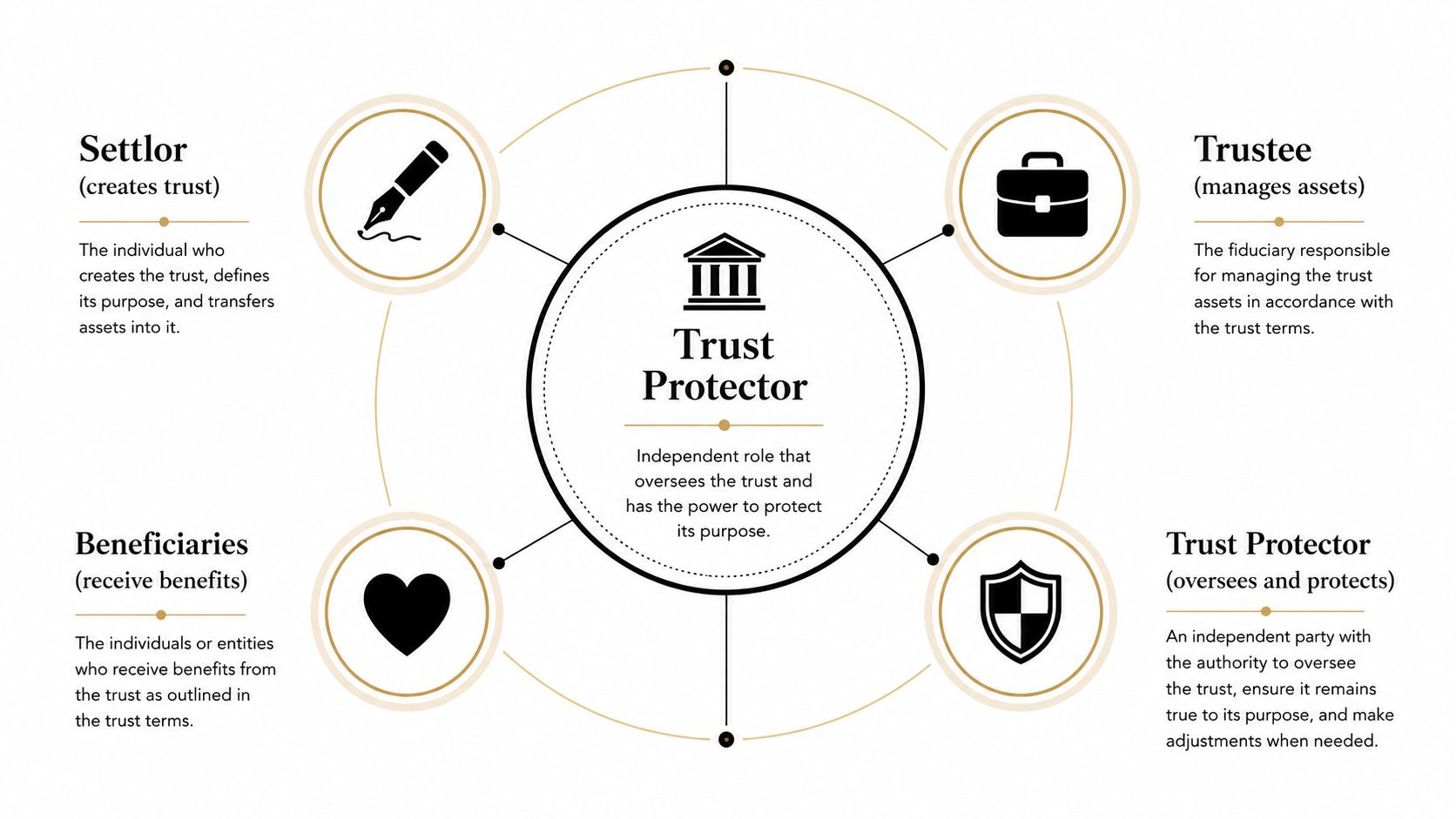
Texas families use this role for a simple reason, they want flexibility without giving up the structure of a trust. Foundational trust materials describe protectors as holding administrative and strategic powers, especially in complex or cross-jurisdictional trusts, and they commonly include authority to remove and replace trustees, approve accountings, change situs, and respond to tax law changes, all depending on the deed's wording. The role exists because long-term trusts need a built-in way to adapt without starting from scratch. See also the trust-administration overview in Texas Trust Administration: A Trustee's Guide for the broader administration context.
The key point is that the title alone does nothing. The trust instrument has to grant the authority. Without that grant, there is no free-floating power just because someone is called a protector.
The Core Powers a Trust Protector Can Hold
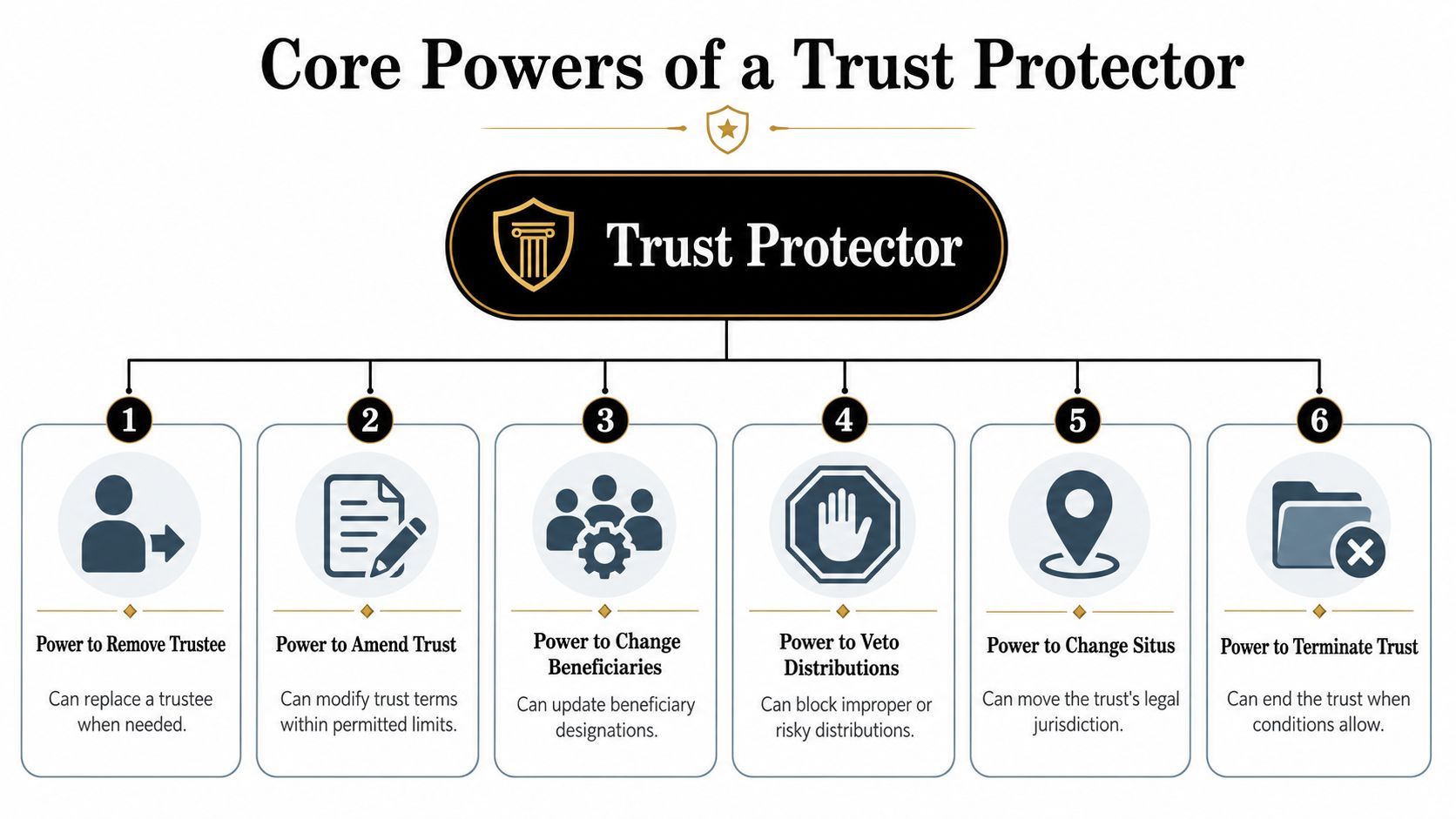
The best way to understand protector powers is to sort them by function. Some powers are administrative, like checking the trustee's work. Others are substantive, because they can change who gets what, where the trust is governed, or whether the trust stays in place at all.
Oversight and control powers
Common drafting gives a protector the power to remove and replace trustees, veto trustee actions, and approve or review accountings. Those powers are useful when a trustee has become slow, inattentive, or too rigid for the family's needs. A well-drafted clause might read, “The Trust Protector may remove a trustee and appoint a successor trustee upon written notice.”
Other instruments go further and let the protector direct investments or change the trust's governing law. A sample clause might say, “The Trust Protector may direct the trustee to transfer the trust's situs if the change better serves administration.” Those powers are common because administration problems often show up first in the choice of trustee, the choice of situs, or the choice of investment structure.
Substantive powers that change outcomes
Some trusts give the protector authority to modify beneficiary interests, exercise a power of appointment, or even make changes that function like decanting into a new trust. In practical terms, that means the protector can sometimes reshape the trust to fit new family facts without asking a court to intervene. One resource that discusses decanting in the Texas context is decanting a trust in Texas explained, which is useful when the trust terms need careful comparison before any move is made.
Practical rule: if the deed doesn't grant the power, the protector doesn't have it.
That's why the exact language matters. A protector with a veto power can stop a trustee from acting in a narrow set of circumstances, while a protector with a broader amendment power can affect the trust's long-term shape. Texas families should review those distinctions carefully with a Texas trust administration lawyer before signing or before relying on an older trust.
How Texas Law Treats Trust Protectors and Their Limits
Texas law does not treat the title “trust protector” as a blank check. The role exists through the trust instrument, along with the Texas Trust Code and fiduciary principles found in Texas estate and trust practice. In other words, the deed creates the power, and the law polices how that power gets used.

The power must stay inside the instrument
A protector acts only within the express terms of the trust. If the protector goes outside those terms, the act is void. That is a hard boundary, and it is the first thing a trustee should check before following a protector's direction. The deed may authorize removal of trustees, withhold consent, verification of accounts, or document inspection, but those powers exist only if the deed says so.
Scotland's Trusts and Succession legislation shows how far the idea can be spelled out in modern instruments, including powers to direct trustee removals and additions, withhold consent to beneficial interests, verify accounts, and inspect documents, all in a legal framework that recognizes the role more explicitly. Texas readers can use that example as a drafting reminder, because precision matters more than labels.
Fiduciary conduct still matters
Where the protector's power is fiduciary, the protector must act in the beneficiaries' best interests. That means the role is not just advisory, and it is not a casual family appointment. A protector may need to pause, review whether action is required, and then decide carefully. A Texas court can scrutinize the action if the facts show overreach, bad faith, or a decision made outside the granted authority.
If a trustee is unsure whether to follow a protector's request, the first question is simple, does the trust actually give that request power?
For a practical Texas planning discussion of when trust terms may need later adjustment, families often also review how to modify a trust in Texas. That topic comes up when the original plan no longer fits the family, but a court filing or trust-based solution may still be necessary.
A Real-World Texas Scenario Showing the Powers in Action
A family trust in Dallas holds operating business interests and was designed to last for generations. The original corporate trustee has already been replaced once, and the family is now asking whether the trust should stay in Texas or move to another jurisdiction with a better administrative fit. The protector steps in, not to run the business, but to keep the trust structure workable.
First, the protector removes an underperforming trustee and appoints a new one. That action is usually the easiest to understand because it tracks the protector's oversight role. Then the protector approves a partial decanting to clean up outdated administrative terms, but only because the trust instrument allows that kind of change.
The family then considers a situs change. A protector with that power can help move the trust's governing law if the move serves administration and the deed permits it. In a Texas trust administration setting, that choice can matter when the trustee, assets, and beneficiaries are all in different places.
Here is where the landmine appears. After the death of a beneficiary, the protector wants to change beneficial interests far beyond the authority written in the trust. The trustee should stop there and review the instrument carefully. If the protector's request exceeds the granted power, the trustee cannot treat it as valid just because everyone at the table agrees.
A trustee needs to think in two tracks, administration and authority. The fact that a protector can change one part of the trust does not mean the protector can rewrite the entire plan. Families often understand this better when they compare protector powers with the broader guidance in what happens when a trustee dies in Texas?, because successor control and continuity issues often arise together.
Drafting Choices and Best Practices for Texas Families
Good drafting decides whether a protector becomes a useful safeguard or a source of confusion. Texas families need to choose who should serve, what powers that person should have, and how the protector's authority interacts with the trustee's fiduciary duties.
| Drafting Decision | Common Option | Texas-Specific Trade-off |
|---|---|---|
| Who serves as protector | Trusted family member, independent professional, or committee | Family members know the people, but independence often reduces conflict |
| Successor protector | Named individual or default appointment method | Clear succession avoids gaps when the original protector dies or resigns |
| Standard of authority | Good faith, reasonable judgment, or broader discretion | Stronger discretion can help flexibility, but it can also invite disputes |
| Trustee conflict rules | Consent required, notice only, or tie-breaking power | More structure can prevent deadlock, but too much detail can limit agility |
| Tax-sensitive powers | Express tax election or no express tax role | Tax authority can help with planning, but it should be drafted carefully |
The most common drafting mistake
One mistake is naming a beneficiary as protector without thinking through the conflict. That can create tension when the protector has a say over distributions, trustee removal, or tax-sensitive choices that affect the protector personally. Another mistake is failing to state whether the protector acts in a fiduciary capacity. If that point is left vague, families often end up arguing about the standard after the damage is done.
A third mistake is omitting tax-related powers from a trust that is clearly meant to last for decades. Trusts designed for long-term planning often need flexibility tied to changing tax law. If that flexibility is missing, the family may be forced into a harder path later.
Texas counsel can help compare light-touch drafting with broader drafting. In some cases, a protector should have only a narrow veto or consent role. In others, a professional protector with legal or tax experience may be more appropriate, especially for a Texas estate planning attorney working with dynasty-style planning, business succession, or long-term administration. Families exploring multi-generational planning may also find dynasty trusts in Texas useful as a related planning concept.
Questions Trustees, Settlors, and Beneficiaries Commonly Ask
Can a trust protector also be a beneficiary? Sometimes yes, if the trust allows it, but that choice can create conflicts when the protector's own interests are at stake. A trustee should review the document carefully before relying on any direction from a conflicted protector.
Can a protector delegate or be replaced? The answer depends on the instrument. If the trust names successor protectors or allows replacement, the transition can be smooth. If it does not, the family may need legal guidance before taking action.
How is a protector's decision different from a trustee's decision? The trustee handles administration, assets, records, and distributions within the trust terms. The protector holds only the specific powers granted in the deed, such as consent, removal, or a limited amendment role. Those jobs overlap in effect, but they are not the same job.
What should a trustee do if a protector's request conflicts with fiduciary duty? Stop and read the trust language first. If the request falls outside the granted power, the trustee should not follow it. If the request is within the power but still seems harmful or unclear, the trustee should seek legal advice before acting.
A trustee who follows the deed carefully usually makes a better record than a trustee who tries to solve a family problem by guessing.
Families dealing with these issues often need help from a Texas estate planning attorney, a trust administration team, or in some cases probate or guardianship counsel if the broader family situation also includes incapacity or estate disputes. The right answer depends on the trust language, not on a general rule pulled from another state.
Building a Trust That Holds Up for Generations
A well-drafted protector role can help a trust survive changing tax law, trustee turnover, and family conflict without losing the settlor's intent. A poorly drafted one can create a second layer of disagreement where clarity was supposed to exist. Texas families get the best results when the trust language, fiduciary duties, and family communication all point in the same direction.
That is why this role should be discussed alongside the rest of the estate plan, not added as an afterthought. Families who also care about business succession and long-term asset protection can compare the protector role with broader planning tools like asset protection for rental investors and the firm's explanation of Texas trust administration as part of a larger planning conversation. The goal is the same, keep the plan workable when life changes.
If you're managing a trust or planning your estate, contact The Law Office of Bryan Fagan, PLLC for a free consultation. Our attorneys provide trusted, Texas-based guidance for every step of the process, from trust administration and fiduciary duties in Texas to questions about how to modify a trust in Texas. Visit Law Office of Bryan Fagan, PLLC to talk through your options with a team that understands Texas trust administration, probate, guardianship, and asset protection.


