Managing a loved one's trust can feel straightforward right up until the first real decision lands on your desk. A Houston-area sibling steps in as trustee, opens a binder full of old forms, and starts checking the internet for the Uniform Trust Code. That's usually where the confusion begins, because Texas borrowed some uniform concepts but never signed on to the UTC in full, so the guidance that looks familiar may not control the administration in front of you.
| Topic | UTC Approach | Texas Trust Code Approach |
|---|---|---|
| Overall structure | Uniform model used by adopting states | Texas hybrid statute with its own structure |
| Beneficiary accounting waivers | Express waiver flexibility | No analogous provision in the Trust Code |
| Private settlement flexibility | Broader UTC-style tools | More limited, Texas-specific tools |
| Investment defaults | Uniform prudent investor framework | UPIA applies only when the trust is silent |
| Persuasive value | Binding in UTC states | No precedential value in Texas, though it can guide analysis when Texas law is silent |
A trustee who assumes the UTC and Texas law line up can miss a reporting duty, overread a waiver clause, or lean on a modification tool that Texas doesn't recognize the same way. For a fiduciary, that's not a theory problem, it's a liability problem. A careful Texas trust administration lawyer looks at the trust instrument, the Texas Trust Code, and the Texas Estates Code together, then checks where uniform language stops matching local doctrine.
Why Texas Trustees Ask About the Uniform Trust Code
A trustee often reaches for the UTC after reading a national guide that seems to fit the facts, then runs into a Texas-specific limit. A family trust in the Houston area might have a broad distribution clause, a discretionary income standard, and beneficiaries asking for less paperwork. The trustee wants to know whether a UTC article about waiving accountings or approving settlements solves the problem, but Texas law may not give that article the same effect.
The practical point is straightforward. Reference materials often describe the UTC, while the binding law in Texas is the Texas Trust Code, housed in the Texas Estates Code and shaped by local legislative choices. When those sources diverge, the trustee has to follow the Texas statute first, then use UTC commentary only as background where Texas law is silent.
A trustee should treat UTC language as a clue, not as the answer, unless Texas has adopted that concept in the same form.
That difference matters because trustees do more than distribute assets. They communicate with beneficiaries, keep records, decide when to disclose information, and manage disputes before they harden into litigation. If the trustee relies on a UTC rule that Texas never adopted, the trustee may set expectations that cannot be met, which is how avoidable conflict starts. For a fiduciary, that creates real liability risk rather than an abstract concern.
For families already in administration, the stakes feel immediate. One beneficiary wants more reporting, another wants less, and the trustee is trying to avoid both over-disclosure and a breach claim. That is why questions about the Texas Trust Code are really questions about fiduciary duties in Texas, even when the trustee is just trying to finish a calendar-year accounting.
If the trust has already moved into Texas or may be moved here, a focused review of situs and administration issues can help. A practical overview of trust situs and moving a trust to Texas can help frame those questions before the trustee makes a decision. Texas bookkeeping support can also be useful where records, annual reporting, and beneficiary accounting work need to stay organized alongside legal review.
How the Texas Trust Code Was Actually Built
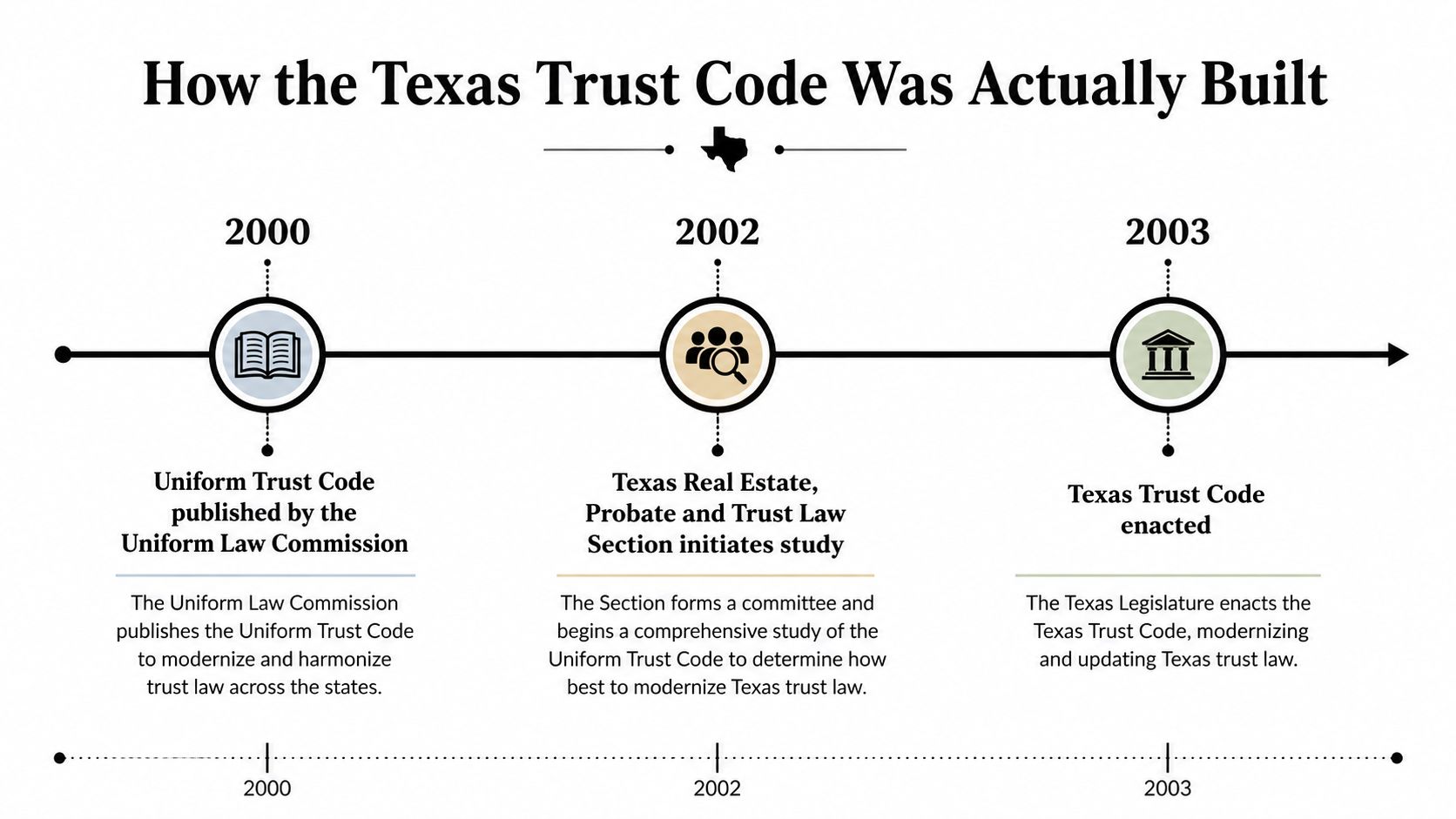
Texas did not copy the UTC wholesale. The House committee report on HB 1190 says the Texas Real Estate, Probate and Trust Law Section spent years studying the 2000 UTC and decided Texas should not adopt it in full, but should instead incorporate selected provisions into Texas law. That same report explains that Section 111.0035 was modeled on UTC Section 105, and that several revisions were lifted directly from UTC language. Texas legislative analysis of HB 1190
That history matters because it explains why Texas trust law feels familiar and different at the same time. The statute keeps its own structure, numbering, and internal logic inside the Texas Estates Code. It also uses borrowed concepts where Texas lawmakers thought the uniform rule fit local policy, which is why a practitioner can find recurring UTC language in some provisions but not others.
A trustee or advisor who understands that hybrid design can draft and administer more cleanly. A Texas estate planning attorney is not just asking, “What does the UTC say?” The question is, “What did Texas keep, reject, or recast?” In practice, that distinction affects notice, beneficiary rights, and how aggressively a trust can be administered without court involvement.
For day-to-day administration, this hybrid model also changes the paperwork trail. One trust may need tighter internal records than a UTC-style summary approach would suggest, while another may justify more flexibility because the governing instrument is specific. If a trustee is balancing receipts, distributions, and tax reporting, a coordinated file is often the difference between a routine administration and a dispute that gets expensive fast.
The Fiduciary Duties of a Texas Trustee captures the baseline duties well, loyalty, prudence, and impartiality under the Trust Code, which are the duties most trustees feel first when beneficiaries start asking questions.
Where Texas Departs From the UTC in Practice
Texas diverges from the UTC most sharply where uniform flexibility would give beneficiaries and trustees more room to negotiate privately. The biggest examples involve beneficiary information, accounting waivers, and the way Texas handles default rules when a trust instrument is silent. A Texas CPA review notes that the UTC expressly allows beneficiaries to waive accounting rights in a nonjudicial settlement agreement, while Texas has no analogous provision in the Trust Code. Texas CPA publication on trustee issues
That difference is not academic. It affects how trustees pace disclosures, how families negotiate transparency, and how much confidence a trustee can place in a private waiver. The same review also notes Texas's added age qualification for first-tier beneficiaries and other drafting differences, which can change who receives notice and when.
UTC vs. Texas Trust Code at a glance
| Topic | UTC Approach | Texas Trust Code Approach |
|---|---|---|
| Accounting waivers | Beneficiaries may waive accounting rights in a nonjudicial settlement agreement | No analogous provision |
| Private settlements | Broader settlement flexibility | More limited, state-specific approach |
| Beneficiary notice | More uniform waiver-oriented tools | Notice duties remain more constrained |
| Investment defaults | Uniform prudent investor default | UPIA applies only when the trust is silent |
| Persuasive effect | Binding where adopted | Not precedential in Texas |
Practical rule: if a Texas trust needs lighter reporting, build for it in the instrument and confirm whether Texas law actually permits the shortcut you want.
Texas also departs from the UTC in how much weight it gives the trust document. Under the Texas handbook on the Uniform Prudent Investor Act, the trust document controls when it specifies different investment rules, and the UPIA functions as a default only when the instrument is silent. Texas UPIA handbook That puts the settlor's written instructions ahead of the uniform default in a very concrete way.
For creditor issues, the divergence can be equally important. Texas spendthrift and discretionary-trust treatment gives beneficiaries different protection contours than a UTC framework might suggest, and the practical question becomes what claims can reach the trust. Where the trust language is broad but Texas law is narrower, the trustee should not assume a creditor release or beneficiary waiver will carry the same weight that a UTC article would give it.
One useful internal resource for a deeper Texas-specific dispute concept is virtual representation under Texas Trust Code 114.086, because representation rules often intersect with reporting, consent, and modification questions.
Real-World Scenarios Where the Difference Matters
A sister serving as trustee wants to cut the paperwork down to a short summary and send full accountings only if someone objects. Under UTC-style logic, she might look for a beneficiary waiver or a settlement shortcut. Texas doesn't give her an equivalent accounting waiver tool, so the safer move is to provide the disclosure Texas law requires, then narrow future disputes with clear written notices and clean records.
A second family has a trust with an investment advisor acting under a directed arrangement. The trustee assumes a trust protector-style uniform approach will solve every authority question, but Texas and the UTC do not line up neatly here. A directed-trust structure in Texas needs to be read against the actual instrument, the Texas statute, and the fiduciary role each person holds.
For that kind of administration, decanting a trust in Texas explained is often the next issue families ask about, because redrafting around a bad structure can sometimes be cleaner than litigating over it.
The third scenario shows up when a creditor presses a beneficiary's interest. The trustee may be tempted to rely on a general UTC summary and assume the trust is safe because distributions are discretionary. Texas spendthrift and discretionary-trust rules need a more careful read, especially when the trust was drafted for family protection and later becomes part of a collection fight.
A Texas trust administration lawyer will usually ask three immediate questions in these cases.
- What does the trust instrument say? The document can override the default investment rule if it is specific.
- What disclosure is Texas law requiring? A private waiver that would work in a UTC state may not solve the Texas problem.
- Who is the fiduciary actor? Trustee, advisor, protector, and beneficiary consent all matter differently in Texas practice.
If a trustee feels pressure to “just follow the UTC,” the better move is to slow down and compare the instrument to Texas law line by line.
Drafting Tips for Texas-Focused Estate Plans
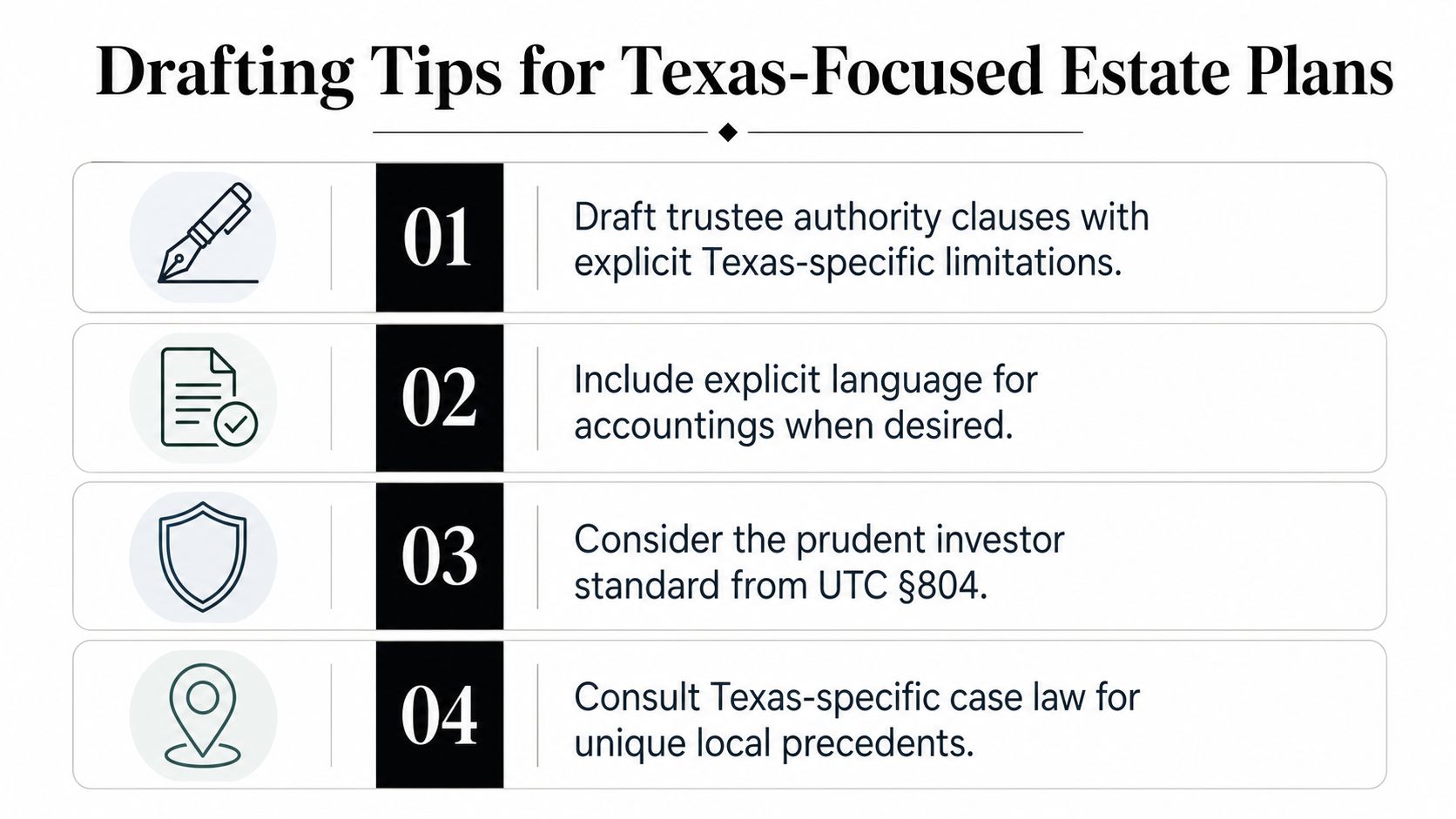
Texas drafting works best when it anticipates the gaps instead of hoping uniform language will fill them later. If you want the trustee to have broad discretion, say so clearly, but also spell out any reporting expectations, consent procedures, and approval mechanics. That reduces the chance that beneficiaries later argue the trustee was supposed to use a UTC-style shortcut that Texas doesn't recognize.
One practical move is to draft express accounting and notice provisions instead of relying on implied waiver language. Another is to define investment authority with enough precision that the trust does not depend on default rules for core decisions. In Texas, that is especially important because the UPIA serves as a default only when the trust is silent.
Where modification or decanting might become necessary later, include authority language that fits Texas procedure rather than assuming a generic uniform clause will work. Families who hold digital assets or plan to pass online accounts also benefit from coordinated estate planning, and The Coin Course on digital inheritance can be a useful educational companion when those assets need to be addressed in the broader plan.
A Texas-focused estate plan should also coordinate with related documents, not stand alone. Trust provisions, pour-over wills, powers of attorney, and beneficiary designations can pull in different directions if they are not reviewed together. Texas Trust Administration: A Trustee's Guide is a useful companion reference when you're trying to align the administration side with the drafting side.
The cleanest plans usually reflect one core principle. Draft for the Texas statute first, then use flexible language only where Texas allows it.
Where Texas Trust Law Is Heading Next

Texas has shown a steady pattern of selective borrowing rather than full adoption. That trend appears in the way Texas uses uniform ideas in targeted areas, while still preserving its own fiduciary structure. The UTC can still help when Texas law is silent, but in Texas it has no precedential value, so it remains a guide, not controlling authority.
For trustees, that means future amendments are more likely to refine specific pressure points than to rewrite the whole system. The recurring issues are the ones that affect administration every week, notice, discretion, investment rules, and the scope of beneficiary protection. The practical result is a code that keeps moving toward clarity without surrendering Texas control over trust administration.
The strongest planning approach is to assume selective convergence, not full uniformity. A settlor who wants a more modern administration structure should have the document drafted with Texas law in mind, then reviewed again if the trust's investment, income, or principal rules need to track newer fiduciary frameworks. That is the safest way to keep the plan functional as Texas continues to borrow and reject uniform language in different places.
Practical Next Steps for Texas Trustees and Beneficiaries
If you're a trustee, start with the trust instrument, then check whether the Texas Trust Code supports the shortcut you're considering. If you're a beneficiary, ask for the accounting, notice, and authority basis in writing before assuming a UTC-style waiver or settlement controls. If you're a settlor, review your trust language whenever your family, assets, or tax plan changes, because older uniform-form language may not match Texas administration today.
When retirement assets are part of the plan, it also helps to keep the beneficiary designations and trust terms coordinated. A plain-language resource like the Gold IRA Association guide can help families think through inheritance structure before they make changes that affect the trust.
If you need help sorting through a trustee duty issue, a reporting dispute, or a trust update, a Texas trust administration lawyer can walk through the document, the statute, and the practical administration steps together. For many families, that's the fastest way to lower conflict and keep the trust moving.
If you're managing a trust or planning your estate, contact The Law Office of Bryan Fagan, PLLC for a free consultation. Our attorneys provide trusted, Texas-based guidance for every step of the process, from beneficiary reporting questions to trust modification and administration under the Texas Trust Code. Visit Law Office of Bryan Fagan, PLLC to get clear, specific help for your situation.