 Skip to content
Managing a loved one's trust can feel overwhelming, especially when the trust reaches across generations and the family tree keeps growing. A Texas trustee may need to ask a court to modify a trust, sell real estate, or clean up an administrative problem, yet some beneficiaries are minors, some are unborn, and some haven't even been identified yet. In that setting, virtual representation under Texas Trust Code §114.086 can be the practical path that keeps a case moving without turning it into a service nightmare.
Texas trust administration is full of these collision points. A trustee has fiduciary duties to carry out the trust carefully, but also has to protect the process from unnecessary delay, expensive joinder issues, and later attacks on the judgment. Texas law gives practitioners a way to handle that tension, and the doctrine works best when the facts are clean, the interests line up, and the court can see exactly why the absent parties are fairly bound.
Why Virtual Representation Matters in Texas Trust Disputes
A trustee in Houston may be dealing with a family trust created decades ago. The current beneficiaries are adult children, but the trust also names minor grandchildren as remainder beneficiaries, and it may include future descendants who don't exist yet. Serving every interested person individually can be slow, expensive, and sometimes impossible, which is why Texas's virtual-representation framework exists in the first place. It is designed to avoid the cost and delay of joining every interested person individually, allowing a person with a substantially identical interest to bind absent minors, unborn beneficiaries, or unidentified beneficiaries when there is no conflict of interest. (Baylor Law trust materials)
For trustees, that matters in the world. Trust modification and termination proceedings often involve multiple generations, contingent interests, and future beneficiaries who can't be served directly. If the court can rely on a properly aligned representative, the case can move forward without forcing a separate appearance for every possible interested person. That can reduce the risk that a judgment later gets challenged for lack of proper parties.
Practical rule: if the representation is clean on paper and the interests truly match, virtual representation can be a safe, efficient path. If the facts feel messy, the doctrine probably needs a harder look.
For readers trying to sort through a trust dispute, this doctrine is not a legal trick. It is a procedural tool that helps families, trustees, and counsel get to a result that holds up. A seasoned Texas trust administration lawyer will usually start by asking who the true decision-makers are, who can legally speak for the absent beneficiaries, and whether any conflict has already appeared.
If you're comparing trust and probate issues, a basic overview like Texas Trust Administration: A Trustee's Guide can help frame how administration works differently from probate. But when representation issues arise, the question becomes narrower, and far more important, who can bind whom, and on what basis.
Reading §114.086 in Plain English
Texas Trust Code §114.086 is easier to use when you strip away the formal language and focus on the mechanics. The core idea is simple. If someone already has a substantially identical interest to an absent beneficiary, that person may represent and bind the absent party in the proceeding, so long as there's no actual conflict of interest. That can include minor beneficiaries, unborn beneficiaries, or people whose identities are still unascertained.
The two things the court cares about most
The statute works because Texas courts are trying to answer two questions. First, does the representative's economic position really line up with the absent person's position. Second, is there any reason to think the representative would sacrifice the absent person's interests to improve their own. If the answer to the second question is yes, virtual representation breaks down.
That is why the doctrine is often described as a safe harbor. When the facts fit, a court is less likely to find that the judgment failed because someone important wasn't joined. But safe harbor doesn't mean automatic. A trustee still has to build the record carefully and explain why representation is fair.
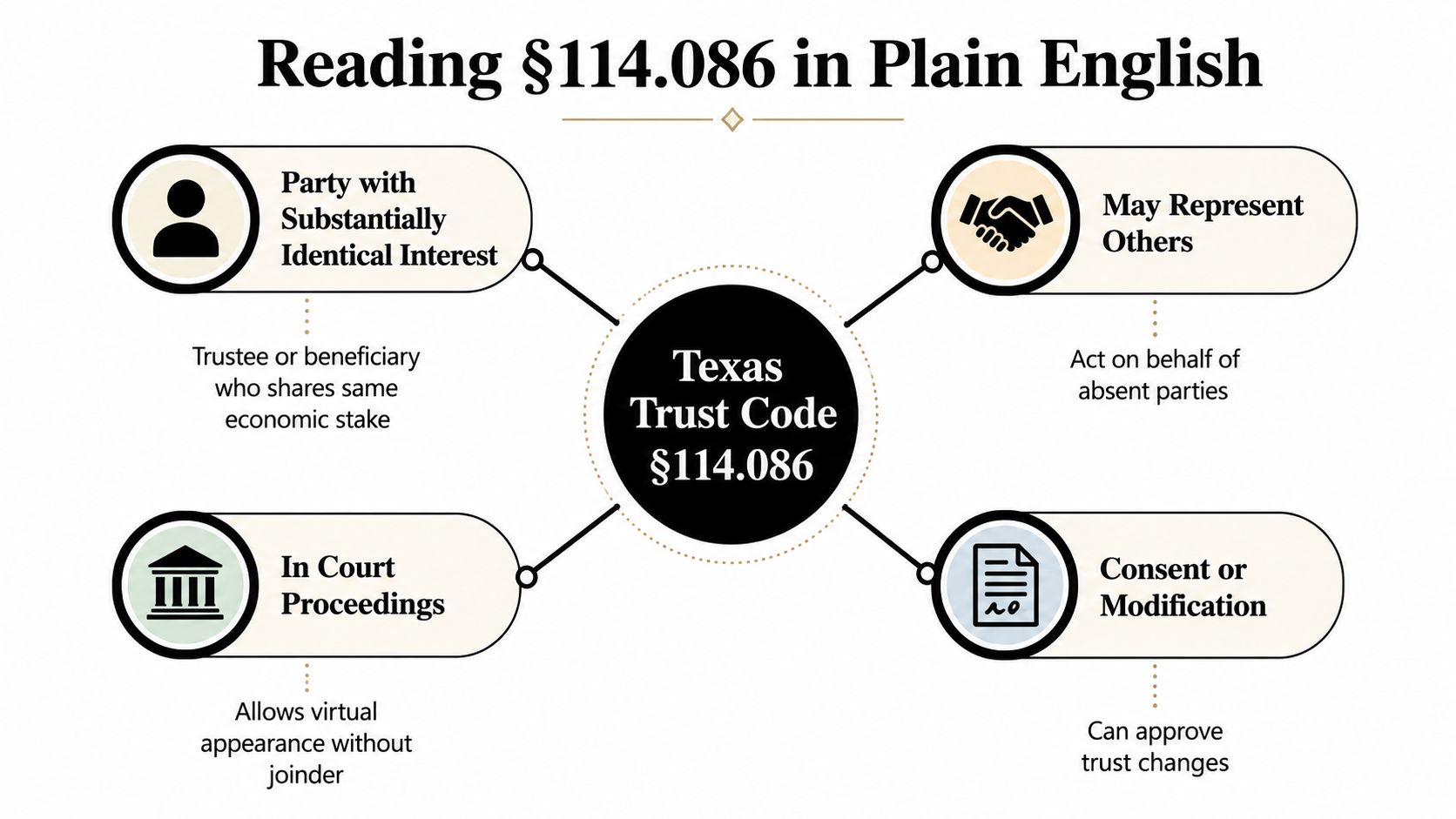
For trustees and beneficiaries who need a procedural benchmark, the statute belongs in the same file as the court pleadings, notice plan, and fiduciary records. It is not a substitute for notice where notice is required. It is not a shortcut around conflict. It is a way to let a properly aligned party speak for those who can't appear directly.
One useful point of confusion to clear up is that §114.086 is not the same thing as the certification-of-trust rule. The certification statute is a transaction tool, while virtual representation is about binding absent beneficiaries in a proceeding. Mixing those up causes avoidable mistakes, especially in trust-administration disputes that touch real property or title work.
Who Can Step In as a Virtual Representative
Texas uses more than one pathway for representation, and the right one depends on the facts. A trustee or beneficiary should first ask whether the absent person already has a fiduciary who can speak for them. If not, the next question is whether someone in the case already has a substantially identical interest and no conflict. If neither of those fits, the law may allow a parent to serve in limited circumstances, or the court may need to appoint a representative.
The four pathways in practice
- Existing fiduciary for the beneficiary. A guardian, conservator, or trustee of a separate trust for that beneficiary can usually step in when the role fits the issue and there's no conflict.
- A party with a substantially identical interest. This is the workhorse category. If the adult beneficiary's stake aligns with the absent beneficiary's stake, representation is often available.
- A parent in limited cases involving minors. This can work when the parent's interests are not adverse to the child's.
- A court-appointed representative. This is the fallback when the easier options don't work.
| Pathway | Representative | Typical Scenario | Common Disqualifier |
|---|---|---|---|
| Existing fiduciary | Guardian or trustee for the beneficiary | A minor beneficiary already has a guardian handling the proceeding | The fiduciary's own interest conflicts with the beneficiary |
| Substantially identical interest | Adult beneficiary or co-beneficiary | Two beneficiaries share the same economic stake in a trust modification | A dispute over fees, distributions, or trustee conduct |
| Parent | Parent of a minor beneficiary | A routine proceeding affecting a child's remainder interest | The parent's interest is adverse to the child's |
| Court-appointed representative | Person appointed by the court | No clean representative exists | A simpler representative was actually available |
Here's the hard part. A representative can't bind others if the representative's own position is under attack in a way that changes the economics of the case. For example, if the trustee's compensation is being challenged, that trustee is not a good stand-in for beneficiaries whose interests may suffer from that dispute. The same problem appears when one beneficiary wants broader distributions and another wants to preserve principal.
In practice, the safest map is the simplest one. Match the category to the facts, document why the match is clean, and move on only if the record supports the choice.
Virtual Representation vs Guardian Ad Litem and Direct Joinder
Texas practitioners usually weigh three procedural paths. Virtual representation is the leanest option, direct joinder is the most literal, and a guardian ad litem or similar court-appointed representative is the protective middle ground when someone vulnerable needs independent eyes on the case. The right choice depends less on theory and more on whether the interests are aligned.

Virtual representation works best when the beneficiaries' positions move together. That often shows up in routine modification or termination proceedings where the current adult beneficiaries and the absent minors or unborn beneficiaries have the same economic incentive. Direct joinder makes more sense when the group is manageable and the cost and delay of service are not a serious problem. A guardian ad litem, by contrast, becomes more attractive when the court needs someone to look past the aligned family story and test whether a child's or incapacitated person's interests are diverging.
The Estates Code side of the equation matters too, because Texas courts already know how to protect minors and incapacitated persons through representative appointments. If you're trying to understand where that route fits, how to apply for guardianship is a useful contrast point, even though guardianship is a broader incapacity tool rather than a trust-specific one.
A practical way to think about the choice is this:
- Choose virtual representation when the beneficiaries' economic interests are aligned and the record is clean.
- Choose a guardian ad litem or independent counsel when the vulnerable party's interests need independent review.
- Choose direct joinder when service is feasible and bringing everyone into the case won't create unnecessary friction.
The tool should fit the conflict, not the other way around.
That decision often determines whether the proceeding feels efficient or contested from day one. A careful Texas estate planning attorney will treat the representation question as part of fiduciary risk management, not just courtroom procedure.
Two Texas Scenarios Showing the Doctrine at Work
A family trust with land in Travis County sits in the background of the first scenario. The trust was created for a parent's descendants, and the current adult children want to modify administrative terms so the trust can be managed more efficiently for the next generation. Their children are minors, but the adult children and the minors share the same economic direction, because neither group benefits from a fight over the terms. In that setting, the court can often accept virtual representation and bind the minor or future descendants through the aligned adult beneficiaries.
Scenario one, a clean multi-generational modification
The trustee files the petition, explains the family tree, and shows that the adult children's interests are substantially identical to the interests of the minor grandchildren. No one is fighting over distributions, fees, or who controls the trust. The court's likely outcome is straightforward, because the absent beneficiaries are fairly represented and the record supports a single proceeding.
That's the doctrine doing what Texas meant it to do, reduce delay and avoid needless duplication. It also preserves privacy and keeps the administration moving without forcing the family through a stack of separate service efforts.
The second scenario is very different. A discretionary trust gives one beneficiary a strong incentive to push for larger distributions, while another beneficiary would rather preserve principal for the future. Those positions are not just different, they're opposed. In that case, virtual representation falls apart because the representatives do not share a substantially identical interest.
Scenario two, a conflict among beneficiaries
The trustee may want a quick resolution, but speed is not the test. Once the beneficiaries are pulling in different directions, the court needs independent protection for the affected parties. That might mean a guardian ad litem, independent counsel, or direct joinder, depending on the posture of the case.

For beneficiaries involved in a contested matter, a trust dispute is often less about the label on the case and more about whether the process respected the actual alignment of interests. If you're trying to understand the rights side of that equation, beneficiary rights in Texas trust administration is a helpful reference point.
A related point comes up in litigation over trustee behavior. If the trust conflict is really about administration, loyalty, or self-interest, counsel may need to look at a broader challenge such as a trust contest in Texas, rather than trying to force the matter into a representation shortcut that doesn't fit.
Trustee and Beneficiary Checklist Before Relying on §114.086
A good §114.086 analysis starts before anyone files papers. The trustee should build the record with the same care used in fiduciary accounting, because a later challenge will focus on whether the representative was aligned and whether the court had enough information to rely on the doctrine. Many bad filings fail at this point, not because the idea was wrong, but because the support was thin.
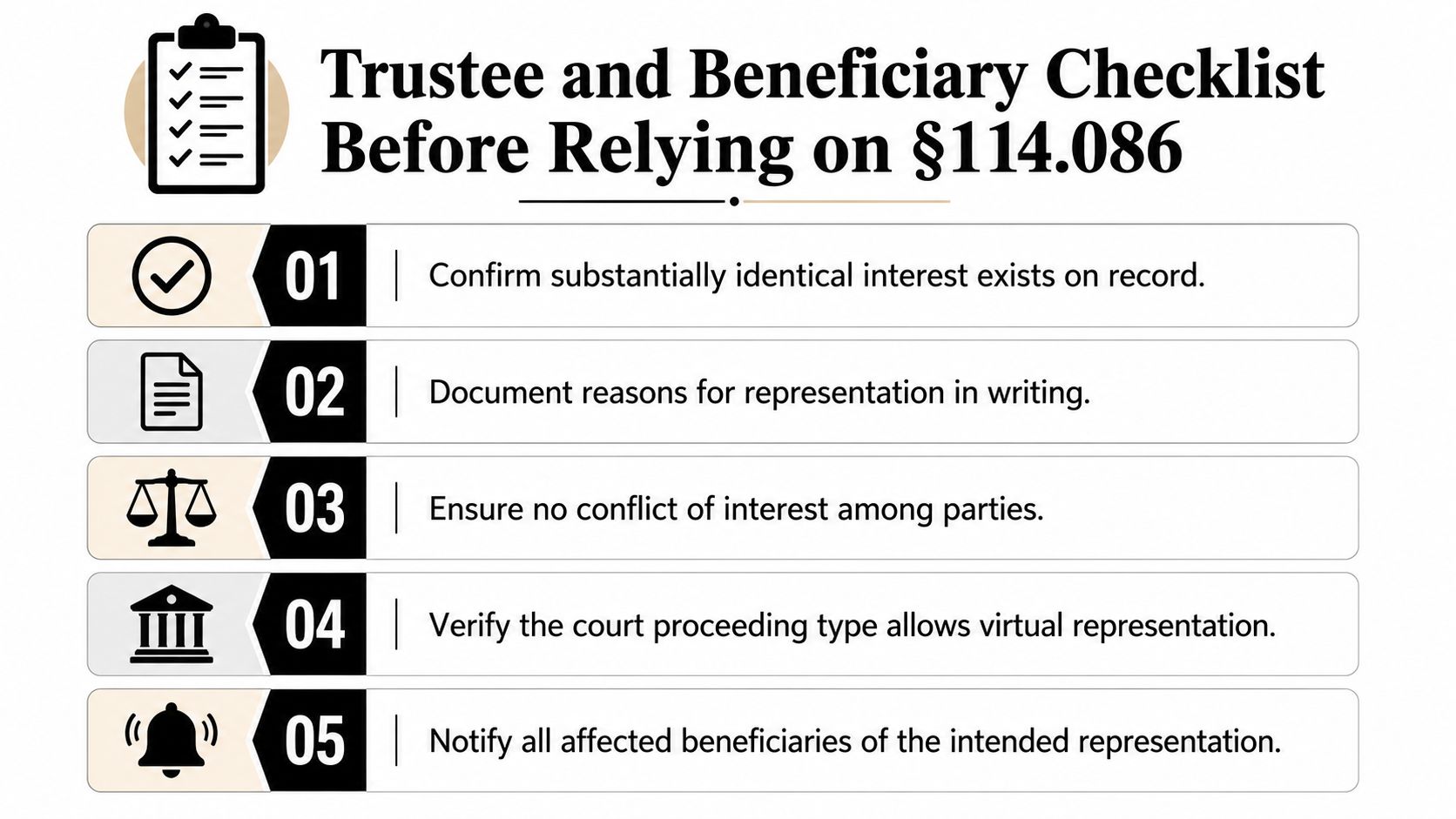
- Confirm the alignment. The record should show a substantially identical interest, not just a vague family connection.
- Write down the reasoning. Keep a clear memo or pleading explanation showing why the representative fits the role.
- Check for conflict. Any disputed fee claim, breach allegation, or distribution fight should get treated as a warning sign.
- Match the procedure to the case. Some proceedings are better suited to virtual representation than others, and the court will care about that fit.
- Preserve notice to the representative. Even when absent parties are represented, the process still needs a defensible notice trail.
A few red flags should push the matter away from virtual representation. If one beneficiary is accusing the trustee of breach, the interests are already unstable. If the trustee's compensation is on the table, the trustee's personal stake may collide with the beneficiaries' positions. If a beneficiary has already taken an adverse position, that person is not a reliable stand-in for anyone else.
Rule of thumb: if you'd have trouble explaining the representation choice to a judge in one paragraph, the record probably isn't ready.
That's where fiduciary discipline matters most. Trustees don't win trust disputes by improvising. They win, or at least protect themselves, by documenting careful decisions and respecting the line between a clean representation structure and a true conflict.
How §114.086 Fits with the Broader Texas Fiduciary Framework
Texas did not invent the idea of virtual representation from scratch. The doctrine has common-law roots, and Texas codified related protections in the Trust Code so courts could treat a properly represented absent party as bound by the result. That matters because trust administration often turns on whether the court can reach a durable order without reopening the same issue every time a new descendant appears.
The distinction from the certification-of-trust statute is also important. Certification of trust is a transaction tool used by trustees when dealing with third parties, while §114.086 is a procedural tool used in court proceedings to bind absent beneficiaries. Those are different jobs, even though they both sit in the Texas trust law ecosystem and both show up in real estate and administration work. The recorded certification rule under Texas Property Code § 114.087 also gives good-faith purchasers and lenders a reliance path when the certification is recorded in the county where the property sits, which is useful in title work but not a substitute for representation in litigation. (Texas Property Code § 114.087)
That broader framework also ties into daily fiduciary work. Trustees still need clean beneficiary communication, accurate accounting, and careful dispute resolution. If the representation analysis is weak, the rest of the administration can become harder to defend, because every later step rests on whether the right people were fairly bound at the right time.
For a deeper dive into the duty side of that picture, a practical resource on fiduciary duty can help frame the standards that govern loyalty and care. And if you're putting all of this into a larger administration plan, the broader trust-administration materials on the firm's site can help connect representation, accounting, and distribution decisions in one place.
Get Clear Answers on Texas Trust Representation
Virtual representation is powerful when everyone's interests line up, and risky when they don't. The doctrine can save time, lower friction, and keep a trust proceeding from stalling out over impossible service problems, but it can't cure a real conflict or replace sound fiduciary judgment. If you're acting as a trustee, executor, or beneficiary, get the representation question right before you rely on it in a contested matter.
The safest next step is a personalized review of your trust, your beneficiary structure, and the specific proceeding you're facing. A Texas trust administration lawyer can help you decide whether virtual representation fits, whether notice or joinder is still needed, and whether the facts call for a different procedural tool altogether. If you're trying to understand how to modify a trust in Texas, or whether a trustee has met fiduciary duties in Texas, that advice needs to be tied to the exact record, not a generic template.
If you're managing a trust or planning your estate, contact The Law Office of Bryan Fagan, PLLC for a free consultation. Our attorneys provide trusted, Texas-based guidance for every step of the process, including trust administration, fiduciary disputes, and estate planning decisions that need to hold up in the world. Visit Law Office of Bryan Fagan, PLLC to get started with help for your situation.


