
Managing a loved one's trust can feel overwhelming, especially when one beneficiary needs reliable income and another is focused on preserving long-term growth. A trustee may face that exact conflict when a portfolio has significant appreciation but produces little cash flow. The income beneficiary needs distributions for ordinary living expenses, while the remainder beneficiary worries that payments from principal will reduce what eventually passes to the family.
Texas law provides a carefully limited solution through the trustee power to adjust between principal and income in Texas. This power can help a trustee address an investment-return mismatch, but it isn't permission to move money whenever a beneficiary makes a request. The trustee must follow the trust terms, satisfy statutory conditions, act prudently, and create a record showing why the decision was fair.
Navigating Trust Distributions in Texas
Consider a trust created for a surviving spouse during the spouse's lifetime, with the remaining assets later passing to the settlor's children. The spouse receives trust income, but the trust portfolio is invested largely for long-term appreciation. Dividends and interest are modest, while the portfolio's value grows through assets that don't generate much current income.
The spouse begins asking why the trust is growing while monthly distributions remain tight. The children, as remainder beneficiaries, worry that increasing payments will consume the principal they expect to inherit. The trustee feels caught between two legitimate interests and may fear that any decision will look like favoritism.
That situation illustrates why principal and income must be administered carefully. Income generally describes the return produced by trust assets, while principal represents the trust property itself and its long-term value. When different people benefit from those two interests, investment choices can unintentionally favor one group. A portfolio designed only for growth may leave the income beneficiary without enough cash. A portfolio chosen only for immediate yield may limit the remainder beneficiaries' interest in preserving and growing principal.
Practical rule: A trustee should never begin with the question, “Which beneficiary is more persuasive?” The better question is, “What do the trust terms and Texas fiduciary law require after considering everyone's interests?”
The trustee power to adjust can provide a lawful way to address the mismatch. In the right circumstances, the trustee may reallocate value between principal and income, including allocating all or part of a capital gain to trust income. The decision still requires careful analysis and documentation.
Trustees, beneficiaries, and families should also distinguish trust administration from probate. Trust administration concerns assets held by the trust and the trustee's management of them. Probate concerns assets owned individually by a deceased person and may involve an executor or administrator under the Texas Estates Code. A plain-language overview, Texas Trust Administration: A Trustee's Guide, can help families understand that difference before distribution questions become disputes.
Statutory Authority for Trustee Adjustments
The Texas Property Code supplies the central authority for the trustee power to adjust between principal and income. Section 116.005 establishes the power within a prudent-investor framework, so a trustee must begin with the investment standard rather than with a beneficiary's immediate request.
The statutory conditions
A trustee should work through the legal requirements in sequence:
-
The trust must be invested and managed prudently. The adjustment power is connected to responsible investment and management. A trustee can't use an adjustment to excuse a portfolio that was handled carelessly or without appropriate attention to the trust's purposes and beneficiary interests.
-
The trust terms must tie distributions to income. The power addresses a trust where a beneficiary's distribution rights depend on income. If the document uses different distribution language, the trustee must first determine how the document interacts with the statute.
-
The trustee must be unable to comply with impartiality under Section 116.004(a) without adjusting. This condition matters. The trustee isn't free to adjust merely because a different allocation would be more convenient. The trustee must identify why ordinary administration would fail to treat the beneficiaries fairly and reasonably.
-
The trustee must observe statutory limits and exclusions. Section 116.005 contains mandatory factors and prohibitions that can affect whether an adjustment is available or how it may be made. A complete review of the current statutory text is essential before action.
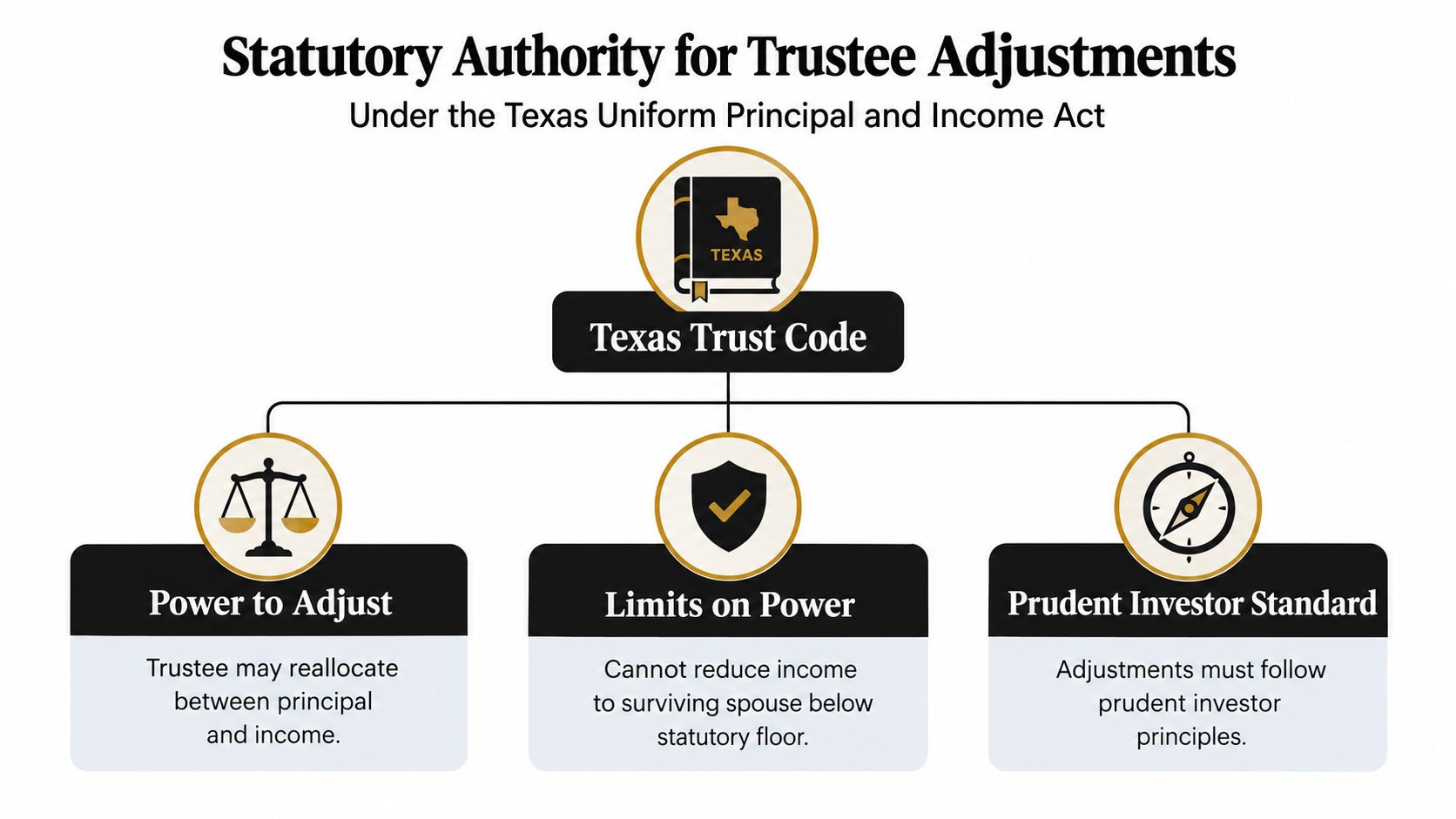
The Texas statute expressly permits a trustee to allocate all or part of a capital gain to trust income. That feature is historically significant because it aligns trust administration with total-return investing, rather than forcing a trustee to treat only interest, dividends, or other traditional income as available for an income beneficiary. Texas sources trace the operative version to the effective date of HB 2241 on January 1, 2004, and the rule remains part of the 2025 codification. The statute therefore reflects more than two decades of modern Texas trust administration under this adjustment framework. See the Texas Property Code text for Section 116.
The power isn't the same as changing the trust. A trustee is reallocating an accounting interest under statutory authority, not rewriting who benefits or replacing the settlor's plan. The Texas Trust Code controls trustee powers and fiduciary standards, while the Texas Estates Code may become relevant when trust administration overlaps with wills, probate, guardianship, or estate transfers.
For a focused discussion of principal and income allocation, trustees may also consult the Texas Uniform Principal and Income Act allocation guide. The guide can be useful as an educational starting point, but a trustee should compare any general explanation with the governing trust document and current law.
Evaluating Fairness and Tax Implications
The adjustment power solves a legal problem only when the trustee uses it consistently with the duty of impartiality. Texas Property Code Section 116.004 requires a fiduciary to administer the trust impartially and act fairly and reasonably toward all beneficiaries unless the trust clearly indicates an intent to favor one group. Impartiality doesn't always mean identical treatment. It means the trustee must account for the different interests the trust creates and avoid using discretion for personal reasons.
A trustee evaluating an adjustment should ask:
- Does the current investment strategy produce too little or too much income for the income beneficiary?
- Would an adjustment protect the remainder interest rather than undermine it?
- Does the trust document show a clear preference for a particular beneficiary?
- Is the proposed amount connected to the trust's investment performance and distribution terms?
- Would the decision remain defensible if every beneficiary reviewed the same records?
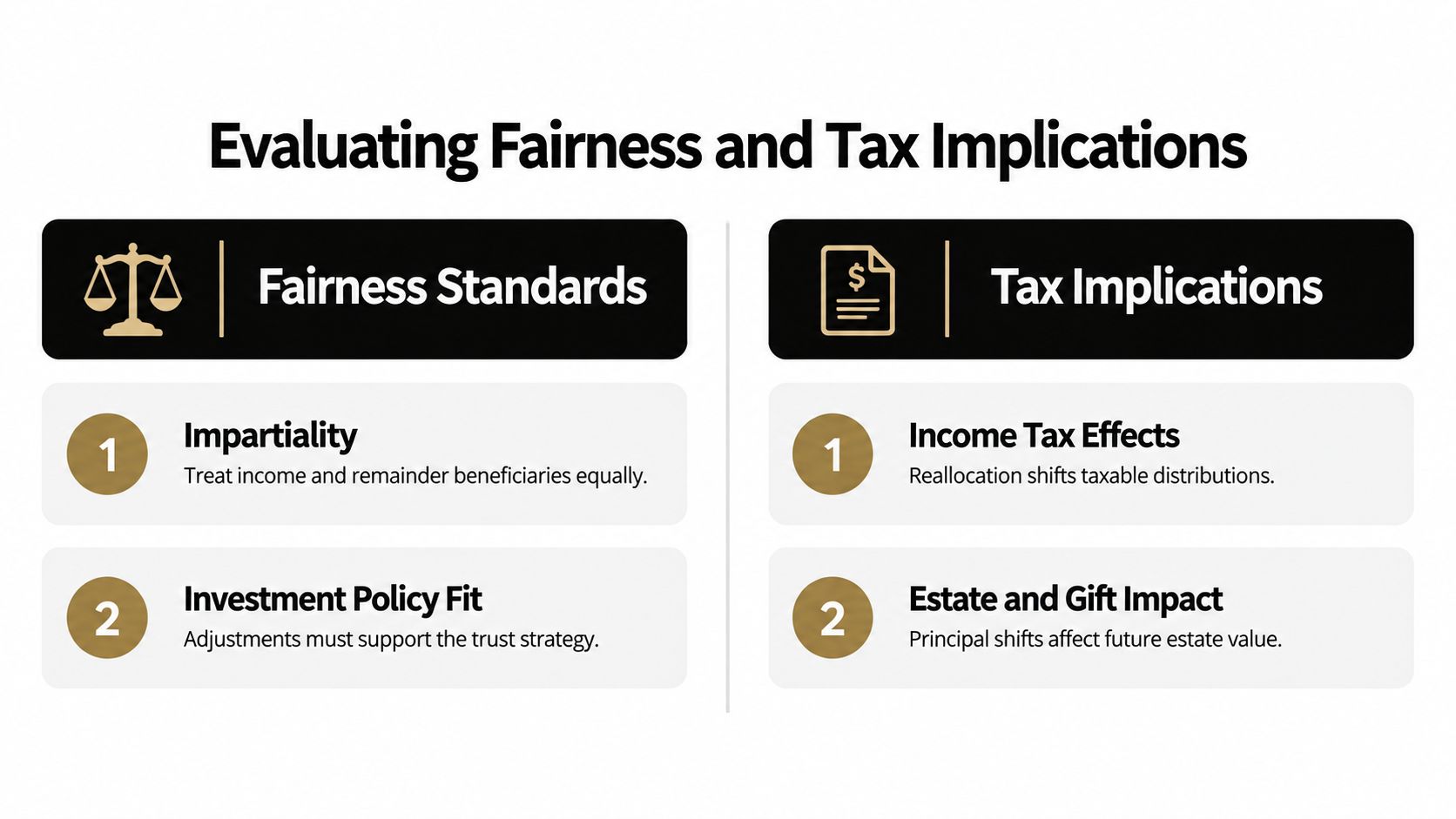
Tax allocation requires separate analysis
Texas treats principal-income allocation as part of a broader fiduciary and tax-management system. Section 116.205 provides detailed mechanics. A tax on receipts allocated to principal must come from principal. A tax on the trust's share of an entity's taxable income must be paid from income, principal, or both in proportion to how the entity's receipts are allocated. After those rules are applied, the trustee must make a further adjustment when trust taxes are reduced because the trust receives a deduction for payments made to a beneficiary. Review the Texas rules for tax allocation under Section 116.205 before finalizing the accounting.
Section 116.206 adds another tax-balancing tool. It allows adjustments to offset tax-driven economic shifts between income and remainder beneficiaries, including situations where entity-level taxable income is included in the taxable income of the estate or trust. That means the trustee may need to correct not only an investment-return mismatch but also a tax distortion that causes one beneficiary to bear an unfair economic burden.
Tax accounting and trust accounting aren't interchangeable. A CPA can analyze reporting and tax consequences, while a Texas trust administration lawyer can evaluate authority, impartiality, notice, and fiduciary exposure. Trustees should coordinate both perspectives before moving a capital gain or another receipt between accounting categories. For beneficiary-focused tax questions, consult this guide to how trust distributions are taxed in Texas.
Procedural Steps and Documentation Requirements
A beneficiary may question an adjustment even when the trustee acted carefully and in good faith. A reliable process builds the record before any dispute arises. The file should let a neutral professional, beneficiary, or court understand the trust terms, financial facts, competing interests, and reasons for the decision.
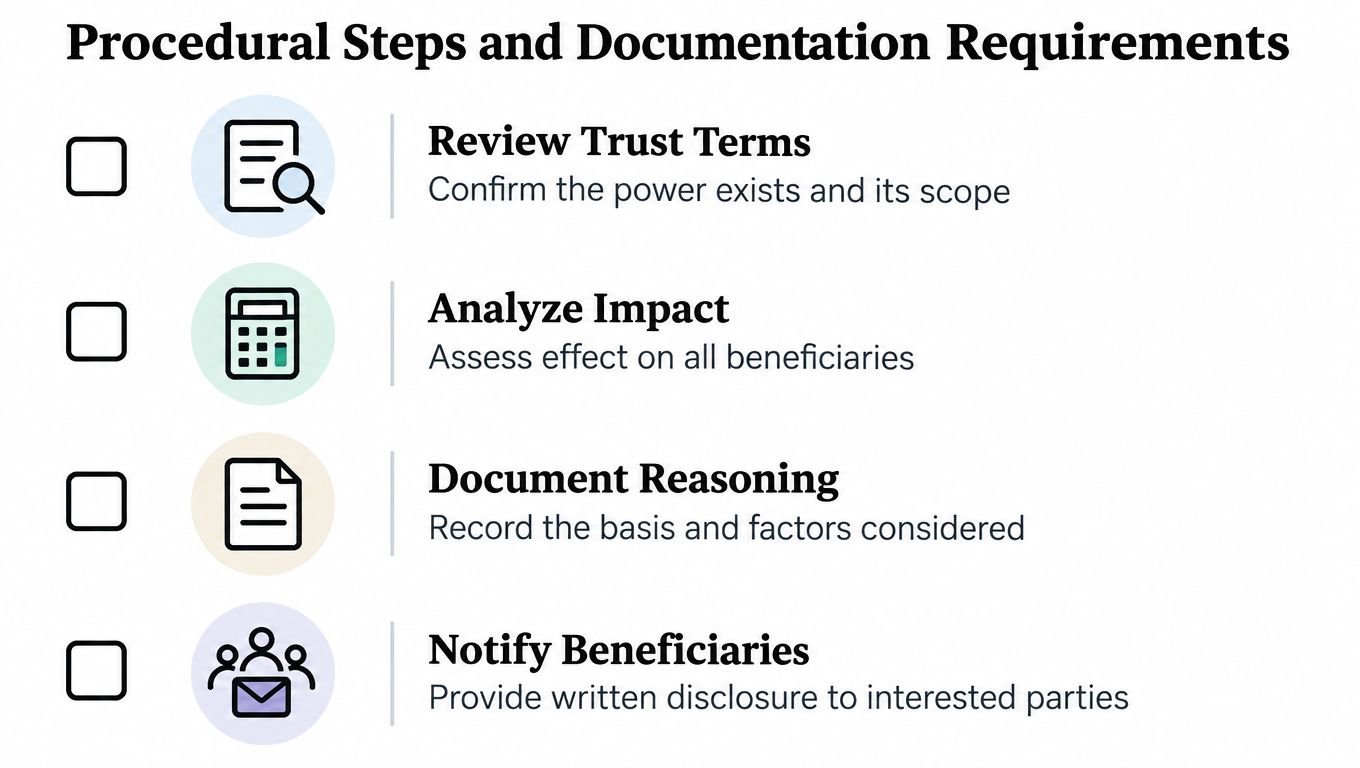
Build the decision file
Use a written workflow:
-
Read the trust agreement and amendments. Identify the distribution standard, definitions of income and principal, express adjustment authority, and provisions that limit or prohibit the power.
-
Confirm the investment history. Gather statements, allocation reports, investment-policy documents, and relevant advice. Record whether the trust was invested and managed prudently.
-
Describe the problem in neutral terms. Explain whether the current income stream is too low or too high in relation to each beneficiary's interests. Avoid wording that portrays one beneficiary as more deserving.
-
Analyze each beneficiary's position. Review the income beneficiary's distribution rights, the remainder beneficiary's preservation interest, the trust's duration, liquidity needs, taxes, and the proposed adjustment's effect.
-
Identify the statutory authority. State why the trustee believes Section 116.005 applies and why ordinary administration would not satisfy Section 116.004's impartiality standard.
-
Calculate the proposed allocation. Show the receipt, its original accounting treatment, the proposed adjustment, and the resulting effect on income, principal, distributions, and taxes. A clear calculation works like a map, allowing someone else to follow the change from the original entry to the final allocation.
Communicate and preserve records
Beneficiary communication should remain factual and consistent. Depending on the trust terms and circumstances, the trustee may need to provide notice, information, or an accounting. A written explanation can reduce suspicion, but privileged legal advice and tax advice should not be disclosed without professional guidance.
Update the fiduciary ledger promptly. Keep the trustee's resolution or internal memorandum, supporting statements, tax analysis, correspondence, notices, delivery records, and approvals together. The Texas trust accounting requirements guide can help identify the records that should be organized during administration.
Documentation principle: Write the memo as though a neutral reader will see it without knowing the family history. Facts, statutory authority, calculations, and beneficiary impact matter more than personal explanations.
A beneficiary's silence does not necessarily establish consent. Counsel should confirm whether the trust and applicable law support that conclusion. If the adjustment is unusually large, affects a family business, creates a tax concern, or may trigger conflict, the trustee should consider legal advice or appropriate court guidance before acting.
Real-World Scenarios and Practical Examples
The adjustment power becomes easier to understand when applied to ordinary trust administration. These examples are hypothetical illustrations, not predictions about how a court would decide a particular dispute.

A capital gain and an income shortfall
A trust provides income distributions to a surviving spouse and later distributes the remaining principal to the settlor's children. The trustee follows a prudent investment strategy focused on total return. The portfolio has appreciated, but the assets generate limited traditional income, and the spouse's current distributions don't meet the trust's practical purpose.
The trustee reviews the trust terms, investment records, and the interests of both beneficiary groups. The trustee determines that ordinary income accounting would produce an unfair result and that an adjustment is necessary to comply with impartiality. Under Section 116.005, the trustee may have authority to allocate all or part of a capital gain to trust income, provided the statutory conditions and restrictions are satisfied.
The trustee then prepares a written analysis explaining why the adjustment is needed, how much value will move, how the decision affects the remainder interest, and what tax consequences require review. The result may provide the spouse with a more appropriate distribution without abandoning the children's interest in preserving principal.
A family business and tax distortion
Now consider a trust that holds an interest in an entity. The entity's taxable income is included in the estate or trust's taxable income, but the trust's cash distribution doesn't match that taxable income. The income beneficiary may bear an economic tax burden without receiving enough cash, while the remainder beneficiary may see the principal affected by taxes associated with the entity interest.
Section 116.206 can provide a separate tool for addressing tax-driven shifts between income and remainder beneficiaries. The trustee must still apply the impartiality standard and maintain a clear tax allocation record. A CPA can calculate the tax effect, while counsel can evaluate whether the proposed adjustment falls within the statutory framework.
In both examples, the trustee isn't choosing a favorite. The trustee is correcting a mismatch created by the relationship between investment returns, accounting categories, distributions, and taxes. That distinction should appear plainly in the written decision record.
Common Pitfalls and Misconceptions to Avoid
The most dangerous misconception is that the trustee power to adjust is an unlimited license to move principal into income whenever a beneficiary needs money. It isn't. The statute ties the power to prudent investment and management, income-based distribution terms, the inability to satisfy impartiality through ordinary administration, and additional statutory factors and prohibitions.
Mistaking discretion for ownership
A trustee may have authority to make an adjustment, but trust property still belongs to the trust. The trustee can't use the power to reward a preferred relative, settle a personal disagreement, or accelerate a distribution that the trust doesn't authorize. A decision based on family pressure rather than documented fiduciary analysis can expose the trustee to a beneficiary challenge.
Ignoring the remainder interest
An income beneficiary's needs matter, but so does the remainder beneficiary's interest. The trustee should document how the adjustment preserves a fair balance rather than assuming that current need automatically overrides future ownership. The trustee also shouldn't make an adjustment solely to maximize principal growth if the income beneficiary is being deprived of the benefit the trust intended to provide.
Treating capital gains as ordinary income
Texas expressly allows the trustee's power to include allocating all or part of a capital gain to trust income, but that doesn't mean every capital gain belongs in income. The trustee must identify the statutory basis for the decision and analyze the tax consequences. A casual ledger entry can produce consequences that extend beyond bookkeeping.
Forgetting charitable trust protection
Section 116.004 includes an important protection for charitable trusts. A trustee of a charitable trust may not be removed solely for exercising the power to adjust between principal and income. That protection doesn't eliminate the duty to act impartially or comply with the statute. It confirms that the legislature recognizes lawful adjustment as part of responsible fiduciary administration.
A fair result needs a fair process. If the trustee can't explain the adjustment using the trust document, financial records, statutory requirements, and beneficiary impact, the decision needs more work before implementation.
Trustees should also avoid relying on informal family agreements, incomplete accountings, or verbal explanations. Beneficiaries who disagree may later remember conversations differently. Written records give everyone a more reliable basis for understanding what happened.
Securing Trusted Legal Guidance for Your Trust
Serving as trustee is a serious responsibility, but you don't have to handle every principal-income question alone. The Texas Trust Code provides a framework for fiduciary duties, while the trust document supplies the private instructions that govern the particular family. The Texas Estates Code may also become important when the trust intersects with a will, probate, incapacity planning, guardianship, or estate transfers.
A trustee should seek advice before acting when:
- The trust document uses unclear or conflicting income language.
- Beneficiaries disagree about current distributions or investment strategy.
- The proposed adjustment involves capital gains, an entity interest, or tax balancing.
- The trustee is also a beneficiary and may appear to benefit personally.
- A beneficiary threatens litigation or demands a formal accounting.
- The trustee is considering court approval, a settlement, trust modification, or termination.
Beneficiaries can seek guidance too. An income beneficiary may need help understanding whether distributions reflect the trust terms and statutory rules. A remainder beneficiary may need to evaluate whether principal is being depleted without adequate justification. An experienced Texas trust administration lawyer can help identify the issue, request appropriate records, and pursue dispute resolution without immediately escalating family conflict.
Trust administration also often connects with broader planning. A Texas estate planning attorney can help families structure future trusts, coordinate beneficiary designations, and address tax and asset protection goals. Related counsel may be needed for probate, guardianship, business succession, or protection of family assets. The Law Office of Bryan Fagan, PLLC handles trust creation, administration, modification, termination, fiduciary accounting, tax planning, beneficiary communication, and trust disputes, with related services involving estate planning, probate, guardianship, and asset protection.
The central lesson is reassuring but important. A careful trustee doesn't need perfect instincts. The trustee needs a disciplined process, accurate records, respect for every beneficiary's interest, and timely professional advice when the facts become complicated.
If you're managing a trust or planning your estate, Law Office of Bryan Fagan, PLLC offers Texas guidance on trustee duties, principal and income adjustments, fiduciary accounting, tax coordination, and beneficiary disputes. Schedule a free consultation to discuss your trust administration, estate planning, probate, guardianship, or asset protection needs with counsel familiar with Texas law.