Under Texas Property Code §115.014, a court may appoint an attorney ad litem in a trust suit whenever it determines that the appointment is necessary to represent an interest adequately, especially for a minor or incompetent beneficiary. The court may act at any point in the trust proceeding, not only at the beginning.
Managing a loved one's trust can feel overwhelming, especially when one beneficiary is a child, another has been adjudicated incompetent, and a third family member cannot be located. You may be wondering whether the case can move forward, who will speak for those beneficiaries, and whether a court order could bind people who never had a fair chance to participate.
Texas law provides a procedural safeguard for that situation. An attorney ad litem can investigate the dispute, communicate the protected person's position to the court, and defend the interest assigned by the appointment. The role doesn't replace the trustee's obligations or the individual counsel of other parties. It helps close a representation gap so the court can address the trust dispute with a more complete record.
When a Texas Trust Suit Needs an Attorney Ad Litem
A trust dispute in Harris County begins after a trustee proposes a distribution. One beneficiary is a minor. Another beneficiary has been adjudicated incompetent and has no lawyer in the case. A third person may have an interest in the trust, but the family doesn't know where that person lives. The trustee wants a final ruling, yet the judge must first consider whether every legally protected interest has adequate representation.
Under Texas Property Code §115.014, a court in a trust proceeding may appoint an attorney ad litem at any point in the case to represent an interest the court considers necessary. The statute specifically includes defending an action under §114.083 for a trust beneficiary who is a minor or has been adjudicated incompetent. The court may also appoint a guardian ad litem when representation would otherwise be inadequate for a minor, incapacitated person, unborn or unascertained person, or someone whose identity or address is unknown. Texas Property Code §115.014 provides the statutory foundation.

Who the appointment protects
The appointment matters most when a person's age, incapacity, unknown location, or uncertain identity makes ordinary participation difficult. The court isn't declaring that a trustee acted improperly merely because it considers an ad litem appointment. Instead, the judge is asking whether the proceeding can fairly protect the relevant interest without additional representation.
For example, a trustee seeking instructions about a distribution to a beneficiary under eighteen may need to address special representation concerns before paying funds directly. Families dealing with that issue can review trust fund distribution to beneficiaries under eighteen in Texas while obtaining advice specific to the trust and the pending case.
Practical rule: A trustee who identifies a possible representation gap should raise it promptly with counsel instead of waiting for another party or the judge to discover it.
The central question is not whether the family agrees about the trust. It's whether the person whose interest may be affected has an adequate voice in the proceeding. Addressing that question early can help prevent a judgment from being challenged later because a vulnerable beneficiary wasn't properly protected.
Understanding the Statute and the 2023 Amendment
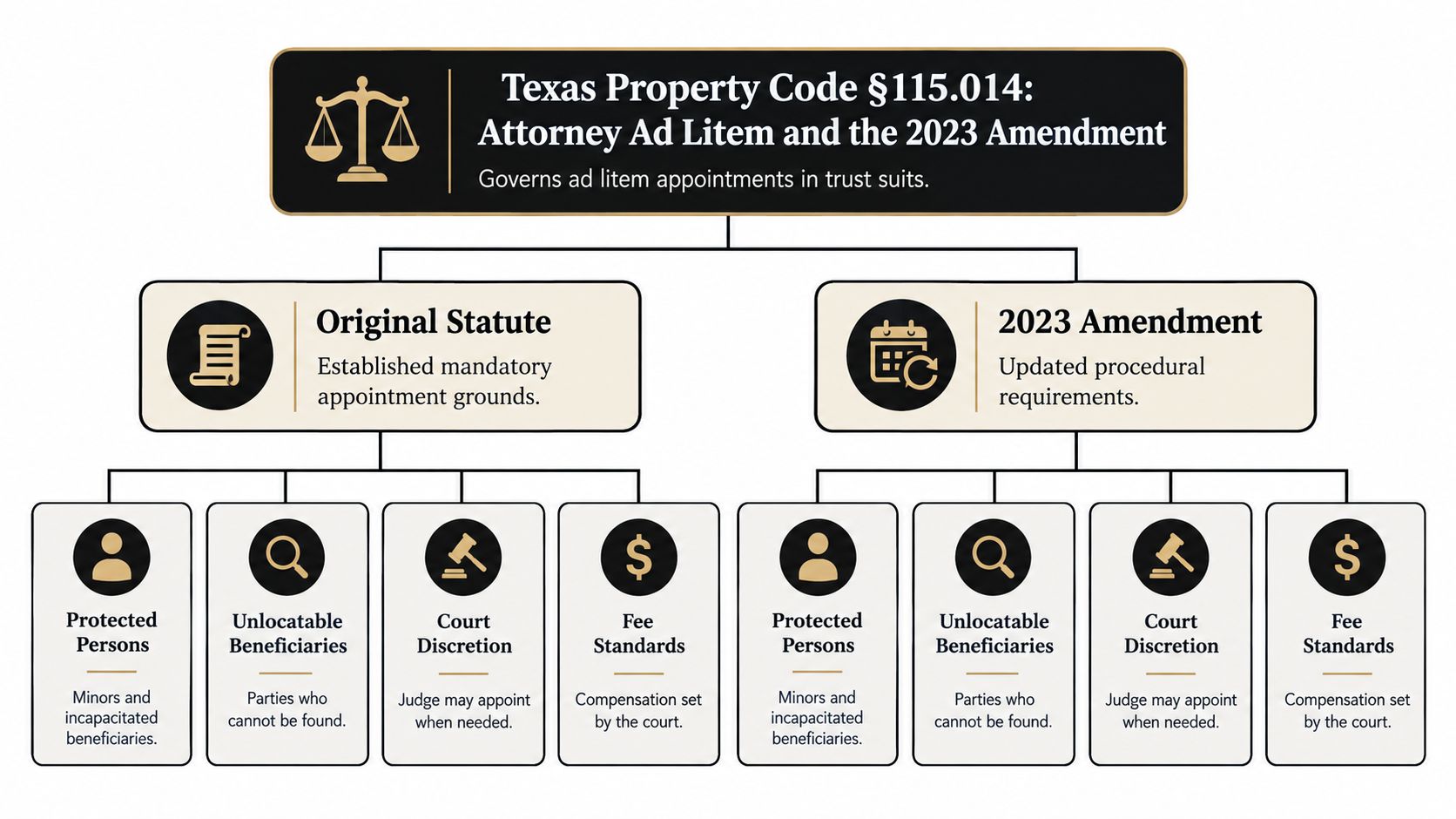
Section 115.014 gives the court flexibility to respond to representation problems in trust proceedings. It authorizes an attorney ad litem appointment when the court considers representation necessary for an interest involved in the case. It also addresses guardian ad litem appointments for people who may be unable to protect their interests through ordinary participation, including minors, incapacitated persons, unborn or unascertained persons, and people whose identity or address is unknown. The statutory text should be read with the facts of the particular proceeding, not treated as an automatic appointment rule for every trust dispute.
The major procedural change came through a 2023 legislative clarification. Before that change, legislative materials indicated that a finding of inadequate representation was required for a guardian ad litem, but the standard for an attorney ad litem wasn't clearly aligned. The amendment requires the court to determine that appointing an attorney ad litem is necessary for adequate representation before making the appointment. The legislative analysis of the amendment describes this as an important procedural update for proceedings involving minor or incompetent beneficiaries.
What changed in courtroom strategy
The amendment strengthens judicial gatekeeping. A party seeking an appointment should explain why existing representation is inadequate and why the proposed appointment is necessary to protect the interest at issue. A trustee can use that standard proactively by identifying minors, incapacitated beneficiaries, unknown parties, and conflicts before asking the court to approve a settlement, modification, or termination.
The update doesn't remove protection. It creates a clearer framework for deciding when protection requires an attorney ad litem. The statute also preserves compensation rights, with reasonable fees set by the court under the trust-cost framework in §114.064. For a practical discussion of loyalty, prudence, and impartiality under the Trust Code, see The Fiduciary Duties of a Texas Trustee.
The same general concern appears outside trust litigation. Texas Estates Code provisions provide for an attorney ad litem in a proceeding to declare heirship when heirs' names or locations are unknown, and Texas law allows protection to extend to additional incapacitated interests when needed. Texas Estates Code provisions on heirship and ad litem representation show that Texas courts use these appointments to address participation problems across estate proceedings.
How the Appointment Process Works in Practice
The appointment process usually begins when a party identifies a protected or unrepresented interest and asks the court to address it. That request may come from a trustee, beneficiary, counsel, or another party with a legitimate concern. The request should identify the person affected, describe the nature of the interest, explain the representation problem, and connect the requested appointment to the issues before the court.
A practical sequence
Identify the representation gap. Determine whether the affected person is a minor, has been adjudicated incompetent, is unknown or unlocatable, or faces another circumstance that makes ordinary representation inadequate.
Present the issue to the court. The requesting party may raise the issue in a pleading, motion, or hearing, depending on the posture of the case. The court considers the trust, the disputed action, the person's interest, and the existing representation.
Apply the necessity standard. After the 2023 clarification, the judge must determine that an attorney ad litem appointment is necessary for adequate representation. That finding is the key procedural gate.
Enter an appointment order. The order should identify the represented interest and define the ad litem's assignment. Parties should read the order carefully because the scope of the role depends on what the court has assigned.
Allow investigation and participation. The attorney ad litem reviews pleadings and trust records, communicates with relevant people, evaluates the proposed action, and participates in the case for the protected interest.
Address compensation. The attorney ad litem is entitled to reasonable fees set by the court under the trust-cost framework in §114.064. The court's order controls the amount and payment structure.
The 2023 legislative materials explain that the amendment aligned the attorney ad litem standard with the existing inadequate-representation requirement associated with guardian ad litem appointments. That alignment gives trustees and beneficiaries a clearer argument to make, while leaving the judge responsible for deciding whether appointment is necessary.
Courtroom perspective: The strongest request focuses on the person who needs protection and the decision that may affect that person. It doesn't rely only on the family's conflict or the seriousness of the lawsuit.
A trustee shouldn't assume that requesting an appointment admits wrongdoing. In many cases, the request shows that the trustee is taking fiduciary responsibilities seriously and wants the court to resolve the matter in a way that protects all affected beneficiaries.
Duties, Limits, and Fiduciary Connections
An attorney ad litem is appointed to represent a particular interest, not to become every party's lawyer. The attorney owes professional duties to the person or interest identified in the court's order. That means the ad litem may take a position that differs from the trustee's preferred outcome, another beneficiary's request, or even a family consensus.
The role fits within the broader fiduciary system created by the Texas Trust Code. A trustee must administer the trust according to its terms and applicable law, communicate appropriately, protect trust property, and act with the care required by fiduciary principles. The core duties commonly discussed in Texas trust administration include loyalty, prudence, and impartiality. An attorney ad litem doesn't take over those duties. Instead, the attorney helps ensure that a beneficiary's position is presented while the trustee remains responsible for administration.

What the attorney ad litem may do
The exact assignment comes from the appointment order, but the attorney may review relevant trust documents, investigate facts, participate in hearings, raise defenses, negotiate within the scope of the appointment, and make recommendations or arguments protecting the represented interest. The attorney may also challenge a proposed modification, distribution, settlement, or termination if the action appears inconsistent with that interest.
The ad litem isn't a neutral mediator just because the judge appointed the lawyer. Nor is the attorney an investigator for the trustee. The lawyer's responsibility is to advocate for the assigned interest within the law and the limits of the order.
What the attorney ad litem cannot do
The attorney generally can't give personal legal advice to every beneficiary, rewrite the trust, manage trust assets, or replace counsel for the trustee. A beneficiary with separate concerns about a trustee's conduct may need independent representation. Likewise, a trustee should have counsel who advises the trustee directly about fiduciary duties, tax planning, administration, and litigation strategy.
For families, the most useful approach is respectful cooperation. Provide complete records, identify deadlines, avoid coaching a minor or incapacitated person, and let the ad litem communicate through appropriate legal channels. Clear boundaries protect the proceeding and reduce unnecessary conflict.
Attorney Ad Litem vs Guardian Ad Litem in Trust Disputes
Texas law uses both roles to address inadequate representation, but they aren't interchangeable in every situation. An attorney ad litem is a lawyer appointed to represent a designated interest. A guardian ad litem is appointed to protect a person's interests when the person may need a representative because of minority, incapacity, an unknown identity or address, or another circumstance recognized by the court.
The right request depends on the person involved, the type of proceeding, and the relief sought. The 2023 amendment brought greater alignment to the adequacy standard, but it didn't erase the functional difference between legal advocacy and broader protective representation.
Decision matrix
| Feature | Attorney Ad Litem | Guardian Ad Litem |
|---|---|---|
| Primary function | Provides legal representation for the assigned interest | Protects the person's interests when ordinary representation may be inadequate |
| Typical concern | A beneficiary needs a lawyer to defend or present a position in the trust suit | A minor, incapacitated person, unborn or unascertained person, or unknown party needs court-appointed protection |
| Court inquiry | Whether appointment is necessary for adequate representation | Whether representation would otherwise be inadequate |
| Authority | Advocates within the scope of the court's order | Acts within the protective authority granted by the court |
| Common trust issues | Defending a beneficiary in a trust action, responding to pleadings, evaluating proposed relief | Protecting a vulnerable person affected by modification, termination, distribution, or another order |
| Compensation | Reasonable fees set by the court under the applicable trust-cost framework | Determined through the court's applicable appointment and cost procedures |
A family shouldn't choose based only on the title. A Texas trust administration lawyer can review the pleadings, trust terms, beneficiary information, and requested relief, then help frame the issue for the judge. Filing the wrong request can delay the case or leave the court without the information needed to protect the affected person.
The same person may also have separate counsel outside the ad litem role. For example, an adult beneficiary may need personal advice about a settlement, while an attorney ad litem represents a minor's interest in that same settlement. Those interests may overlap, but they aren't automatically identical.
Why Early Legal Guidance Protects Trustees and Beneficiaries
Early legal guidance gives families a chance to address representation gaps before a hearing becomes a crisis. A trustee who spots a minor beneficiary, a beneficiary whose location is unknown, or a possible incapacity issue can gather the facts and present the question in an orderly way. A beneficiary can do the same when a proposed trust modification or distribution may affect someone who isn't participating.
That planning matters because trust administration combines legal, financial, and personal concerns. The trustee may need to preserve records, communicate with beneficiaries, coordinate tax planning, and protect trust property while a dispute is pending. A beneficiary may need to understand notice rights, fiduciary duties in Texas, and the difference between disagreement with a distribution and a legally actionable breach.
What proactive counsel can accomplish
A Texas estate planning attorney can review the trust language and beneficiary structure before litigation escalates. Counsel may help prepare a motion, organize supporting documents, identify conflicts, explain the effect of a proposed settlement, and coordinate with counsel for the trustee or beneficiaries. Early review can also reveal whether the core issue involves administration, modification, termination, guardianship, probate, or asset protection.
A family that waits may force the court to sort through incomplete information during a contested hearing. A family that prepares can give the judge a clearer record and reduce avoidable confusion. That doesn't guarantee agreement, but it can make the disagreement more manageable.
A calm first step: Ask who could be bound by the requested order, then ask whether each affected person has an adequate and independent voice.
If you're unsure whether counsel is needed, review when to hire a trust administration attorney in Texas and discuss the specific facts with a qualified lawyer. The Law Office of Bryan Fagan, PLLC handles trust administration, estate planning, guardianship, probate-related disputes, and asset protection matters for Texas families and fiduciaries.
Next Steps After an Attorney Ad Litem Is Appointed
An appointment changes the case immediately. The attorney ad litem now needs enough information to understand the trust, the protected person's interest, and the decision awaiting the court. Parties should respond promptly, remain accurate, and avoid assuming that a family agreement eliminates the ad litem's independent responsibilities.

A practical document and communication checklist
- Start with the appointment order. Confirm exactly which person or interest the attorney represents and whether the order limits the assignment to a particular claim or transaction.
- Assemble the trust file. Provide the trust instrument, amendments, accountings, notices, pleadings, proposed orders, relevant correspondence, and records concerning the disputed transaction.
- Preserve the timeline. Identify hearings, response dates, mediation sessions, discovery obligations, and any deadline stated in the court's order.
- Keep communications factual. Explain what happened, identify missing information, and avoid pressure for a preferred result. The ad litem must evaluate the assigned interest independently.
- Use separate counsel when needed. The trustee and adult beneficiaries should obtain their own advice about fiduciary exposure, settlement positions, and personal rights.
If a party disagrees with a fee request or a settlement recommendation, that concern should be raised through the proper court process and supported with specific reasons. The court controls the appointment and fee determination. A disagreement doesn't justify withholding documents or communicating directly with a protected person in a way that could undermine the representation.
A simple written request can help organize the next conversation: “Please confirm the scope of your appointment, identify the documents you need, and advise us of upcoming deadlines.” That language is practical, neutral, and focused on moving the case forward.
The following video provides additional context for families organizing trust and estate information after a legal issue arises.
The appointment isn't a signal that the family has failed. It's a court-supervised step designed to protect an interest that may otherwise go unheard. With organized records and appropriate legal guidance, trustees and beneficiaries can participate confidently while the court works toward a fair and legally sound resolution.
If you're managing a trust or planning your estate, Law Office of Bryan Fagan, PLLC offers Texas guidance on trust administration, attorney ad litem issues, estate planning, probate, guardianship, tax planning, and asset protection. Schedule a free consultation to discuss the trust documents, the representation concerns, and the next step for your family.