
Managing a loved one's trust can feel overwhelming, especially when one brokerage statement includes dividends, asset sales, fees, and tax payments that don't fit neatly into a single category. As trustee, you're responsible for more than moving money. You must show why each receipt or expense belongs to income or principal, protect competing beneficiary interests, and preserve records that explain every entry.
Texas codified the Uniform Principal and Income Act in Chapter 116 of the Texas Property Code. The statute provides the working rules trustees use to allocate receipts and disbursements during administration, including rules for entities, liquidating assets, rental property, insurance, taxes, and deferred compensation. The practical challenge is turning those rules into a reliable ledger.
Navigating the Texas Allocation Hierarchy
Suppose a trust receives a distribution from a closely held company. The payment includes ordinary earnings, a return of capital, and an amount connected to a partial liquidation. The trustee cannot label the entire deposit “income” because the beneficiary needs cash, or “principal” because the company called it a capital distribution. Texas law requires a defined order of analysis.
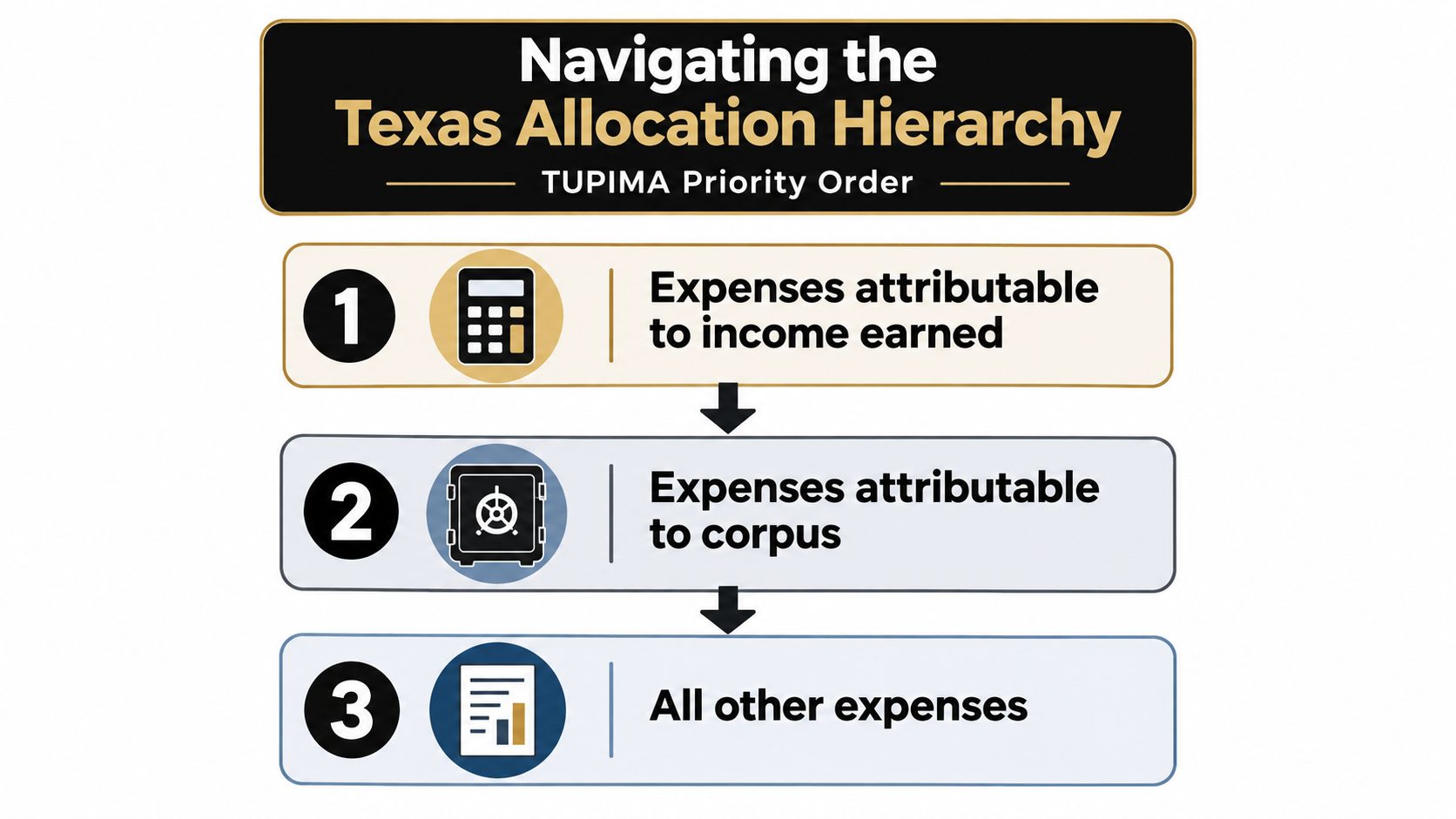
The core purpose of the Texas Uniform Principal and Income Act allocation framework is fairness. An income beneficiary may depend on recurring distributions, while a remainder beneficiary expects the trust corpus to be preserved for a later transfer. If every receipt were treated the same way, one group could benefit at the expense of the other.
The three-step order
Texas's default methodology is hierarchical:
- Read the governing instrument first. The trust document controls when it provides a valid allocation direction. A provision may classify a receipt, assign an expense, or give the trustee a specific power that changes the default result.
- Apply the statutory category next. If the instrument is silent, Chapter 116 supplies the applicable rule. The statute addresses many recurring items, including receipts from entities, liquidating assets, rental property, insurance, and administration costs.
- Allocate an unclassified item to principal. If neither the trust instrument nor a statutory provision supplies a different answer, the item goes to principal.
That order should appear in the trustee's working papers. For each entry, record the relevant trust provision, identify the Chapter 116 category, and explain why principal is the residual account if no specific rule applies.
Practical rule: A bank statement describes what the trust received. It doesn't decide how the trustee must allocate it.
The same discipline applies to expenses. Texas law includes split treatment for certain administration costs. For example, one-half of trustee compensation and one-half of mixed accounting or judicial costs are charged to income unless a fiduciary-duty-based deviation is justified. A trustee should therefore identify the expense, determine whether it relates to income production or corpus, apply a specific statutory rule, and document any permissible departure.
This process also protects beneficiaries during an accounting review. A beneficiary may disagree with the result, but a contemporaneous explanation shows that the trustee followed the governing instrument and statutory sequence rather than making an informal choice.
Applying Statutory Rules to Complex Receipts
Specific asset classes require more than the general hierarchy. The ledger may need a formula, a financial statement, or a fair-market-value input before the trustee can post the entry. Texas's modern allocation rules moved away from an older general approach that legal commentary described as allocating 27.5% of gross proceeds to principal and 72.5% to income, adopting more flexible standards intended to account for the character of the transaction and beneficiary interests. The historical comparison appears in the Texas Chapter 116 statutory text.
Liquidating assets and entity distributions
For receipts from a liquidating asset, the Texas statute provides a concrete default: 10% of the receipt goes to income and the balance goes to principal. The trustee should not round the result informally or post the entire payment to the account that needs cash. Instead, the accounting entry should show the total receipt, the income allocation, the principal allocation, and the statutory basis.
Entity distributions require a separate inquiry. A distribution or series of related distributions is treated as a partial liquidation when it exceeds 20% of the entity's gross assets, measured using the entity's year-end financial statements immediately preceding the first receipt. The trustee should obtain the relevant financial statements, identify whether the distributions are related, and retain the calculation with the trust records.
A company's label isn't enough. “Return of capital” may be useful evidence, but the trustee still needs to compare the payment with the governing instrument and statutory classification rules. The trustee must also consider the trust's investment and management obligations, including the prudent investor standard described in A Trustee's Investment Duties Under Texas Law.
For additional context on how Texas allocation rules differ from broader uniform-law approaches, trustees can review Texas departures from the Uniform Trust Code. The point isn't to substitute a summary for legal analysis. It's to remind trustees that a familiar model from another jurisdiction may not control a Texas ledger.
Deferred compensation and annuity payments
Section 116.172(c) creates a mechanical ceiling for deferred compensation, annuities, and similar payments when the payer doesn't characterize any portion as interest or dividends. The trustee allocates to income only the amount up to 4% of the fair market value of the future-payment asset, reduced by prior income allocations from that same asset during the accounting period. The remaining amount goes to principal.
For example, assume the asset's fair market value is $100,000. The annual benchmark is $4,000. If the trustee has already allocated $1,500 from that asset to income during the accounting period, only $2,500 of a later qualifying payment can be allocated to income under the cap. The balance goes to principal.
The formula changes when the payment isn't required or represents the entire amount due. In those circumstances, the full amount goes to principal. A trustee who fails to track cumulative payments can over-allocate to income and reduce the remainder unfairly.
Managing Tax Allocations and Entity Income
Tax payments can make a trust ledger look inconsistent unless the trustee separates taxable income, trust accounting income, and the allocation of the underlying receipt. A pass-through entity may generate taxable income for the trust even when the trust doesn't receive matching cash. The trustee must account for both the tax burden and the economic allocation.
A disciplined tax workflow
Use this sequence for each material tax item:
- Classify the underlying receipt. Start with the trust instrument, then Chapter 116, then the residual principal rule if necessary.
- Identify the tax source. Determine whether the tax relates to a principal receipt, an income receipt, or the trust's share of an entity's taxable income.
- Charge the correct account. Under Section 116.205, a tax paid on a receipt allocated to principal is paid from principal, even if a taxing authority calls it an income tax. Taxes on the trust's share of an entity's taxable income are charged to income, principal, or both in proportion to the way the entity receipts were allocated.
- Check for excess tax. Any tax above the total entity receipts is paid from principal.
- Record beneficiary distribution effects. If a beneficiary distribution deduction reduces the trust's taxes, adjust income or principal receipts as required by the statute.
- Reconcile the period. Compare estimated payments, return figures, entity statements, and final tax liabilities before closing the accounting period.
The statutory rule prevents a trustee from treating every tax payment as an income expense just because the tax return uses that label. It also prevents a principal beneficiary from bearing a tax burden tied entirely to income receipts.
Pass-through entities and reimbursement
Section 116.206 allows a fiduciary to adjust principal and income to offset shifting economic interests or tax benefits created by tax elections, taxes imposed on fiduciaries or beneficiaries, and ownership of pass-through entities whose taxable income is included in a trust or beneficiary's taxable income. The statute also addresses reimbursement when an estate tax marital or charitable deduction is reduced because the fiduciary deducts an item for income tax purposes instead of estate tax purposes. Beneficiaries who received the income-tax benefit may need to reimburse principal in proportion to that benefit.
Keep a separate schedule for each pass-through entity. Track the entity's taxable income, cash distributions, allocation classification, taxes paid, and any adjustment. Trustees dealing with tax debt after death may also find it useful to speak with Omni Tax Help about the tax issues that can arise during administration.
A trustee should coordinate the accounting file with the preparer handling Form 1041. The Texas trust tax return guidance can help identify the information the tax professional needs, but it doesn't replace a review of the trust instrument and Texas allocation rules.
Using the Trustee Power to Adjust
Strict default rules don't always produce a fair economic result. A trust invested heavily in growth assets may generate little traditional income, leaving the current beneficiary with limited distributions while the remainder beneficiary benefits from appreciation. Texas provides a limited power to adjust, but that power isn't a general license to rewrite the trust.
Texas Property Code Section 116.005 permits an adjustment only when three conditions exist:
- The trustee is investing and managing trust assets under the prudent investor standard.
- The trust uses income-based distribution language.
- After applying the mandatory allocation rules in Section 116.004(a), the trustee cannot otherwise comply with the duty of impartiality.
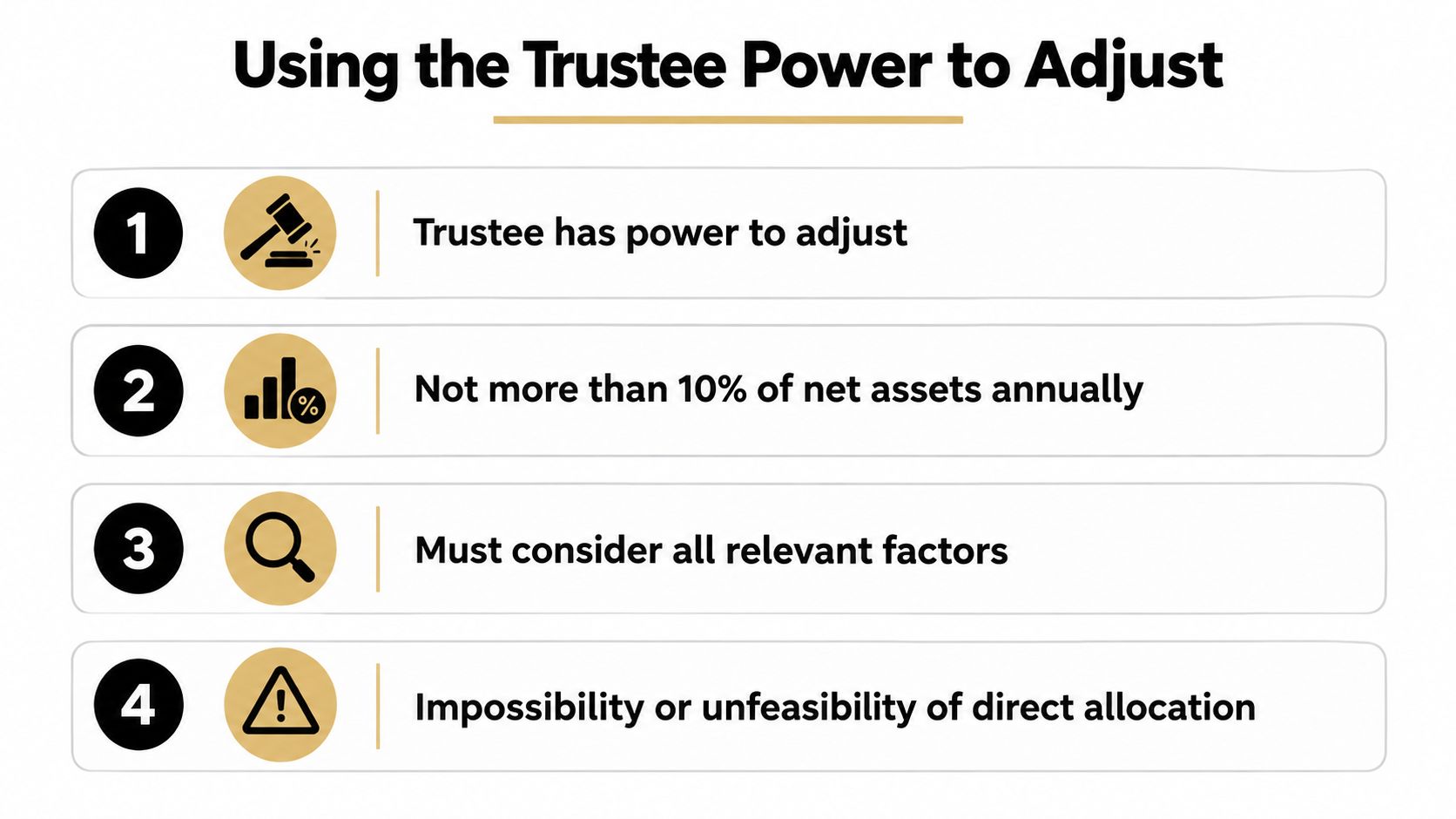
The comparison is practical. A default allocation is mechanical and predictable. An adjustment is discretionary and fact-sensitive. The trustee must consider the trust's objectives, the beneficiaries' needs, the nature of the assets, the duration of the trust, tax consequences, and the effect on both income and remainder beneficiaries.
What supports a defensible adjustment
Before acting, prepare a written memorandum that answers:
- What does the trust instrument require?
- Which mandatory allocation rules apply?
- Why do those rules create an impartiality problem?
- What investment strategy is the trustee using, and why is it prudent?
- What adjustment would address the problem without favoring one beneficiary for an unrelated reason?
- What tax effects or beneficiary objections could follow?
The statute's power exists to address shifting economic interests and tax effects, including retained entity income and tax elections. It shouldn't be used just because one beneficiary wants a larger payment or because a tax result appears convenient.
Discuss the proposed approach with qualified counsel before posting the entry. A trustee who documents the analysis, gives appropriate notice, and applies a consistent method is in a stronger position than one who makes an unexplained year-end transfer.
Recordkeeping and Avoiding Fiduciary Pitfalls
A correct allocation is difficult to defend when the trustee can't show how the decision was made. The accounting file should allow another professional to trace an entry from the bank statement to the trust provision, statutory rule, calculation, and beneficiary distribution.
A working checklist
Maintain these records for each accounting period:
- Source documents: Bank statements, brokerage reports, entity financial statements, invoices, insurance notices, tax statements, and closing documents.
- Allocation worksheets: Show gross receipt or expense, income portion, principal portion, rounding method, and legal basis.
- Cumulative schedules: Track prior payments from the same annuity, deferred compensation asset, or other item subject to a period-based cap.
- Tax reconciliation: Match tax payments and liabilities to the receipts that generated them.
- Adjustment memoranda: Explain the impartiality problem, relevant factors, calculation, notice, and approval process.
- Beneficiary communications: Preserve requests, responses, accountings, objections, and explanations.
- Asset records: Keep valuation evidence, ownership documents, and records showing whether an entity payment was ordinary or liquidating.
Trustee compensation and mixed accounting or judicial costs deserve special attention because Texas law may require a split between income and principal. Recurring insurance premiums can also create confusion when the policy, trust purpose, and beneficiary interests point in different directions. Don't use a recurring template without checking whether the underlying facts have changed.
The same problem appears with concentrated assets. A trustee may receive a large payment from a business, retain an interest in that business, and distribute cash to an income beneficiary. The ledger must distinguish the entity's receipt, the trust's ownership interest, taxes, and any adjustment. Combining those entries hides the economic effect.
A clean ledger is more than bookkeeping. It is evidence that the trustee exercised care, impartiality, and judgment.
For trustees who need structured support, fiduciary accounting assistance in Texas can be part of a broader administration process. A trustee should also review whether the trust requires beneficiary reports, court approval, or professional involvement before making a disputed allocation.
When to Seek Professional Trust Guidance
A trustee doesn't need to know every answer before asking for help. Recognizing a problem early is part of responsible administration, especially when an allocation could affect family relationships, tax reporting, or future litigation.
Red flags that justify legal review
Contact a Texas trust administration lawyer before acting when:
- The trust language conflicts with the statutory default or uses unclear income and principal terms.
- A beneficiary demands a distribution that would reduce the remainder or asks for a retroactive reclassification.
- A closely held company makes a large distribution, redemption payment, or possible partial liquidation.
- The trust owns pass-through entities and taxable income doesn't match cash distributions.
- The trustee is considering an adjustment under Section 116.005.
- Beneficiaries disagree about trustee compensation, insurance, investment expenses, or accounting fees.
- The trust has property, beneficiaries, or tax obligations connected with another state or country.
- A trustee has a personal relationship or financial interest that could affect impartiality.
A legal review may involve the trust attorney, CPA, investment adviser, and beneficiaries' counsel. That team can determine how to modify a trust in Texas when court involvement or a consent-based process is available, rather than forcing a trustee to make an unsupported administrative change. Families may also need related assistance with estate planning, probate, guardianship, or asset protection, depending on the larger circumstances.
The Texas Estates Code also matters when the fiduciary is administering an estate rather than an established trust. Section 310.004 provides allocation mechanics for income from property devised to a specific devisee, including reductions for property taxes, other taxes, ordinary repairs, insurance premiums, post-death interest, and management expenses. Net income from undistributed estate assets is allocated to other devisees in proportion to their interests.
That rule illustrates why an executor should separate estate administration from later trust administration. A Texas estate planning attorney can help families coordinate the documents before death, while a trust administration lawyer can help the acting fiduciary apply the documents after death. Seeking advice isn't a sign that you've failed as trustee. It's often the most prudent way to preserve the trust, protect beneficiaries, and create a defensible record.
If you're managing a trust or estate, the Law Office of Bryan Fagan, PLLC provides Texas guidance on fiduciary accounting, tax coordination, beneficiary communication, trust administration, and related probate matters. Schedule a free consultation by visiting Law Office of Bryan Fagan, PLLC to discuss the allocation questions and recordkeeping steps affecting your family.