Managing a loved one's trust can feel overwhelming, especially when you're handed legal documents, financial statements, and tax forms all at once. As a newly appointed Texas trustee, you may wonder whether the trust needs its own federal return, what information belongs on it, and whether a filing mistake could expose you to personal liability.
The central form is IRS Form 1041, U.S. Income Tax Return for Estates and Trusts. Understanding when it's required, how distributions affect beneficiary reporting, and which records support the return can make the process far more manageable. The federal tax rules work alongside your responsibilities under the Texas Trust Code and Texas Estates Code, so tax compliance is both an IRS obligation and part of prudent fiduciary administration.
Managing a Trust Means Managing Its Tax Obligations
Suppose your aunt named you successor trustee of a family trust holding a Houston rental property and an investment account. After her death, you begin collecting rent, paying insurance, and reviewing brokerage statements. Then you discover that the trust may need to file its own federal income tax return. That realization can feel like one more responsibility added to an already emotional transition.
You're not alone in finding this process intimidating. A trustee may be grieving, unfamiliar with fiduciary accounting, or trying to balance the interests of several beneficiaries. The good news is that Form 1041 becomes easier when you separate the questions: what income did the trust receive, what expenses did it pay, what distributions did it make, and what does the trust document allow?
A trust is generally treated as a separate taxpayer for federal income tax reporting when it isn't treated as a grantor-owned trust. The fiduciary files the return, reports the trust's financial activity, and provides beneficiaries with the information they need when income passes through to them. The IRS instructions for Form 1041 identify the core filing triggers and reporting obligations.
Practical rule: Treat every trust transaction as something you may eventually need to explain to the IRS, a beneficiary, or a court.
Texas law adds another layer. Under the Texas Trust Code, trustees must administer the trust according to its terms and applicable law while observing fiduciary duties of loyalty, care, impartiality, and prudent administration. The Texas Estates Code can also become relevant when trust administration follows a probate matter or overlaps with estate administration. A missed return, unsupported deduction, or inaccurate beneficiary allocation may therefore create more than a tax concern. It can fuel a demand for an accounting or a claim that the trustee failed to act prudently.
This guide addresses the filing threshold, trust income, deductions, Schedule B, Schedule K-1, deadlines, estimated payments, common errors, and professional support. It also explains why a Texas trust administration lawyer may be useful when federal tax reporting intersects with trustee decision-making, beneficiary rights, or a potential dispute.
What Form 1041 Is and Who Must File It
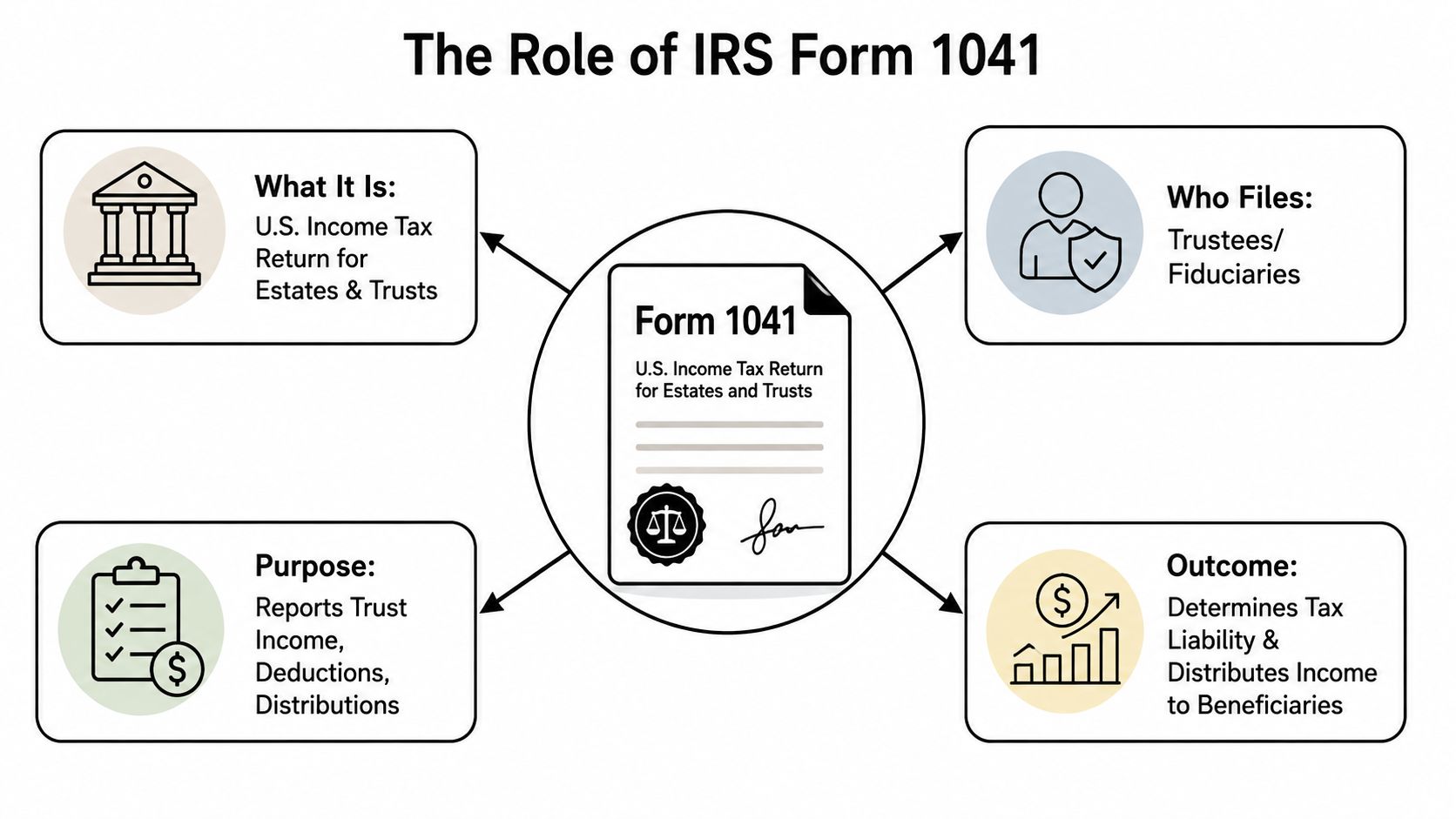
Form 1041 is the federal return used by the fiduciary of a domestic estate or trust to report income, deductions, credits, and distributions. It tells the IRS what the trust earned and how the fiduciary handled that income. When taxable income is distributed, the return also supports the information reported to beneficiaries through Schedules K-1.
The IRS identifies three primary filing triggers for a domestic trust:
- Any taxable income: The trust must file even if the amount is small.
- Gross income of $600 or more: The gross-income test applies before reducing income by deductions.
- A nonresident alien beneficiary: This can require filing even when the trust's income is otherwise limited.
These requirements are stated in the IRS explanation of Form 1041 filing obligations. The important point is that gross income isn't the same as taxable income. A trust could receive income and later offset it with deductible expenses, yet still have a filing obligation because its gross receipts reached the applicable threshold.
Simple and complex trusts
A simple trust generally requires current distribution of its income and doesn't make discretionary charitable distributions or distribute trust principal in a way that changes its classification. A complex trust may retain income, make discretionary distributions, or distribute principal. The classification can affect how the return is prepared, but neither label eliminates the need to analyze the filing triggers.
Consider a Houston family trust that owns a rental home. Rent is gross income even if property expenses later reduce the trust's taxable result. The trustee should preserve lease records, deposit records, repair invoices, insurance statements, and bank activity so the return reflects both sides of the transaction.
A revocable trust may be reported differently while the grantor is treated as the owner for federal income tax purposes. After a change in circumstances, such as the grantor's death, the trust's tax status and identification requirements must be reviewed carefully. For a plain-English discussion of one important classification issue, trustees can review grantor and non-grantor trusts in Texas.
The trustee's fiduciary duties matter here. A trustee who ignores a known filing obligation may have difficulty defending that decision later, particularly if beneficiaries incur consequences because income was omitted or K-1 information was delayed.
Step-by-Step Form 1041 Filing Checklist for Texas Trustees
A reliable filing process begins before tax preparation software or a tax professional enters a single figure. The trustee should first establish who owns the assets, which tax identification number belongs to the trust, and what the trust instrument says about income and distributions.
Build the file before preparing the return
Use this checklist as a working file for the trust:
Confirm the trust's status. Read the trust instrument, identify the current trustee, determine whether the trust is domestic, and review whether it's treated as a grantor or non-grantor trust for federal tax purposes.
Obtain the trust's EIN. An Employer Identification Number identifies the trust for tax reporting. It isn't an employee count, and the trust doesn't need employees to use one. Don't substitute the trustee's Social Security number without confirming the proper reporting treatment.
Separate trust finances. Use a trust bank account and keep trust income and expenses separate from personal funds. The Texas trust record organization guide can help create a clear administrative record.
Collect income records. Gather statements showing interest, dividends, rents, royalties, capital transactions, and income received from business or investment interests. Review the trust's bank and brokerage accounts rather than relying only on tax forms mailed to the trustee.
Track administration expenses. Preserve invoices and proof of payment for trustee fees, tax preparation, legal work, accounting, appraisals, property costs, and other expenses that may be relevant under federal tax rules and the trust's terms.
Reconcile distributions. Record the date, amount, recipient, purpose, and authority for every payment or transfer to a beneficiary. A distribution that seems routine may have tax and fiduciary consequences.
Understand Schedule B and beneficiary reporting
Schedule B calculates the trust's income distribution deduction. The IRS Schedule B instructions explain that Schedule B is used when the estate or trust must distribute income currently or paid, credited, or was required to distribute other amounts to beneficiaries during the tax year.
When income is allocated to beneficiaries, the trustee generally prepares a Schedule K-1 for each applicable beneficiary. The K-1 communicates the beneficiary's share and the character of the income reported. A trust claiming an income distribution deduction must also report the number of attached Schedules K-1 on page one of Form 1041.
The trustee should prepare the return and K-1s as one coordinated project. If the return says one thing while the beneficiary's K-1 says another, the inconsistency can create IRS correspondence and beneficiary distrust.
For immediate administrative orientation after taking office, First Steps for a Successor Trustee in Texas addresses what to do immediately after stepping into the trustee role. It doesn't replace tax advice, but it can help organize the first administrative tasks.
Deadlines and Estimated Tax Payments Every Trustee Must Know
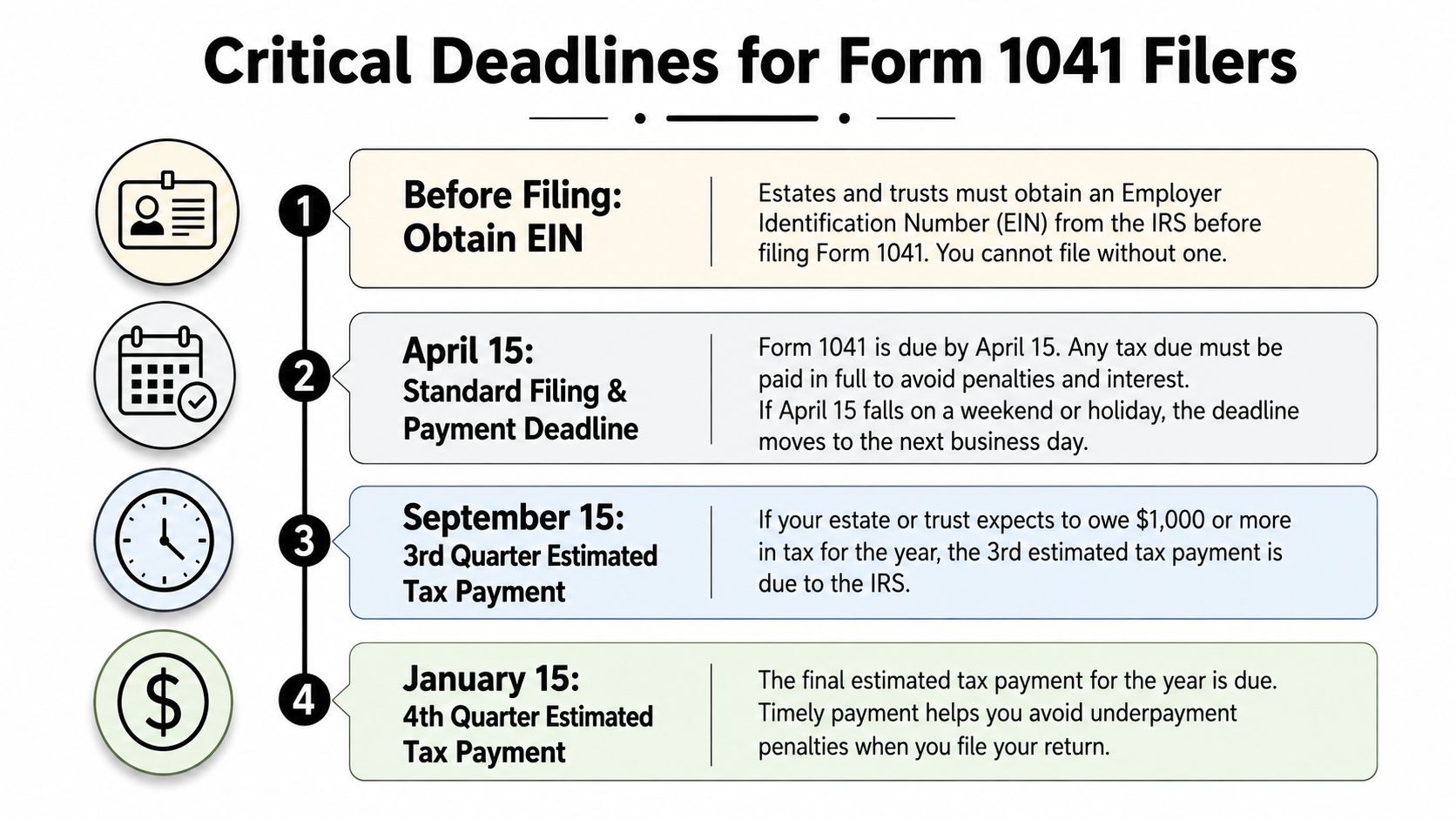
A newly appointed trustee may believe the tax work can wait until every brokerage statement and property record arrives. That approach can put both the filing deadline and beneficiary communications under pressure. For a calendar-year trust, the federal Form 1041 deadline is generally April 15. The IRS estimated tax guidance explains the related payment obligations, while Form 7004 may provide an automatic filing extension.
The extension gives the trustee an additional five and a half months to file. It does not postpone payment of tax that the trust owes. Filing and paying are separate duties, much like submitting an accounting and paying an approved trust expense. The trustee should confirm the trust's tax year, mark the applicable deadline, and begin gathering records early.
Estimated payments require active monitoring
A trust may need quarterly estimated payments if it expects to owe $1,000 or more in federal tax for the year. The commonly used payment dates are:
- April 15, for the first estimated payment.
- June 15, for the second payment.
- September 15, for the third payment.
- January 15, for the fourth payment for the preceding tax year.
These dates should prompt a forecast, not an automatic payment made without review. The trustee should ask the tax preparer to project income after considering distributions, property sales, rent, dividends, and deductible expenses. A trust that retains substantial income or sells property may need a different payment amount from one that distributes its income.
Federal rules may also allow a trust to elect to treat estimated payments as made by a beneficiary in appropriate circumstances. Because that election can affect the trust, beneficiaries, and family tax planning, the trustee should have a qualified tax professional review it before making the election.
Texas has no state individual income tax, which may simplify part of the state analysis. It does not remove the federal Form 1041 duty or change federal payment deadlines. Trustees handling both federal requirements and Texas administration can review this overview of trust taxation in Texas for additional context.
Under the Texas Trust Code, fiduciary administration includes keeping reliable records and addressing known obligations. A late return, late payment, or underpayment can create financial consequences and make the trustee's accounting harder to explain to beneficiaries. Timely tax planning therefore protects more than the trust's tax position. It also gives the trustee a clear record of responsible administration.
Common Form 1041 Errors and How to Avoid Penalties
Many Form 1041 problems begin with a reasonable but incorrect assumption: if the trust ends the year with little or no taxable income, no return is necessary. The IRS rules focus on the filing triggers discussed earlier, including gross income, taxable income, and the status of a beneficiary.
Errors that create avoidable trouble
Using the wrong identification number: Confirm the trust's EIN and reporting status before entering information. Using a trustee's personal number can blur ownership and create problems matching income to the correct taxpayer.
Ignoring gross receipts: Review total interest, dividends, rent, royalties, and other income before considering deductions. A net loss doesn't automatically erase a filing requirement.
Leaving out Schedule B or K-1s: If the trust distributed or was required to distribute income, review whether Schedule B is required and whether each beneficiary needs a Schedule K-1.
Miscomputing the distribution deduction: The deduction depends on the trust's distributable income and the governing documents. Don't treat every payment of principal as a deduction for distributed income.
Filing incomplete records: A trustee who can't show how figures were calculated may struggle to answer beneficiary questions or respond to an IRS notice.
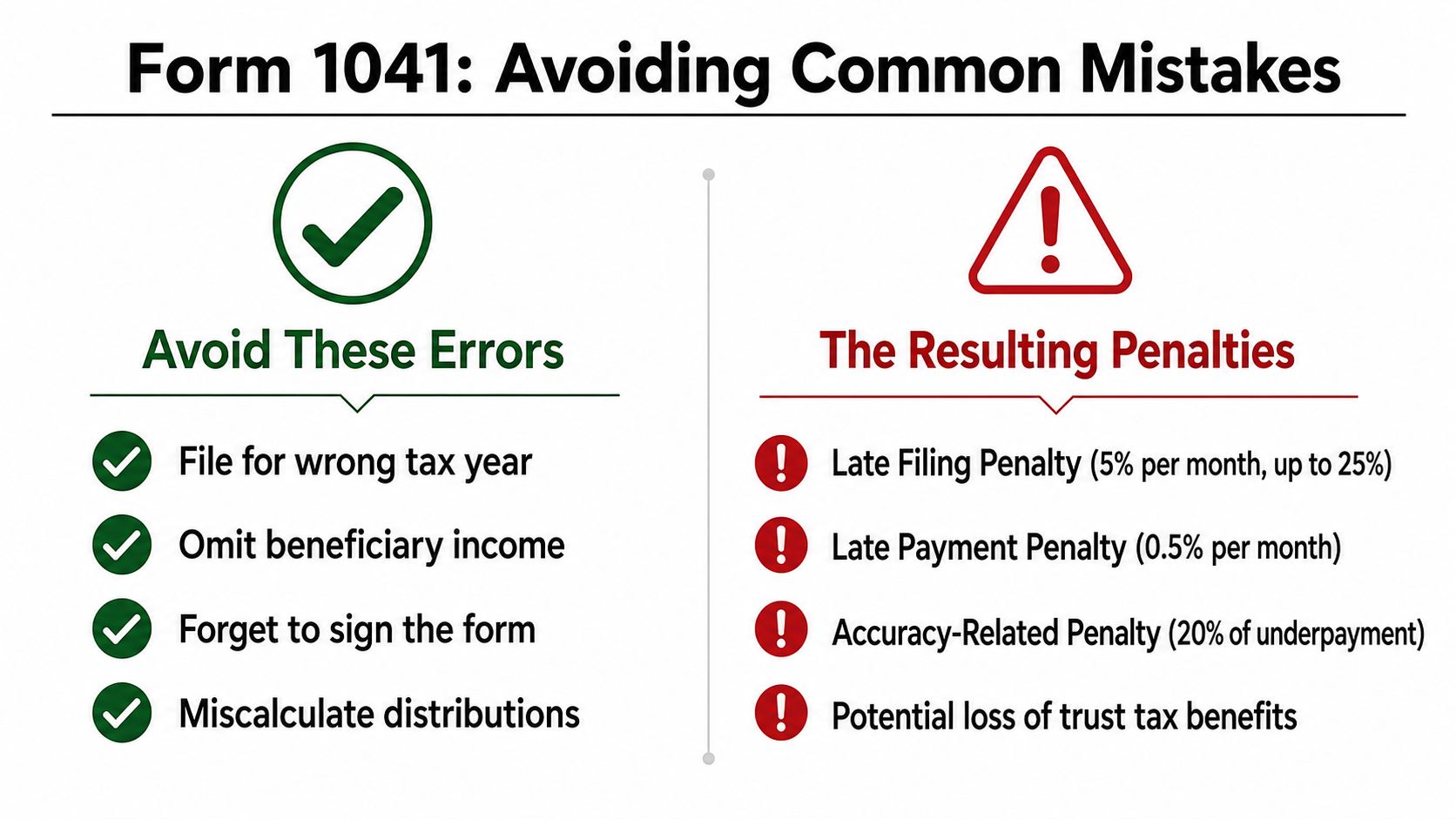
A missed deadline can lead to penalties and interest. The exact result depends on the circumstances, the amount involved, the length of the delay, and whether the trustee had reasonable cause. A trustee shouldn't assume that filing late is harmless because beneficiaries received their distributions.
Correcting a filed return
Suppose a Texas trustee discovers a previously unreported capital gain from the sale of trust property. The trustee should gather the closing statement, brokerage or title records, basis information, and any related correspondence. A tax professional can then determine whether an amended Form 1041, including Form 1041-X when applicable, is appropriate and whether corrected K-1s must be issued.
Corrections should also be communicated carefully. If a beneficiary received an incorrect K-1, the trustee should explain what changed, provide the corrected document, and preserve the written explanation with the trust's records. Clear communication can prevent a tax correction from becoming a broader dispute under the Texas Trust Code.
When to Handle Form 1041 Yourself and When to Hire a Professional
A trustee may be able to manage a straightforward return when the trust has one ordinary investment account, limited transactions, one beneficiary, and well-organized records. Even then, the trustee remains responsible for providing accurate information and following the trust instrument. Using a preparer doesn't transfer the trustee's fiduciary responsibility.
Professional help becomes more important when the trust owns rental property, business interests, partnership investments, or multiple assets with different income characteristics. Multiple beneficiaries can also make distributions and K-1 reporting more difficult, particularly when the trustee must apply standards of impartiality and document why a distribution was made.
A Texas trust administration lawyer and a CPA serve different roles. A CPA typically focuses on tax calculations, return preparation, and tax reporting. An attorney can analyze whether a proposed distribution is authorized, whether the trustee is acting consistently with the Texas Trust Code, how to respond to beneficiary objections, and whether a tax decision creates a fiduciary risk.
| Trust Characteristic | DIY Filing | CPA Recommended | Attorney Recommended |
|---|---|---|---|
| One bank account and ordinary interest income | May be reasonable with organized records | Useful for review | Usually not necessary unless a legal issue exists |
| Rental property or multiple investment accounts | Risk increases substantially | Appropriate for income, expenses, and depreciation analysis | Appropriate when ownership, distributions, or disputes are unclear |
| Business or partnership interests | Generally unsuitable | Strongly recommended | Recommended for governance and fiduciary questions |
| Multiple beneficiaries | Possible only with careful accounting | Recommended for K-1 allocation | Recommended when impartiality or beneficiary conflict is present |
| Proposed modification or unusual distribution | Not advisable without legal review | May calculate tax effects | Appropriate for questions about how to modify a trust in Texas |
The Law Office of Bryan Fagan, PLLC works alongside CPAs to support trust administration, fiduciary accounting, tax planning, and beneficiary communication. The right team depends on the assets, the trust language, and the decisions facing the trustee.
Protecting Your Trust and Your Beneficiaries Through Proper Compliance
A trustee in Texas may face a beneficiary's questions months after a return is filed. A clear Form 1041 record helps answer them. It shows the trust's income, expenses, retained funds, and distributions, supporting the trustee's duty to account under the Texas Trust Code and reducing the risk of disputes.
Use these practices:
- Monitor gross income: A domestic trust generally must file when gross income reaches $600, even if deductions leave no taxable income. Review the IRS Form 1041 instructions for the filing requirement.
- Separate trust finances: Keep trust and personal funds apart. Retain bank statements, invoices, receipts, investment records, and other source documents.
- Match distributions to tax reporting: Schedule B and beneficiary K-1 information should agree with the trust's accounting, distribution decisions, and governing instrument.
- Track deadlines: Record the original return deadline, any extension, estimated tax payments, and beneficiary reporting dates.
- Ask for help early: Complex assets, unclear distribution authority, or beneficiary disagreements call for tax and legal review before filing or distributing property.
A tax error can become more than an IRS problem. Under Texas fiduciary standards, missed reporting or inaccurate records may support a beneficiary claim, an accounting proceeding, or a request for trustee removal when the failure causes financial harm or obscures a beneficiary's interests. The trustee does not need to know every tax rule, but should identify questions that require qualified advice and preserve a record of the decisions made.
The Law Office of Bryan Fagan, PLLC assists trustees with Form 1041 coordination, fiduciary accounting, beneficiary communication, trust administration, and related estate planning or asset protection matters. Visit Law Office of Bryan Fagan, PLLC to request a free consultation about your trust and responsibilities under Texas law.