Managing a loved one's trust can feel overwhelming, especially when the document says “irrevocable” and the family's circumstances have changed. An adult daughter in Houston might discover that her late father's 2012 trust still calls for income distributions only at age 35, even though the family business that once supported the plan has collapsed. Her first question is usually simple: Can anyone change this trust?
The answer depends on the trust document, the type of change, the person seeking it, and the consent required. Texas law doesn't treat an irrevocable trust as an ordinary contract that beneficiaries can rewrite whenever they agree. It does, however, provide specific routes for court modification, decanting, and carefully limited agreements. This guide explains how to modify a trust in Texas, who has the power to act, and when a trustee or beneficiary needs court approval.
When a Trust Feels Locked and What Texas Law Still Allows
A trustee receives a family request to delay distributions, replace a trustee, or move assets into a structure that better fits current needs. The word “irrevocable” can make the request sound finished before the analysis begins. It is not. The first task is to identify who holds power under the trust and what consent, notice, or court order the proposed action requires.
An irrevocable trust generally means the settlor, the person who created it, did not retain a unilateral power to revoke it. Under Texas Property Code Section 112.051 and related trust provisions, a settlor may revoke a trust unless the instrument makes it irrevocable. Once that status applies, the settlor usually cannot sign a new amendment and undo the arrangement. The trust instrument and Texas statutes determine the available options.
Start with the trustee's existing authority. A trustee may have discretion over investments and distributions if the document grants it. The trustee may also be able to resign, appoint a successor, or delegate certain functions under the Texas Trust Code. Those powers can resolve an administration problem without changing beneficiaries' rights or other beneficial terms.
A decision tree based on authority and consent
Ask these questions in order:
- Can the trustee act under the existing instrument? If the requested result falls within the trustee's stated discretion, the trustee may act without rewriting the trust. The trustee must still follow fiduciary duties and the document's limits.
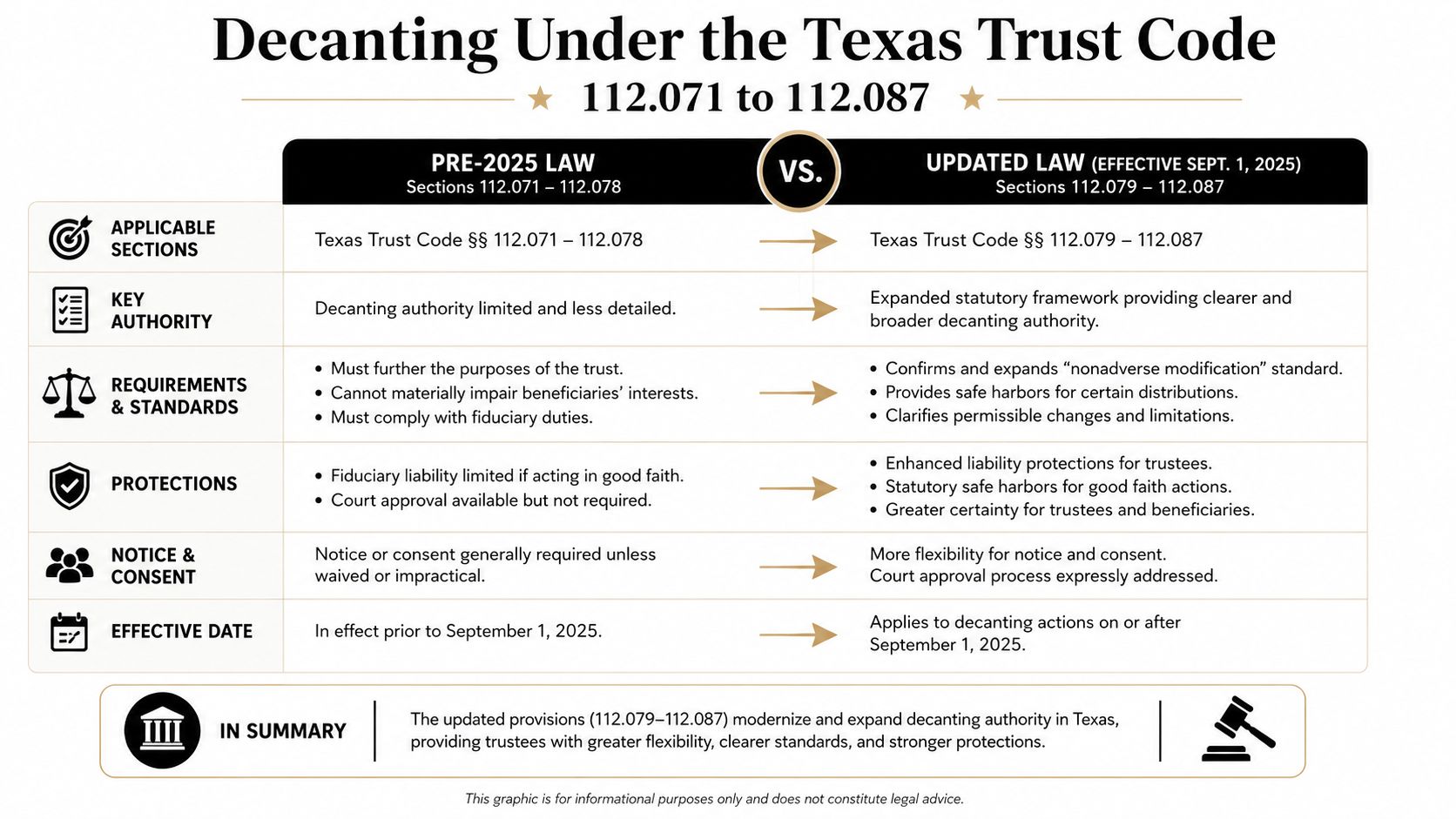
- Does an eligible trustee have statutory decanting power? Under Texas Trust Code Sections 112.071 through 112.087, a trustee may distribute assets into a second trust with updated terms when the statutory requirements are met. This route may avoid court involvement and beneficiary consent, but the trustee must follow its limits, notice rules, and timing requirements. Texas decanting commentary explains why those controls matter.
- Is court authority required? A trustee or beneficiary may seek modification, termination, a trustee change, or authorization for an act under Section 112.054 when a statutory ground exists. The court, not the family's agreement alone, decides whether the requested relief fits the statute. See The statutory text of Section 112.054.
- Can every required party consent to a limited settlement? A written agreement may address an administrative issue when the parties have authority to consent. It cannot replace court approval where beneficial rights or a material trust purpose require judicial action.
Review the instrument, identify each beneficiary class, and document the requested change before promising a solution. The right path turns on the actor with legal power and the consent the law requires.
Judicial Modification Under Texas Property Code 112.054
A trustee may receive a family request to change an irrevocable trust after a beneficiary's needs, finances, or circumstances have shifted. The family cannot rewrite the document by agreement alone. Under Section 112.054, the court holds the power to modify terms, change the trustee, authorize or prohibit an act contrary to the instrument, or terminate the trust in whole or in part. FindLaw's reproduction of Section 112.054 shows the available relief and the statutory limits.
The petitioner must connect the requested result to a recognized ground:
| Statutory Ground | Plain-Language Test | Typical Petitioner |
|---|---|---|
| Purpose achieved or defeated | The trust's purpose has been completed, or continuing it would defeat that purpose | Trustee or beneficiary |
| Unanticipated circumstances | Circumstances changed in a way the settlor did not anticipate, and modification would further the settlor's intent | Trustee or beneficiary |
| Uneconomic administration | Administration has become wasteful or uneconomical compared with the trust's value or purpose | Trustee or beneficiary |
| Impracticability or waste | Following the existing terms is impracticable, impossible, or likely to waste trust property | Trustee or beneficiary |
| Material purpose with consent | The change remains consistent with the trust's material purposes and the necessary parties consent | Trustee, beneficiary, or other authorized petitioner |
These grounds require different proof. A failed business or unexpected family development may support a changed-circumstances argument. Administrative costs that consume an unreasonable share of a small trust point toward uneconomic administration. A drafting mistake may call for reformation, which corrects language to reflect the settlor's intent, rather than modification, which changes how a workable provision operates.
The person with authority to act matters. A trustee, settlor, or person interested in trust property may have a procedural route to court under Texas law, including the petition framework described in Texas Rule of Civil Procedure 695. The judge, not the trustee or family members, decides whether the evidence satisfies Section 112.054. Beneficiary consent can support the request, but it does not remove statutory limits, tax consequences, or the interests of beneficiaries who did not consent or were not adequately represented.
Practical rule: Identify the exact sentence that must change, the statutory ground that supports the request, and the records proving why the current language no longer works.
Before filing, preserve accountings, investment records, notices, correspondence, and documents showing the changed circumstances. A successor trustee organizing the trust's records may find First Steps for a Successor Trustee in Texas useful for immediate administration. That resource does not replace legal advice about a contested modification or the evidence required for court relief.
Ask for the narrowest remedy that solves the problem. Modification adjusts trust terms. Reformation corrects a mistake or clarifies language to carry out intent. Termination ends the trust, in whole or in part, when the statutory requirements support that result. A focused petition gives the court a clear legal ground, a defined requested change, and a better way to preserve the settlor's plan.
Decanting Under the Texas Trust Code 112.071 to 112.087
A trustee receives a request to update an irrevocable trust after a beneficiary develops different needs. The trustee cannot change the document because the family believes it is outdated. Texas decanting gives the authorized trustee a nonjudicial way to move trust property into a second trust with revised administrative or distribution terms, but the trustee must first prove that the governing instrument and statute permit the exercise.
Texas's decanting framework appears in Trust Code Sections 112.071 through 112.087. The law places the decision with the trustee, subject to statutory limits and notice requirements. Beneficiaries do not automatically approve the transaction, although their rights and required consent still control what the trustee may change.
The operational sequence
Use this decision process before signing a new trust or transferring property:
- Confirm the trustee's power. Read the original instrument and every amendment. Identify the trustee's distribution discretion, beneficiary definitions, spendthrift provisions, successor-trustee terms, and restrictions on changing beneficial interests. If the trustee lacks the required distribution authority, decanting is unavailable.
- Define the narrow problem. State whether the proposed receiving trust addresses administration, trustee succession, distribution flexibility, or another permitted concern. Drafting a broader rewrite creates unnecessary risk and may exceed the trustee's authority.
- Draft the receiving trust. Preserve the settlor's material purpose and protect rights that the statute does not allow the trustee to reduce or eliminate. The new instrument should solve the documented problem, not create a different trust without legal support.
- Identify everyone entitled to notice. Review current beneficiaries, presumptive remainder beneficiaries, and any other person covered by the applicable requirements. If the settlor is living, determine whether the statute requires notice to that person.
- Send written notice and wait. Texas decanting materials describe a 30-day waiting period before the transfer proceeds. Texas decanting materials explain why incomplete beneficiary identification, defective delivery, or an early transfer can compromise the exercise.
- Build the record. Keep the notice, delivery evidence, receiving trust, trustee's written decision, asset schedule, and transfer documents in the trust administration file. Those records show who acted, under what authority, and whether the trustee followed the required process.
Limits matter more than speed
Section 112.074 restricts the trustee's power. The trustee cannot use decanting to reduce fiduciary standards, eliminate a mandatory income interest, or diminish fixed rights without the consent the law requires. That makes decanting a better fit for permitted administrative changes and limited distribution adjustments than for rewriting fixed beneficial entitlements.
Choose court involvement when the proposed change needs broader oversight, affects protected interests, or depends on a statutory finding beyond the trustee's unilateral authority. Decanting can remain private, but unclear notice requirements and tax review can make the process lengthy. For a practical explanation of trustee authority, see decanting a trust in Texas explained.
Nonjudicial Settlement Agreements and Beneficiary Consent
A written settlement can be useful when the family agrees about an administrative problem and the proposed solution doesn't defeat the trust's material purpose. Texas Property Code Section 111.002 recognizes the importance of the trust instrument, applicable statutes, and equitable principles in determining how a trust may be administered. The agreement must stay within the authority those sources provide.
This route works best for clarity problems rather than a wholesale rewrite. Depending on the instrument and circumstances, the parties may address ambiguous or inconsistent terms, the timing or manner of distributions, trustee succession, or trustee compensation. The agreement should state the problem, the authority for resolving it, the parties' consent, and the protections used for anyone who can't personally consent.
Consent isn't just a signature
The trustee must consent, and all qualified beneficiaries whose rights are implicated may need to consent unanimously. That group can include people who could receive trust property if the trust were terminated, not only the family members currently receiving checks. A beneficiary who is a minor, incapacitated, unborn, or otherwise represented through another person requires special care. A parent or current beneficiary can't automatically sign away someone else's interest.
A settlement agreement also can't be used to alter fixed beneficial entitlements, defeat a material purpose, or release the trustee from liability in a way inconsistent with the original terms. Charitable trusts, spendthrift provisions, and changes that shift economic interests generally require a court order under Section 112.054 rather than a private agreement.
Consent must be informed, complete, and legally effective. A stack of signatures doesn't cure an omitted beneficiary or an unauthorized change.
Families considering this route should compare the proposed agreement against the trust's distribution history, accounting records, and stated purpose. The discussion in Can All Beneficiaries Agree to Dissolve a Trust in Texas is relevant when the family is considering a consensual resolution, but dissolution and administrative settlement aren't the same thing. If the parties can't establish valid consent from every required person, stop negotiating the final document and evaluate decanting or court modification instead.
Two Texas Scenarios That Show What Works and What Fails
A Houston-area family faced an irrevocable trust built around an investment strategy that made sense in the 1990s but no longer fit the family's needs. The trustee didn't treat the old investment language as permission to improvise. Counsel reviewed the distribution authority, identified the qualified and presumptive remainder beneficiaries, designed a receiving trust, and delivered the required written notice.
The trustee waited the statutory 30-day period before transferring assets, then completed the decanting under Texas Trust Code Sections 112.071 through 112.087. The new trust used a modern unitrust structure, while the trustee maintained records showing the authority, notice, waiting period, asset transfer, and continuing fiduciary duties. The family's agreement helped, but the transaction succeeded because the trustee followed the statute rather than relying on informal approval.
The Corpus Christi example went the other way. The trustee signed a defective agreement, skipped beneficiary notice, and distributed property before the applicable waiting period had expired. An adult beneficiary who expected a later interest challenged the transaction in a Hegstad-style dispute. The trustee then had to defend an action that careful notice and authority analysis could have prevented.
The recurring failure points
- Skipped notice: A trustee can't treat notice as a courtesy when the statute makes it part of the process.
- Incomplete beneficiary lists: Current beneficiaries aren't always the entire notice class. Remainder and contingent interests require document-level analysis.
- Improper representation: Minor, unborn, incapacitated, or unlocated beneficiaries may need legally effective representation, not an informal family signature.
- Unclear material purpose: A change that seems practical may undermine the trust's central protection, such as a spendthrift or preservation purpose.
- Premature transfers: Moving assets before the waiting period ends creates avoidable procedural risk.
The lesson is direct. A cooperative family can make a lawful process easier, but cooperation doesn't replace statutory authority. A trustee who can't prove what power was used, whom the trustee notified, and when the transfer occurred is exposed to objections, fiduciary claims, and costly corrective work.
A Practical Timeline and Consent Checklist for Texas Families
Trust modification should follow a controlled sequence, not a family group message. The timeline below is a practical planning framework. The actual schedule depends on whether the matter requires a court, whether beneficiaries can be located, and whether tax counsel must review the proposed structure.
A week-by-week working plan
First phase, document review. Collect the original trust, every amendment, schedules of assets, prior accountings, tax filings, beneficiary communications, and trustee appointment documents. Confirm governing law and identify whether another statute applies. Texas Estates Code Section 1301.201 provides a separate modification rule for certain trusts, so the fiduciary must identify the trust type and the correct statutory procedure before filing. Texas Estates Code Section 1301.201 illustrates why the general Trust Code isn't always the only source.
Second phase, authority and strategy. Determine whether the requested result is administrative, dispositive, corrective, or terminative. Then compare decanting, a nonjudicial settlement, and judicial modification. Obtain tax input before drafting if the change could alter ownership, inclusion, beneficiary rights, or reporting.
Third phase, notice and execution. Prepare the new trust, agreement, or petition. Identify every person entitled to notice or consent, obtain legally effective signatures where appropriate, and preserve proof of delivery. For a court matter, the final step is a signed order. For decanting, it's the properly documented transfer after the waiting period. For an agreement, it's the executed writing plus updated trust records.
Consent requirements
| Modification Method | Required Party / Action | Statutory Authority |
|---|---|---|
| Decanting | Trustee must possess the required discretion, satisfy statutory conditions, and provide written notice to the applicable beneficiaries before proceeding | Texas Trust Code §§112.071–112.087 |
| Nonjudicial settlement | Trustee and all qualified beneficiaries whose rights are affected must provide legally effective written consent | Texas Property Code §111.002 and applicable trust terms |
| Judicial modification | Trustee, settlor, or person interested in trust property petitions the court, with notice to interested parties | Texas Property Code §112.054 |
Printable trustee checklist
- Collect documents: Trust instrument, amendments, asset records, accountings, tax documents, and fiduciary appointment papers.
- Map beneficiaries: List current, remainder, contingent, minor, unborn, incapacitated, and charitable interests.
- Define the problem: Identify the exact provision and explain why the current result no longer works.
- Test authority: Match the proposed change to the instrument and governing Texas statute.
- Review tax effects: Coordinate with a qualified tax professional before execution or transfer.
- Draft carefully: Prepare the receiving trust, settlement agreement, or court petition.
- Complete notice: Deliver required notices and retain proof of delivery.
- Execute properly: Sign the correct document, observe the waiting period where required, or obtain the court order.
- Update administration: Revise accountings, beneficiary communications, asset registrations, and internal trust schedules.
When to Bring in a Texas Trust Administration Lawyer
Bring in counsel before acting if you're unsure whether the trustee has statutory authority, if a beneficiary can't be located, or if a beneficiary is a minor or incapacitated. The same is true when the trust includes charitable interests, a spendthrift clause, community property, assets in another state, or a proposed change that may affect federal tax treatment.
A trustee also needs legal advice before decanting if the new trust changes distribution timing, trustee powers, fixed interests, or fiduciary standards. Tax review is especially important because a lawful Texas transfer can still create an unintended tax result. Beneficiaries who believe a trustee is withholding information or attempting an unauthorized modification should retain their own lawyer instead of assuming the trustee's counsel represents them.
A Texas trust administration lawyer can review the instrument, identify the correct statutory pathway, draft a Section 112.054 petition, prepare a decanting instrument, issue the written notice required under Texas Trust Code Section 112.075, obtain valid consents, and represent the trustee if a beneficiary objects. The firm's resource on when to hire a trust administration attorney in Texas offers a useful starting point for recognizing when the matter has moved beyond routine administration.
The Law Office of Bryan Fagan, PLLC handles trust administration, modification, termination, estate planning, probate, guardianship, and asset protection matters for Texas families and fiduciaries. A free consultation can help review the trust document, identify who has authority to act, and choose between decanting, settlement, or a court petition.
If you're managing an irrevocable trust or planning your estate, visit Law Office of Bryan Fagan, PLLC to schedule a free consultation. Our Texas attorneys can review the trust, explain the consent and notice requirements, and help you move forward with a clear plan for modification or administration.