Managing a loved one's trust can feel overwhelming, especially when the document promises protection for generations you'll never meet. A Hill Country family in its sixties may sit around the kitchen table with three generations of heirs and ask a reasonable question: will the trust funded in 2019 still protect family assets for descendants in 2289?
That question goes beyond the headline rule against perpetuities Texas 300 year change. Families and trustees also need to know what the statute says, which trusts qualify, how older instruments are treated, whether decanting or modification changes the result, and what language should appear in trust documents today. The answer often depends less on the 300-year number than on the effective-date mechanics that determine when the legal clock began.
Why a 300 Year Trust Rule Matters to Texas Families
For a family holding a ranch, mineral interests, investments, or a closely held company, a long-term trust is more than an estate-planning document. It can serve as a framework for management, distributions, succession, and family decision-making across generations. The concern is practical: if the trust's terms fail under the law, the family's carefully planned ownership structure may end earlier than expected.
Texas substantially changed its rule against perpetuities in 2021. Under Texas Property Code § 112.036, a trust with an effective date on or after September 1, 2021, generally must vest, if at all, no later than 300 years after the trust's effective date. The change replaced the prior default limit based on a life in being, an additional 21 years, and a possible gestation period.
The reform offers greater certainty for new dynasty planning, but it doesn't automatically transform every older trust into a 300-year vehicle. A 2019 trust may still be governed by the legal framework that applied when its relevant interests were created. A later trust that receives assets from that older instrument may also inherit timing limitations rather than receiving a completely fresh period.
Practical point: The trust's effective date, the source of its assets, and the legal nature of any later modification can matter as much as the trust's stated duration.
This article focuses on those questions for settlors, trustees, beneficiaries, and Texas estate-planning attorneys. The discussion also connects the statute to trust administration, tax planning, fiduciary duties, asset protection, and family disputes. A long trust term works only when the documents and administration support it.
What the Common Law Rule Against Perpetuities Actually Did
The common-law rule against perpetuities was designed to prevent property from remaining subject to uncertain future interests forever. In plain English, an interest generally had to vest, if at all, within 21 years after the death of a measuring life who was alive when the interest was created, with a possible gestation period. If the interest might vest too late, the interest could be invalid from the beginning.
Consider a ranch placed in trust for a settlor's children, then grandchildren, with a charitable organization receiving the ranch if no descendants survive. If the charity's interest depended on a remote future event and might not become certain within the required period, that contingent interest could fail. The problem wasn't that anyone expected the event to occur late. The problem was that the possibility existed under the legal test.
Why careful drafting still created risk
Texas lawyers and courts developed ways to address difficult perpetuities problems. Commonly discussed devices included:
- Fertile octogenarian: The law treated a person as potentially capable of having another child, even when that seemed practically unlikely.
- Unborn widow: A beneficiary's future spouse could be treated as unknown and potentially not yet living.
- Slothful executor: A power or condition could remain uncertain because an executor might delay action.
- Charity-to-charity Cy-près: A charitable gift that could not operate exactly as written might be redirected toward a similar charitable purpose.
Each device addressed a narrow problem, but each created another interpretive trap. A trust could contain a thoughtful plan for a ranch, oil interests, or a family business and still expose one contingent interest to invalidation because of a beneficiary who had not yet been conceived.
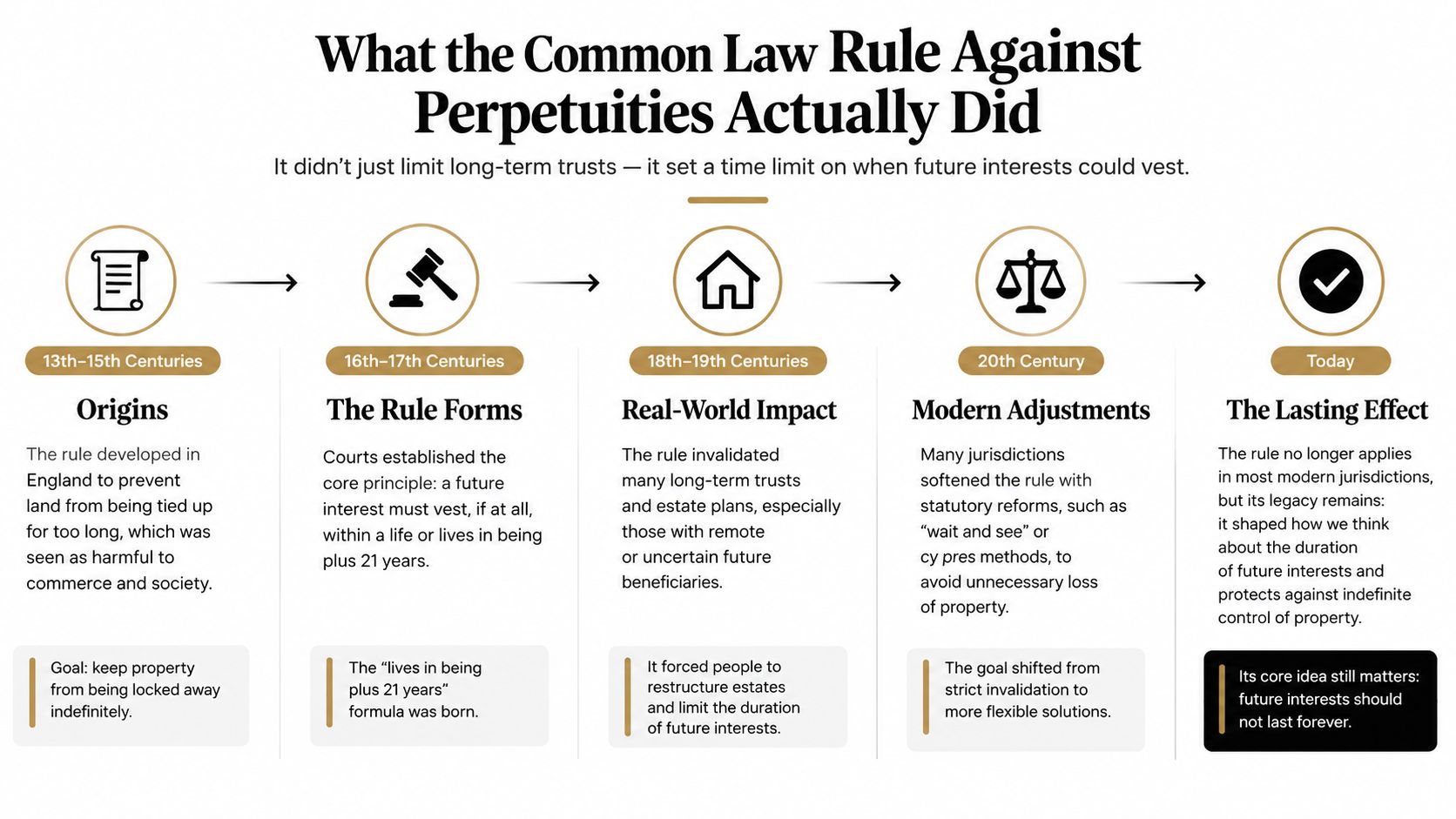
The practical effect was uncertainty. A family might want trustees to hold an asset for descendants, but the old test required lawyers to identify measuring lives and examine every contingent interest. A savings clause could reduce the risk, yet it could also force an early termination that defeated the family's broader goal.
A long-term trust failed under the old framework not because the family lacked a legitimate purpose, but because a future interest might remain uncertain for too long.
That difficulty helps explain the legislative move toward a fixed period. A 300-year ceiling is easier to identify and administer than a rule that depends on multiple lives, future births, and technical vesting analysis.
The history is also important for families reviewing older instruments. A trustee can't assume that a trust with language such as “for descendants forever” is legally perpetual. The trustee must examine the governing instrument, its effective date, any savings clause, and the law applicable to the relevant property interests.
The following video provides additional background on the historical rule and its development.
How HB 654 Replaced Lives in Being With a 300 Year Limit
HB 654 changed the Texas framework by replacing the former lives-in-being approach with a fixed period for qualifying interests. The legislation was signed on June 16, 2021, and took effect on September 1, 2021, according to the Texas Bar's explanation of the change. The amendment is codified in Texas Property Code § 112.036.
For trusts with an effective date on or after September 1, 2021, the statute generally requires a non-vested property interest or trust power of appointment to vest, if at all, within 300 years after the trust's effective date. The statute's terminology matters. A non-vested property interest is an interest that is subject to a condition or event before the holder's right becomes fixed. A power of appointment is authority given to a person to designate who will receive trust property. The perpetuities period is the statutory period used to test whether the interest must vest.
The period begins with the trust's effective date. It doesn't begin when the settlor dies, when a beneficiary reaches a certain age, or when a trustee later modifies the trust. That distinction affects drafting, administration, and any proposed transfer into a continuation trust.
The transition between old and new law
HB 654 didn't automatically rewrite every existing trust. Interests created before September 1, 2021, generally remain subject to the common-law rule or to a prior savings provision. Interests created on or after that date may fall under § 112.036, but the analysis still requires attention to the instrument and the transaction that created the relevant interest.
The Texas legislative analysis of later trust legislation highlights why the phrase “effective date” requires careful review. A later trust may receive property from an originating trust without receiving a wholly new perpetuities period. The transfer may be treated as a continuation, distribution, or other transaction connected to the earlier trust.
Texas selected a bright-line period rather than eliminating the rule entirely. That approach permits long-term dynasty planning while retaining an outside boundary for vesting. Other jurisdictions, including Alaska, South Dakota, Delaware, and Nevada, have taken approaches described as abolishing or effectively suspending the rule, but Texas chose a fixed limit instead.
| Feature | Common-Law RAP, Before Sept. 1, 2021 | Texas Property Code § 112.036, On or After Sept. 1, 2021 |
|---|---|---|
| Basic test | Vesting had to occur within a life in being plus 21 years, with a possible gestation period | Vesting generally must occur within 300 years |
| Measuring point | A qualifying measuring life connected to the interest | The trust's effective date |
| Main risk | A remote possibility could invalidate an interest | The statutory period creates a clearer outer limit |
| Older trusts | Governed by the old rule or an applicable savings clause | Not automatically converted to the new period |
| Administration | Required detailed review of contingent interests | Still requires review of effective dates and continuation transactions |
Trust administration involves more than distributing assets. It requires understanding the difference between administering a trust and administering a probate estate, including the legal authority that governs each process. A practical overview appears in Texas Trust Administration: A Trustee's Guide.
Practical Effects on Trusts, Estates, and Dynasty Planning
The 2021 reform changes how Texas families can structure long-term ownership, but it doesn't solve every estate-planning problem. A new trust can generally use the statutory period to keep non-vested interests open for generations, subject to the statute's terms and any limitations in the governing instrument. That can reduce the need to rely on complicated common-law drafting techniques.
For a settlor, the benefit is planning certainty. The trust can describe a long-term distribution structure without depending entirely on the survival of selected measuring lives. For a trustee, the benefit is a clearer statutory framework. For a beneficiary, the benefit may be continued access to trust administration rather than an earlier forced distribution.
Validity is only one part of the plan
The 300-year period doesn't extend federal generation-skipping transfer tax exemption. A trust intended to benefit grandchildren or more remote descendants still requires careful tax planning, including proper allocation of GST exemption when property is transferred and continued review as assets move through the family structure.
The same distinction applies to creditor protection. A long duration can support a spendthrift-oriented design, but duration alone doesn't shield assets from every claim. The trustee must follow the trust's terms, maintain separation between trust and personal property, document decisions, and avoid conduct that could support a fraudulent-transfer challenge under applicable law.
The trust's assets also create operational concerns. A ranch may require decisions about leasing, conservation, insurance, or sale. A closely held business may have buy-sell restrictions, voting rights, and succession questions. A trustee who expects the trust to last across multiple generations must establish a governance process that future trustees and beneficiaries can understand.
For families considering a long-term structure, Dynasty Trusts in Texas and What High-Net-Worth Families Use provides related information about the planning context. The legal work still needs to be adjusted to the family's assets, tax position, and distribution goals.
A trustee also must distinguish trust administration from probate. The Texas Trust Code governs core trustee authority and fiduciary obligations, while the Texas Estates Code governs probate and related estate proceedings. A will may direct an executor, but a trust instrument gives a trustee continuing authority over trust property. Neither role permits the fiduciary to ignore beneficiary rights, accounting duties, or the governing document.
Fiduciary reminder: A longer trust term increases the importance of accurate records, trustee succession planning, and clear communication with beneficiaries.
The Hidden Trap With Split Effective Dates and Continuation Trusts
The most overlooked issue is that a post-2021 trust doesn't necessarily receive a fresh 300-year period just because someone signed a new document after the statute took effect. The source of the property and the legal relationship between the old and new trusts can control the analysis.
Suppose a trust created before September 1, 2021, holds property subject to the former lives-in-being framework. The trustee later considers decanting the assets into a new trust with updated administrative terms. The new instrument may look modern, but the transfer could be treated as a continuation of the originating trust. If so, the older perpetuities period may carry forward.
Why administration decisions matter
A similar concern can arise with a judicial modification under Texas Property Code § 112.054 or a non-pro-rata distribution into a separate continuing sub-trust. The trustee may intend only to improve administration, separate beneficiary shares, or update outdated provisions. Yet the transaction can affect the legal analysis of vesting and duration.
The legislative materials linked above explain that an effective date can trace back to an originating trust and that a receiving trust may not receive a fresh statutory period when it is a continuation or distribution from an earlier trust. That means the trustee must ask a precise question before moving assets:
Does this transaction create a genuinely new interest, or does it continue an interest created under the older trust?
Reformation under Texas Property Code § 112.057 may offer a different path when the goal is to correct or preserve an instrument rather than create a new perpetuities period. The result depends on the trust's language, the nature of the defect, beneficiary rights, and the court's authority.
A trustee who moves assets merely to “modernize” administration can unintentionally reduce the family's planning horizon. Before any decanting, modification, division, or non-pro-rata distribution, the trustee should obtain a written analysis of the applicable perpetuities period and document the transaction's purpose.
Families reviewing a trust that received assets after 2021 should look for language connecting the new instrument to an older trust. A continuation clause, reference to the originating instrument, or distribution provision may signal that the new document doesn't operate on a completely independent clock. Guidance about trust situs and transfers appears in Trust Situs and Moving a Trust to Texas.
Actionable Steps for Trustees, Families, and Advisors in Texas
A trustee reviewing a family trust after the 2021 reform should not assume the new 300-year rule controls every asset or provision. The governing document, funding history, and date of each transaction may produce different results within the same trust.
Start with the original instrument
For a pre-2021 trust, collect the signed agreement, amendments, funding records, prior accountings, and court orders. Counsel should identify the trust's effective date, any express perpetuities savings clause, and the law governing interests when they were created.
The review should also identify assets added later. A continuation trust, decanted trust, or receiving trust may carry an older interest with an earlier measuring period. A transfer completed after the reform does not necessarily restart the planning horizon.
A written perpetuities opinion gives the trustee a clear decision record. It should explain which date applies to each material interest and address any prior decanting, division, modification, or asset transfer.
Use a transaction review before changing the trust
Before decanting or modifying a trust, review:
- The proposed purpose: State whether the transaction addresses administration, beneficiary protection, tax planning, drafting correction, or another objective.
- The source of the property: Trace each asset to the trust that originally received it, including assets later moved between trusts.
- The duration consequence: Determine whether the transaction preserves an older measuring period or creates a separate statutory analysis.
- Beneficiary rights: Review notice, consent, representation, and court-approval requirements.
- The record: Preserve the legal opinion, notices, consents, appraisals, tax advice, and trustee resolutions.
The trustee should ask whether the receiving trust is genuinely independent or merely continues an interest created under an earlier instrument. That distinction can determine whether the family receives the benefit of the 2021 rule or remains tied to an earlier period.
For new trusts, drafting counsel should consider a savings clause limiting vesting to the longest period lawfully available. The clause should fit the distribution design and should not accidentally require an earlier termination. A sample provision should not be copied without reviewing the entire instrument.
Keep tax and succession planning connected
Settlors should confirm GST-exempt allocations at each relevant generation and coordinate the trust with federal tax counsel and a certified public accountant. Trustees should also review successor-trustee provisions, situs, beneficiary notices, and governance procedures on a recurring schedule, including a five-year review where appropriate. That interval is a planning recommendation, not a statutory deadline.
Retain records showing why distributions were made, how investments were selected, how conflicts were handled, and how beneficiary needs were considered. The records may matter in a fiduciary dispute, creditor proceeding, or tax examination.
Families considering a transfer should review Decanting a Trust in Texas Explained before authorizing the transaction. A Texas trust administration lawyer can then assess whether the proposed change supports the original plan or shortens the trust's duration.
Sample Trust Language and a Quick Comparison Reference
The following examples are educational illustrations, not ready-to-sign provisions. The trust's assets, beneficiary structure, tax goals, trustee powers, and applicable law must be reviewed before any clause is adopted.
Illustrative savings provision
If any provision of this trust would violate an applicable rule against perpetuities, the provision shall be reformed or limited to the maximum period permitted by law, while preserving the settlor's purposes to the greatest extent legally available.
This type of language seeks to prevent an invalid duration from defeating the entire plan. It doesn't guarantee that a court or trustee will interpret the clause as the drafter expects.
Illustrative continuation trigger
Before transferring trust property to a new or separate trust, the trustee shall determine whether the transfer continues an interest created under an earlier trust and shall preserve the earlier perpetuities period when required by applicable law.
This provision highlights the issue but doesn't replace the statutory analysis. A trustee still must review the governing instrument and transaction.
Illustrative durational limitation
No non-vested interest or power of appointment created under this trust shall remain exercisable beyond the maximum perpetuities period permitted by Texas law, measured from the trust's effective date.
The phrase “maximum period permitted” can accommodate changes in applicable law, but it should be coordinated with any specific distribution termination dates.
| Scenario | Measuring Period | Validity Test | Reformability | Creditor Exposure |
|---|---|---|---|---|
| Old-rule trust | Common-law lives in being plus 21 years, with any applicable gestation period | A remote possibility of late vesting could invalidate an interest | May depend on the instrument, savings clause, and available court remedies | Depends on spendthrift terms, beneficiary interests, trustee conduct, and applicable law |
| New Texas trust | Generally 300 years from the trust's effective date | Interests must satisfy § 112.036 and the trust's terms | May be affected by statutory modification or reformation tools | Long duration doesn't itself create protection; structure and administration matter |
| Continuation trust | May carry forward the originating trust's period | The receiving trust may be tested by the original effective date and transaction | Depends on the authority used and the relief sought | Existing protections may change if the new terms alter beneficiary rights or trustee powers |
Frequently Asked Questions and Next Steps for Texas Families
Are existing trusts automatically extended to 300 years?
No. A trust created before September 1, 2021, isn't automatically converted to the newer statutory period. The trustee must review the instrument, its savings clause, the funding history, and any later transaction affecting the trust.
Can a trust drafted under the old rule be fixed?
Sometimes. Options may include reformation, judicial modification, or decanting, but each method has limits. A trustee should not assume that a new document creates a new 300-year period, particularly when the new trust receives assets from an older trust.
Does a long trust avoid GST tax?
No. Duration and GST tax treatment are separate issues. A family needs coordinated federal tax advice and careful exemption-allocation records when planning for grandchildren and more remote descendants.
What should a family bring to counsel?
Gather the original trust, every amendment, deeds and account statements showing funding, prior trustee accountings, beneficiary notices, decanting or modification documents, tax filings, and any court orders. A complete timeline often reveals whether the trust's effective date changed or carried forward.
A practical review should answer these questions:
- What trust first received the property?
- When did each relevant interest become effective?
- Does a savings clause apply?
- Has anyone decanted, divided, modified, or distributed assets?
- Do the current trustee powers and beneficiary rights match the settlor's purpose?
- Are tax, creditor-protection, and governance goals still aligned?
If you're serving as trustee, inheriting under a long-term trust, or considering a Texas estate plan, don't rely on the phrase “300 years” alone. A careful review by a Texas estate planning attorney or Texas trust administration lawyer can clarify the governing period, protect fiduciary decision-making, and identify practical steps before a transfer or modification creates a problem.
If you're managing a trust or planning your estate, the Law Office of Bryan Fagan, PLLC offers guidance on Texas trust administration, trust modification, fiduciary compliance, estate planning, and asset protection. Schedule a free consultation to review your trust's effective date, continuation provisions, and long-term family goals with Texas-based counsel.