Managing a loved one's trust can feel overwhelming, especially when the trust holds most of its value in one company or a family business. You may worry that selling will create tax problems, disappoint beneficiaries, or go against the settlor's wishes. At the same time, keeping a concentrated investment without careful review can expose you to criticism for failing to act prudently.
Texas law gives trustees a framework for handling that tension. The duty to diversify and opting out under Texas 117.004 involves more than deciding whether to sell a particular asset. It requires you to read the trust, understand the beneficiaries' needs, evaluate the portfolio as a whole, and preserve a clear record of why retention or diversification was reasonable.
When a Trust Comes With a Concentrated Portfolio
Suppose your mother's trust holds 70% of its value in a single energy stock, along with a minority interest in the family hardware store. You've recently accepted the trustee role. Selling the stock could trigger capital gains and reduce the trust's connection to a company your mother intentionally supported. Keeping it, however, leaves the trust heavily exposed to one business and one industry.
Neither choice is automatically correct.
Concentrated holdings often appear in Texas estate plans because families transfer legacy assets, employer securities, ranch interests, family businesses, or closely held company shares into a trust. A settlor may believe those assets should remain together for family continuity, business control, or long-term growth. A trust may also contain property that can't be sold easily without harming the business or creating a dispute among family members.
A trustee who sells immediately may be accused of ignoring the settlor's intent. A trustee who holds indefinitely may be accused of ignoring investment risk. The question isn't whether one asset performed well in the past. The question is whether the trustee can show that the decision fits the trust's terms, purposes, distribution needs, and overall investment strategy.
The role of fiduciary judgment
A trustee acts under fiduciary duties in Texas, including duties of loyalty, care, impartiality, and proper administration. Those duties require the trustee to place the trust's interests ahead of personal preferences and to treat current and remainder beneficiaries fairly when their interests differ.
The trustee also has to separate investment judgment from family pressure. A beneficiary may want the stock sold for liquidity. Another may want the family company preserved forever. Those opinions matter as part of the administration record, but they don't replace the trustee's independent analysis.
A useful starting point is to review the trust's distribution provisions, any direction regarding specific assets, and any authority concerning adjustments between principal and income. The discussion in trustee power to adjust between principal and income in Texas can help identify related administration issues, but a concentrated investment decision still requires a legal and financial review.
The central issue is practical: does the trustee have to diversify, and if not, how can the decision be preserved as a legitimate exercise of fiduciary judgment?
What Section 117.004 Actually Requires
A trustee receives a trust holding one company's stock. Selling it may reduce concentration, but it may also conflict with the trust's purpose, tax position, or a direction to retain that asset. Section 117.004 asks the trustee to evaluate the decision in context, then document why the chosen course serves the trust.
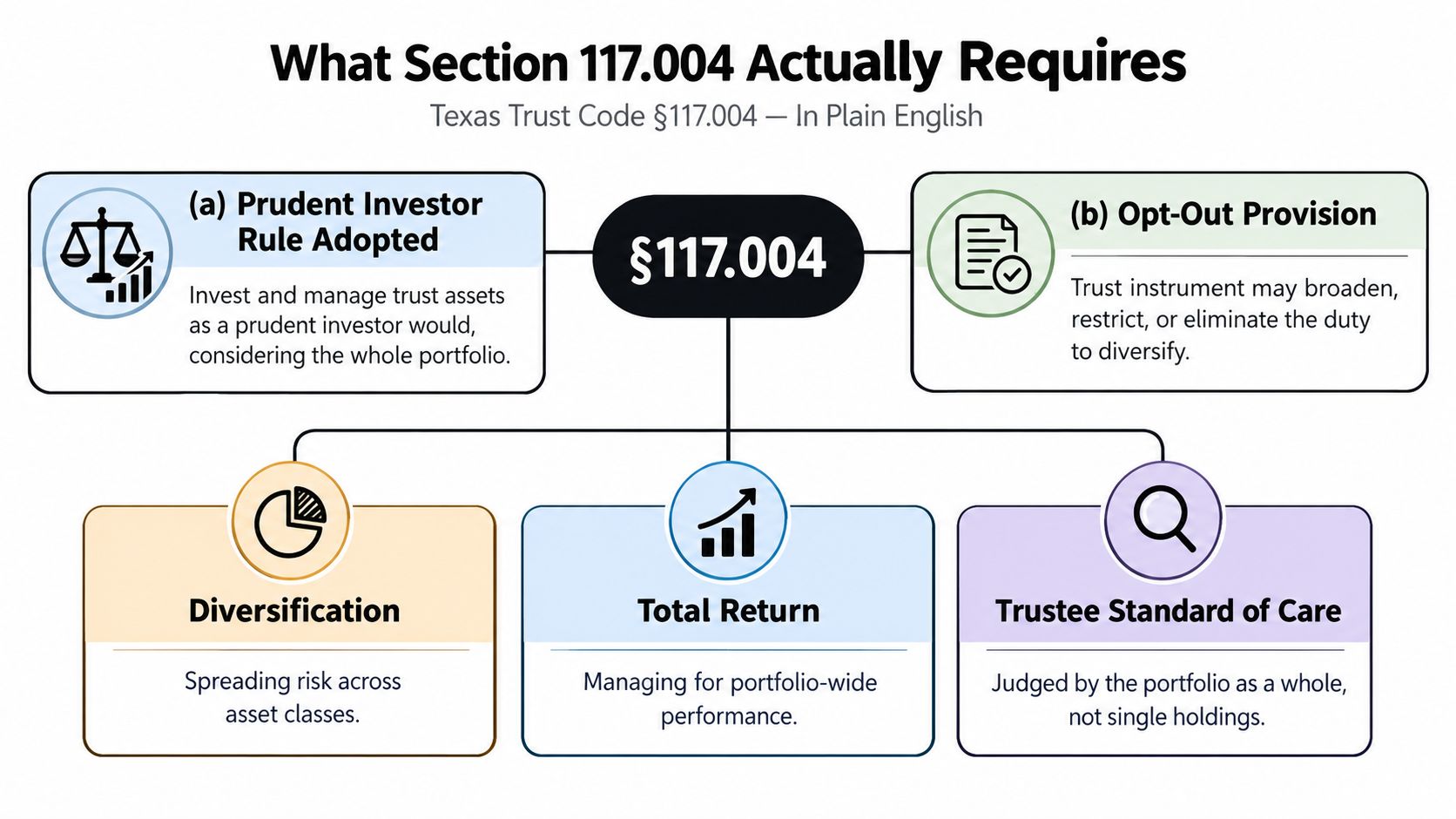
Texas Property Code Chapter 117 provides the modern prudent-investor framework. Under Texas Property Code Section 117.004(a), a trustee must invest and manage trust assets as a prudent investor would, considering the trust's purposes, terms, distribution requirements, and other circumstances. The trustee must exercise reasonable care, skill, and caution.
The review concerns the portfolio as a whole, not each asset in isolation. Section 117.004(b) calls for an overall strategy with risk and return objectives suited to the trust. Texas materials identify January 1, 2004 as the effective date of this modern rule, following enactment in 2003. The statutory language appears in the Texas Property Code provisions governing prudent investing. For the portfolio standard that guides retention and diversification decisions, see the Texas prudent investor rule.
Turning the statute into trustee action
A practical review should follow a written sequence:
- Read the trust first. Identify investment instructions, distribution standards, beneficiary classes, specific-asset language, and any authority to retain property.
- Define the trust's needs. Address income, liquidity, preservation, growth, taxes, and expected distributions.
- Evaluate the portfolio together. Decide whether each holding fits the overall risk and return strategy.
- Document the decision. Keep an investment policy statement, valuation materials, tax advice, meeting notes, and beneficiary communications.
- Review periodically. Reconsider the plan after material changes in value, business conditions, beneficiary needs, or distributions.
A clear opt-out clause can work with Section 113.003 retention authority and an investment policy statement. The clause identifies the asset or concentration the trustee may retain, while the policy explains how the portfolio standard will be applied around it. The statute still reaches acquiring, retaining, exchanging, and disposing of investments, so retention is not automatically justified because the settlor transferred the asset.
For a focused discussion, see A Trustee's Investment Duties Under Texas Law. Firms developing educational materials on fiduciary topics may also review NewsletterAsAService legal marketing.
The Diversification Default and How Opting Out Works
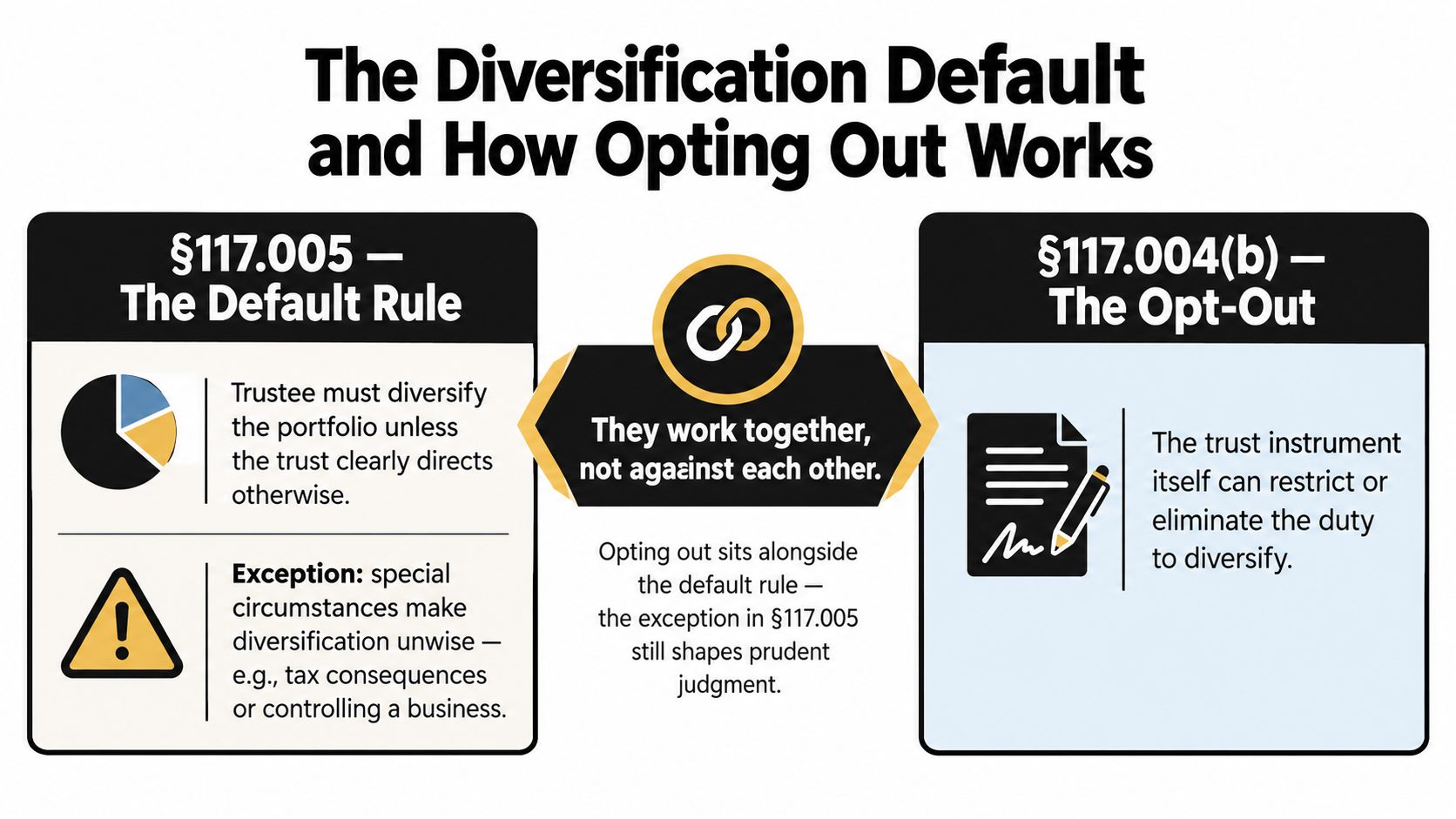
Texas begins with a clear default. Section 117.005 generally requires a trustee to diversify trust investments unless the trustee reasonably determines that special circumstances make the trust better served without diversification. The duty exists because a portfolio concentrated in one company, industry, or type of property can expose beneficiaries to avoidable risk.
The rule isn't absolute. The statute recognizes that diversification may be unwise in a particular trust. Tax consequences, business-control concerns, beneficiary needs, or the nature of the trust property may support continued concentration. Official legislative materials for HB 2240 confirm that Texas embedded diversification into the trust code while allowing special circumstances to justify a different approach. A summary of that legislative background appears in this Texas trust law discussion of diversification and trustee obligations.
Three ways an opt-out may be structured
The trust instrument can expand, restrict, eliminate, or otherwise alter the prudent-investor rules, including diversification. That flexibility allows a settlor to address a known asset directly.
- A named stock: The trust may authorize the trustee to retain shares of a particular company without a duty to sell or diversify those shares.
- A family business interest: The document may permit continued ownership of family hardware store shares, limited liability company units, or other closely held interests.
- Broader retention discretion: The trust may give the trustee authority to retain original assets or a defined category of property, subject to continued prudence for the rest of the portfolio.
Opting out doesn't erase the prudent-investor rule for every other asset. It also doesn't necessarily authorize careless administration. The trustee still must understand the trust's purpose, consider beneficiary needs, and assess how the concentrated holding affects the portfolio's total risk and return.
The trust terms therefore work alongside the statutory default. A clear clause may change the diversification obligation for identified property, while the trustee's broader fiduciary responsibilities continue to govern administration.
Drafting a Clear Opt-Out Clause
A vague sentence such as “the trustee may retain original assets” may not answer the questions that arise later. Which assets? For how long? Does the clause eliminate diversification entirely, or only restrict it for certain holdings? Does the trustee still have to monitor the asset and protect beneficiaries from unreasonable risk?
A careful drafter should address those points directly.
Elements of a workable provision
First, identify the asset or asset class. The provision might refer to named shares, family business interests, employer securities, family limited liability company units, or closely held stock. “Original assets” may be less clear if the trust later receives additional property or if the same business reorganizes.
Second, state the intended effect. The clause should expressly reference Texas Property Code Section 117.004 and explain whether the settlor intends to restrict or eliminate the duty to diversify for the identified property. Texas law allows the trust instrument to alter the prudent-investor rules, but the language should make that intent unmistakable. The relationship between default and mandatory trust provisions deserves careful review, including the discussion of the Texas Trust Code and default versus mandatory provisions.
Third, preserve useful guardrails. The settlor may require periodic review, limit additional purchases, require liquidity planning, or direct the trustee to rebalance after a defined event. The clause can permit retention without turning the trustee into a passive holder.
Drafting example: “The trustee may retain the shares of [identified company] and any successor shares without a duty to diversify those shares under Texas Property Code Section 117.004. The trustee shall continue to evaluate the shares in relation to the trust portfolio, distribution requirements, and the interests of all beneficiaries, and shall review the retention decision periodically.”
This is only a starting point. A drafter may need different language for a family business, a voting-control interest, or property that creates tax and liquidity concerns. Texas Property Code Section 113.003 also allows a trustee to retain the original trust corpus, or property later added to the trust, without regard to diversification and without liability for depreciation or loss from that retention. The statute's retention authority makes the trust document and the source of the asset especially important, as explained in this Texas State Auditor discussion of trustee retention authority.
Ambiguity invites a beneficiary challenge and may leave a court to construe the document. A Texas trust administration lawyer can help coordinate the opt-out clause with the rest of the trust, tax planning, succession provisions, and beneficiary rights.
Administering a Trust That Has Opted Out
An opt-out clause should change the trustee's process, not end it. Once the trustee decides to retain a concentrated asset, the file should show why that decision serves the trust and how the trustee will manage its consequences.
An investment policy statement, or IPS, is often the central document. It should describe the trust's purpose, beneficiaries, distribution expectations, liquidity needs, risk tolerance, and the role of the concentrated asset. It should also explain why immediate sale, gradual reduction, or continued retention was considered.
What the trustee should record
For the energy stock in our example, the trustee might record the trust's expected distributions, the stock's place within the total portfolio, available cash reserves, relevant tax advice, and the effect of a significant price decline on current and remainder beneficiaries. For the hardware business, the trustee might record ownership restrictions, valuation information, buy-sell provisions, management concerns, and whether selling would harm the operating company.
The trustee should also establish monitoring triggers. Those may include a change in business control, a material liquidity need, a distribution deadline, a major change in beneficiary circumstances, or a significant shift in the portfolio's overall composition. The exact trigger should fit the asset and trust rather than follow a generic form.
A well-organized file may include:
- Trust analysis: A copy of the governing document, amendments, asset schedules, and written interpretation of the retention clause.
- Investment analysis: Portfolio valuations, concentration review, cash-flow projections, and professional investment opinions.
- Tax materials: Advice regarding capital gains, income tax, valuation, and the consequences of a sale or transfer.
- Beneficiary records: Notices, questions, responses, and notes showing how differing interests were considered.
- Review history: Dated decisions explaining whether the original retention rationale remains valid.
Families handling other foundational choices may find a plain-language resource on simple estate decisions useful, but a concentrated trust portfolio calls for a more detailed fiduciary record. The goal isn't to guarantee perfect investment performance. The goal is to show a careful, loyal, informed process.
Common Mistakes Trustees Make
A trustee may have a valid opt-out and still face a dispute if the administration looks careless. The clause is not a personal shield. It gives the trustee authority to work within the settlor's design, while the trustee must continue to exercise judgment.
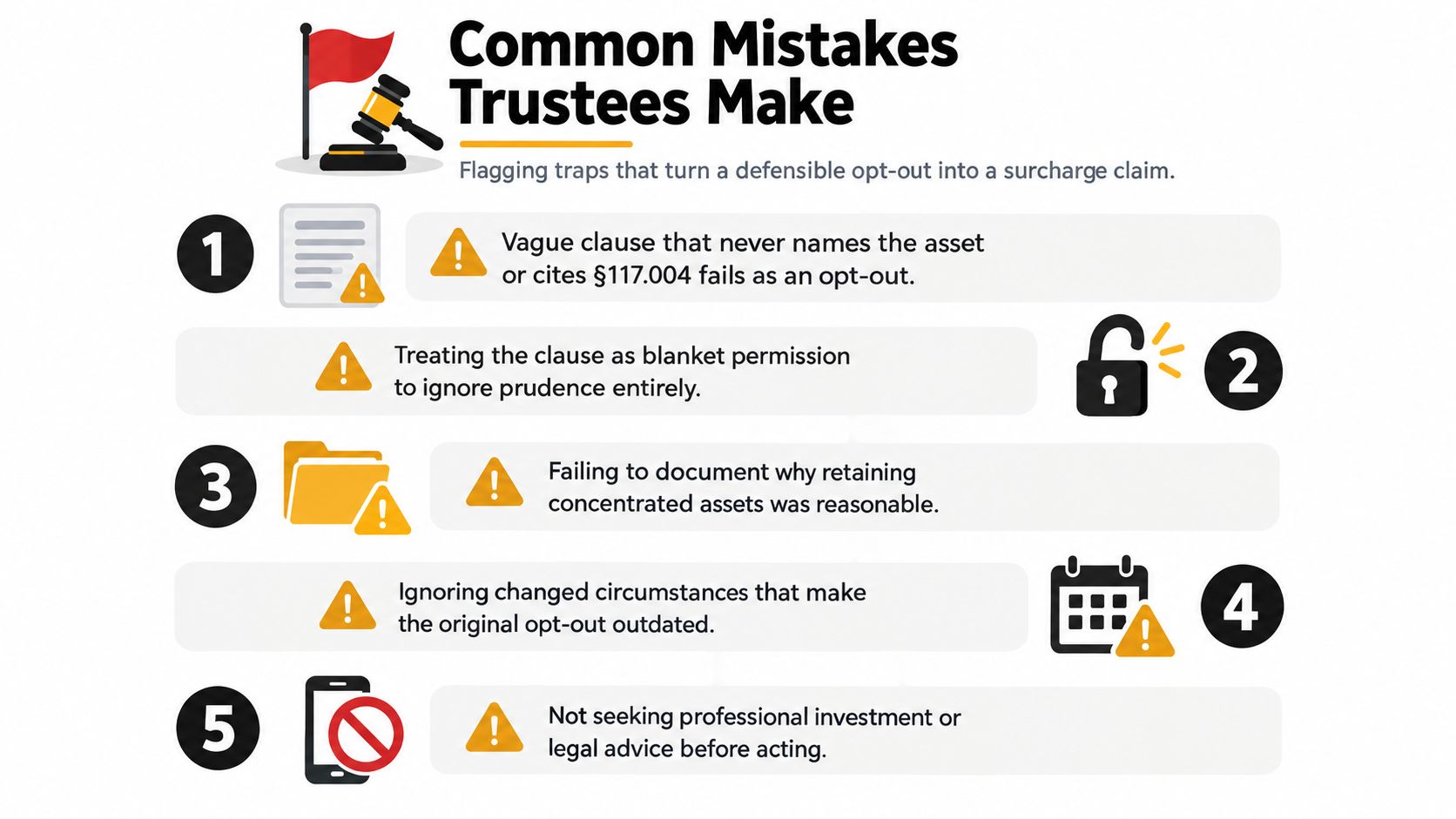
Errors that create avoidable exposure
- Vague language: A clause that mentions “legacy assets” without identifying the property or expressing the intended change to Section 117.004 may not establish a reliable opt-out.
- Blanket permission: A trustee cannot reasonably read a retention clause as permission to ignore prudence, loyalty, impartiality, or distribution obligations throughout the trust.
- No written reasoning: “The family wanted to keep it” is not a complete fiduciary analysis. The trustee should explain how retention serves the trust's purposes and beneficiaries.
- Stale assumptions: Market conditions, business operations, tax circumstances, and beneficiary needs change. A decision made at funding may become unsuitable later.
- Personal bias: A trustee who owns the same stock, works for the family company, or expects a personal benefit must separate those interests from the trustee's role and address conflicts openly.
Another frequent mistake is focusing only on sale-related tax consequences. Tax planning matters, but it doesn't automatically justify indefinite concentration. The trustee should compare the tax impact of selling with the trust's liquidity needs, risk exposure, and distribution duties.
A beneficiary may also challenge a trustee who relies on an opt-out to refuse a reasonable sale. The question may become whether the trustee misunderstood the clause, failed to consider changed facts, or used the provision to avoid making any investment decision at all.
Professional legal and investment advice can help identify these problems before they become a demand for an accounting, a surcharge claim, or trust litigation.
Practical Questions Trustees and Families Ask
Can the opt-out be changed after the trust is funded?
Sometimes, but the answer depends on the trust language, the parties involved, and the available statutory procedure. A trustee generally can't rewrite the settlor's instructions just because the trustee now prefers diversification. Modification may require beneficiary consent, court approval, or another legally authorized process.
Texas Trust Code Section 112.054 may provide a route for modifying or terminating a trust in appropriate circumstances. The court will focus on the governing terms, beneficiary interests, changed conditions, and the settlor's purposes. A trustee considering how to modify a trust in Texas should obtain advice before asking beneficiaries to sign an agreement or filing a petition.
Can a trustee terminate the opt-out alone?
Usually, a trustee shouldn't assume that unilateral action is permitted. The trustee may have discretion to sell an asset if the trust grants that power, but exercising a sale power is different from deleting or rewriting a trust provision. The trustee must distinguish between administering the trust and changing its terms.
Can beneficiaries challenge the arrangement?
Yes. A beneficiary may question whether the clause applies to the asset, whether the trustee followed the clause, or whether the trustee acted prudently in managing the remaining portfolio. Relevant evidence can include the trust document, amendments, investment policy statement, valuations, tax analysis, meeting notes, distribution records, and communications with beneficiaries.
How does decanting fit in?
Texas Trust Code Section 112.071 may permit decanting in certain circumstances, which means moving assets into a new trust with modified terms. Decanting has technical requirements and limits, and it isn't a substitute for individualized review. A proposed decanting should preserve the settlor's purpose while addressing the investment or administration problem that prompted the proposal.
Executors and trustees should also keep the legal systems separate. The Texas Trust Code governs trust administration, while the Texas Estates Code addresses matters such as probate, estate administration, and related court procedures. A Texas estate planning attorney can coordinate both when a concentrated asset passes through an estate before reaching a trust.
Planning Your Next Step With Confidence
A concentrated trust portfolio may fit the settlor's plan. The trustee must document why retaining it is reasonable under the trust's language, purposes, distribution needs, and portfolio-wide risk. An opt-out changes the diversification default, not the trustee's continuing duties.
Start with the trust and amendments, current asset and beneficiary schedules, and an investment policy statement (IPS). The opt-out clause should identify retained property, address Section 117.004 authority, and state what the trustee must still review. Pair it with Section 113.003 retention authority, so the records connect the trust's terms to the decision.
The IPS should address liquidity, tax planning, beneficiary needs, business restrictions, valuation, conflicts, and how the remaining portfolio meets the prudent-investor standard. Keep valuations, meeting notes, communications, and reasons for allocation decisions. If conflict arises, get advice before distributing assets or changing strategy.
If you're managing a concentrated trust portfolio, The Law Office of Bryan Fagan, PLLC can review trust terms and investment records. Schedule a free consultation through Law Office of Bryan Fagan, PLLC for Texas trust administration guidance.