Managing a loved one's trust can feel overwhelming. You may be looking at a brokerage statement, a family business interest, or inherited real estate and wondering whether keeping, selling, or changing an investment could expose you to personal liability. Beneficiaries may have a different concern: is the trustee protecting the trust, or allowing personal preferences to control important decisions?
Texas law provides a practical framework for these questions. The prudent investor rule in Texas asks whether a trustee acted with appropriate care, skill, caution, loyalty, and impartiality in light of the trust's purpose and circumstances. It doesn't demand perfect results or eliminate every investment risk.
This guide explains the governing Texas Trust Code provisions, the way trust language can modify the default rule, and the steps a trustee can take to build a defensible investment process. It also addresses beneficiary concerns, fiduciary duties in Texas, and when a Texas trust administration lawyer can help.
Managing Trust Investments Without the Overwhelm
A newly appointed trustee, Maria, opens the trust's investment account and sees a mixture of stock funds, bonds, cash, and a small interest in a family-owned company. Her father created the trust for her mother's support and for the children who will eventually receive what remains. Maria knows that selling everything could disrupt the family business, but she's also afraid that keeping concentrated assets could be viewed as imprudent.
That uncertainty is common. Trustees often assume they're personally responsible whenever an investment loses value. Beneficiaries may make the opposite assumption, believing that any loss proves the trustee breached a duty. Neither view accurately describes the Texas standard.
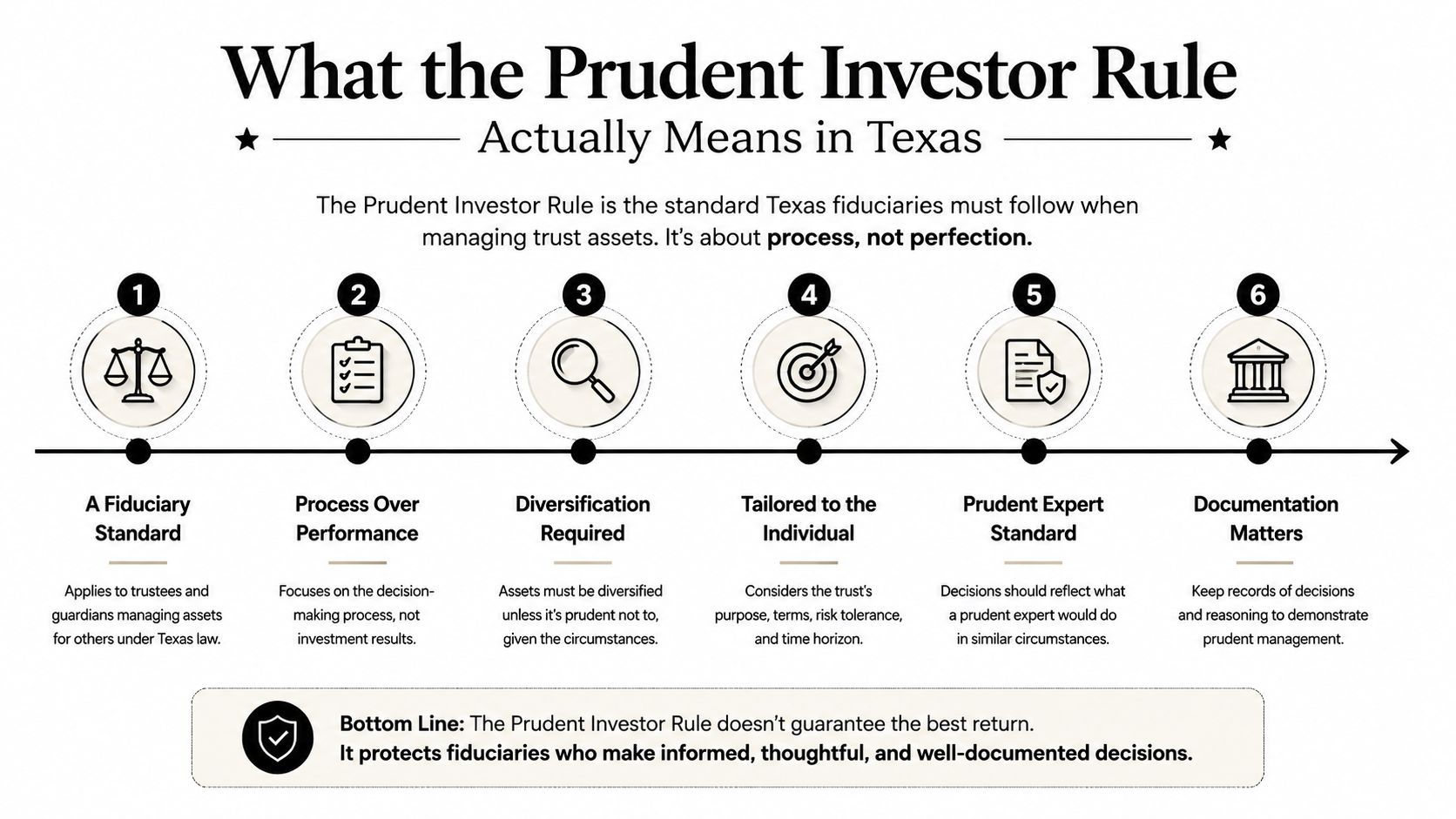
The rule focuses on the trustee's decision-making process, not on whether every investment succeeds. Texas law requires a trustee to consider the trust's purposes, terms, distribution requirements, and other circumstances. A trustee who evaluates those factors, obtains appropriate advice, records the reasoning, and reviews the portfolio can make a defensible decision even when markets move against the trust.
Practical rule: A reasonable investment process matters more than hindsight criticism of a single holding.
A Texas trustee should begin by reading the trust instrument carefully. The document may preserve special assets, direct income to a particular beneficiary, limit investment discretion, or alter the statutory default. The Texas Trust Code provides the baseline, but the trust itself may change how that baseline applies.
The same process helps beneficiaries evaluate concerns without rushing to litigation. A request for account statements, the investment policy, and explanations of major decisions may reveal that the trustee has a sound strategy. If records are missing or the trustee refuses to explain material actions, legal advice becomes more important.
A Texas estate planning attorney can help a settlor draft investment instructions before problems arise. A trustee may need counsel during administration, while a beneficiary may need advice about an accounting, removal, or potential breach. The rest of this guide explains the rule, the statutes, practical compliance steps, and the limits of trustee discretion.
What the Prudent Investor Rule Actually Means in Texas
Texas adopted its version of the Uniform Prudent Investor Act in 2003, and the prudent investor rule became effective on January 1, 2004. The provisions appear in Chapter 117 of the Texas Property Code, including the core investment standard in Section 117.004. Texas Property Code Section 117.003 provides the historical foundation for the Texas framework.
The effective date matters because the modernization wasn't limited to newly created trusts. Texas materials explain that the rule also applied to existing trusts, making 2004 the key transition point for investment standards across the state.
From isolated assets to the complete portfolio
Earlier approaches often treated investments asset by asset. That could make a trustee look imprudent because one holding carried risk, even when the overall portfolio had a reasonable balance of risk and return. The modern approach evaluates each investment within the trust's broader strategy.
In plain English, a single investment that declines in value isn't automatically a breach. The relevant questions include:
- Did the trustee consider the trust's purpose and distribution needs?
- Was the overall portfolio reasonably diversified when diversification fit the trust?
- Did the trustee consider liquidity, taxes, inflation, income regularity, and total return?
- Did the trustee account for the beneficiaries' other resources and any special value of an asset?
- Did the trustee document why a particular holding was retained or acquired?
Section 117.004 requires reasonable care, skill, and caution. It doesn't promise success, eliminate market risk, or require a trustee to choose the most conservative investment available. It asks whether the trustee's conduct was sensible under the circumstances existing when the decision was made.
For a focused explanation of how the standard applies to trust assets, see A Trustee's Investment Duties Under Texas Law. The most useful mental model is simple: prudence is a process, not a guarantee.
Key Texas Trust Code Provisions Every Trustee Should Know
The prudent investor rule works alongside other fiduciary obligations. A trustee can't defend an investment decision solely by saying it produced a reasonable return. The trustee must also act loyally and treat beneficiaries fairly when their interests differ.
The core duties
Section 117.004 requires reasonable care, skill, and caution. The trustee must consider the trust's purposes, terms, distribution requirements, and relevant circumstances. The statute also directs attention to economic conditions, inflation or deflation, tax consequences, total return, liquidity, income regularity, and the beneficiaries' other resources. Texas Property Code Section 117.004 describes the investment standard and its practical scope.
Section 117.007 imposes loyalty. The trustee must invest and manage trust assets solely in the beneficiaries' interest, not to benefit the trustee, a related business, or a favored third party. Texas Property Code Section 117.007 addresses this obligation directly.
Section 117.008 requires impartiality when a trust has two or more beneficiaries. A trustee may need to balance a surviving spouse's need for dependable income against children's interest in preserving and growing principal. Impartiality doesn't mean identical treatment. It means the trustee must account for the different interests created by the trust.
The portfolio approach also prevents a common mistake. A beneficiary shouldn't evaluate one holding without understanding how that holding fits within the complete strategy. Likewise, a trustee shouldn't use diversification as an excuse to ignore a trust's special purpose or express instructions.
| Statute Section | Duty Imposed | Practical Meaning |
|---|---|---|
| Section 117.004 | Reasonable care, skill, and caution | Evaluate investments within the portfolio and the trust's circumstances |
| Section 117.007 | Loyalty | Act solely for the beneficiaries' interests |
| Section 117.008 | Impartiality | Consider competing interests among current and future beneficiaries |
| Chapter 117 framework | Default investment rules | Follow the statute unless the trust validly changes the standard |
The Texas Trust Code also recognizes that the trust instrument can alter the default rule. Section 117.012 treats terms such as “prudent man rule,” “prudent trustee rule,” and “prudent investor rule” as authorizing investments under Chapter 117 unless the trust provides otherwise. Section 117.012 helps explain how older drafting language may connect to the current framework.
Trust administration also involves accounting, notice, distributions, and communication. Trustees seeking a broader statutory overview can review the Texas Trust Code provisions on trustee duties as part of their compliance process.
Practical Steps to Comply With the Prudent Investor Standard
A trustee doesn't need to predict the market. The trustee needs a repeatable method for making and reviewing decisions. The following process creates a useful record and keeps investment choices connected to the trust's legal purpose.
Start with the governing documents
Read the complete trust instrument before changing investments. Identify the beneficiaries, distribution standards, special assets, investment restrictions, powers of delegation, and language modifying the prudent investor rule. A trustee who skips this step may apply a general strategy that conflicts with the settlor's instructions.
Then prepare an Investment Policy Statement, or IPS. The document should address:
- Risk tolerance: How much volatility can the trust reasonably tolerate?
- Return objectives: What does the portfolio need to accomplish for current and future beneficiaries?
- Time horizon: When will distributions likely occur?
- Liquidity needs: Which assets must remain available for regular expenses or anticipated distributions?
- Tax considerations: How might sales, income, or distributions affect the trust and beneficiaries?
- Special assets: Why should the trust retain a family business, legacy real estate, or concentrated position?
The statute expressly identifies many of these considerations. Writing them down shows how the trustee connected the investment plan to actual trust circumstances.

Build, review, and document the strategy
Diversification often supports prudent portfolio management, but it isn't an automatic command to sell every concentrated asset. If the trust owns family-company shares, the trustee should document the reasons for retaining them, the risks considered, possible liquidity needs, and whether the trust instrument authorizes retention.
A trustee may also delegate investment functions to a qualified advisor when delegation is permitted and appropriate. Delegation doesn't eliminate oversight. The trustee should select the advisor carefully, define the responsibilities, receive reports, and monitor whether the strategy remains consistent with the trust.
Keep records of investment discussions, advisor recommendations, approvals, sales, purchases, distributions, and periodic reviews. A short memorandum explaining why the trustee retained an unusual asset can be more valuable than a vague statement that the decision “seemed reasonable.”
For additional administration guidance, trustees can review trust administration strategies in Texas. Professional advice may also be appropriate when tax planning, business valuation, real estate, or competing beneficiary needs complicate the portfolio.
How Trust Language Can Change the Default Rule
Many people read “prudent investor rule” as if it were an unchangeable command. In Texas, that's incomplete. The rule is generally a default standard, and the trust instrument may expand, restrict, eliminate, or otherwise alter it. Texas Property Code Section 117.004 reflects that the trust's terms are part of the prudence analysis.
That flexibility can be essential for a family with a closely held business. Selling the business interest solely to achieve broad diversification could defeat the settlor's succession plan, create tax consequences, or destroy an asset with unique family value. A carefully drafted trust might authorize the trustee to retain the interest, explain the purpose, and establish procedures for handling the associated risk.
Legacy real estate presents a similar question. A trust may hold a ranch, a commercial building, or a residence that carries personal or historical significance. The trustee still needs to consider expenses, liquidity, maintenance, income, and the interests of all beneficiaries. However, clear trust language can change whether immediate sale or diversification is expected.
Reliance and its limits
Texas commentary explains that the prudent investor rule can be modified by the trust instrument, and a trustee generally isn't liable to the extent of reasonable reliance on those provisions. The word reasonable matters. A trustee can't point to broad language while ignoring clear conflicts of interest, acting for personal benefit, or refusing to consider the trust's beneficiaries.
Exculpation language may reduce liability for certain decisions, but it doesn't turn every action into a protected action. A trustee who secretly benefits from a transaction, violates a mandatory distribution provision, or acts disloyally may still face challenge. Beneficiaries can also question whether the trustee's reliance on a provision was genuine and reasonable.
Settlors should address unique assets directly during estate planning. Trustees should obtain legal advice before selling, retaining, or restructuring concentrated holdings when the document is ambiguous. The right question isn't just, “Is this investment risky?” It's, “What does this trust require, permit, and reasonably expect this trustee to do?”

Common Trustee Mistakes and Beneficiary Remedies
Consider a trustee who keeps nearly all trust assets in one company because the shares belonged to the settlor. The trustee never reviews the concentration, never checks the trust language, and can't explain the decision in writing. Even if the company performs well, the process creates avoidable risk. If the shares later decline, the absence of documentation may make the trustee's defense more difficult.
Another trustee takes the opposite approach. She invests for aggressive growth and ignores a surviving spouse's need for regular income. The portfolio may have a reasonable long-term objective, but the trustee failed to connect the strategy to the trust's distribution requirements and the beneficiary's current needs.
Common warning signs include:
- Undocumented concentration: The trustee retains a major position without recording the trust-based reason.
- Personal attachment: The trustee treats a family home, business, or property as untouchable without analyzing costs and beneficiary interests.
- One-sided planning: The trustee favors current income or future growth while overlooking the other beneficiary group.
- Poor records: The trustee can't produce statements, decisions, advisor communications, or distribution explanations.
- Conflicts of interest: The trustee directs trust business toward a personal company or related party without proper review.
A beneficiary who sees these warning signs should begin with a focused written request for information and an accounting. Clear communication may expose a misunderstanding rather than misconduct. It may also give the trustee an opportunity to correct the process before the dispute becomes more serious.
If concerns remain, a beneficiary may ask a court for an accounting, seek trustee removal when the legal requirements are met, or pursue a surcharge for losses caused by a breach. The appropriate remedy depends on the trust terms, the trustee's conduct, the records, and the actual harm.
A trustee who receives a serious complaint shouldn't respond defensively or destroy records. Preserve documents, pause questionable transactions, and consult a Texas trust administration lawyer. Beneficiaries seeking a structured explanation of potential claims can review trustee breach of fiduciary duty in Texas.

Protecting Your Trust With the Right Legal Guidance
The prudent investor rule is designed to give trustees a workable standard, not a trap. A trustee is in a stronger position when the trust instrument has been reviewed, the statutory duties are understood, the investment plan is written, and decisions are supported by clear records.
A practical self-audit should ask:
- Does the trust document change the default investment rule?
- Does the current portfolio match the trust's purposes and distribution requirements?
- Have the trustee's loyalty and impartiality duties been addressed?
- Are liquidity, taxes, income needs, and special assets documented?
- Has the trustee reviewed advisor performance and the overall strategy?
- Can the trustee explain the reason for each major investment decision?
Settlors should address concentrated stock, family businesses, real estate, succession goals, and beneficiary differences during drafting. A Texas estate planning attorney can help coordinate those provisions with broader estate planning, tax planning, asset protection, and business succession goals. Families dealing with incapacity or court-supervised matters may also need guidance involving probate or guardianship.
Trustees and beneficiaries don't have to resolve every concern alone. The Law Office of Bryan Fagan, PLLC helps Texas families and fiduciaries with trust creation, administration, fiduciary accounting, trustee guidance, disputes, estate planning, probate, guardianship, and asset protection. Legal counsel can help a trustee create a defensible process or help a beneficiary understand available options before taking a confrontational step.
The right advice depends on the trust document, the assets, the beneficiaries, and the history of the administration. A confidential review can clarify whether the issue is a drafting problem, a communication failure, a correctable process mistake, or a genuine fiduciary dispute.
If you're managing a trust or planning your estate, contact the Law Office of Bryan Fagan, PLLC for a free consultation about prudent investing, trustee compliance, estate planning, or beneficiary concerns. Our Texas attorneys can help you understand the trust language, document the investment process, and choose a practical path forward.