Managing a loved one's trust can feel overwhelming, especially when the successor trustee is a sibling and every decision seems to carry emotional weight. A Houston family may understand that their father created a revocable trust, yet still wonder when distributions should begin, what records beneficiaries can request, and whether everyone is being treated fairly.
Texas trust distribution to beneficiaries involves more than writing checks. The trustee must follow the trust instrument, apply fiduciary principles, classify trust assets correctly, and preserve records that show why each payment was made. This guide explains the process from the first notice through final distribution, with practical steps for trustees and beneficiaries who need clarity.
When a Texas Trust Reaches the Distribution Stage
After their father's death, three Houston siblings learn that their brother, Daniel, is the successor trustee of the family's revocable trust. The trust owns investment accounts, a rental property, and cash. Daniel tells his siblings that administration has started, but he doesn't yet provide a distribution schedule. One sibling needs money for immediate expenses. Another wants to know whether rental income is being paid to anyone. The third worries that Daniel, who is also a beneficiary, may favor himself.
This situation is common in its basic shape. A family member becomes trustee during a period of grief, and the trustee must shift from managing a parent's affairs to administering property for several beneficiaries. The trust document may require immediate payments, delayed distributions, discretionary support, or a final division after debts, expenses, and tax matters are addressed.
The end of a probate proceeding doesn't automatically answer every trust question. A will may control property that passes through probate, while a properly funded trust may serve as the primary vehicle for transferring other assets. The trustee still has to identify trust property, confirm the beneficiaries, review the governing terms, and communicate appropriately.
Why distribution creates family tension
Distribution is where different interests become visible. A current beneficiary may need income now, while a remainder beneficiary wants the trustee to preserve principal. One sibling may receive a payment authorized by the trust, while another receives nothing because the trustee has discretion rather than a mandatory payment duty.
Practical insight: A trustee's silence can create suspicion even when the administration is legitimate. Clear written communication and traceable records protect both the family and the trustee.
A careful roadmap helps. Beneficiaries should understand what they can request and how to compare distributions. Trustees should treat each payment as a fiduciary decision, not a private family arrangement. If the trust owns a business, real estate, or complex investments, a Texas trust administration lawyer can help prevent administrative mistakes before they become disputes.
The Texas Legal Framework for Trust Distributions
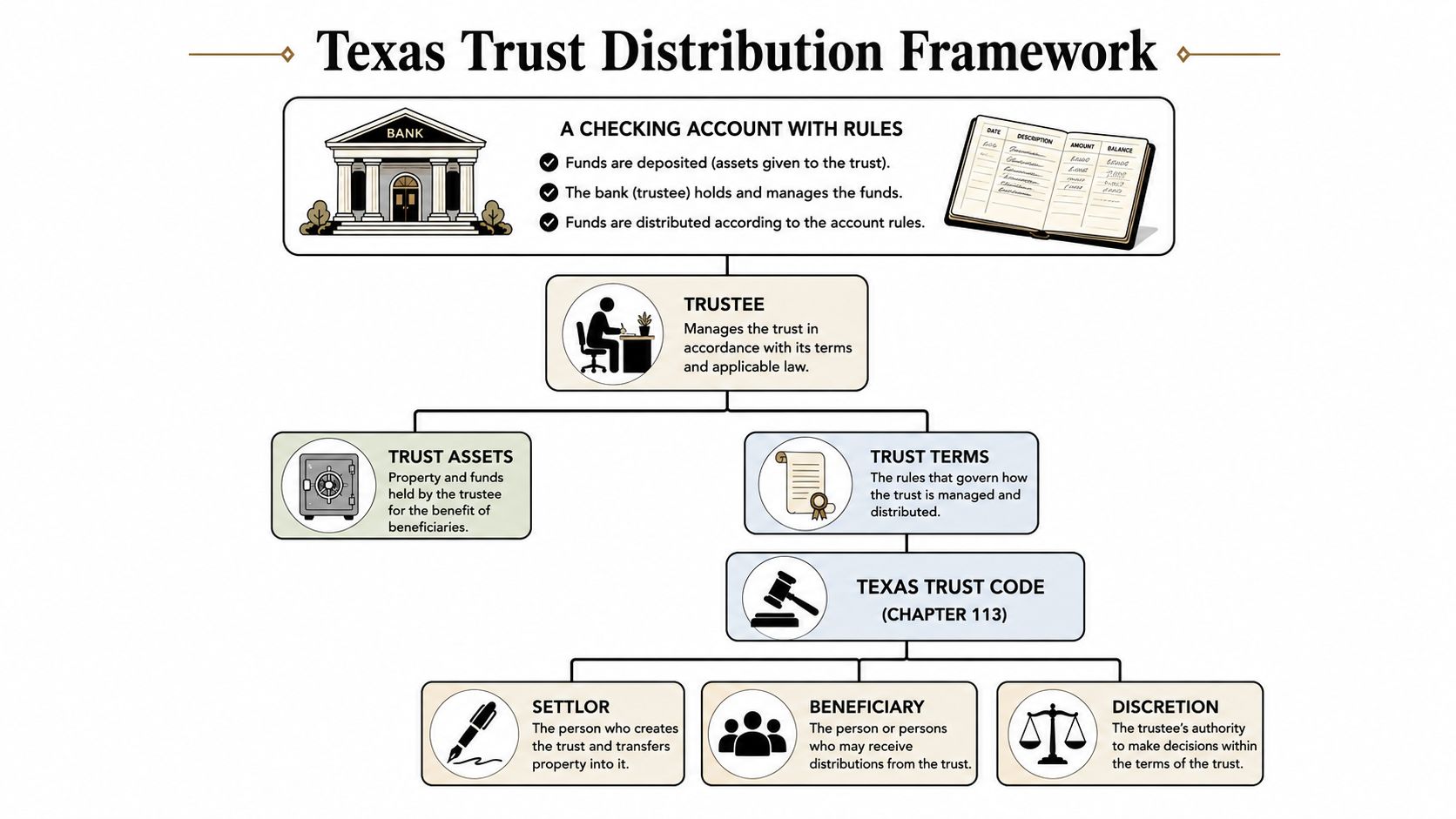
A useful analogy is a checking account with rules attached. The settlor creates the account and writes the rules. The trustee controls the account, but only for the purposes stated in the trust. The beneficiaries are the people entitled to receive benefits under those rules. The assets may include cash, securities, real estate, or business interests.
Texas trust law adds statutory rules to that arrangement. The Texas Trust Code is primarily found in the Texas Property Code, including Chapter 113, while other provisions address trust creation, administration, modification, and enforcement. The trust instrument generally controls over default statutory provisions when Texas law permits the trust to vary those rules. That's why a trustee must read the complete trust, including amendments, before assuming that a standard distribution practice applies.
Trust types and beneficiary interests
An inter vivos trust is created during the settlor's lifetime. A testamentary trust is created through a will and takes effect at death. A revocable trust can generally be changed or revoked by the settlor while the settlor has the required capacity and authority. An irrevocable trust generally places stronger limits on later changes, although modification or other relief may still be possible under the trust terms and Texas law.
Beneficiary rights can also change when a revocable trust becomes irrevocable, often after the settlor's death. At that point, the trustee must administer the trust for the beneficiaries under the governing instrument and applicable law.
Texas uses a demand-based accounting structure
Texas has historically relied heavily on demand-based administration rather than a fully automatic notice-and-reporting system. Under Texas Property Code Section 113.151, a beneficiary may make a written demand for an accounting. The trustee generally has 90 days to provide it and generally isn't required to provide more than one accounting in a 12-month period. A separate Texas rule requires at least 30 days' written notice before certain trust divisions or combinations, with notice to beneficiaries who might be entitled to distributions, as described in Texas Property Code Section 112.057.
For a plain-language overview of the difference between trust administration and probate, Texas Trust Administration: A Trustee's Guide can provide useful background.
Trustee Duties That Shape Every Distribution Decision
A trustee's authority comes with fiduciary duties in Texas. The trustee must administer the trust according to its terms, act in good faith, protect the beneficiaries' interests, and maintain records that support the administration. The duties become especially important when the trustee is also a beneficiary or when current and remainder beneficiaries want different outcomes.
Core duties in practical terms
The duty of loyalty requires the trustee to avoid using trust property for personal advantage. A compliant trustee documents a transaction with an independent vendor and confirms that the price serves the trust. A breaching trustee directs trust work to a personal business without proper safeguards or disclosure.
The duty of impartiality doesn't always require equal dollar payments. It requires the trustee to consider the interests of beneficiaries fairly under the trust's terms. For example, paying authorized income to a current beneficiary may be proper even when a remainder beneficiary receives no immediate payment. Favoring one sibling without a trust-based reason creates a different problem.
The duty to inform and account requires meaningful records, not just a balance snapshot. A trustee should preserve receipts, investment statements, distribution records, and explanations for discretionary decisions. A trustee who refuses to show how assets were used makes it harder for beneficiaries to determine whether the trust was administered properly.
Prudent investment and separation of assets also matter. Trust property shouldn't be mixed casually with a trustee's personal account, and investment decisions should reflect the trust's purposes and the interests of the beneficiaries.
For a focused discussion of the governing obligations, see the Texas Trust Code and trustee duties.
| Duty | Compliant Trustee | Breaching Trustee |
|---|---|---|
| Loyalty | Uses trust property only for authorized trust purposes | Directs trust funds toward personal interests |
| Impartiality | Applies distribution standards consistently | Favors one beneficiary without a trust-based reason |
| Information and accounting | Preserves transaction records and responds to proper demands | Withholds records or provides unexplained summaries |
| Prudent administration | Reviews liquidity, risk, and trust objectives | Makes careless decisions without documentation |
| Separate administration | Keeps trust assets and records distinct | Commingles funds with personal property |
A beneficiary who sees unequal treatment shouldn't immediately assume misconduct. The right question is whether the trust authorizes the difference and whether the trustee can show a reasoned, documented basis for it.
Discretionary Versus Mandatory and Income Versus Principal
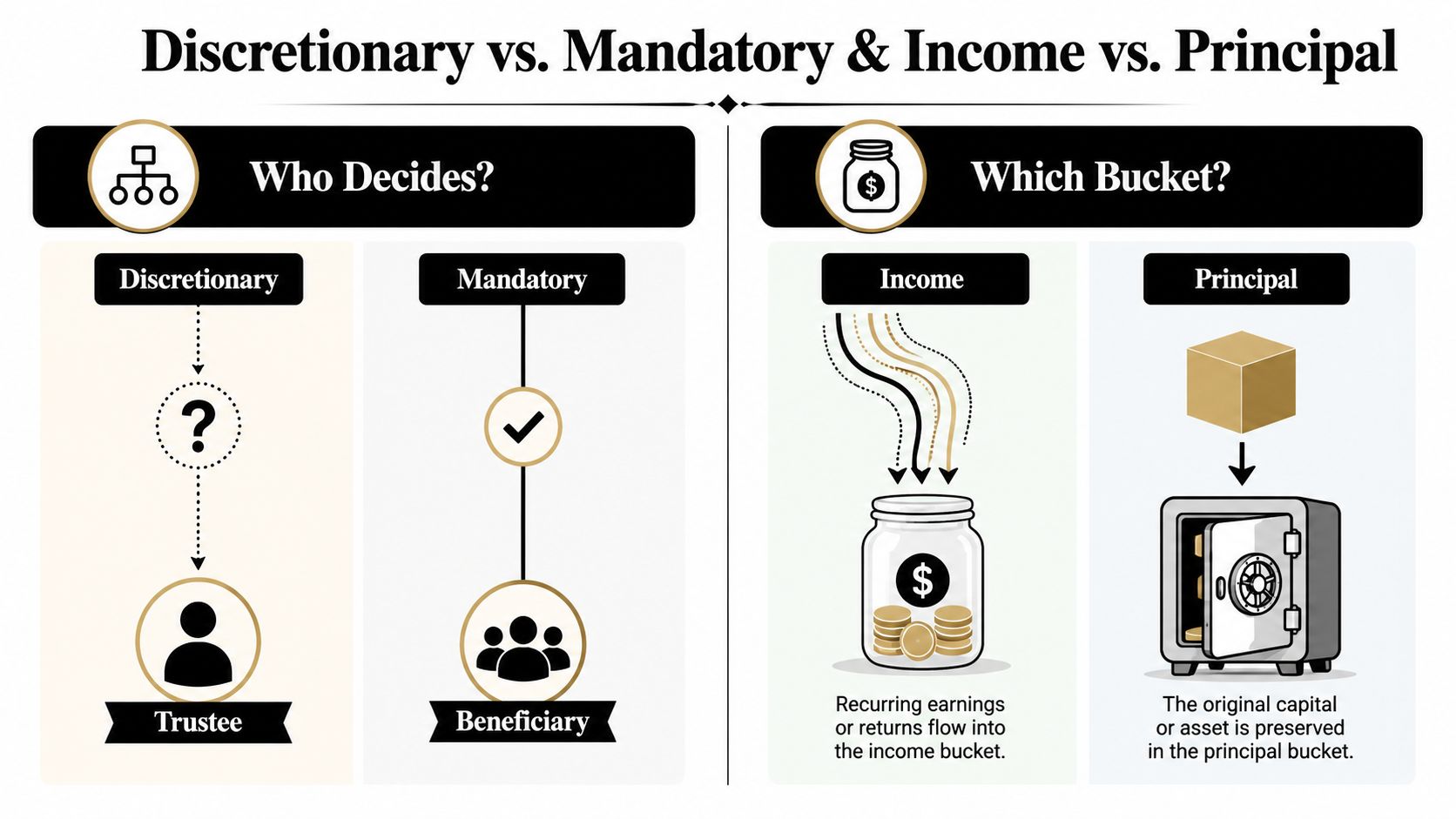
Two separate questions control many distributions. Who decides whether payment occurs? And which trust bucket funds the payment? Confusing these questions can make a lawful distribution look improper or cause a trustee to misapply trust property.
A mandatory provision directs the trustee to make a defined payment when its conditions are met. A trust might direct a payment of part of the principal when a beneficiary reaches a specified age. The trustee's job is to follow the instruction, confirm that the condition occurred, and document the transfer.
A discretionary provision gives the trustee permission to distribute, but doesn't require payment every time a beneficiary asks. The trustee may need to evaluate a stated standard involving health, support, maintenance, or education. Discretion isn't unlimited. The trustee must still act in good faith, follow the trust's purposes, and avoid favoritism.
The two-bucket problem
Trust accounting often separates income from principal. Interest, dividends, and rental income may generally be treated as income, while proceeds from selling stock or real estate commonly belong to principal. The governing instrument and applicable Texas rules control the final classification.
Consider a trust that owns a rental property and investment securities. Net rent may be available for a current income beneficiary, while proceeds from selling an investment property may remain in principal for a remainder beneficiary. The same family can therefore see different payments from the same trust without the trustee necessarily acting unfairly.
| Question | Mandatory distribution | Discretionary distribution |
|---|---|---|
| Decision maker | The trustee follows a defined directive | The trustee applies judgment under the trust standard |
| Main concern | Whether the triggering condition occurred | Whether the decision is authorized and reasoned |
| Record needed | Proof of the condition and payment calculation | Written explanation and supporting facts |
| Beneficiary expectation | Payment may be enforceable when the terms are met | A request doesn't automatically guarantee payment |
The income and principal distinction adds another layer. Using principal to satisfy an income obligation, or treating income as principal without support, can create an accounting imbalance and fuel conflict. A trustee handling these classifications should understand ascertainable standards in Texas trusts and obtain tax advice when the classification affects reporting.
How Distributions Actually Happen Step by Step
A sound distribution process begins before money moves. The trustee should first identify the beneficiary, confirm the beneficiary's legal status, and read the trust terms, amendments, and prior accountings. This prevents a common error, paying someone based on a family understanding that the written trust doesn't support.
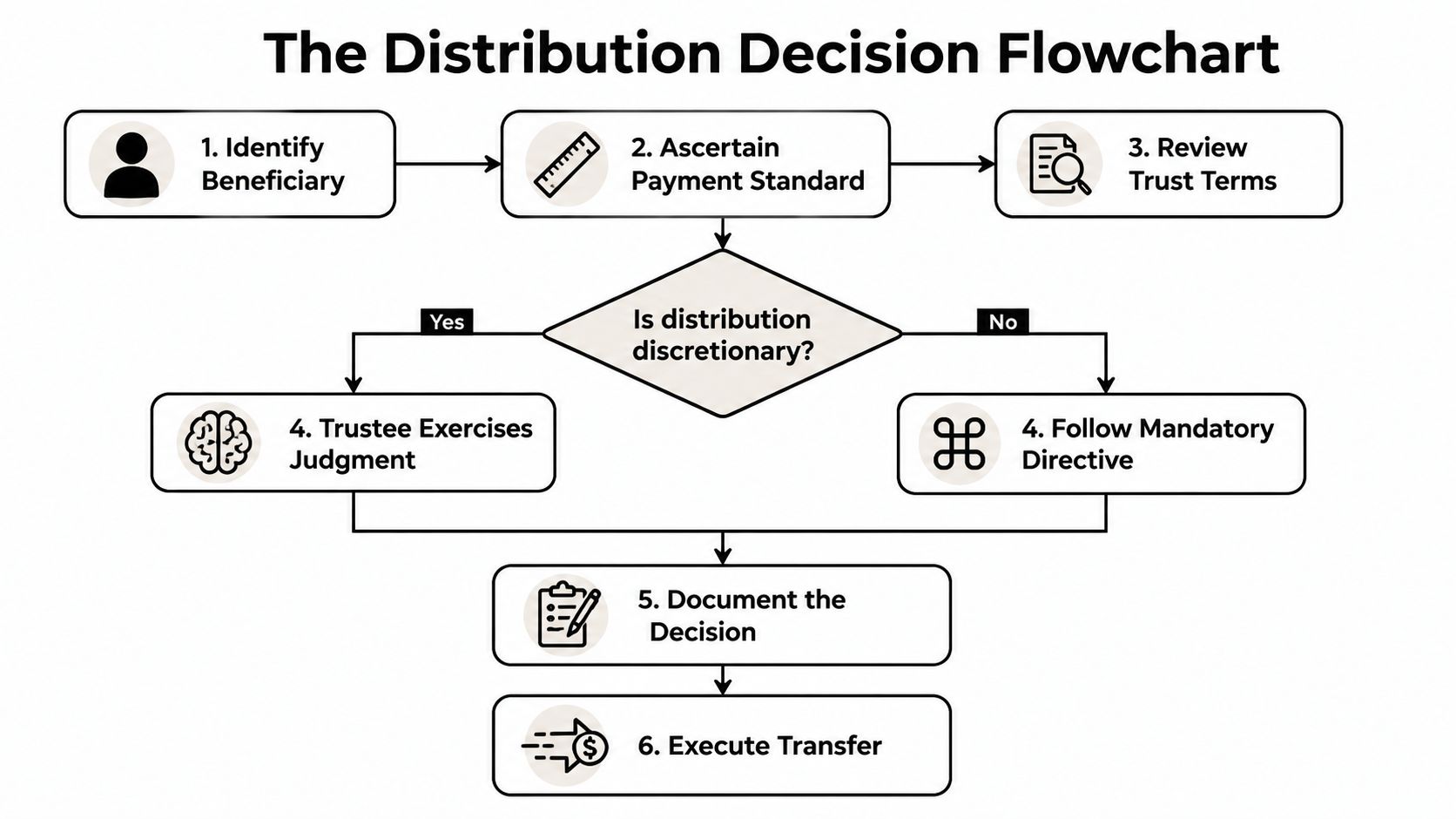
A careful payment sequence
Identify the beneficiary. Confirm whether the person is a current beneficiary, remainder beneficiary, minor, or incapacitated adult.
Determine the payment standard. Decide whether the trust requires payment or gives the trustee discretion.
Review the trust terms. Check amendments, definitions, distribution timing, and any conditions attached to the payment.
Classify the funding source. Determine whether the payment comes from income, principal, or a combination supported by the accounting rules.
Apply discretion consistently. For a discretionary request, document the relevant facts, the trust standard, and the reason for approval or denial.
Check liquidity and reserves. Confirm that the trust has available cash, appropriate investments, and reserves for known expenses and tax obligations.
Choose a traceable transfer method. Use a check or electronic transfer to the beneficiary or an authorized account. Keep proof of delivery and receipts.
Update the records. Record the amount, purpose, funding source, date, and any withholding or related expense.
Texas law gives trustees a specific framework when distributing principal to residuary or remainder beneficiaries. Under Texas Property Code Section 116.052, a beneficiary is entitled to net income tied to the beneficiary's fractional interest in undistributed principal assets, and repeated distributions require records showing each beneficiary's share of collected but undistributed net income.
A trustee may also need to honor written objections in certain distribution contexts and may carry the burden of showing that a distribution furthers the trust's purposes, follows the terms, and serves beneficiary interests.
The following video may help families visualize the administrative process:
Texas's accounting system is demand-based. Under Section 113.151, a beneficiary's written demand seeks a statement covering transactions since the later of the last accounting or trust creation. The trustee generally has 90 days to respond under Texas law, as summarized in this Texas fiduciary disclosure resource.
Distributions to Minors and Incapacitated Beneficiaries
Maria is trustee for her late sister's children. One child is a minor, and another adult beneficiary cannot manage financial affairs independently. Maria knows that sending a substantial check directly to either person could create problems, even if the trust authorizes a distribution.
Texas law gives a trustee several possible payment channels. Under Texas Property Code Section 113.021, the trustee may pay the beneficiary directly, pay a guardian, use a UTMA custodian, use the funds for health, support, maintenance, or education, reimburse a caregiver, or hold the amount in a separate fund subject to the beneficiary's continuing right to withdraw it.
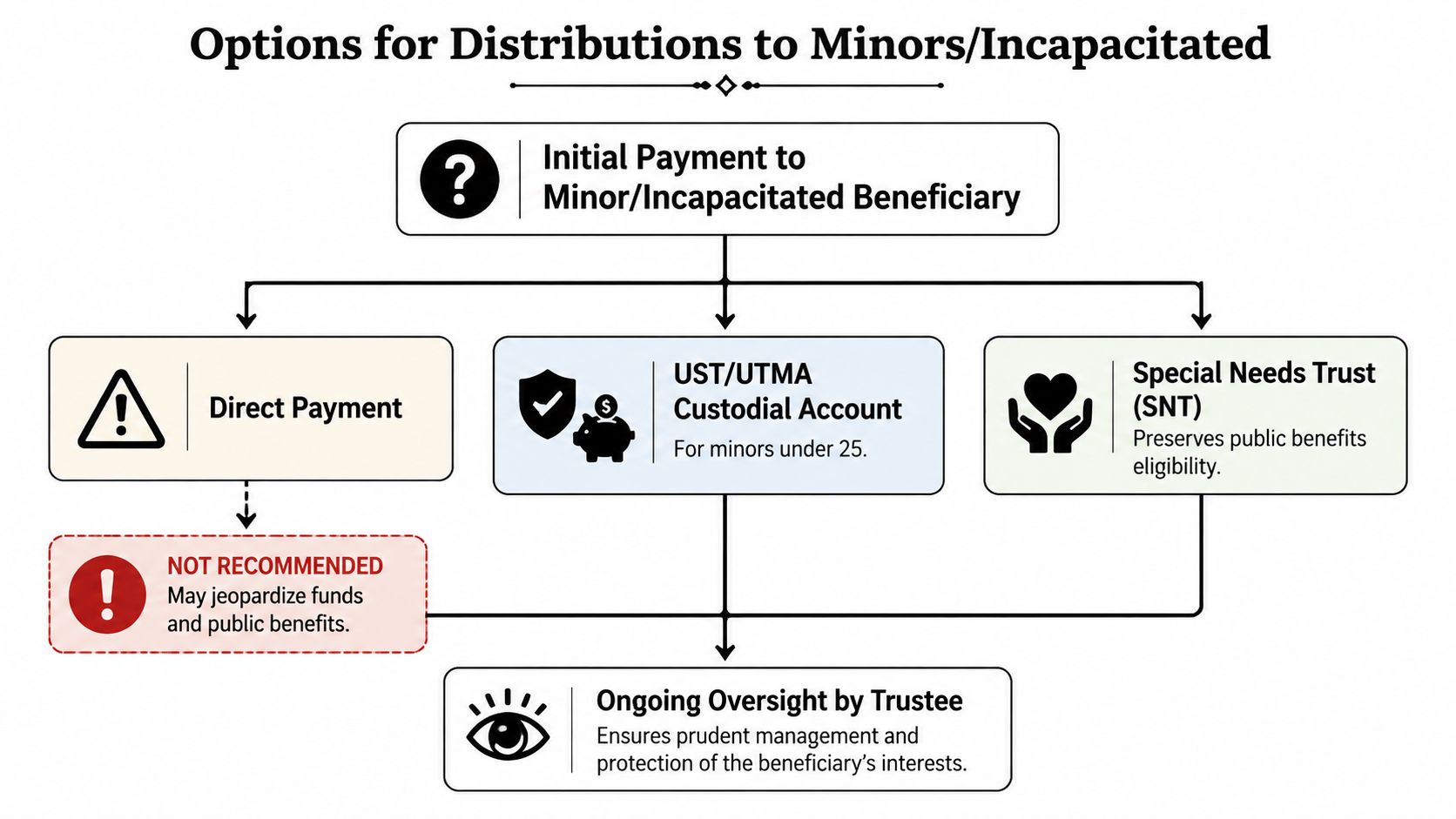
Choosing the appropriate route
For the minor child, Maria might pay approved education or medical providers directly, or use a properly established custodial arrangement if the trust and circumstances support it. For the incapacitated adult, she may need to confirm authority through a guardian, power of attorney, separate trust arrangement, or court-supervised process.
The correct method depends on the trust language, the beneficiary's capacity, the purpose of the payment, and whether public benefits must be preserved. A direct payment could affect benefit eligibility or create tax and accounting complications. The trustee should document why a particular route was selected and should avoid receiving a personal benefit from that choice.
For families: Capacity questions are legal questions, not merely banking details. Obtain current advice before transferring control of funds for a vulnerable beneficiary.
Common Disputes and How Beneficiaries Protect Themselves
Trust disputes often begin with a practical complaint. A distribution is delayed. One sibling receives income while another receives nothing. The trustee gives a vague explanation but no records. The accounting later shows expenses charged to the trust, yet the beneficiaries can't tell who received the benefit.
A demand-based system gives beneficiaries a concrete way to move from suspicion to evidence. Under Texas Property Code Section 113.151, a beneficiary may make a written demand for a detailed accounting. The accounting should address transactions, including distributions, rather than merely show the current balance.
Comparing unequal treatment
Suppose one adult child receives regular income from a trust-owned rental property while another receives no payment. That difference might be authorized if the first child is a current income beneficiary and the second is only a remainder beneficiary. It might also reveal a problem if the trustee has no trust-based explanation or has failed to account for the rental receipts.
The beneficiary should request the trust and relevant records in writing. The demand should identify the requested accounting period and ask for distributions, income, expenses, investments, trustee compensation, and material transactions. Under Texas law, the trustee generally has 90 days to provide the accounting, and generally isn't required to provide more than one accounting in a 12-month period.
Recognizing litigation triggers
Common warning signs include:
- Delayed payments: The trustee repeatedly postpones a distribution without explaining the trust-based reason.
- Uneven treatment: Beneficiaries in similar positions receive materially different treatment without documented justification.
- Missing records: The trustee provides a balance but not the transactions supporting it.
- Self-dealing: Trust assets or services benefit the trustee personally or benefit a related party.
- Classification errors: Income and principal appear to be assigned in a way that changes beneficiary outcomes.
- Unclear tax handling: The trustee makes payments or deductions without coordinating the accounting and tax consequences.
Texas law permits court remedies for breaches of trust, which can include trustee removal, monetary relief charged to the trustee, and recovery connected to improper profits. A beneficiary should preserve emails, letters, statements, and payment records before filing suit. A resource on remedies when a Texas trustee won't distribute trust property may help explain the issues to raise with counsel.
Trustee Checklist and When to Call a Texas Attorney
Trustees can reduce risk by using the same review process for every payment. The checklist should be specific enough that another professional could later understand what happened and why.
Trustee administration checklist
- Read the controlling documents: Review the trust, amendments, beneficiary designations, and related estate documents.
- Identify every beneficiary: Separate current, remainder, minor, and incapacitated beneficiaries.
- Confirm notices: Review notice obligations under the Texas Property Code, including rules applying to certain trust divisions or combinations.
- Classify assets and payments: Apply the trust terms and Texas Trust Code provisions to income, principal, receipts, and expenses.
- Record discretion: Write the facts considered, the standard applied, and the reason for approving or denying a discretionary request.
- Keep separate records: Maintain trust accounts, transaction files, investment statements, and communications apart from personal records.
- Prepare accountings: Respond to valid written demands and provide required reports under current law.
- Plan the final distribution: Confirm expenses, tax matters, reserves, title transfers, and releases before closing administration.
- Preserve the file: Keep supporting records for the period advised by qualified Texas counsel and tax professionals.
Beneficiaries should also know the practical rights they may have. They can request the trust document, ask for information about administration, make a written accounting demand, examine how trustee compensation and investments affect the trust, and petition a Texas court for relief when a trustee breaches duties. The precise scope of a right can depend on the trust language and the beneficiary's status.
Texas law also permits certain trustees to exercise distribution powers without settlor or beneficiary consent or court approval, but Texas Property Code Section 112.074 requires written notice to current beneficiaries and presumptive remainder beneficiaries in the situations covered by that provision. That notice requirement matters when a trustee considers moving assets into a second trust.
Warning signs that call for legal advice
Contact counsel promptly if the trustee refuses to provide an accounting, stops responding, commingles assets, appears to self-deal, or relies on disputed distribution language. A disagreement is easier to evaluate when the trust, amendments, statements, and communications are organized before positions harden.
A Texas estate planning attorney can help families create clearer distribution terms before conflict begins. For ongoing administration, a Texas trust administration lawyer can help trustees meet their fiduciary duties in Texas, while beneficiaries may need advice about accounting demands, court petitions, or dispute resolution. Families also sometimes need related guidance involving estate planning, probate, guardianship, or asset protection.
The Law Office of Bryan Fagan, PLLC helps trustees and beneficiaries with trust administration, fiduciary accounting, distribution disputes, tax planning, and related estate and guardianship matters. Visit Law Office of Bryan Fagan, PLLC to schedule a free consultation and discuss the trust documents, records, and distribution concerns affecting your family.