An ascertainable standard trust limits distributions to a beneficiary's health, education, maintenance, or support, often called HEMS. That gives a trustee a measurable legal threshold to follow, and it can help keep trust assets outside estate-tax inclusion when the document is drafted and administered correctly.
Managing a loved one's trust can feel overwhelming, especially when a family member is waiting on money for care, school, or living expenses. The right trust language removes guesswork, but only if everyone understands what the words mean under Texas trust administration and federal tax rules.
Managing a Loved One's Trust Without the Guesswork
A Texas family may sit at the kitchen table after a parent's death, with one sibling serving as trustee and another asking for help with medical bills. The trustee wants to do the right thing, but every check written from the trust has to fit the trust's limits. That's where an ascertainable standard trust becomes practical, because it replaces vague judgment with a legal test tied to specific needs.
Why the standard matters in real life
When a trust says distributions may be made for health, education, maintenance, or support, the trustee is not guessing about whether a request fits. A request for surgery, tuition, rent, or other ordinary living costs can be evaluated against the trust terms instead of family pressure or emotion. That structure matters in Texas trust administration because trustees owe fiduciary duties to follow the document, keep records, and treat beneficiaries consistently.
The phrase also gives beneficiaries something concrete to understand. Instead of wondering whether a trustee can approve a request “if it feels right,” the family can ask whether the request falls within the measurable categories set out in the trust. For many families, that clarity lowers conflict before it starts.
Practical rule: If the trustee cannot explain how a distribution fits the trust language, the trustee should slow down and review the document before paying it.
The legal background is not just local drafting custom. Federal tax law recognizes the HEMS framework as a real standard, and that is why estate planners use it so often in Texas and across the country. The concept sits at the intersection of trust administration, tax planning, and family fairness, which is why a Texas estate planning attorney will often focus on it early when reviewing an old trust or drafting a new one.
Families also get confused because the standard sounds flexible, and it is. But flexible does not mean open-ended. A trustee still has to be able to justify each decision under the trust terms, the Texas Trust Code, and basic fiduciary principles.
Understanding the HEMS Formula in Texas Trusts
A Texas trustee often gets a request that looks simple on its face. A bill for braces, a tuition invoice, rent after a job loss, or help with groceries can all raise the same question, does this fit the trust's measurable standard? The HEMS formula gives the trustee a way to answer that question by looking at the request, the beneficiary's needs, and the exact wording of the trust. The words matter because they are objective enough to guide administration and defend the decision if someone later challenges it.
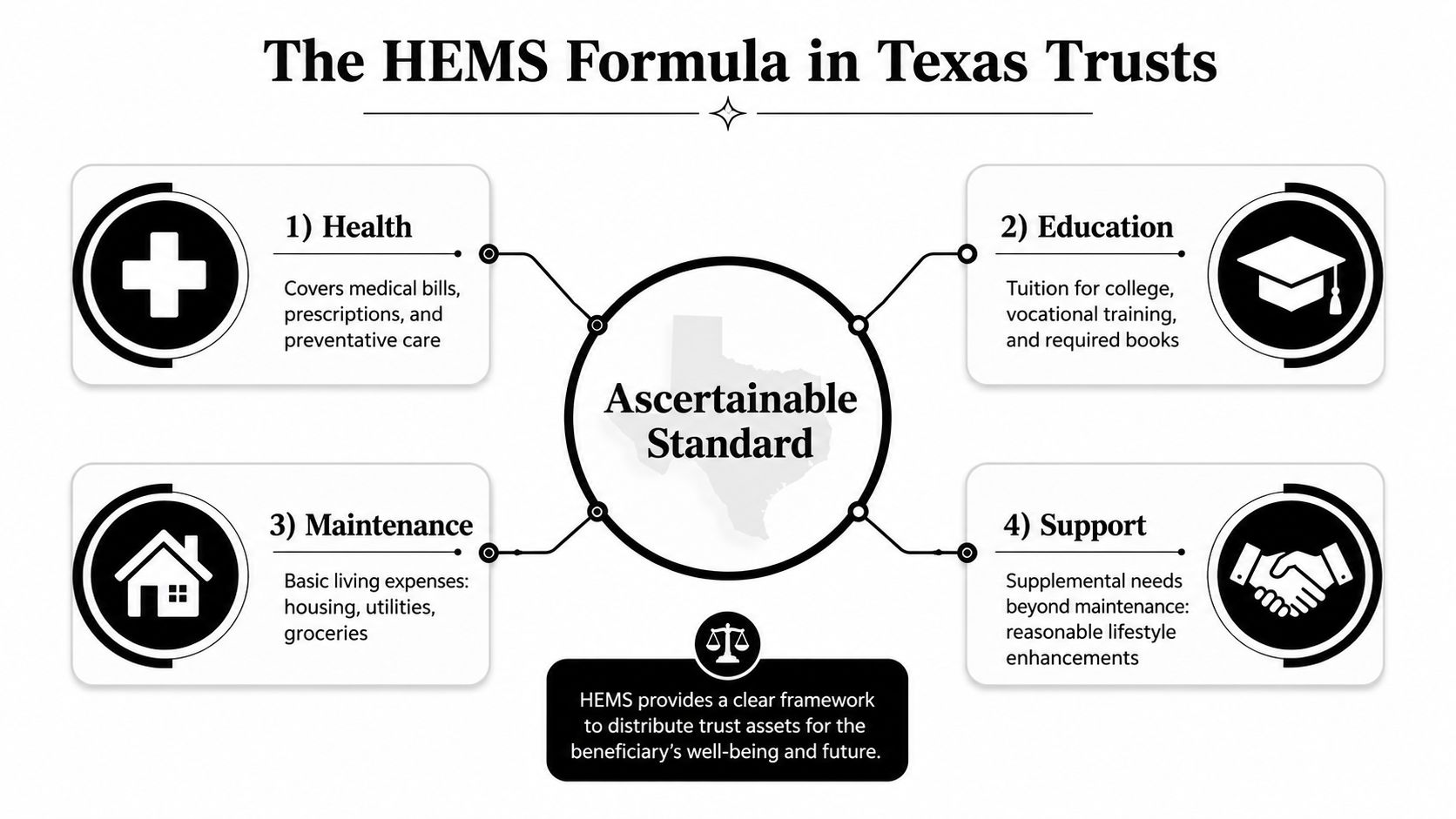
Health, education, maintenance, and support
Health usually covers medical care, prescriptions, therapies, and related expenses. If a beneficiary needs treatment after an accident in Houston or ongoing care for a chronic condition, a trustee may review that request under the health prong.
Education reaches school-related costs. In real families, that often means tuition, books, and other necessary expenses connected to learning. A beneficiary finishing college in Austin or training for a trade in Dallas may ask for help that fits comfortably within this part of the standard.
Maintenance focuses on ordinary living needs. Rent, mortgage payments, utilities, groceries, and basic household expenses are the kinds of requests trustees usually compare against maintenance. The point is not luxury, it is reasonable living.
Support overlaps with maintenance, but it often captures broader needs tied to reasonable well-being. In a Texas family, that can include help with stable housing or other living costs that keep the beneficiary on solid footing.
The Uniform Trust Code defines the standard as one relating to an individual's health, education, support, or maintenance, and Treasury regulations treat related phrases such as “support,” “support in reasonable comfort,” and “maintenance in health and reasonable comfort” as qualifying standards, as explained in the WealthCounsel overview of ascertainable standards. That matters because it shows why Texas lawyers treat HEMS as a real legal threshold, not a decorative phrase.
A trustee comparing requests can use the trust language like a checklist. A utility bill is easier to evaluate than a vague ask for “help,” and that difference protects everyone. If a trustee needs more guidance on whether a requested payment fits the standard, Texas rules on when a trustee may withhold a distribution explain why the trustee should slow down and review the document before paying it. For administration issues that intersect with investment decisions, A Trustee's Investment Duties Under Texas Law explains how the prudent investor standard applies to trust assets.
Common mistake: Families sometimes assume “support” means anything a beneficiary wants. In practice, the trustee still has to connect the expense to the trust's objective standard.
If a trustee is unsure whether a request belongs inside HEMS, the safer move is to document the facts and seek legal guidance before distributing funds. Texas trust administration works best when decisions are tied to the document, not to pressure in the moment.
Ascertainable Standard Trusts Versus Discretionary Trusts
An ascertainable standard trust and a fully discretionary trust are not the same thing, even though families sometimes use the terms loosely. The difference affects how much power the trustee has, how much certainty the beneficiary has, and how carefully the document must be drafted to avoid tax issues. That distinction matters in Texas because families often want protection and flexibility at the same time.
Side by side comparison
| Feature | Ascertainable Standard Trust | Discretionary Trust |
|---|---|---|
| Trustee authority | Limited to measurable purposes like HEMS | Broader discretion based on trustee judgment |
| Beneficiary rights | Beneficiary can point to a defined standard | Beneficiary usually has less ability to demand a distribution |
| Tax focus | Designed to fit federal ascertainable-standard rules | Can raise more estate-tax and inclusion questions depending on drafting |
| Administration style | More document-driven and reviewable | More flexible, but often harder to predict |
| Family use | Common when a trustee-beneficiary structure needs guardrails | Common when the grantor wants wider discretion |
The practical tradeoff is simple. Ascertainable standards create a clearer safe harbor because the trustee has a measurable rule to follow. Discretionary trusts can offer more flexibility, but that flexibility can cut both ways if the document doesn't carefully limit who can do what.
The National Association of Estate Planners & Councils has noted that an ascertainable standard does not cure every estate-inclusion problem, which is why Texas families should not assume HEMS solves everything by itself, as reflected in the discussion from the NAEPC newsletter on HEMS and estate inclusion. That point comes up often when a beneficiary also serves as trustee.
For families comparing options, the question is less “which trust is better?” and more “which trust matches the risk we're willing to accept?” If the goal is tighter guardrails and a clearer tax framework, HEMS is usually the better fit. If the goal is broader trustee discretion, the trust can be drafted that way, but the consequences should be discussed carefully with a Texas estate planning attorney.
Decision point: If a beneficiary may ever act as trustee, the trust should say exactly when distributions to that person are allowed and who reviews them.
Administration also matters. A trust can look clear on paper and still create disputes if the trustee applies the terms inconsistently. A guide like Texas Trust Administration: A Trustee's Guide is useful because it distinguishes trust administration from probate, which helps families understand the workflow once the trust becomes active.
The Hidden Estate Tax Trap for Beneficiary-Trustees
A family can draft HEMS language carefully and still leave a hidden tax issue in place. That is the trap many Texas families miss. If a beneficiary also serves as trustee and can approve distributions for themselves in a way that reaches beyond the limiting standard, federal tax law may treat that control very differently than the family intended.
Why the drafting detail matters
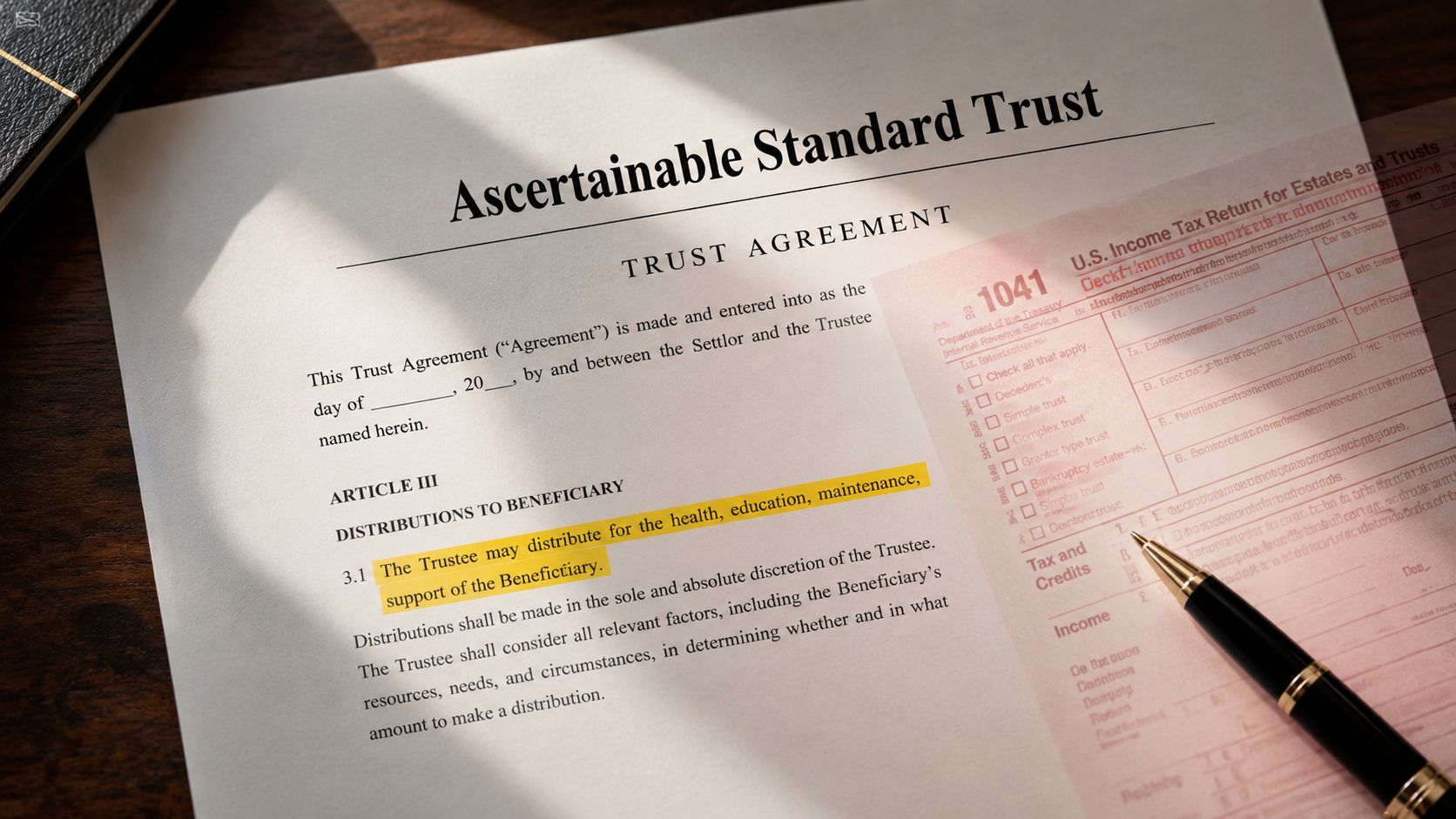
Federal tax law treats an unrestricted power to distribute trust assets to oneself as a general power of appointment. That kind of control can bring trust property into the holder's taxable estate. A power limited by an ascertainable standard tied to health, education, support, or maintenance is treated differently under Internal Revenue Code sections 2041(b)(1)(A) and 2514(c)(1). The Massachusetts Bar Association materials explain that a power limited by an ascertainable standard “shall not be deemed a general power of appointment,” and that, if the standard is respected, the trust property is not included in the power holder's gross estate under IRC section 2041. Precise drafting matters because the tax result turns on the actual limits in the document, not on the family's informal understanding.
The risk grows when one person fills two roles, trustee and beneficiary. Texas families sometimes assume that HEMS language alone solves the issue, but that assumption can go too far if the beneficiary-trustee still has practical control beyond the standard. The Trustee Alliance paper on HEMS and fiduciary duties explains why the standard works as a tax safe harbor only when it is drafted and followed with care.
Administration matters too. If the trustee makes distributions casually, or if the records do not show how a request fit the standard, the trust can start to look less like a limited fiduciary arrangement and more like personal control. A Texas trust administration lawyer can help the family document distributions, separate personal needs from trust purposes, and keep administration aligned with the document.
What Texas families should watch for
- Self-benefiting powers: If the trustee can pay themselves for reasons outside HEMS, that can create inclusion risk.
- Loose language: Words like “best interests” or “comfort” without definition can blur the line.
- Weak records: Good intentions do not substitute for clear documentation.
Trustees should also keep investment duties in view. Distribution decisions do not erase the duty to manage the trust property carefully. The article on fiduciary duties of trustees is a useful reminder that prudence applies to the assets themselves, not just to the payout decisions.
A beneficiary-trustee does not need absolute control to create tax problems. Limited control used the wrong way can be enough.
Trustee Duties and Beneficiary Rights Under Texas Law
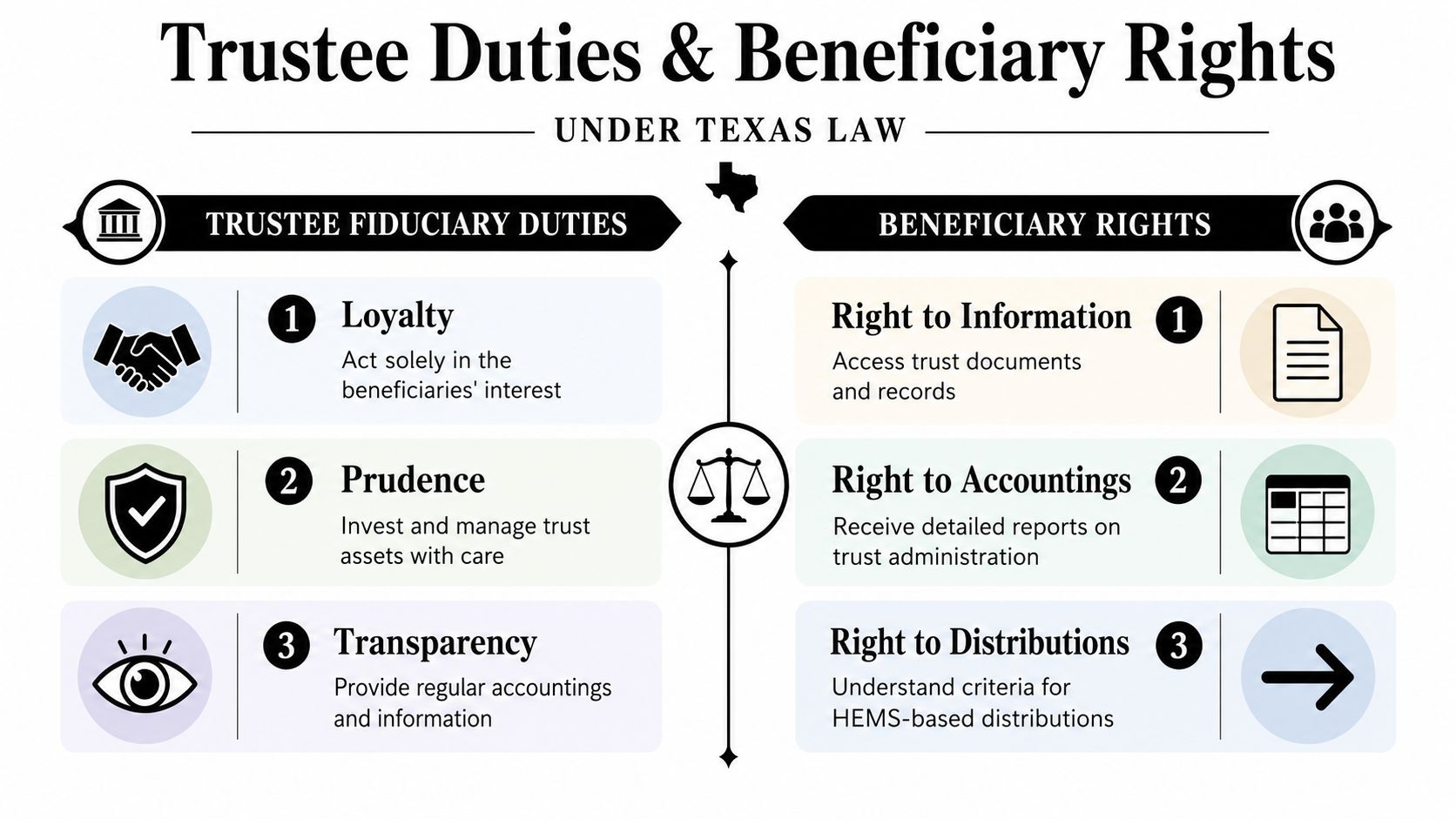
Texas trustees owe fiduciary duties that go beyond “trying to be fair.” They must act with loyalty, prudence, and transparency, and those duties shape how HEMS distributions get made in real life. Beneficiaries, in turn, are entitled to understand what the trust allows and how the trustee is applying it.
What the trustee must do
A trustee should keep the trust terms in front of every distribution decision. Loyalty means the trustee acts for the beneficiaries, not for personal convenience or family politics. Prudence means the trustee manages trust assets with care, which includes thoughtful recordkeeping and sound investment decisions, as discussed in fiduciary duties of trustees.
Transparency matters just as much. When a beneficiary asks for information or questions a denial, the trustee should be able to explain the decision in terms of the trust language, not just a general sense that “it seemed appropriate.” That kind of documentation reduces friction and helps a trustee defend the decision if a dispute turns into a legal issue.
What the beneficiary can expect
Beneficiaries typically want three things, information, fair treatment, and distributions that follow the trust. If the trust uses HEMS, a beneficiary can ask the trustee to evaluate a request under that standard and to explain the basis for approval or denial. The beneficiary is not entitled to every dollar requested, but they are entitled to a trustee who applies the standard consistently.
Disputes usually start when the trustee says no without explanation or when one beneficiary sees another beneficiary receiving different treatment. That is where Texas estate planning and trust administration intersect with conflict prevention. Clear records, written requests, and careful responses can keep a family argument from becoming a courtroom problem.
Helpful habit: Put distribution requests in writing, tie them to a HEMS category, and save the trustee's response with the trust records.
If the document is unclear, or if the trustee and beneficiary disagree about what “support” includes, a Texas trust administration lawyer can help interpret the language before the conflict escalates. In some cases, the answer is simple. In others, the family may need court guidance or a formal clarification of the trust terms.
Drafting Tips and Sample Clauses for Texas Families
Good drafting prevents most of the confusion that later turns into a dispute. A Texas trust should say what HEMS means, who decides, and how much discretion the trustee really has. If the trust leaves those issues fuzzy, families may spend months arguing about a phrase that should have been clear from the start.
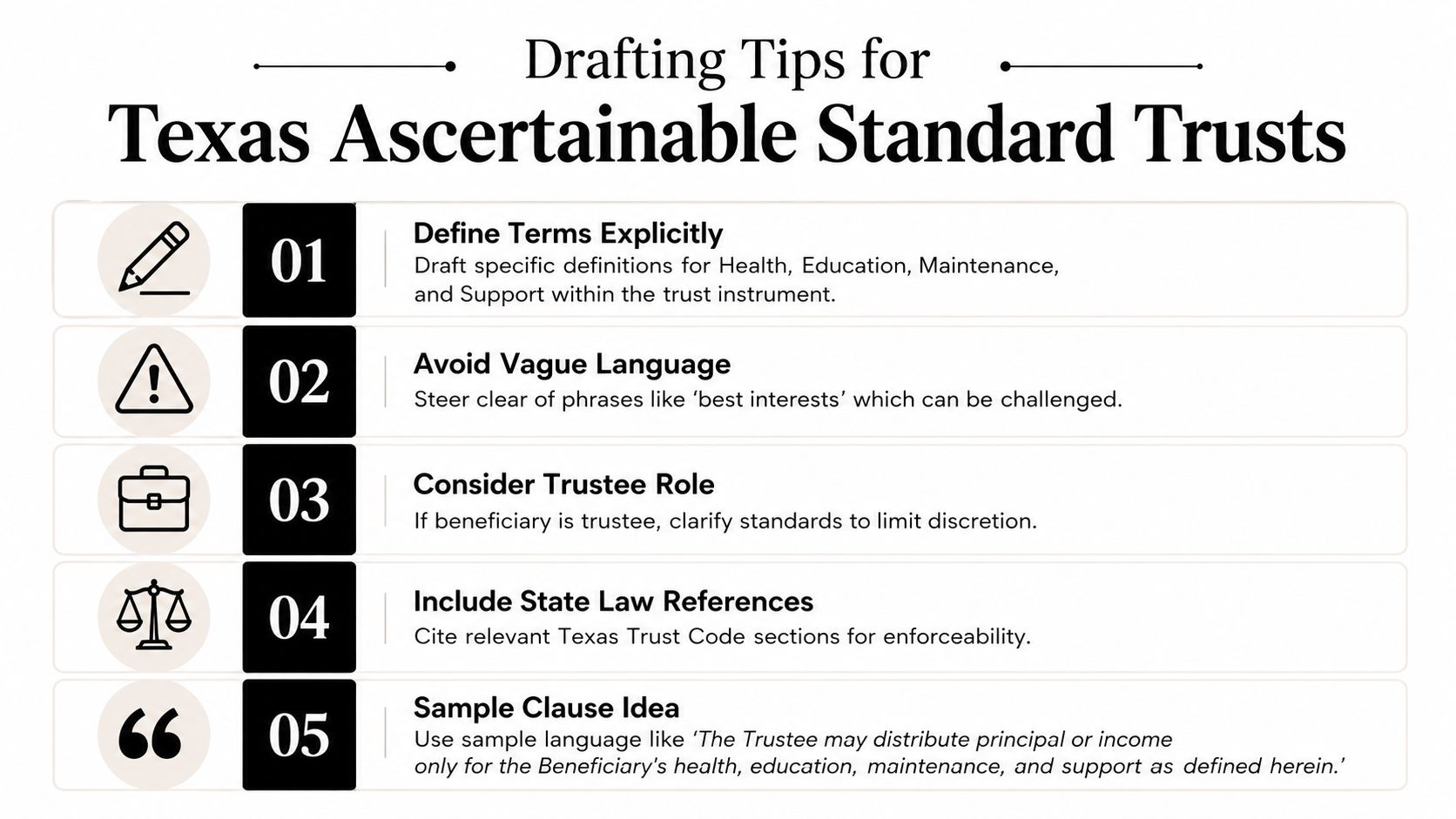
Draft with the trustee in mind
A strong clause does more than repeat the acronym. It tells the trustee how to apply the standard in daily administration, especially if the trustee is also a beneficiary. It should also avoid vague phrases that invite later disagreement, such as “whatever the trustee thinks is best,” unless the family intentionally wants broader discretion.
A practical sample clause might read this way, “The Trustee may distribute principal or income only for the Beneficiary's health, education, maintenance, and support as defined herein.” That wording keeps the trustee inside a measurable lane and gives the family something real to evaluate later. If the family wants more detail, the trust can define each category in separate paragraphs, which is often helpful in Texas estate planning.
Common drafting fixes
- Define the categories clearly: Spell out what counts as health, education, maintenance, and support.
- Avoid conflicting clauses: Don't pair HEMS with language that secretly grants unlimited discretion.
- Address the trustee-beneficiary issue directly: Say what happens if the trustee is also a beneficiary.
- Coordinate with tax planning: Make sure the trust terms match the family's estate-tax goals.
- Use Texas law consistently: Keep the trust aligned with Texas Trust Code principles and the rest of the estate plan.
The broader plan matters, too. A trust does not stand alone. It has to work with wills, powers of attorney, asset protection goals, and the rest of the family's estate documents. For families setting up a new trust, how to set up a living trust in Texas can be a useful companion topic when the goal is to coordinate the whole plan.
Good drafting doesn't just reduce disputes. It makes administration simpler for the trustee and more predictable for the family.
In a number of Texas families, the best next step is a review of the existing trust before any distribution problem gets worse. A Texas estate planning attorney can compare the current language to the family's goals and explain whether the trust should be left alone, clarified, or updated.
Frequently Asked Questions About Ascertainable Standards
A lot of families ask whether HEMS applies to every trust. It doesn't. The standard only matters when the trust instrument uses it, or when the drafting language points clearly to a measurable distribution limit. If the trust says the trustee has broad discretion, HEMS may not control the way a family expects.
Another common question is what happens when a trustee denies a request. The trustee should respond in writing, identify the trust category involved, and keep the records with the trust file. That simple step can prevent a small disagreement from becoming a larger trust dispute.
Families also ask whether they can change a trust if the language is too vague or too rigid. Sometimes the answer is yes, but it depends on the document, the beneficiaries, and Texas law. If someone is asking how to modify a trust in Texas, the first move is usually a careful legal review, not a guess.
If you're handling a trust distribution dispute, or you're worried a beneficiary-trustee may have too much control, speak with counsel before making the next move. A Texas trust administration lawyer can look at the language, the administration history, and the tax concerns together so the family can make a calmer decision.
If you're managing a trust or planning your estate, contact The Law Office of Bryan Fagan, PLLC for a free consultation. Our attorneys provide trusted, Texas-based guidance for every step of the process, from trust administration and fiduciary disputes to estate planning, probate, guardianship, and asset protection. Visit Law Office of Bryan Fagan, PLLC to get clear advice for your family's situation.