Managing a loved one's trust can feel overwhelming, especially when the family home, ranch, investments, or business interests may have a different tax basis after death. A Texas family may gather around the kitchen table with a trust document in one hand and a proposed sale agreement in the other, worried that a rushed decision could create an unnecessary tax bill.
The central question is whether the asset qualifies for a step-up in basis. Under Internal Revenue Code §1014, inherited property generally receives a new basis equal to its fair market value on the decedent's date of death. For trust assets, however, the answer depends on the trust structure, the drafting, the grantor's retained rights, and whether the property is included in the decedent's gross estate. Texas community-property characterization can add another important layer for married couples.
Managing Trust Assets After a Loved One Passes
Suppose a parent in San Antonio placed the family home and investment accounts into a revocable living trust. After the parent dies, the children learn that the home has appreciated substantially. One child wants to sell it, another wants to keep it, and the successor trustee is trying to determine the correct tax basis before anyone signs documents.
That uncertainty is understandable. The family may assume that assets held in a trust automatically receive a tax reset, while another advisor may warn that trust assets never receive one. Neither statement is reliable without reviewing the trust and the estate-inclusion rules.
What the reset means
Basis is generally the figure used to measure taxable gain when property is sold. If a parent bought an asset for a low price and it was worth much more at death, the difference represents built-in appreciation. A qualifying basis adjustment replaces the historical basis with the asset's fair market value at death, potentially removing the appreciation that occurred during the parent's lifetime. The IRS explanation of inherited property basis under Publication 551 identifies date-of-death fair market value as the general starting point for property acquired from a decedent.
For example, an asset purchased for $100,000 and worth $600,000 at death may receive a basis reset to $600,000, eliminating the embedded $500,000 gain for a later sale at that value. The trustee still needs support for the date-of-death value, because future reporting depends on reliable records.
Practical rule: The trust title matters, but estate inclusion matters more.
A revocable trust is commonly treated as still owned by the grantor for tax purposes. That often means the assets remain included in the gross estate and qualify for the adjustment. An irrevocable trust may produce a different result, even if the grantor paid income tax on the trust's earnings.
The Texas Trust Code governs trustee administration, while the Texas Estates Code supplies rules affecting estates, probate, and related fiduciary procedures. Together with federal tax law, these rules require trustees to identify assets, preserve records, communicate with beneficiaries, and avoid distributions that could complicate valuation or tax reporting.
How the Step Up in Basis Works Under Federal Tax Law
The easiest way to understand the federal rule is to follow the asset from purchase to death to sale.
A parent buys a ranch outside San Antonio in 1985 for $120,000. At death, the ranch is worth $1.8 million. Without a basis adjustment, a sale for $1.8 million would create $1.68 million of appreciation. At an assumed 20% federal rate, the estimated federal tax on that gain would be $336,000. With a qualifying adjustment, the basis becomes $1.8 million, so a sale at that same value produces no capital gain from the period before death.
The figures in this illustration are mathematical examples, not a prediction of a family's final tax liability. Actual results can depend on sale expenses, later appreciation, the asset's classification, and the taxpayer's circumstances.
The estate-inclusion test
IRC §1014 supplies the basic date-of-death basis rule, but the trust must be examined under the federal estate-inclusion framework. Property included in the decedent's gross estate can generally receive the adjustment even when the estate owes no federal estate tax. Estate inclusion and estate-tax liability are different questions.
A revocable living trust commonly remains estate-includible because the grantor retained the power to amend, revoke, or control the property. The federal rule therefore can apply to assets passing through that trust. A trustee should not confuse avoiding probate with avoiding estate inclusion. A trust can simplify administration while its assets remain treated as the grantor's property for federal estate purposes.
Step-up, step-down, and excluded accounts
The adjustment can also work in the opposite direction. If an asset is worth less at death than its historical basis, the new basis may be lower. That result is often called a step-down in basis.
Some assets follow different tax rules. IRAs and annuities are commonly treated as income in respect of a decedent, so they generally don't receive the same basis adjustment as inherited real estate or securities. Trustees should identify those assets separately instead of applying one rule to every account.
| Scenario | Original Basis | Date-of-Death Value | Capital Gain on Sale | Estimated Federal Tax (20%) |
|---|---|---|---|---|
| Ranch sold without a qualifying adjustment | $120,000 | $1.8 million | $1.68 million | $336,000 |
| Ranch sold after a qualifying adjustment at date-of-death value | $120,000 | $1.8 million | $0 | $0 |
Families handling these issues should coordinate legal administration with tax advice. A Texas trust taxation resource can help trustees identify questions for the estate attorney and CPA before distributing or selling appreciated property.
Revocable Versus Irrevocable Trusts and Basis Adjustments
The difference between revocable and irrevocable trusts is central to the phrase step up in basis trust assets Texas. The trust's label provides a starting point, but the controlling issue remains whether the property is included in the grantor's gross estate at death.
Revocable trusts usually preserve the adjustment
A revocable living trust generally leaves the grantor with control during life. The grantor can usually change beneficiaries, amend the terms, or withdraw property. Because the grantor remains treated as the owner for federal estate purposes, the trust assets are commonly included in the gross estate at death.
That structure often produces the familiar result. The home, brokerage account, or investment property receives a new basis tied to its fair market value on the date of death. The trustee still must document the value and administer the trust under its terms. At death, a revocable trust generally becomes irrevocable, and the successor trustee takes on fiduciary responsibilities that may include collecting property, notifying beneficiaries, paying proper expenses, and making distributions.
The process described in Administering a Revocable Living Trust After Death in Texas focuses on how a revocable trust becomes irrevocable and is administered after the settlor dies.
Irrevocable trusts require closer analysis
An irrevocable trust may remove assets from the grantor's estate. If those assets aren't included in the gross estate, they generally retain their prior basis. Beneficiaries can therefore inherit property with substantial unrealized appreciation.
The most important clarification came from IRS Revenue Ruling 2023-2, issued in 2023. The ruling addressed irrevocable grantor trusts and confirmed that grantor-trust status for income-tax purposes, by itself, doesn't create a basis adjustment when the assets aren't included in the grantor's gross estate. The IRS distinction applies nationally, including to Texas trusts. The professional summary of Revenue Ruling 2023-2 describes estate inclusion as the controlling factor.
An irrevocable grantor trust can serve planning goals such as asset protection or long-term-care planning while producing no basis reset for excluded assets. The planning choice may still be appropriate, but the family should understand the tradeoff before transferring highly appreciated property.
Trustees should review:
- The trust instrument: Identify retained powers, beneficiary rights, and provisions affecting estate inclusion.
- The funding history: Confirm what property entered the trust, when it was transferred, and whether any assets were later substituted.
- The tax classification: Grantor status helps explain income-tax reporting, but it isn't a substitute for estate-inclusion analysis.
- The distribution plan: Consider whether selling, distributing, or retaining appreciated property best serves the trust and its beneficiaries.
For a plain-language discussion of income-tax classification, see this guide to grantor and nongrantor trusts in Texas. A Texas trust administration lawyer can then connect that classification to the trust terms, federal estate rules, and fiduciary duties in Texas.
The Texas Community Property Advantage for Married Couples
Texas's community-property system can change the basis result for married couples. Texas Family Code §3.002 generally defines community property as property acquired by either spouse during marriage, subject to separate-property rules. The key question is not just whose name appears on a deed or account. Families must examine the property's origin, agreements, tracing records, and the trust's language.
When qualifying community property is included in the estate of the first spouse to die, federal rules can provide a double basis adjustment. Both the deceased spouse's half and the surviving spouse's half may be adjusted to fair market value at the first death. This differs from the ordinary treatment of separate property, where the deceased spouse's interest is the part principally examined for the adjustment.
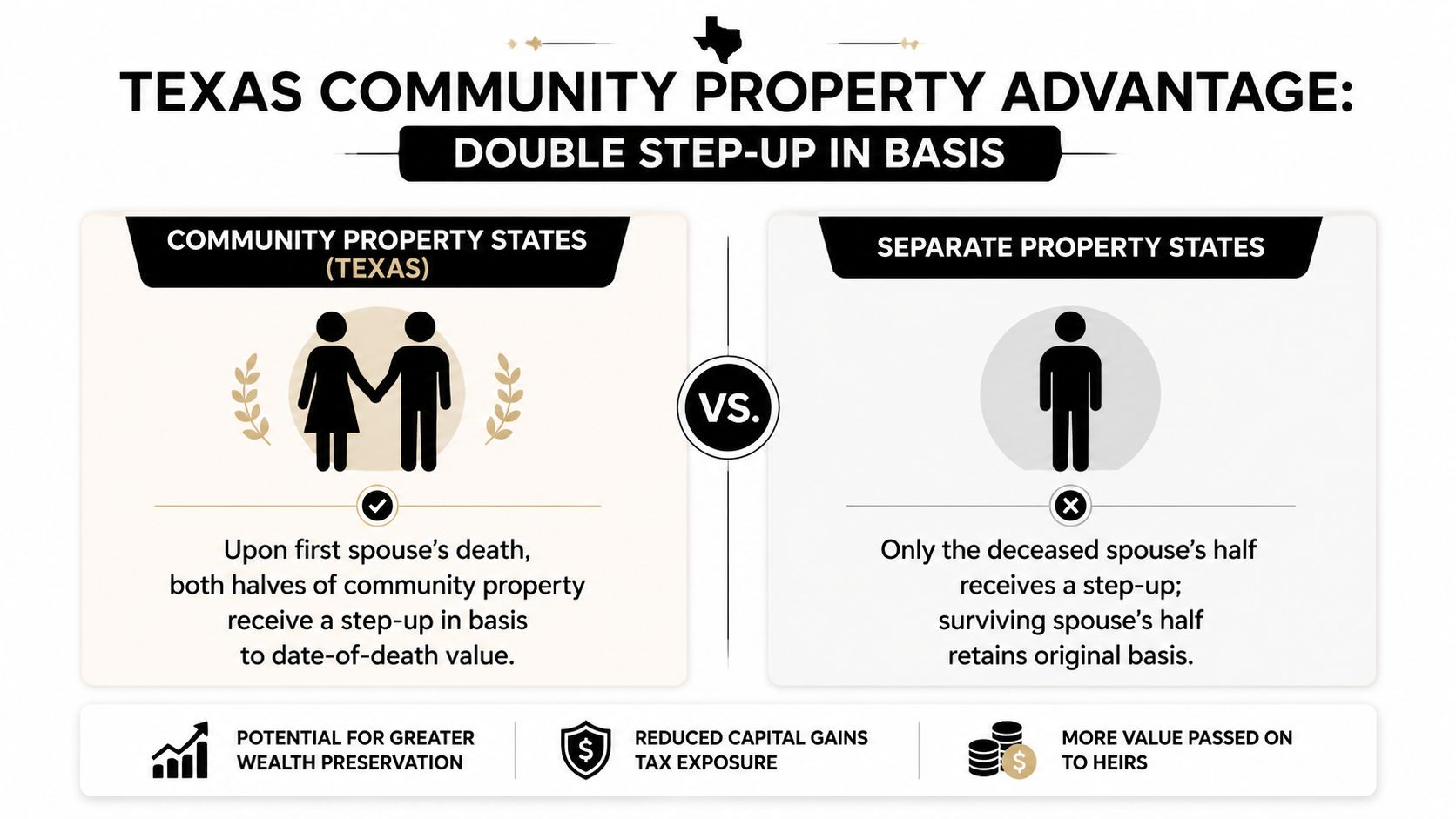
Trust drafting can preserve the character
A married couple may use a joint revocable trust for community assets. The trust should clearly identify whether property remains community property or belongs separately to one spouse. Texas trust drafting may include express language preserving that characterization, consistent with the Texas Trust Code and the parties' ownership rights.
Ambiguous drafting can create problems. A spouse may contribute separate property to a joint trust, combine it with community funds, or sell it and reinvest the proceeds without maintaining a clear paper trail. Those actions may make later tracing more difficult. The surviving spouse, trustee, and CPA may then disagree about which portion received the applicable adjustment.
The Texas community-property discussion of basis planning highlights why characterization inside a revocable trust deserves careful attention. The trust itself doesn't automatically change every asset's character, but its language and funding records can help preserve or undermine the parties' intended treatment.
For married couples: Keep title documents, account statements, premarital or marital agreements, inheritance records, and contribution histories together with the trust file.
A trustee should ask whether each asset is community, separate, or mixed before preparing an inventory. The trustee should also avoid treating a surviving spouse's continued ownership as proof that the entire asset received an adjustment. The legal character and estate inclusion must be established first.
A Texas estate planning attorney can work with a CPA to coordinate trust drafting, asset titling, and future sale planning. Careful preparation before death is usually easier than reconstructing ownership after a spouse has died.
Documentation and Valuation Steps for Trustees and Beneficiaries
A basis adjustment is only useful if the trustee and beneficiaries can support it. The fiduciary's records should tell a clear story from the date of death through any later sale or distribution.
Build the administration file
Start with the death certificate, the complete trust instrument, amendments, account statements, deeds, prior tax returns, purchase records, and insurance documents. The trustee should prepare an inventory separating real estate, publicly traded securities, business interests, mineral interests, retirement accounts, and other property.
Use reliable valuations. A county appraisal or online estimate may not establish fair market value for federal tax reporting. Real estate, closely held business interests, and difficult-to-value property often require an appropriate appraisal or valuation analysis as of the date of death.
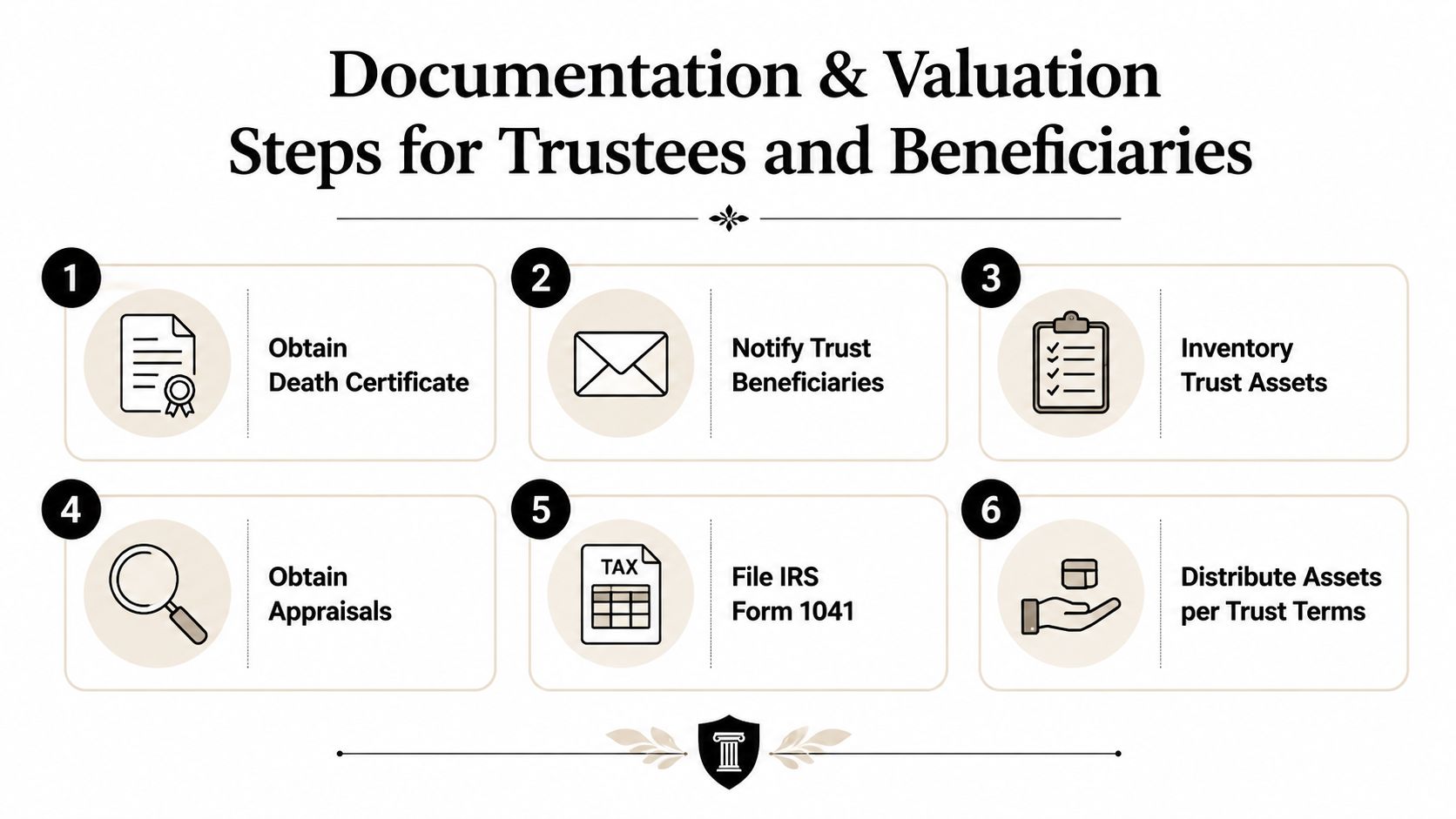
A practical workflow looks like this:
- Confirm the date of death: Use the official death certificate and preserve certified copies for institutions.
- Review ownership: Determine whether each asset was held in a revocable trust, an irrevocable trust, another estate-included structure, or outside the trust.
- Classify the property: Record community, separate, or mixed-property facts for a married couple.
- Obtain values: Engage qualified professionals for assets whose value isn't readily established.
- Coordinate tax reporting: Ask the CPA how the trust's income tax return, the decedent's final return, and any estate return should reflect basis.
- Delay final distribution when appropriate: Don't sell or distribute difficult assets until the trustee understands the valuation and tax consequences.
The guide to valuing trust assets after death can help trustees organize the questions that arise during this process.
Match records across fiduciaries
Publicly traded securities may have date-of-death values available through the brokerage firm, but the trustee should retain the supporting statements. If a federal estate tax return is required, the executor and CPA must address Form 706, Form 8971, and Schedule A when applicable. The basis consistency rules under IRC §1014(f) can restrict a beneficiary from claiming a basis higher than the value reported by the executor.
The trustee also owes fiduciary duties in Texas. Those duties include acting in good faith, following the trust, protecting trust property, keeping proper records, and communicating as required by law and the instrument. Distributing an asset before valuation is complete can expose the trustee to beneficiary objections or later accounting problems.
Common Misconceptions That Cost Texas Families Money
Families often receive simplified advice about trusts and basis. The following assumptions can create serious trouble when appreciated property is involved.
Misconception one
All trust assets receive a step-up.
A revocable trust commonly qualifies because its assets remain estate-includible. An irrevocable trust may not qualify when the assets are outside the grantor's gross estate. The answer requires a document review, not a trust label alone.
Misconception two
Grantor-trust status guarantees the adjustment.
Revenue Ruling 2023-2 rejected that shortcut for irrevocable grantor-trust assets not included in the gross estate. Income-tax ownership and estate-tax inclusion are separate concepts. Paying income tax on trust earnings doesn't, by itself, produce a new basis at death.
Misconception three
A Texas trust automatically preserves community-property treatment.
A trust can hold title while the underlying characterization still requires analysis. Drafting, marital agreements, tracing, and records all matter. If the couple's community-property status isn't documented, the trustee may struggle to establish whether both halves qualify for the applicable adjustment.
Misconception four
No Texas inheritance tax means basis planning doesn't matter.
Federal capital-gains exposure can still affect a later sale of ranch land, mineral interests, securities, or a family business. An asset purchased for $100,000 and valued at $600,000 at death illustrates how a $500,000 built-in gain may disappear with a qualifying adjustment, as explained by Texas step-up-in-basis guidance. Without that adjustment, the gain may remain for the beneficiary to address.
| Misconception | Reality |
|---|---|
| Every trust asset receives a basis reset | Estate inclusion controls the federal result |
| Grantor status is enough | Revenue Ruling 2023-2 separates income-tax status from estate inclusion |
| Trust title proves community property | Character depends on ownership history, drafting, and records |
| No inheritance tax ends the analysis | Capital-gains consequences can remain after death |
When disagreements arise, beneficiaries can request information and an accounting, and trustees can seek legal advice before taking an irreversible action. A Texas probate lawyer may also help when trust administration overlaps with probate, creditor issues, or a contested estate.
Protect Your Family With Trusted Texas Legal Guidance
Basis planning for Texas trust assets sits at the intersection of federal tax law, IRS administrative guidance, the Texas Trust Code, the Texas Estates Code, and Texas community-property principles. A trustee who treats every trust the same may miss an estate-inclusion issue, overlook a community-property benefit, or distribute property before its value and tax treatment are documented.
Professional review is a fiduciary safeguard, not an admission that the family made a mistake. A Texas trust administration lawyer can examine the trust, identify the successor trustee's duties, coordinate with the CPA, and help beneficiaries understand the records supporting the reported basis. If a dispute develops, counsel can also address fiduciary accounting, beneficiary communication, mediation, or trust litigation.
Families may also need broader planning. A Texas estate planning attorney can review wills, powers of attorney, beneficiary designations, and trust funding. Related guidance on Texas probate services, guardianship planning, and asset protection planning may be relevant when incapacity, creditor concerns, or blended-family issues are part of the picture.
If you're managing a trust or planning your estate, contact The Law Office of Bryan Fagan, PLLC for a free consultation. Our attorneys provide trusted, Texas-based guidance for every step of the process.
The Law Office of Bryan Fagan, PLLC helps trustees and beneficiaries review trust terms, document valuations, address Texas community-property questions, and coordinate administration with tax professionals. Visit Law Office of Bryan Fagan, PLLC to schedule a free consultation about your trust assets, estate plan, or fiduciary responsibilities.