Managing a loved one's trust can feel overwhelming, especially when most assets have already been distributed and you're still unsure whether the trust is legally finished. A successor trustee may have paid expenses, transferred property, and answered beneficiary questions, yet one unresolved account, missing document, or unclear notice can keep the administration open.
Closing a trust after administration in Texas is more than handing out the remaining assets. It's a documented wind-down shaped by the Texas Trust Code, fiduciary duties, beneficiary rights, tax responsibilities, and the trust instrument itself. Texas law provides a practical framework for moving from administration to final closure, but the correct path depends on why the trust ended, the value of its property, and whether beneficiaries or court involvement must be addressed.

When Closing a Trust Feels Overwhelming in Texas
Consider a successor trustee in Houston who has finished selling a home, paid known bills, transferred investment accounts, and sent distributions to the people named in the trust. The trustee believes the work is over, but a beneficiary asks for a complete accounting, a tax expense remains possible, and the trust document uses language that doesn't clearly identify the final termination date.
That situation is common because trust closure is a process, not a single moment. A trustee's fiduciary duties in Texas continue through the wind-down. The trustee must protect trust property, address debts and taxes, identify the correct distributees, and show how the final property reached the proper people.
The Texas Trust Code provides authority for a trustee to continue exercising trustee powers for the reasonable time needed to settle a trust after a terminating event. That period allows the trustee to complete necessary work instead of treating the termination event as an immediate cutoff. Texas law also provides a separate route for certain small trusts, where continued administration may not make economic sense.
Practical rule: Don't treat the final check or asset transfer as the closing document. Treat it as one part of a file that should show why the trust ended, what remained, who received property, and how the trustee completed the fiduciary process.
Families often confuse trust administration with probate. Probate generally concerns a deceased person's estate under the Texas Estates Code, while trust administration concerns property held by the trust and the trustee's duties under the Texas Trust Code. The two processes can overlap, but closing a trust still requires its own review of the trust instrument, assets, beneficiaries, and accounting.
A careful trustee should create a closing file containing the trust document and amendments, asset records, liability information, notices, tax materials, accounting records, distribution documents, and beneficiary communications. If you're unsure how to organize the first steps, the resource on what to do when a trustee feels overwhelmed in Texas can help frame the immediate questions.
Some administrative tasks also involve non-Texas issues. For example, a family handling an overseas business or registration matter may benefit from a separate guide to VAT deregistration when a foreign value-added tax registration must be addressed outside the trust's Texas administration.
Prerequisites for Closing a Trust Under Texas Law
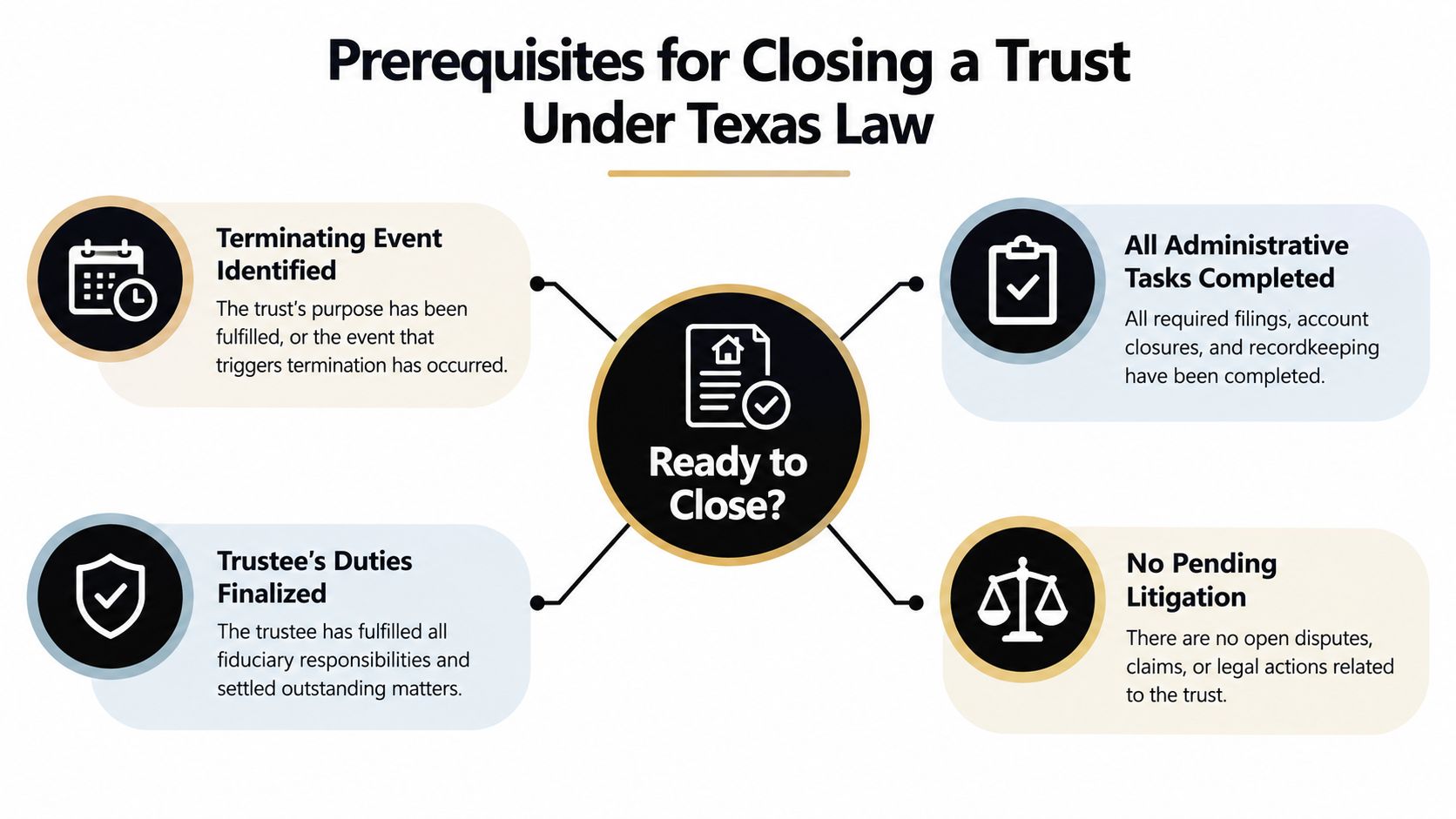
Before distributing the last assets, the trustee should determine whether the trust is ready to close. The decision starts with the governing instrument and then moves to the trust's purpose, property value, beneficiaries, and any unresolved legal issues.
Identify why the trust ended
Look for the trust's stated termination date, beneficiary age or event, completion of a specific purpose, or another terminating event. Texas law allows the trustee to continue using trustee powers for the reasonable time required to settle and distribute the trust after that event. The statute therefore recognizes a transition between termination and final wind-down rather than requiring an instant shutdown. (Texas Property Code Section 112.052)
The trustee should preserve a written explanation identifying the relevant provision or event. A short memorandum can state the event, the date it occurred, the assets still held, the remaining obligations, and the proposed closing method.
Confirm the trust's purpose and value
Ask whether the trust's purpose has been fulfilled, become illegal, or become impossible to accomplish. Those facts may support court termination or modification under Texas Property Code Section 112.054. A trustee or beneficiary may petition the court, and for termination under the applicable consent-based provision, all beneficiaries must consent or be deemed to consent. (Texas Property Code Section 112.054)
Then value all trust property and identify liabilities. Texas provides a specific small-trust path when trust property is less than $50,000, continued administration isn't economically justified, and the trustee follows the required beneficiary notice process. (Texas Property Code Section 112.059)
Choose the proper closing track
The facts usually point toward one of three routes:
- Standard wind-down: The trust ended under its terms or another terminating event, and the trustee uses a reasonable period to complete administration and distributions.
- Small-trust termination: The property is below $50,000, ongoing administration isn't economical, required notice is given, and the assets are distributed consistently with the trust's purpose. (Texas Property Code Section 112.059)
- Court petition: The trust's purpose has been fulfilled, become illegal, or become impossible, or the trustee needs judicial direction about modification or termination. (Texas Property Code Section 112.054)
Before selecting a path, identify current and contingent beneficiaries, review the trust's notice provisions, and check for pending claims, disputes, or uncertain ownership. A trustee handling the first stage of the role may also consult First Steps for a Successor Trustee in Texas for an overview of immediate trustee responsibilities.
How to Complete Final Administration and Distributions
Once the trustee has confirmed the closing basis, the work becomes a controlled sequence. Each step should leave a record that another person can understand without relying on memory or informal conversations.
Start with debts, taxes, and reserves
Review every known bill, claim, expense, and tax obligation. Texas trust-administration guidance identifies payment of trust debts and taxes as part of the trustee's wind-up duties. If a tax obligation or expense remains possible, the trustee may need to keep enough property in the trust to address it before making the final distribution. (Texas trust wind-up guidance)
The trustee should coordinate with a tax professional about required filings, available information, and whether beneficiaries need tax reporting documents. The trustee shouldn't distribute every dollar just because the known bills have been paid. A documented reserve decision is safer than an unexplained holdback or an emergency request for money after closure.
Preserve property during the wind-down
The trustee's responsibilities don't disappear while the final work is pending. Trust property must remain protected and appropriately managed until it can be transferred or liquidated. That may involve maintaining insurance, securing real estate, monitoring financial accounts, preserving business records, or keeping personal property safe.
For example, a trustee in Dallas-Fort Worth may need to maintain a vacant house while preparing a deed. A trustee in Austin may need to preserve investment statements while confirming beneficiary shares. The location changes, but the fiduciary principle remains the same: protect the trust property and act for the beneficiaries rather than for personal convenience.
Confirm distributees and shares
Read the distribution provisions carefully. Confirm each recipient's identity, address, eligibility, and share before preparing a transfer. A beneficiary's understanding of the family's wishes doesn't replace the trust's written terms.
For real estate, the transfer may require a properly prepared and recorded deed. Financial accounts may require trustee instructions, beneficiary documentation, or account-specific transfer forms. Personal property should be described clearly enough to prevent later confusion. Keep signed receipts or acknowledgments showing what each beneficiary received.
The resource on trust fund distribution to beneficiaries in Texas addresses the practical issues that arise when trust property moves from the trustee to the beneficiaries.
Prepare the accounting or final report
Texas law gives a beneficiary a formal accounting right after a written demand. The demand may request a statement of accounts covering transactions since the last accounting, or since the trust was created if no later accounting exists. This makes accounting a central closing task, not an optional courtesy. (Texas Property Code Section 113.151)
A useful final accounting can organize:
- Opening information: Property held at the beginning of the relevant accounting period.
- Receipts: Income, sale proceeds, refunds, and other money received.
- Disbursements: Debts, taxes, professional fees, maintenance, and other payments.
- Asset changes: Sales, transfers, gains, losses, and valuation adjustments.
- Distributions: The recipient, property transferred, date, and stated share.
- Closing balance: Any remaining property and the plan for handling it.
Provide the report to beneficiaries when required or appropriate, and document any waiver or written acknowledgment. Don't describe a beneficiary's silence as approval unless the applicable law and facts support that conclusion.

Use clear notices and closing documents
For a small-trust termination, the trustee must give notice to current or contingent distributees before proceeding without court involvement, and the trustee must determine that the trust's purpose and property do not justify continued administrative cost. The final distribution must remain consistent with the trust's purpose. (Texas Property Code Section 112.059)
For any closing, use a written closing packet that may include the final accounting, distribution schedule, deeds or assignments, receipts, tax information, notices, and a trustee statement explaining the basis for termination. A beneficiary release can be useful, but it should be reviewed carefully and shouldn't be presented as a substitute for duties that Texas law still requires.
| Phase | Key Actions | Documentation Tip |
|---|---|---|
| Confirm termination | Identify the trust provision or legal basis | Keep the governing language and written determination |
| Finish obligations | Pay debts and taxes, preserve property, and assess reserves | Keep invoices, statements, and tax records |
| Account and notify | Prepare the accounting and send required notices | Use dated delivery records and retain responses |
| Distribute and close | Transfer property and document final receipts | Keep deeds, assignments, receipts, and the closing report |
Trustee Powers Taxes and Records During the Wind Down
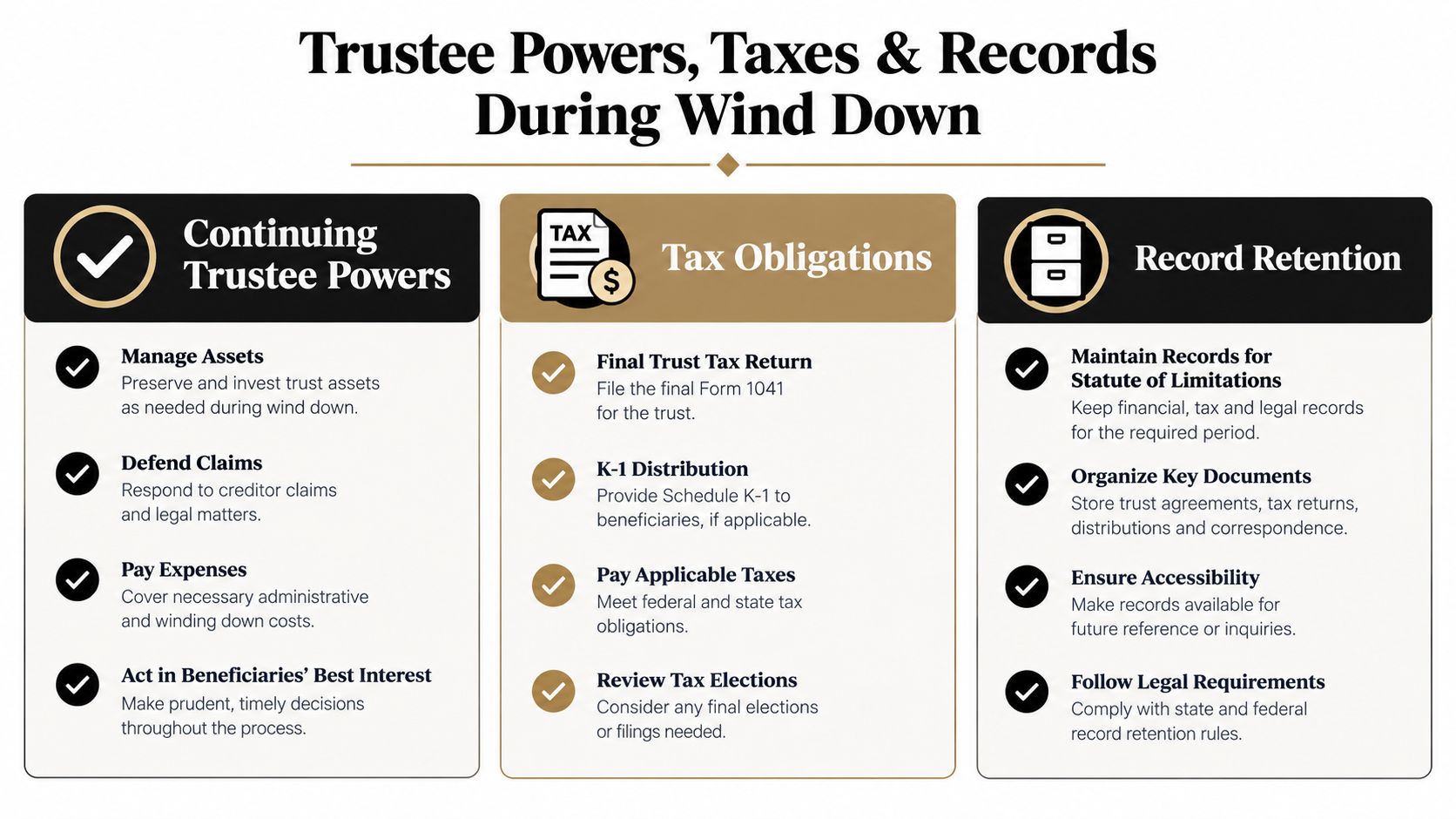
A trust's termination event doesn't necessarily end the trustee's authority immediately. Texas law permits the trustee to continue exercising trustee powers for the reasonable time needed to settle the trust and distribute its assets. That authority supports practical acts such as protecting property, paying expenses, completing transfers, and responding to claims during the wind-down. (Texas Property Code Section 112.052)
The authority is limited by purpose. A trustee shouldn't use the wind-down period to begin unrelated investments, delay distributions without a reason, or treat trust property as personal property. The trustee should act efficiently while preserving enough flexibility to resolve legitimate expenses and obligations.
Handle taxes and asset transfers carefully
The trustee should coordinate final tax work with a qualified tax professional. Trust tax obligations may involve collecting final income information, reporting distributions, and addressing tax documents requested by beneficiaries. The trustee should also confirm whether a reserve remains necessary before transferring the balance.
Real estate requires particular care. A deed should identify the property correctly, name the proper parties, and comply with recording requirements for the county where the property is located. Financial institutions may impose their own transfer procedures. A trustee in San Antonio, Houston, or any other Texas community should confirm each institution's requirements instead of assuming one form works for every asset.
For a focused discussion of the federal fiduciary return, review the information on the Texas trust tax return Form 1041. Legal counsel, a CPA, and a financial professional may each have a distinct role, and the trustee should document the advice received and decisions made.
Build a records file that answers future questions
Keep records that show the trust's starting property, transactions, notices, communications, valuations, expenses, tax work, distributions, and closing basis. The purpose isn't to create paperwork for its own sake. A complete file helps answer a beneficiary's later question and gives the trustee evidence of careful administration if a dispute reaches court.
A trustee should be able to hand a reviewer the file and explain every major movement of trust property.
Use consistent file names and preserve both signed documents and reliable copies of electronic records. Include proof of delivery for notices, written beneficiary responses, account statements, settlement documents, and evidence that transferred property was retitled. Recordkeeping should continue after the last distribution according to appropriate legal and tax advice.
Common Issues When Closing a Texas Trust and How to Resolve Them
Trust closure problems usually arise from uncertainty, not from one dramatic mistake. A trustee can reduce risk by matching each problem with a documented response.
Missing or uncertain beneficiaries
Problem: A current or contingent beneficiary can't be located, or the trustee isn't sure whether a person falls within the trust's class.
Response: Review the trust language, family records, prior notices, and available contact information. Don't distribute property based on an assumption that excludes a possible distributee. If uncertainty remains, ask a Texas trust administration lawyer whether court instructions, a special notice process, or another legal remedy is appropriate.
Disputed accounting
Problem: A beneficiary questions expenses, investment decisions, or the amount distributed.
Response: Answer with records rather than defensiveness. Provide a clear transaction history, explain unusual items, identify supporting documents, and correct errors promptly. Texas beneficiaries have a written demand right for a statement of accounts, so a trustee should take an accounting request seriously. (Texas Property Code Section 113.151)
Disagreement about value or shares
Problem: A beneficiary disputes the value of a home, business interest, securities, or personal property, or believes the distribution shares are wrong.
Response: Separate valuation from entitlement. Obtain appropriate valuation support, preserve the trust's distribution language, and show how the calculation was made. Don't change shares solely to end an uncomfortable conversation.
Lingering debt or tax concern
Problem: A creditor, tax professional, or beneficiary raises an obligation after the trustee planned to distribute everything.
Response: Pause the affected distribution, identify the legal obligation, and assess whether a reserve is needed. A trustee's duty to protect trust property continues during the reasonable wind-up period. (Texas Property Code Section 112.052)
The trust's purpose no longer works
Problem: The trust's purpose has been completed, become illegal, or become impossible, but the document doesn't provide a simple closing route.
Response: Consider a court petition for termination or modification. Texas Property Code Section 112.054 authorizes court action in those circumstances, subject to the statute's requirements. A trustee should seek advice before treating an unclear purpose as permission to distribute.
Families sometimes research unrelated logistics while organizing trust records, such as quotes from National Car Transport when a vehicle must be moved. That information may help with transportation planning, but it doesn't replace the legal work needed to confirm title, beneficiary rights, and proper distribution.
Get Confident Help Closing Your Texas Trust
A proper Texas trust closing follows a clear sequence. First, identify the terminating event or other legal basis. Next, confirm the trust's purpose, value the property, identify beneficiaries, resolve obligations, provide required notices, prepare the accounting, and complete documented distributions. The trustee then retains a closing file that explains the decisions and protects the interests of both fiduciary and beneficiaries.
The Texas Trust Code supplies the primary framework for trust administration, termination, accounting, and fiduciary conduct. The Texas Estates Code becomes especially relevant when trust matters overlap with probate, wills, guardianship, or estate administration. A Texas estate planning attorney can also help families review whether the trust's structure still fits their goals and how to modify a trust in Texas when circumstances have changed.
Legal guidance can be especially helpful when a beneficiary disputes the accounting, a beneficiary is missing, property ownership is unclear, taxes remain unresolved, or court approval may be necessary. The Law Office of Bryan Fagan, PLLC works with trustees and families on trust administration, fiduciary accounting, tax planning, asset distribution, estate planning, guardianship, asset protection, and trust disputes throughout Texas.
You don't have to guess whether the trust is closed because the assets have been distributed. A careful review can identify the remaining steps and give you a practical, documented path forward.
If you're managing a trust or planning your estate, Law Office of Bryan Fagan, PLLC provides Texas-based guidance on administration, accounting, tax planning, distributions, and disputes. Schedule a free consultation to discuss your trust's termination basis, remaining obligations, and the records needed for a confident closing.