Managing a loved one's trust can feel overwhelming, especially when a creditor, lawsuit, or bankruptcy claim raises questions about whether trust assets are protected. Families often discover that a document labeled “spendthrift trust” doesn't automatically shield every interest from every creditor under Texas law.
The answer depends on who created the trust, who funded it, who benefits from it, and which statutory exception may apply. A careful review of Texas Property Code § 112.035 can help settlors, trustees, and beneficiaries understand where protection exists, where it fails, and what records may matter during a dispute.
Understanding the Texas Rule on Self-Settled Spendthrift Trusts
An older Texas couple creates a trust during retirement. The husband transfers investment property into it, names himself as a beneficiary, and adds spendthrift language that appears to restrict transfers and creditor claims. Later, a judgment creditor argues that the trust cannot prevent access to the husband's beneficial interest. The family is surprised because they believed the words “spendthrift trust” ended the discussion.
Under the general rule in Texas Property Code § 112.035, a settlor may restrict a beneficiary's ability to transfer a beneficial interest voluntarily or involuntarily. But when the settlor is also a beneficiary, the protection doesn't block creditors from reaching that settlor-beneficiary's interest. The statutory text makes the distinction central to the analysis. Texas Property Code § 112.035
That rule means Texas generally doesn't recognize the classic self-settled spendthrift trust model. A person can't place assets in a trust for personal benefit, retain a beneficial interest, and rely on spendthrift wording to place that interest beyond the reach of creditors.

Why the settlor-beneficiary relationship matters
The important question isn't only whether the trust contains a spendthrift clause. The question is whether the person facing the claim created or funded the trust and also holds the beneficial interest that the creditor seeks.
A federal appellate decision applying Texas law described the principle as the self-settlor rule. Its reasoning is straightforward: a debtor shouldn't be able to create a trust for personal benefit and then use spendthrift language to evade creditors. Federal appellate authority applying Texas law
This doesn't mean every trust connected to a debtor is automatically unprotected. A trust funded by someone else for the debtor's benefit may receive different treatment. Later sections address how third-party contributions, spousal structures, and limited statutory carve-outs can change the analysis.
For families considering a trust, the practical lesson is clear. Don't evaluate protection by the trust title alone. Review the source of each contribution, the identity of each settlor, the beneficiary provisions, and the timing of trust creation with a Texas trust administration lawyer.
Why Texas Limits Creditor Protection for Self-Settled Trusts
Texas limits self-settled creditor protection because the law treats a person's beneficial interest as connected to that person's own property rights. If someone can create a trust, keep the benefit, and block all creditor access through drafting language, the trust could become a tool for avoiding legitimate claims rather than a structure for managing property for others.
The policy behind the rule
The statute balances two interests. On one side, Texas recognizes that a settlor may want to protect a beneficiary from poor decisions, pressure, or future creditors. On the other, Texas preserves a creditor's ability to pursue an interest that the debtor created or retained for personal benefit.
That balance explains why a third-party trust and a self-settled trust aren't interchangeable. A parent may establish a trust for an adult child and include spendthrift protection. The child may receive benefits without having created the trust or contributed the property. A different result can apply when the child establishes the trust, funds it, and names themselves as a beneficiary.
The rule also supports honest fiduciary administration. A trustee must follow the trust terms, preserve records, communicate appropriately with beneficiaries, and administer property under the Texas Trust Code. A trustee can't treat spendthrift language as permission to ignore a valid creditor claim, and a creditor can't assume that every trust asset is available without examining the governing documents.
Practical rule: Spendthrift wording controls transfers only within the limits allowed by Texas law. It doesn't override the statute's treatment of a settlor-beneficiary interest.
What the rule means for planning
A person exploring asset protection trusts in Texas should first identify the actual planning objective. Asset protection from civil claims, long-term care planning, estate administration, and control during incapacity involve different legal concerns. A trust designed for one purpose may not solve another.
The resource Texas Trust Administration: A Trustee's Guide describes what trust administration involves and how it differs from probate. That distinction matters here because a trustee may need to administer trust property while also responding to a creditor inquiry, beneficiary objection, or court proceeding.
Texas law doesn't make the decision for the family in every case. It establishes the starting point, then requires careful analysis of the trust's terms and facts. A Texas estate planning attorney can help determine whether the proposed arrangement is a third-party trust, a partially self-settled trust, or a structure that may fit a narrow statutory exception.
How the 112.035 Exception Changes the Picture
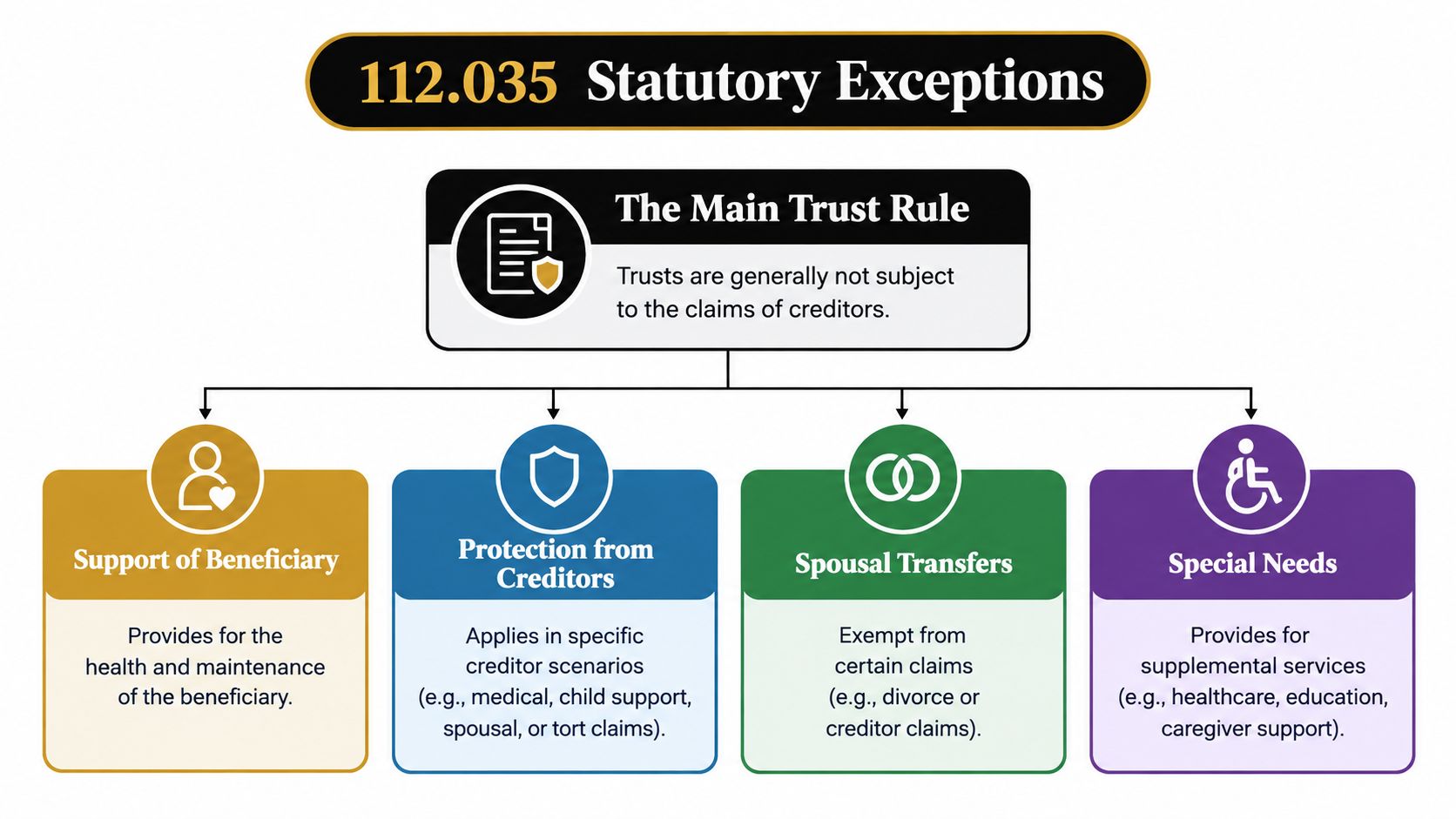
The general rule is not the entire story. Texas revised § 112.035 in 2013, adding significant exceptions to the broad prohibition against spendthrift protection for self-settled trusts. The Legislature didn't authorize unrestricted self-settled asset protection trusts. Instead, it created targeted carve-outs for specific family-transfer and power-of-appointment structures. University of Texas CLE discussion of the 2013 revision
That distinction is the key to understanding the self settled spendthrift trust Texas 112.035 exception. The exception doesn't erase the default rule. It asks whether the facts place the trust within a narrowly described statutory pathway.
Three questions guide the analysis
First, who contributed the property? Trace each asset separately. Property contributed by a third party may receive protection even when another part of the trust was contributed by the beneficiary facing a claim.
Second, who holds the beneficial interest? A person may be a beneficiary without being the settlor, or may be treated differently under a limited spousal or power-of-appointment arrangement. The drafting language and the transaction history both matter.
Third, does a statutory carve-out apply? Section 112.035 includes provisions addressing certain spousal trusts, powers of appointment, and related family-transfer structures. The exception depends on the precise facts, not on a general belief that the trust benefits a family member.
Why narrow exceptions create practical risk
A family may hear that a spousal trust is protected and assume any transfer between spouses qualifies. That assumption can be dangerous. The attorney and trustee must examine the source of the property, the trust's beneficiaries, the powers reserved by each person, and whether the documents follow the statutory structure.
Researchers and lawyers may use legal research using AI to locate cases and compare statutory language, but research tools don't replace legal judgment or document review. The final analysis should connect the statute to the actual trust instrument, contribution records, and creditor facts.
Texas also has its own variations from uniform trust principles. Reviewing where Texas departs from the Uniform Trust Code can help a trustee understand why a general treatise or out-of-state form may not answer a Texas administration question.
The safe approach is to treat the exception as a fact-sensitive statutory defense, not as a broad permission slip. A trustee should avoid distributing or withholding assets based on an informal summary of the exception. The trustee should preserve the documents and obtain counsel before taking a position that could affect creditors or beneficiaries.
Creditors, Settlors, and Beneficiaries Under Texas Law
Consider three trusts holding similar investment property. In the first, a grandparent creates and funds a trust for a grandchild. In the second, the grandchild creates and funds a trust for personal benefit. In the third, the grandparent funds one portion while the grandchild later contributes separate property. The trust documents may use similar spendthrift language, but the creditor analysis can differ because the contribution sources and beneficiary relationships differ.
Third-party funding compared with self-settled funding
A third-party trust begins with someone other than the beneficiary providing the property. The beneficiary receives an interest, but the beneficiary didn't create that interest from their own property. Spendthrift protection may apply according to the trust terms and Texas law.
A self-settled trust involves a settlor who also benefits from the trust. Under the default rule, the spendthrift restraint doesn't stop creditors from reaching that settlor's beneficial interest.
A partially self-settled trust requires an allocation analysis. The protected portion contributed by a third party may remain sheltered, while the portion attributable to the settlor-beneficiary may be reachable to the extent of that interest. Texas federal and bankruptcy decisions recognize this contribution-sensitive approach. Federal bankruptcy decision applying Texas law
What a creditor or bankruptcy trustee may examine
A creditor isn't limited to the trust's caption or a single sentence in the document. The review may focus on:
- Contribution records: Deeds, account statements, assignment documents, and transfer histories can show who supplied the property.
- Beneficial interests: Distribution rights, withdrawal rights, powers of appointment, and discretionary provisions may affect the value and reach of an interest.
- Trust formation evidence: The execution date, funding date, amendments, and related marital or property agreements can help establish the transaction's legal character.
- Administration conduct: Accounting records and trustee decisions may show whether the trust operated as drafted or as the settlor's personal account.
A trustee also has fiduciary duties in Texas. That includes acting within the governing instrument and applicable law, keeping trust property properly identified, and avoiding decisions that favor one interested party without legal support. If a beneficiary demands payment while a creditor asserts an interest, the trustee may need a court proceeding or written advice from counsel before acting.
The practical comparison is simple. Spendthrift language may protect a beneficiary's interest, but it doesn't decide whether the beneficiary's own contribution is reachable. The settlor-beneficiary relationship and the property trail often matter more than the label placed on the trust.
Real Texas Scenarios Where the Exception Matters
A married couple owns property that they want to preserve for the family while providing financial support for one another. Their attorney considers whether a statutory spousal structure may fit the facts. The couple's goals don't answer the legal question by themselves. The analysis must examine ownership, transfers, beneficiary designations, powers of appointment, and the trust terms.

A spousal transfer
One spouse may transfer property into a trust benefiting the other spouse. Because the contributing spouse and beneficiary spouse aren't automatically the same person, the arrangement may raise a different question from a trust that the debtor created for themselves. Section 112.035 includes narrow provisions involving spousal trusts and related family transfers, so counsel must compare the proposed structure with the statutory requirements.
A power of appointment
A trust may give a beneficiary a power to direct property to certain people or purposes. That power can affect how the interest is characterized, particularly when the statute addresses a specific power-of-appointment structure. The trustee should preserve the instrument granting the power, any exercise or release, and the surrounding transfer records.
A family trust with mixed contributions
A parent establishes a trust for an adult child and later the child contributes separate property. The trust may continue to contain valid spendthrift language for the parent's contributions, while the child's own contribution creates a separate creditor-access question. The trustee should not treat all assets as identical just because they share one trust account.
These scenarios show why formation timing, contribution source, and beneficiary status deserve close attention. During a dispute, a trustee, executor, or beneficiary may need to produce more than the signed trust agreement. Bank records, deeds, marital-property agreements, correspondence, and prior amendments may help establish what the parties intended and what occurred.
Drafting and Planning Steps for Texas Settlor and Trustee Guidance
Good planning starts before a creditor dispute. The settlor, trustee, and family should create a record that makes the trust's structure understandable to someone reviewing it later. That record can't guarantee a result, but it can reduce uncertainty and help counsel evaluate the statutory framework.
Build an asset and contribution map
List each asset separately and identify its source. A schedule might show whether property came from the settlor, a spouse, a parent, a business interest, or another third party. Keep the supporting deed, account statement, assignment, or transfer document with the trust records.
The trustee should also track later additions. A contribution made years after the trust was signed may raise a different question from the original funding. Separate accounting can help preserve the distinction between protected third-party property and a settlor-beneficiary's own interest.
Confirm the legal roles
The documents should clearly identify the settlor, trustee, current beneficiaries, remainder beneficiaries, and anyone holding a power of appointment. Counsel should review whether a proposed spousal or family structure fits the statutory language instead of relying on a generic form.
Trustees should maintain a current copy of the trust, amendments, certifications, account records, tax documents, and fiduciary accountings. Beneficiaries should request information through the proper channel and keep communications organized. These habits support the fiduciary duties in Texas and can reduce conflict during administration.
Coordinate the broader estate plan
A spendthrift provision is only one part of a Texas estate plan. The family may also need wills, powers of attorney, health-care documents, beneficiary designations, business succession documents, and a plan for probate or incapacity. Texas Estates Code provisions may affect wills, probate administration, and guardianship matters, while the Texas Trust Code governs the trust relationship and trustee conduct.
Tax planning deserves separate review. The trustee, settlor, and tax adviser should coordinate income reporting, asset valuations, basis questions, and fiduciary accounting without assuming that a creditor-protection goal produces a particular tax result.
If disagreement develops, begin with document collection and a written issue list. Then consider counsel-assisted communication, a trustee accounting, mediation, or court instructions. A trustee shouldn't distribute disputed property merely to end an argument, and a beneficiary shouldn't accuse the trustee of wrongdoing without reviewing the governing instrument and records.
Next Steps and When to Consult a Texas Trust Lawyer
A person evaluating a self-settled spendthrift trust should bring the full picture to counsel. The most useful consultation isn't based on the trust title alone. It examines the trust instrument, funding history, family relationships, current claims, and the purpose of the proposed or existing arrangement.
Questions to prepare
Before meeting with a Texas estate planning attorney, gather:
- The trust documents: Include the original agreement, amendments, certifications, and related marital or property agreements.
- The asset history: Identify what was transferred, by whom, and through which accounts or deeds.
- The creditor facts: Explain whether a claim is anticipated, asserted, reduced to judgment, or part of a bankruptcy proceeding.
- The family objective: Clarify whether the priority is inheritance, management during incapacity, creditor planning, support, special needs, or orderly administration.
- The administration status: Note whether you're a trustee, executor, beneficiary, creditor, or family member seeking information.
Counsel can then explain whether the default anti-self-settled rule controls, whether a narrow statutory exception deserves consideration, or whether another planning tool better matches the family's objective. The answer may also involve reviewing exempt property, entity ownership, insurance, probate planning, or a separate trust funded by a third party.
Families should act carefully when a dispute is already developing. Moving property after a claim arises can create separate legal problems, and a trustee who ignores competing interests may expose the trust to litigation. Early advice gives the trustee and beneficiaries a clearer process for preserving records, communicating, and seeking court guidance when necessary.
For families asking how to modify a trust in Texas, the answer depends on the trust terms, the parties' consent, the applicable Texas Trust Code provisions, and sometimes court approval. Modification isn't a substitute for analyzing creditor access, and termination or distribution may create different fiduciary, tax, and beneficiary concerns.
If you're managing a trust or planning your estate, contact The Law Office of Bryan Fagan, PLLC for a free consultation. Our attorneys can review the § 112.035 issues, trust administration duties, estate planning goals, and potential disputes, then provide Texas-based guidance suited to your circumstances. Visit Law Office of Bryan Fagan, PLLC to take the next step.