Texas law allows a trustee to divide one trust into two or more separate trusts, or combine multiple trusts into one, without going to court, as long as the trust document doesn't forbid the action and beneficiary rights remain protected. Texas law also requires written notice at least 30 days before the effective date of the division or combination.
Managing a loved one's trust can feel overwhelming, especially when the trust was drafted years ago and the family's needs have changed. A trustee may be trying to manage different assets, respond to beneficiaries with different circumstances, or determine whether the original structure still serves its purpose. Section 112.057 of the Texas Property Code can provide a practical path forward, but the authority must be used carefully.
When Trust Administration Becomes Complicated
A trustee in Dallas may open a revocable living trust that once seemed easy to manage. Years later, one child may need structured support, another may have different financial circumstances, and the trust may contain investments, real estate, and business interests. The trustee now faces a practical question: should everything remain together, or would separate trusts make administration clearer and better suited to each beneficiary?
A Houston trustee may face the reverse situation. Related family trusts may have been created at different times, leaving separate records, accounts, and expenses. Combining them could reduce administrative work, yet efficiency alone does not make the change safe. The trustee must first compare the governing documents and consider whether the proposed structure would affect anyone's rights.

The trustee's concern is understandable
Trust administration changes as families and assets change. A trustee may worry that dividing or combining trusts will appear unfair, create an unexpected tax issue, or invite a beneficiary dispute. That concern reflects the trustee's fiduciary responsibility. A structural change can affect records, investment management, distributions, and how easily beneficiaries can understand what happened.
The law has developed to give trustees practical tools for these problems. Since 1991, Texas trust administration has moved toward allowing more flexibility without requiring every adjustment to begin in court. Section 112.057 of the Texas Property Code provides the statutory foundation for dividing or combining trusts when the governing instrument does not expressly prohibit the action and the transaction does not impair beneficiary rights or trust purposes. Texas Property Code Section 112.057
A trustee does not have to choose between leaving a flawed arrangement untouched and asking a court to rewrite the trust. The first task is to determine whether the trust document and existing law already provide a lawful solution.
That solution still requires careful preparation. The trustee should review the trust terms, identify affected beneficiaries, document the proposed allocation or combination, and decide whether separate legal and accounting records are needed. A written plan can work like a map, showing which assets, obligations, and administrative duties will move or remain in place.
The trustee should also distinguish statutory trust restructuring from a constructive trust, which may arise as an equitable remedy in a dispute. The Lighthouse Consultants constructive trust discussion can help clarify that difference.
Incomplete notices, unclear records, or decisions that appear personal can increase trust administration and litigation exposure. Careful documentation helps the trustee explain not only what changed, but why the change served the trust and its beneficiaries.
Understanding Texas Trust Code Section 112.057
Section 112.057 answers a focused question: can a trustee change the number of trusts without asking a judge to approve the change? In Texas, the answer can be yes.
The statute permits two basic actions:
- Division: One trust becomes two or more separate trusts.
- Combination: Two or more trusts become one trust.
That authority isn't unlimited. The trust instrument must not expressly prohibit the transaction. The trustee also must avoid impairing a beneficiary's rights and must preserve the trust's purposes. Those requirements are the guardrails around the trustee's power.
What the statute permits
A division may separate property and administration among different trusts. For example, a trustee might create separate post-division trusts with distinct assets, trustees, or administrative records, provided the transaction doesn't improperly change the beneficial interests established by the original trust.
A combination may bring related trusts under one administrative structure. The trustee still needs to compare the governing terms carefully. Similar family relationships alone don't establish that two trusts can be combined. Differences in distribution standards, trustee powers, remainder beneficiaries, or protective provisions may matter.
The statute also supports nonjudicial administration. That means the trustee may be able to complete the transaction without filing a court proceeding, but “without court” doesn't mean “without documentation.” A trustee needs a defensible record showing what authority was reviewed, how beneficiaries were protected, and why the selected structure serves the trust.
For readers who need a general overview of the difference between trust administration and probate, Texas Trust Administration: A Trustee's Guide addresses what trust administration involves and how it differs from probate.
What the statute doesn't permit
Section 112.057 doesn't give a trustee permission to rewrite the economic deal for personal convenience. A trustee can't use a division or combination to remove a beneficiary, reduce a required benefit, defeat a trust purpose, or obtain a personal advantage.
When the existing instrument doesn't authorize the desired result, a different legal route may be necessary. In some circumstances, a trustee or beneficiary may need to consider judicial modification of a Texas trust under Section 112.054. The correct path depends on the document, the proposed change, and the interests of the people affected.
The practical lesson is simple. Section 112.057 provides flexibility, not a blank check. A trustee should treat the statute as a structured decision-making tool and not as a shortcut around fiduciary responsibilities.
How Texas Trust Law Evolved to Empower Trustees
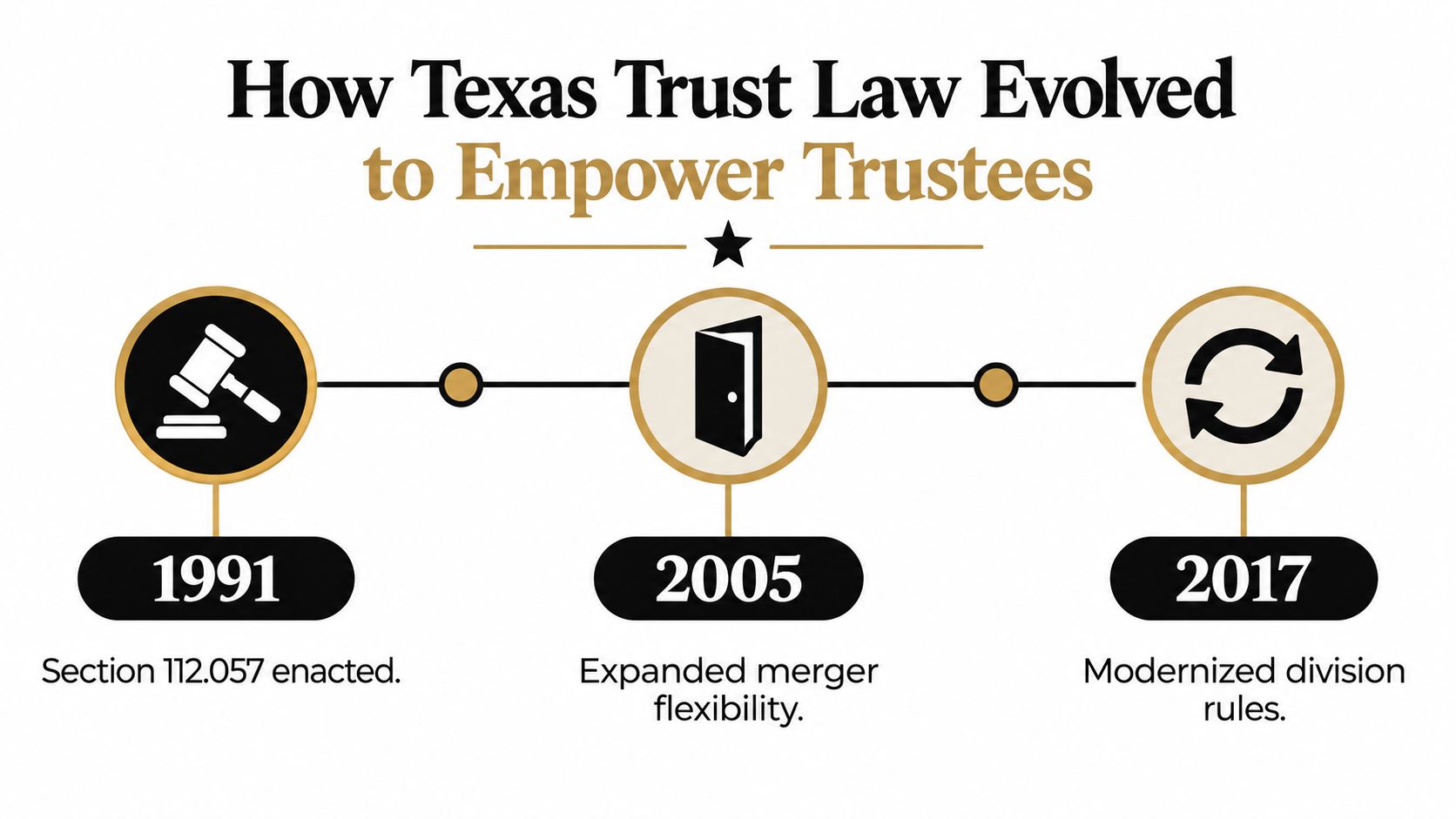
Texas did not always give trustees this level of flexibility. The modern division-and-combination rule traces to 1991, when the authority was added to the Texas Trust Code. The Legislature later broadened the rule in 2005 and amended it again in 2017. The statutory history of Section 112.057 reflects that progression.
Before the 2005 amendment, Texas law took a much narrower approach to mergers. A trustee could merge trusts only when the trusts had identical terms and the trustee determined that the merger would produce significant tax savings. That framework focused on a limited tax-driven purpose and left less room for practical administration.
The 2005 amendment adopted language based on the Uniform Trust Code. It expanded the rule so trusts could be combined for broader reasons, as long as beneficiary rights weren't impaired and trust purposes weren't harmed. The change recognized that trustees may need to address family changes, administrative complexity, and planning needs that don't fit within a narrow tax-savings test.
Why the timeline matters
The evolution from 1991 through 2017 shows a balancing effort. Texas expanded trustee authority, but it kept beneficiary protection and trust purpose at the center of the rule. The result is a framework that can respond to modern estate planning concerns without eliminating fiduciary oversight.
The pre-2005 restriction is especially important for families reviewing older documents. A trustee may assume that a merger is available only for tax reasons because that was once the central limitation. The current statute is broader, but the trustee must apply the law in effect and examine the particular trust language.
The 2017 amendment is also part of the modern framework. It reinforces that procedural details matter when a trustee divides a trust. Trustees should not rely only on a general belief that the transaction is allowed. They should confirm the current statutory requirements, document the decision, and communicate with beneficiaries in a way that gives them meaningful notice.
The history of Section 112.057 can reassure trustees, but it shouldn't replace careful legal review. Broader authority still requires disciplined fiduciary judgment.
This development also explains why a Texas trust administration lawyer may recommend a written legal analysis before implementation. The question is not merely whether the trustee wants separate or consolidated administration. The question is whether the proposed transaction fits the document, the statute, the fiduciary duties in Texas, and the beneficiaries' protected interests.
Key Requirements for Dividing or Combining Trusts in Texas
A trustee handling a Section 112.057 transaction should treat it like a carefully recorded change to the trust's blueprint. The governing document must permit the proposed action, and the trustee must confirm that the change preserves beneficiary rights and the trust's purposes. The trustee also needs a written process showing what was considered, why the structure is changing, and how the final arrangement will work.
Written notice must reach each qualified beneficiary at least 30 days before the effective date. The notice should identify that date, explain whether the trustee will divide or combine trusts, describe the allocation method, and identify the resulting or surviving trusts. The trustee should also check whether a person holding a power of appointment must receive notice. Texas trust provisions addressing division procedures provide context for these procedural requirements.
For a division, the trustee must prepare a written instrument acknowledged before a notary. Property may be allocated proportionally, assigned by specifically identified assets and liabilities, or distributed through another reasonable method. The chosen method should make the new trusts understandable to beneficiaries, accountants, and anyone who later reviews the trustee's records.
A practical comparison
| Requirement | Division | Combination |
|---|---|---|
| Governing authority | The statute may authorize separate resulting trusts | The statute may authorize trusts to be brought together |
| Trust document | Must not expressly prohibit the transaction | Must not expressly prohibit the transaction |
| Beneficiary protection | Beneficiary rights cannot be impaired | Beneficiary rights cannot be impaired |
| Trust purpose | Each resulting trust must preserve the original purposes | The combined trust must preserve the relevant purposes |
| Written notice | Required at least 30 days before the effective date, with the transaction's practical details | Required at least 30 days before the effective date, with the transaction's practical details |
| Written instrument | Required and acknowledged before a notary | Written records should establish the combination and its effect |
| Property treatment | Assets and liabilities may be allocated fractionally, specifically, or by another reasonable method | Property and records must be consolidated consistently with the governing terms |
Allocation is more than bookkeeping
An allocation schedule is the trust's property map. It should show which assets enter each resulting trust, which liabilities follow them, and how shared property is handled. Real estate, investment accounts, business interests, and obligations may require specific identification rather than a broad percentage.
The schedule also helps establish whether the post-division trusts will operate as separate legal and accounting units. The form of the transaction alone does not determine its income tax treatment. Texas provisions on trust division and allocation offer context for reviewing how property and beneficial interests are assigned.
The trustee must apply loyalty, prudence, and impartiality throughout the process. A trustee who favors one beneficiary, overlooks a liability, or relies on incomplete records may create problems even when the general transaction is authorized. The explanation of the fiduciary duties of a Texas trustee provides a focused review of these obligations.
Before signing, the trustee should confirm:
- Authority: The trust document and current law support the proposed action.
- Notice: Every required recipient receives complete written notice within the required period.
- Allocation: The property schedule is reasonable, complete, and supported by records.
- Purpose: The transaction preserves distribution standards and protective provisions.
- Impartiality: Competing beneficiary interests received fair consideration.
A trustee considering a different modification technique should distinguish Section 112.057 from decanting a trust in Texas. Decanting can involve different rules and consequences, so the trustee should identify the authority before choosing a path.
Why Trustees Choose to Divide or Combine Trusts
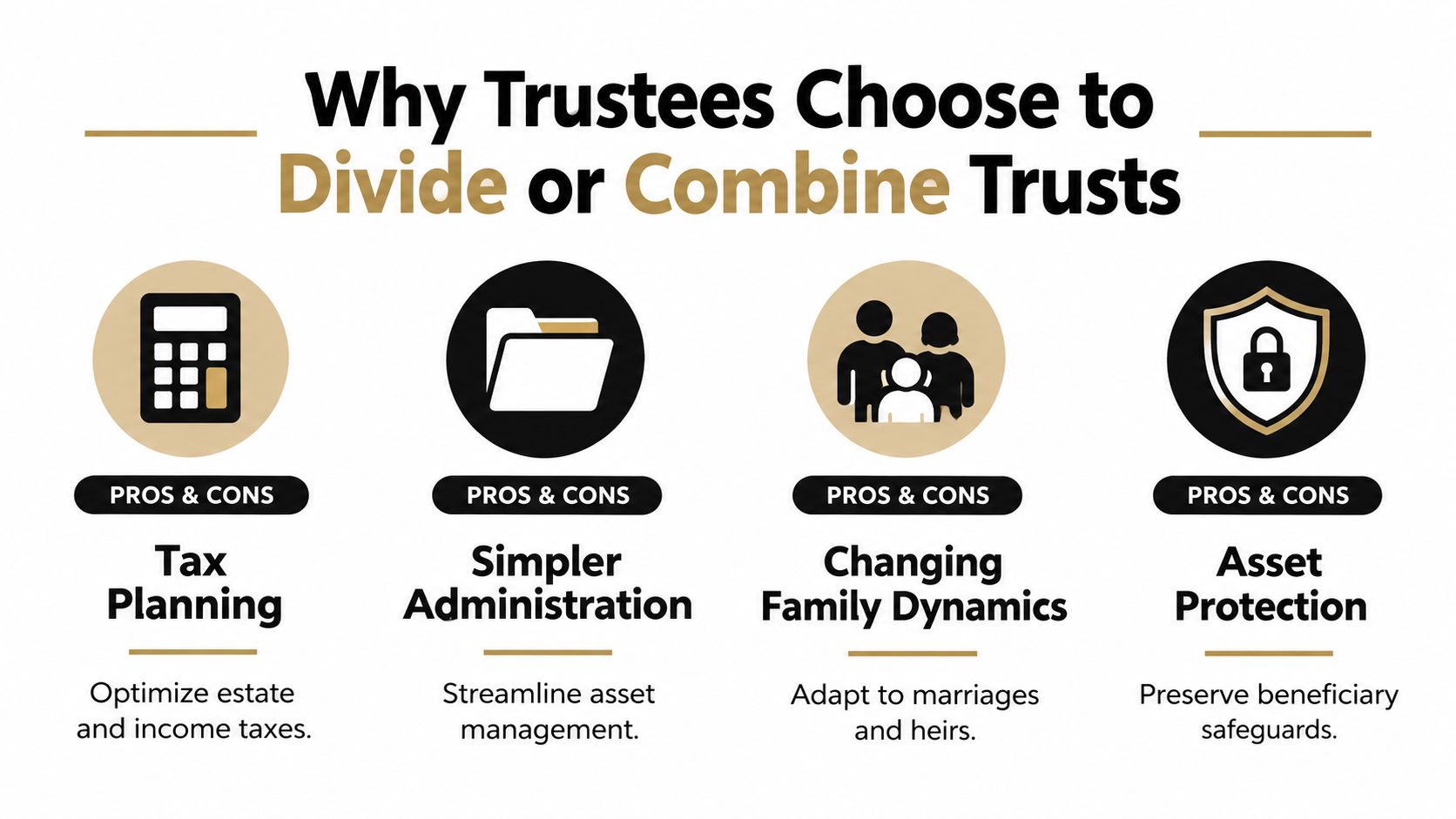
Trustees usually consider division or combination because the current structure no longer fits the family's practical needs. Texas materials interpreting Section 112.057 explain that the Legislature broadened trustee authority in 2005 so trustees could divide or merge trusts for any reason, as long as beneficiary rights and trust purposes weren't harmed. The legislative history discussed in Texas trust materials connects that broader authority with tax planning, family changes, and administrative cleanup.
When division may make sense
Division can help when beneficiaries have different needs or when separate administration would make the trustee's records clearer. A trust may be divided so that one resulting trust applies a support standard to a beneficiary who needs ongoing assistance, while another follows a different administration plan for a beneficiary with greater financial independence.
Tax planning can also influence the discussion, but the trustee shouldn't assume a division automatically produces a tax benefit. The trustee, estate planning attorney, and tax adviser should examine the assets, income, beneficiary interests, and applicable tax rules before treating a division as a tax strategy.
Asset protection concerns require similar care. A trustee may want to preserve protective provisions for a beneficiary, but those protections must be carried into the resulting trust in a way that doesn't weaken the original purpose.
When combination may make sense
Combination may be appropriate when related trusts create duplicate records, separate accountings, or unnecessary administrative work. A consolidated structure can make it easier to track assets and communicate with beneficiaries, but convenience alone isn't enough if the trusts have materially different terms.
The trustee should compare:
- Distribution standards: Do the trusts require different types or timing of distributions?
- Beneficiary groups: Would combining the trusts blur separate interests?
- Trustee powers: Do the governing instruments give the trustee compatible authority?
- Protective provisions: Would consolidation alter spendthrift or support protections?
- Tax treatment: Could consolidation affect reporting or tax analysis?
A trustee's fiduciary duties remain central in either direction. The transaction should serve administration and beneficiaries, not merely make the trustee's job easier. A written explanation of the decision can help demonstrate that the trustee considered the relevant interests before acting.
Real-World Examples of Trust Division and Combination in Texas
Consider a hypothetical trustee in San Antonio administering a revocable trust for two adult children. One child needs distributions directed toward educational expenses, while the other needs broader support for ordinary living costs. The original trust gives both children beneficial interests, but its single structure makes the trustee's records and distribution decisions difficult to separate.

Example one involving a division
The trustee first reviews the trust document for language that expressly prohibits division. The trustee then compares the proposed arrangement with the beneficiaries' existing rights and the trust's purposes. If the structure is permissible, the trustee prepares a written instrument, creates an allocation schedule, and identifies which assets and liabilities will belong to each resulting trust.
The trustee also provides written notice at least 30 days before the planned effective date. The records should explain how the trustee selected the allocation method and how the division preserves the beneficial interests. If the trust's terms are unclear or the beneficiaries disagree, the trustee should pause rather than treating silence as approval.
The result isn't automatically valid merely because the trustee believes the division is fair. Documentation, notice, and preservation of the original purpose all matter.
Example two involving a combination
Now consider a hypothetical trustee in Austin overseeing three small successor trusts created for related beneficiaries. The trustee wants one administrative structure, but the trusts may contain different distribution standards or remainder provisions.
The trustee compares the documents line by line and prepares a written plan addressing the assets, liabilities, accounting records, and beneficiary interests. The trustee sends the required notice before the effective date and preserves documentation showing why the combined structure doesn't impair rights or trust purposes.
The combination may simplify recordkeeping, but the trustee shouldn't assume that reduced administrative burden is enough. If one trust contains a special protective provision or a different standard for distributions, combining the trusts could create an unintended change.
These examples also show why beneficiaries should ask focused questions. They can request the proposed effective date, the allocation or consolidation method, and an explanation of how their rights will remain protected. A trustee who communicates clearly is more likely to identify concerns before they become a formal dispute.
When to Seek Guidance from a Texas Trust Administration Lawyer
Section 112.057 can help a trustee adapt a trust without a court proceeding, but the decision still carries legal, tax, and fiduciary consequences. A mistake in the trust document review, beneficiary notice, allocation schedule, or accounting records can lead to conflict and personal exposure for the trustee.
A Texas trust administration lawyer can help by:
- Reviewing the trust instruments and amendments.
- Comparing the proposed action with beneficiary rights and trust purposes.
- Preparing or reviewing the written instrument and allocation schedule.
- Coordinating with tax professionals about reporting and income consequences.
- Developing a communication plan for beneficiaries.
- Identifying whether judicial modification, decanting, or another remedy is more appropriate.
The same careful process can support executors, beneficiaries, and families handling probate, guardianship, estate planning, and asset protection concerns. A trustee doesn't have to make an uncertain decision alone, particularly when family relationships are already strained.
The Law Office of Bryan Fagan, PLLC helps trustees and families review trust documents, plan divisions or combinations, address fiduciary duties, and manage related estate planning or trust disputes. Visit Law Office of Bryan Fagan, PLLC to schedule a free consultation and receive Texas-focused guidance for your situation.