Managing a loved one's trust can feel overwhelming, especially when a family member serving as trustee won't provide clear records. You may be hearing that “everything is being handled” while wondering what happened to trust assets, whether expenses were proper, and why distributions have changed. Texas law gives beneficiaries a practical way to replace uncertainty with documentation.
A ninety-day demand for trust accounting under Texas Property Code § 113.151 is more than a polite request for paperwork. When properly made, it creates a statutory response deadline for the trustee and can support a lawsuit to compel delivery of the accounting. The demand can become a strategic beneficiary tool, but only if the sender qualifies, the request is properly documented, and the delivery date can be proven.
When a Family Needs Answers From a Texas Trustee
A sister may be serving as trustee of a parent's irrevocable trust. The adult child beneficiary hasn't received statements for two years. Each time the beneficiary asks, the answer is the same: “Trust the process.” Family gatherings become tense because nobody can explain what the trust owns, what it has paid, or why money has or hasn't been distributed.
The beneficiary's central question is straightforward: What legal right do I have to see how the trust is being managed? Texas Property Code § 113.151 provides a formal mechanism for a beneficiary to make a written demand for a statement of accounts. After receiving the demand, the trustee generally has 90 days to deliver the written statement, unless a court orders a longer period. If the trustee fails or refuses to provide it by the deadline, the statute authorizes a beneficiary to file a lawsuit compelling delivery. Texas Property Code § 113.151 contains the statutory framework.
The demand matters because it converts an informal family disagreement into a documented fiduciary event. It gives the trustee a clear opportunity to respond and gives the beneficiary a date against which compliance can be measured. It also requires the accounting to be delivered to all beneficiaries, not only the person who made the demand.
Practical rule: Don't treat the 90-day period as a suggestion. It's the statutory deadline connected to the beneficiary's ability to seek judicial enforcement.
Section 113.151 has been part of Texas trust law since legislation enacted in 1983, with the original provision effective January 1, 1984. The Legislature later amended it in 2003, with that amendment effective September 1, 2003. The statute's legislative history shows that this framework isn't a recent administrative custom.
A careful process begins by confirming who may make the demand, checking the trust document, identifying the trustee of record, and preserving proof of delivery. From there, the beneficiary can assess the accounting, request corrections, and pursue court relief if the trustee doesn't comply.
For a plain-English overview of related beneficiary rights, see Texas trust beneficiary rights.
Who Can Send a 90-Day Demand and How It Must Be Served
The demand should come from a person who has a legally recognized beneficiary interest in the trust. Don't assume that every relative, potential heir, or person mentioned in family conversations has authority to trigger the statutory deadline. The trust instrument, the current facts, and the nature of the person's interest all matter.
A beneficiary may also act through an authorized representative when appropriate. But a person who merely expects to inherit someday, holds a power of appointment, or believes they should receive information doesn't automatically have the right to make a statutory demand. A virtual representative or family spokesperson also shouldn't act independently without confirming the authority behind the request.
Confirm status before sending
Before preparing the letter, gather:
- The trust document: Review the provisions identifying beneficiaries, trustee powers, reporting terms, and any accounting language.
- The sender's interest: Identify why the sender is a beneficiary and whether that interest is sufficiently connected to the trust's current administration.
- The trustee's identity: Use the trustee's legal name and current mailing address.
- Prior accountings: Check whether a formal accounting has already been delivered and what period it covered.
- Authority documents: If someone is acting for another beneficiary, preserve the written authorization or other basis for that representation.
Service also matters. Section 113.151 requires a written demand delivered in the manner specified by the statute or through another method the trustee and beneficiary have agreed to in writing. Certified mail is a sensible choice because it creates a delivery record. Email can be used as a backup, but don't rely on an informal message as your only proof unless the parties have agreed in writing to that method.
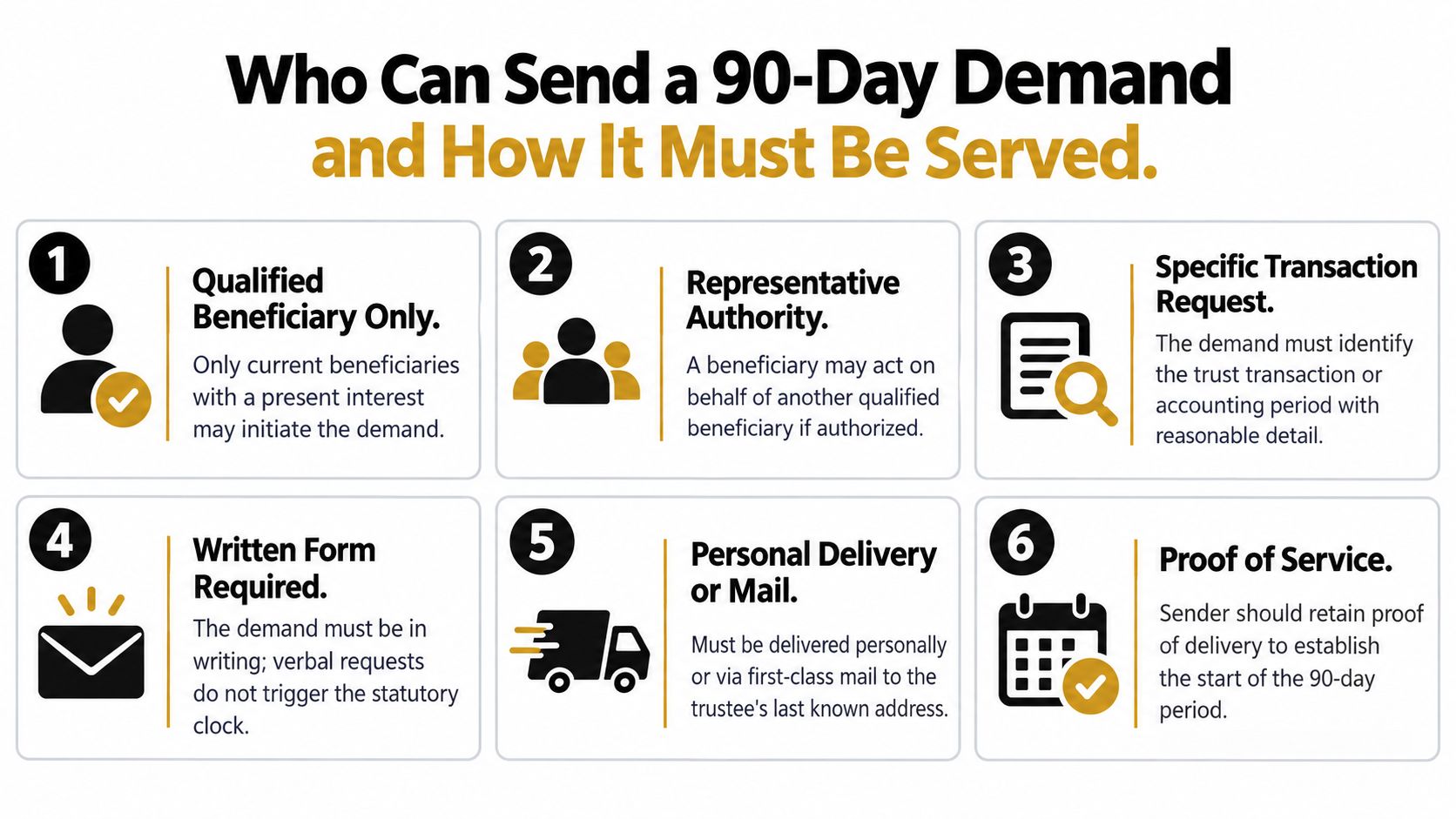
Keep the signed demand, mailing receipt, tracking history, delivery confirmation, and any response. A dispute about the delivery date can become a dispute about when the 90-day period began. If you're a successor trustee trying to organize administration from the start, First Steps for a Successor Trustee in Texas addresses immediate administrative tasks after stepping into the role.
What the Demand Must Say and How the 90-Day Clock Runs
A strong demand is written, signed, directed to the trustee, and clear about the accounting being requested. It should identify the trust sufficiently, request a written statement of accounts, and describe the administration period covered by the request. Avoid turning the letter into an argument about suspected misconduct. The initial objective is to obtain a complete accounting that can be reviewed against the statutory requirements.
The clock begins when the trustee receives the demand, not merely when the beneficiary places it in the mail. That distinction is why delivery evidence matters. The trustee then has 90 days to deliver the statement, unless a court orders a longer response period.
A beneficiary can adapt language such as this:
I am a beneficiary of the [full trust name], dated [date of trust]. I request a written statement of accounts covering transactions occurring since [the later of the last accounting or the trust's creation]. Please deliver the statement to [beneficiary address] and to the other beneficiaries as required by Texas law. Please send the response to [trustee address].
The statute also limits the frequency of demands. Unless a court orders greater frequency, the trustee generally isn't required to account more than once during any 12-month period. Before sending a new demand, check whether a prior formal accounting was delivered, what period it covered, and whether the trust document imposes a different reporting obligation.
| Required Element | What It Means in Practice |
|---|---|
| Written demand | Put the request in a signed written document. |
| Identified trust | Name the trust and provide its date or other identifying details when available. |
| Beneficiary status | Explain the sender's connection to the trust without making unsupported accusations. |
| Requested accounting period | The accounting covers transactions since the later of the last accounting or the trust's creation. |
| Trustee delivery | Send the demand to the trustee using a legally recognized or agreed method. |
| Delivery proof | Preserve records showing when the trustee received the demand. |
| Compliance timing | The trustee generally has 90 days after receipt, subject to a court-ordered extension. |
The accounting itself must be measured against Property Code § 113.152. A vague request for “all information” can create unnecessary conflict. A focused statutory demand is usually stronger. For a related explanation of the trustee's reporting obligation, see A Trustee's Duty to Account to Beneficiaries.
What a Sufficient Texas Trust Accounting Must Contain
A Texas trust accounting isn't merely a folder of bank statements. Section 113.152 provides the content floor, and the trustee's job is to present a coherent financial record of the trust's administration.
A technically sufficient accounting should begin with an inventory of all trust property known to or possessed by the trustee. That includes assets outside the trustee's primary checking account. The trustee should then classify and total receipts, disbursements, and other transactions, separately identify principal and income receipts, list property under administration, identify the depository and its location, and disclose known liabilities.
The numbers should reconcile. Beginning balance, plus receipts, minus disbursements, should agree with the ending cash balance. A practical quality-control benchmark is zero unexplained variance among the transaction ledger, bank or brokerage statements, tax records, and ending balance. Material transfers should have source documentation and a description that explains what occurred.
Why a bank packet falls short
A bank statement may show that money moved. It usually doesn't explain whether a payment was for taxes, repairs, professional services, a beneficiary distribution, or trustee compensation. A brokerage statement may show a security position without explaining why an investment was sold or where the proceeds went.
The difference is analytical, not cosmetic. The beneficiary should be able to follow the trust's financial story without guessing.
| Required Item under Tex. Trust Code §113.152 | Bank-Statement Packet | Statute-Compliant Accounting |
|---|---|---|
| Trust property | Shows only assets held in the listed account | Inventories trust property known to or possessed by the trustee |
| Receipts | Shows deposits with limited context | Classifies and totals receipts, including principal and income |
| Disbursements | Shows withdrawals or checks | Explains payments and supports material transactions |
| Property under administration | May omit real estate, brokerage assets, or other property | Lists property being administered |
| Reconciliation | May provide an ending balance only | Reconciles beginning balance, receipts, disbursements, and ending cash |
| Depository information | May not identify all custodians | Identifies the depository and its location |
| Liabilities | Usually omits unpaid obligations | Discloses known liabilities |
Common failures include omitting assets outside the primary account, mixing principal and income, failing to disclose liabilities, and providing a report that doesn't cover the full required period. Beneficiaries should compare the production to the statutory checklist and document missing items in writing.
A trustee handling rental-property records may also encounter general bookkeeping resources, including a virtual assistant for rental finances. That kind of administrative support doesn't replace legal analysis, but organized records can make the accounting process more reliable.
For a Texas-focused discussion of formal accounting requirements, review formal accounting for a trust in Texas.
What Happens if the Trustee Does Not Respond in 90 Days
Silence isn't a safe response to a properly delivered demand. If the trustee fails or refuses to deliver the required statement by the end of the 90-day period, Section 113.151 authorizes a beneficiary to file a lawsuit compelling delivery.
That lawsuit is usually focused first on obtaining the accounting itself. The beneficiary should be prepared to show the trust document or beneficiary status, the written demand, the method of delivery, the date the trustee received it, and the absence of a compliant response. A clean evidentiary record gives the court something concrete to evaluate.
Build the file before escalating
Keep these materials together:
- The original demand: Preserve the signed version exactly as sent.
- Delivery evidence: Save the certified-mail records, tracking history, or written agreement supporting another delivery method.
- Trust records: Maintain the trust instrument and prior accountings.
- Trustee communications: Keep emails, letters, and partial productions.
- Accounting deficiencies: List specific omissions instead of describing the response generally as “incomplete.”
The court may extend the response period, but the extension must be court-ordered. A beneficiary shouldn't assume that sending a second demand automatically restarts the deadline or cures a defective first demand. That's where advice from a Texas trust administration lawyer can prevent a procedural mistake.
The accounting may also reveal a separate problem. Missing assets, unexplained transfers, commingling, or unsupported payments can raise questions about fiduciary duties in Texas. Those issues require careful legal analysis because a demand for records and a claim for loss are different steps.
A court case should be based on a provable timeline and specific accounting defects, not only on family frustration.
Before filing, discuss the demand with counsel and evaluate whether a focused attorney letter, negotiated production, or petition to compel is appropriate. A beneficiary can pursue clarity without making accusations that the available records don't yet support.
For a practical explanation of court enforcement, see compelling a trust accounting in court when the trustee refuses.
Common Defenses and Exceptions Trustees Raise
A trustee may have a legitimate defense, but the defense should be tested against the trust document, the delivery record, and the accounting provided. The fact that a trustee sends some documents doesn't automatically establish compliance. The key question is whether the response satisfies the applicable statutory requirements.
One common issue is service. If the demand wasn't delivered in the manner required by Section 113.151 or agreed to in writing, the trustee may challenge the date on which the deadline began. Another issue is frequency. A trustee generally isn't required to account more than once during a 12-month period, absent a court order requiring greater frequency.
The requesting person's status can also matter. A person who hasn't established a beneficiary interest may not be able to invoke the statutory demand process. The trust instrument may contain provisions affecting reporting, and a court may have already approved an extension or limited reporting in a particular administration.
| Defense Raised | Statutory or Contract Basis | Beneficiary Counter |
|---|---|---|
| Improper delivery | The demand wasn't served through a permitted or agreed method | Produce the delivery record and verify the statutory method |
| Recent accounting | A prior accounting was provided within the applicable 12-month period | Compare the prior accounting's date, period, and completeness |
| Insufficient beneficiary status | The sender's interest may not qualify under the trust and governing law | Provide the trust language and obtain advice on standing |
| Court-ordered extension | A court may have allowed a longer response period | Review the actual order and its scope |
| Trust-document limitation | The instrument may address reporting or accounting terms | Analyze the clause against non-waivable and statutory duties |
| Informal disclosure | The trustee may argue that statements or summaries were enough | Compare the production to the Section 113.152 accounting requirements |
Trustees sometimes argue that voluntary statements satisfy the demand. That position depends on substance, not labels. A stack of statements without an inventory, classification, reconciliation, depository information, and liabilities disclosure may leave the central accounting questions unanswered.
Beneficiaries should preserve any waiver language, prior reports, and the complete trust instrument. Trustees should do the same. The dispute often turns less on what family members remember and more on what the trust document and financial records show.
When to Send the Demand and When to Call a Lawyer
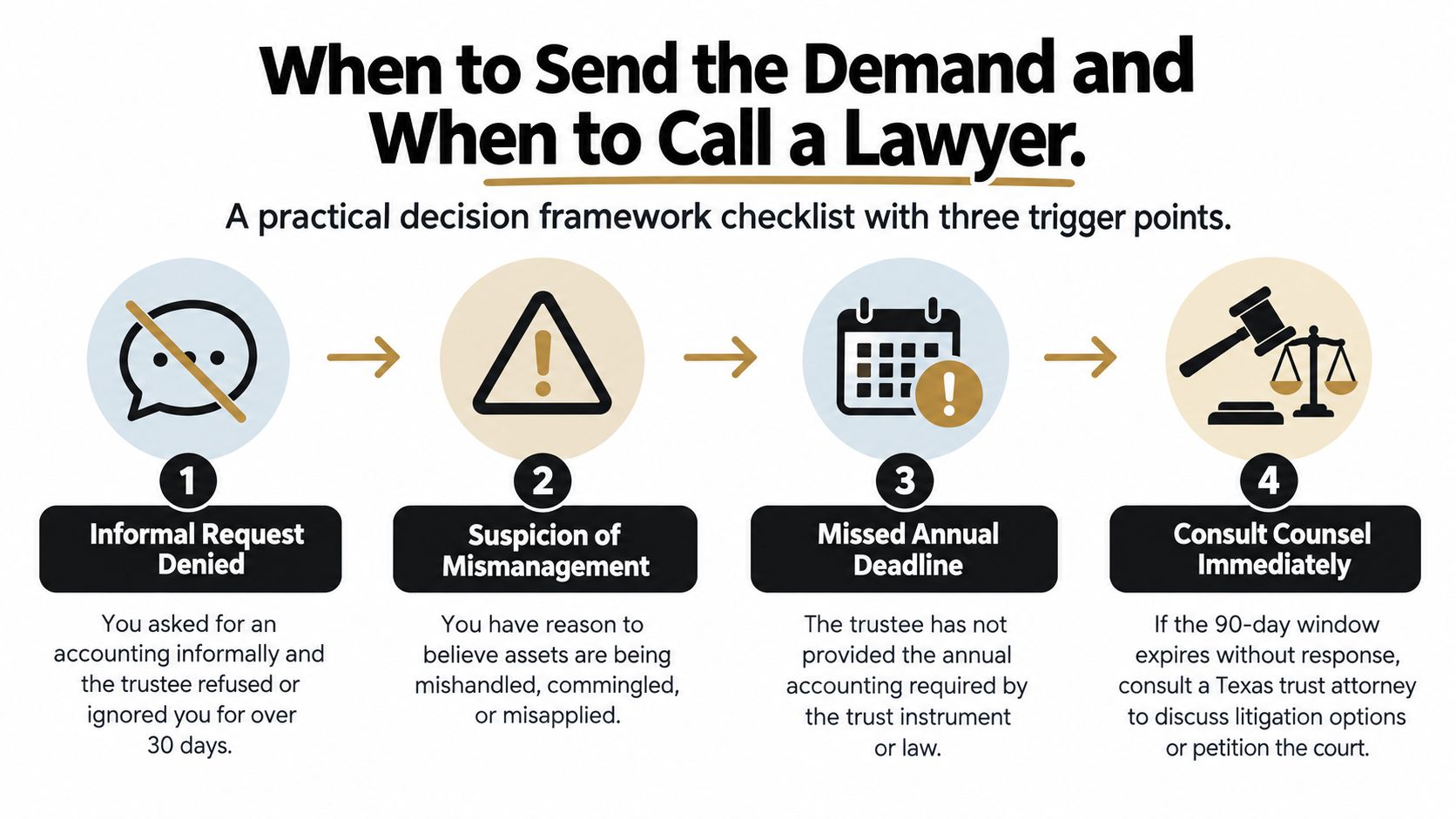
The right time to send a demand is when informal communication has failed and the beneficiary needs a formal, verifiable accounting. Don't send one merely to express anger. Don't wait until records are disappearing or the trust's administration has become impossible to reconstruct.
Three practical triggers deserve attention:
- An informal request goes unanswered. If the trustee has been asked for meaningful records and responds only with general assurances, a written demand may be the next appropriate step.
- The expected reporting cycle passes. Check the trust instrument and any prior accounting. A missing report may justify a formal request, but first determine whether a complete accounting was already provided.
- A distribution is delayed without explanation. A delay doesn't automatically prove wrongdoing, but it justifies asking what assets exist, what obligations are pending, and how the trustee is applying the trust terms.
Before sending, verify the sender's beneficiary status, identify the trustee of record, review the last accounting, and select a delivery method that produces proof. Also read the trust carefully. It may affect the reporting process, even though it doesn't eliminate the need to comply with applicable statutory duties.
Red flags that call for legal review
Speak with counsel before sending when:
- Status is disputed: Someone questions whether the sender is a beneficiary or whether the interest is sufficient.
- Trustee succession is contested: The identity or authority of the current trustee is unclear.
- Self-dealing is suspected: A trustee, relative, or related business appears to have received trust funds.
- Several trusts overlap: Assets, beneficiaries, or transactions may be confused across separate trusts.
- Reports arrived piecemeal: Prior disclosures may or may not qualify as a formal accounting.
- The trust includes tax-sensitive assets: Accounting, tax planning, and distribution decisions may affect one another.
The escalation ladder should be orderly:
Informal request, then written demand, then attorney demand letter, then petition to compel an accounting if the trustee still doesn't comply. Skipping directly to litigation can increase cost and family damage, while waiting too long can weaken the practical record. A Texas estate planning attorney can also help when the accounting dispute connects to probate, guardianship, asset protection, or questions about how to modify a trust in Texas.
If you're managing a trust or planning your estate, Law Office of Bryan Fagan, PLLC can help review the demand, assess the accounting, and advise trustees and beneficiaries on practical next steps under Texas law. Schedule a free consultation for guidance that may also include trust administration, estate planning, probate, guardianship, and asset protection concerns.