Managing a loved one's trust can feel overwhelming, especially when a teenager, an incapacitated adult, or a family caregiver needs help quickly. A Texas trustee may receive a request for money from a trust benefiting a teenage grandchild or an incapacitated adult sibling and still wonder who can legally receive the check.
The confusion often grows when the trust document says the trustee has “sole,” “absolute,” or “uncontrolled” discretion. Those words can sound as if anything goes. They don't. The discretionary distribution standards Texas 113.021 trustees rely on provide flexibility, but that flexibility operates within the Texas Trust Code, the trust document, and fiduciary principles.
This article explains the six delivery methods under Texas Property Code § 113.021, the good-faith requirement under § 113.029, and the practical records that can help prevent later disputes. It also addresses family conflict, disputed incapacity, informal caregiving, and the point at which a Texas trust administration lawyer should become involved. If you're unsure how an ascertainable standard works alongside trustee discretion, this guide to what an ascertainable standard trust means in Texas offers helpful context.
Why Discretionary Distributions Confuse Texas Trustees
Consider Maria, who becomes trustee after her father's death. Her teenage grandson needs funds for school expenses, while Maria's adult brother has an incapacity that makes direct financial management unsafe. The family asks Maria to “just write the checks,” but two relatives disagree about who should receive the money and whether the brother is actually unable to manage it.
Maria's concern is reasonable. A payment to the wrong person can create questions about misdelivery, fiduciary duties in Texas, and whether the trust's assets were used for the beneficiary's benefit. At the same time, delaying every payment can harm the very person the trust was created to protect.
What the statute is really doing
Texas Property Code § 113.021 is not a command to use one particular payment method. It gives trustees a set of recognized delivery options for a minor or incapacitated beneficiary. The trustee must still read the trust instrument first, because its terms or a court order may restrict or change the available approach.
The statute also sits within the broader Texas Trust Code, which governs trust administration, trustee powers, beneficiary rights, accounting, and fiduciary conduct. Related Texas Estates Code and guardianship principles may matter when a guardian, conservator, or incapacity determination is involved. A trustee shouldn't treat the distribution provision as an isolated permission slip.
Practical rule: “Absolute discretion” gives a trustee room to make a judgment. It doesn't remove the obligation to make that judgment carefully, honestly, and for a proper trust-related reason.
The safest approach is to identify the beneficiary's capacity, understand the trust's purpose, select the delivery method that fits the circumstances, and document why. The six methods become much easier to use once the trustee sees them as a compliance menu rather than six competing traps.
The Six Delivery Methods Under Texas Property Code 113.021
Texas Property Code § 113.021 gives trustees six specific ways to deliver a distribution to a minor or incapacitated beneficiary. The statute also says that written receipts from the proper recipients are a “full and complete acquittance” to the trustee, creating important protection when the trustee can show who received the funds and why. The Texas statutory text for trustee distributions should be reviewed with the trust instrument before money moves.
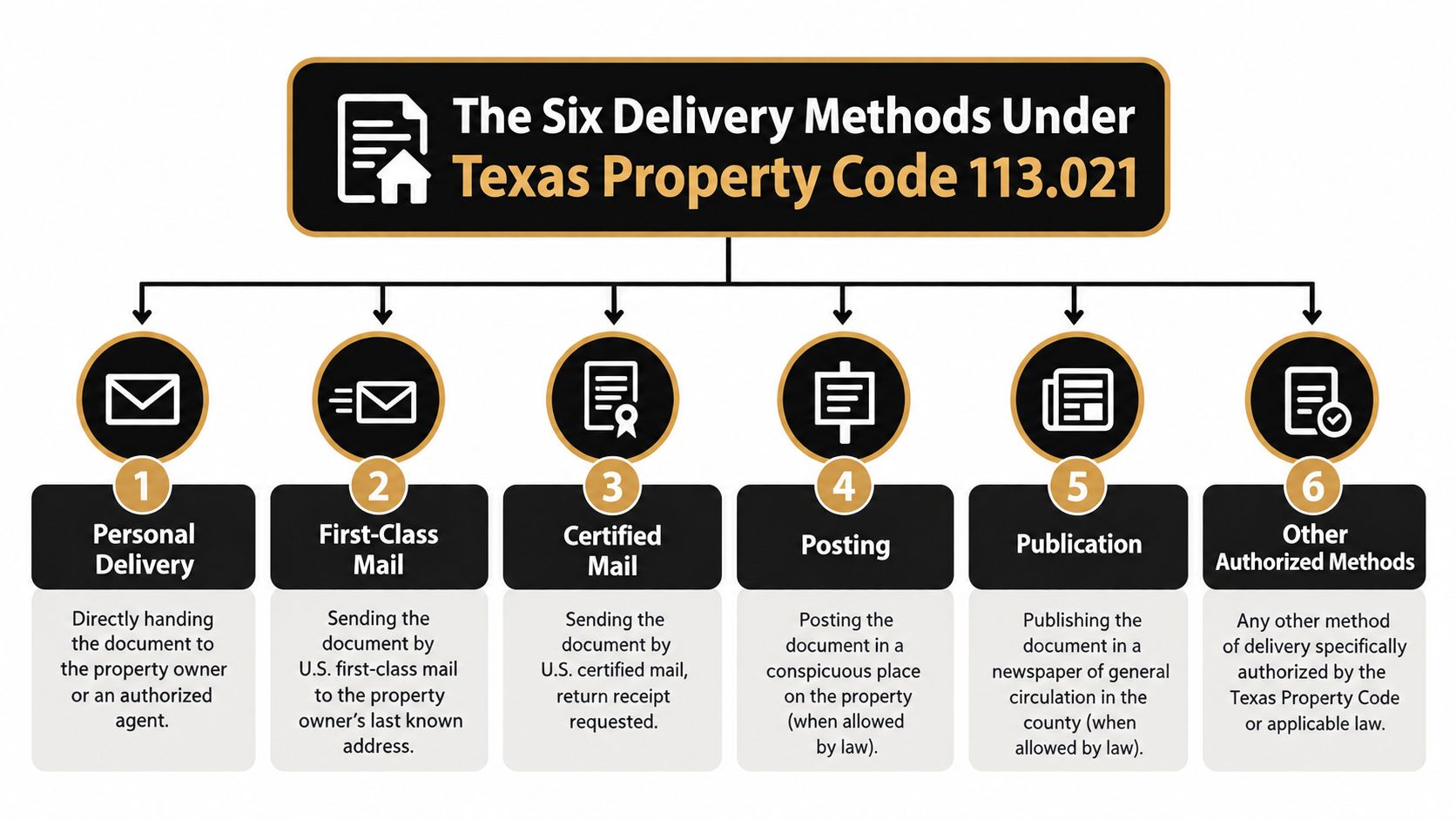
The six pathways in plain English
Pay the beneficiary directly. This can fit when the beneficiary can safely receive and use the funds. For example, a mature teenager might receive a permitted payment for an educational expense, if the trust and circumstances support that method.
Pay a guardian. When a court-appointed guardian manages the beneficiary's property or needs, the trustee may deliver the distribution to that guardian. A guardian receiving funds should provide a written receipt and maintain records showing how the money is handled.
Use the money for health, support, maintenance, or education. The trustee can apply funds directly to a qualifying need without handing cash to the beneficiary. For example, the trustee might pay a school, medical provider, or landlord for a covered expense.
Pay a custodian under the Texas Uniform Transfers to Minors Act. A UTMA custodian can receive property for a minor and manage it under the applicable custodial arrangement. This may be useful when a formal custodial structure is more practical than direct payment.
Reimburse the person caring for the beneficiary. If an aunt, sibling, or other caregiver is providing care, the trustee may reimburse that person for appropriate expenses. The trustee should verify the relationship, the care provided, and the expenses before approving payment.
Manage the distribution as a separate fund. The trustee can hold the property separately while preserving the beneficiary's continuing right to withdraw it. This can offer stability when capacity is uncertain or immediate payment would create avoidable risk.
A trustee beginning the role may also review First Steps for a Successor Trustee in Texas for information about what to do immediately after stepping into the trustee role. For broader administration questions, the firm's guide to distribution of trust assets in Texas can help organize the process.
How Good Faith Limits Absolute Discretion in Texas
The most dangerous misunderstanding is that “sole and absolute discretion” means a trustee's decision can never be questioned. Texas Property Code § 113.029 imposes a good-faith standard even when the trust uses words such as “absolute,” “sole,” or “uncontrolled.” The trustee must act consistently with the trust's terms and purposes and with the beneficiaries' interests, as explained in the Texas rule on discretionary trustee powers.

A trustee may have discretion over whether and how to distribute trust property, but the trustee must exercise that discretion in good faith and in accordance with the trust's purposes and the beneficiaries' interests.
The historical rule and the modern overlay
Traditional Texas trust explanations often emphasized that a beneficiary generally couldn't force a distribution from a trust with complete discretionary language. Courts also generally didn't substitute their own judgment for the trustee's judgment just because they might have chosen differently.
That principle still matters, but it isn't the whole analysis. Section 113.029 adds a statutory overlay. A trustee cannot use broad wording as a reason to ignore the trust's purposes, favor a family member without a sound basis, or choose a payment route that creates an avoidable risk for the beneficiary.
The connection to § 113.021 is practical. The trustee may select among the six lawful delivery methods, but the choice should fit the beneficiary and the trust. Paying an informal caregiver may be sensible when that person is providing documented care. Paying the same person without confirming the arrangement may look careless when family members dispute the caregiver's role.
Trustees should also understand their broader fiduciary duties in Texas, including loyalty, prudence, proper administration, and adequate records. The firm's overview of trust fiduciary duty in Texas provides related educational information. Good faith isn't a promise that every family member will agree. It is a disciplined process showing that the trustee made a reasoned decision for a legitimate trust purpose.
Choosing the Right Distribution Path for Each Situation
Knowing the six options is only the beginning. The harder question is which method best fits the beneficiary's capacity, the family's relationships, and the trustee's ability to document the transaction. Section 113.021 functions as a compliance menu, allowing the trustee to match the channel to the beneficiary's circumstances and operational needs while preserving an acquittance defense when the proper recipient signs a receipt. The statutory options are summarized in the Texas Property Code distribution provision.
The trust instrument comes first. A court order may also control. If neither limits the statutory choices, use the following comparison as a practical starting point.
| Distribution Method | Best Used When | Key Documentation | Liability Risk |
|---|---|---|---|
| Direct payment | The beneficiary can safely receive and use the funds | Capacity information, purpose, payment record, receipt | Higher if capacity or spending is disputed |
| Payment to a guardian | A legally appointed guardian manages the beneficiary's property | Appointment records, guardian receipt, distribution purpose | Moderate if authority or scope is unclear |
| Direct use for health, support, maintenance, or education | The trustee can pay the need directly | Invoice, provider information, trust-purpose memo | Lower when the expense is clearly documented |
| Payment to a UTMA custodian | A minor needs property managed through a custodial arrangement | Custodial details, transfer record, written receipt | Moderate if the custodial setup is incomplete |
| Caregiver reimbursement | An informal caregiver has actually paid or provided care | Expense records, caregiver statement, receipt | Higher when family members dispute the arrangement |
| Separate fund | Capacity is disputed or immediate payment could create conflict | Separate account records, withdrawal terms, trustee memo | Lower for delivery problems, but ongoing administration remains |
A family example
Suppose an adult beneficiary has cognitive limitations, and a sibling has handled groceries, transportation, and housing costs without a formal guardianship. Direct payment to the beneficiary may be risky. Payment to the sibling could be appropriate, but only after the trustee verifies the care arrangement and keeps supporting records. A separate fund may be more prudent if another relative challenges the sibling's involvement.
The right method is not always the most convenient method. It is the method that best protects the beneficiary while honoring the trust's purposes and preserving a clear administrative record.
When Discretionary Distribution Decisions End Up in Court
Trust disputes often begin with an ordinary family disagreement. One beneficiary believes the trustee favors a sibling. Another says the trustee refused to distribute anything without explaining why. A caregiver receives money during a capacity dispute, and a different relative claims the payment should have gone to a guardian.
Consider a trustee who approves repeated support for one beneficiary but gives another beneficiary no explanation for a refusal. The trustee may have a legitimate reason, such as different needs or different trust provisions. But if the trustee has no written explanation, the decision can appear arbitrary even when it wasn't.
Another dispute may involve a payment delivered to an informal caregiver. If the caregiver can't show what expenses were paid, or if the trustee never confirmed that the caregiver was providing support, the family may argue that the trustee misdelivered trust property. A written receipt helps, but it works best when paired with records showing why that recipient was selected.
What abuse of discretion means
Texas Property Code § 116.006 limits judicial interference with a discretionary decision. A court may not order a trustee to change that decision unless it finds an abuse of discretion, as stated in the Texas statute addressing judicial review of discretionary decisions.
That standard does not mean a trustee wins automatically. It means the court focuses on whether the trustee acted outside the lawful range of judgment, ignored the trust's purposes, acted in bad faith, or failed to administer the trust properly. Evidence of consistent reasoning, beneficiary needs, trust language, invoices, receipts, and communications can make the trustee's position easier to evaluate.
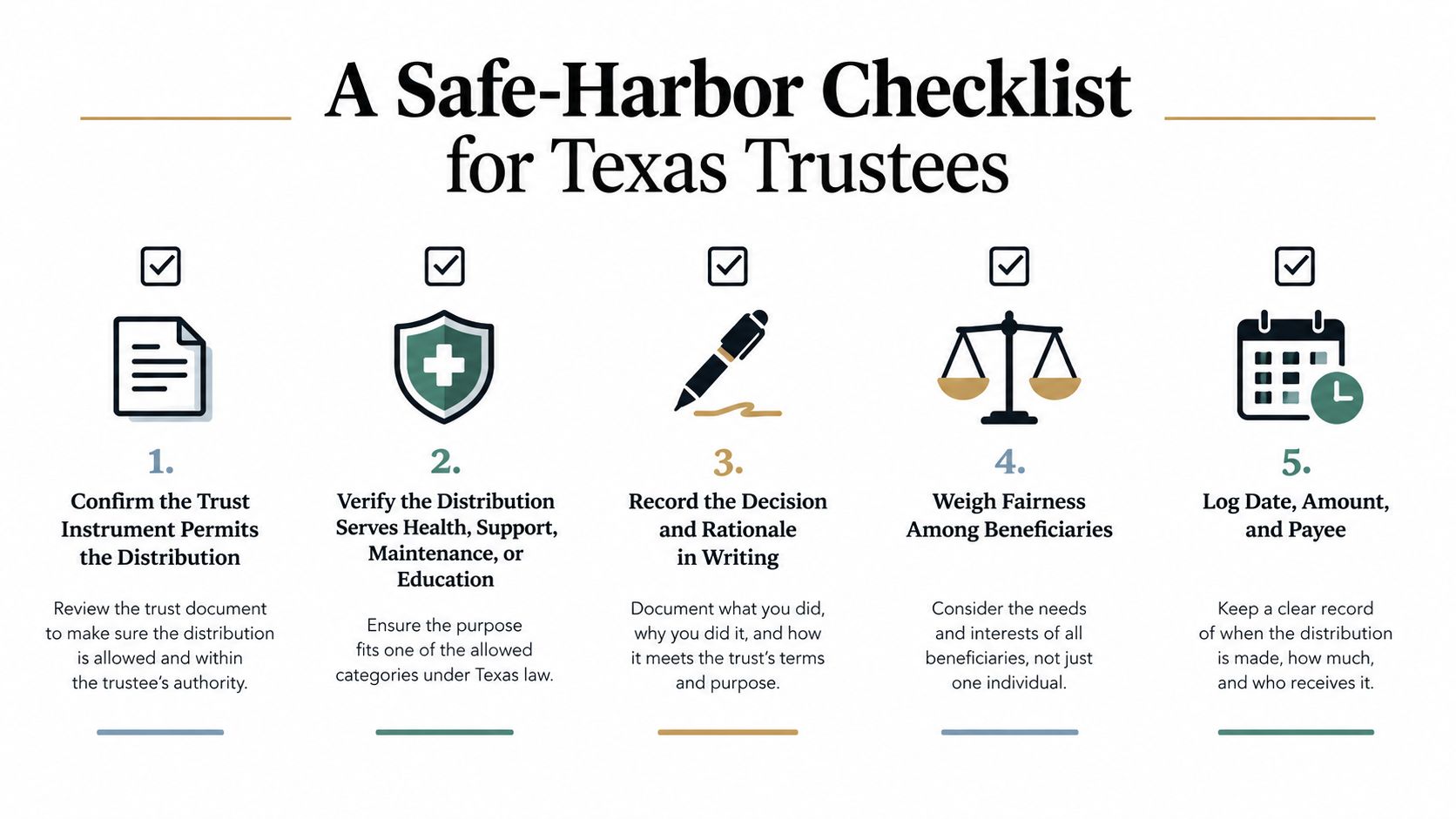
A trustee facing a challenge should preserve the decision file rather than trying to reconstruct it after litigation begins. The file should show the request, the trust provision considered, the beneficiary's needs, the chosen delivery method, the recipient's authority or relationship, and the receipt or payment confirmation.
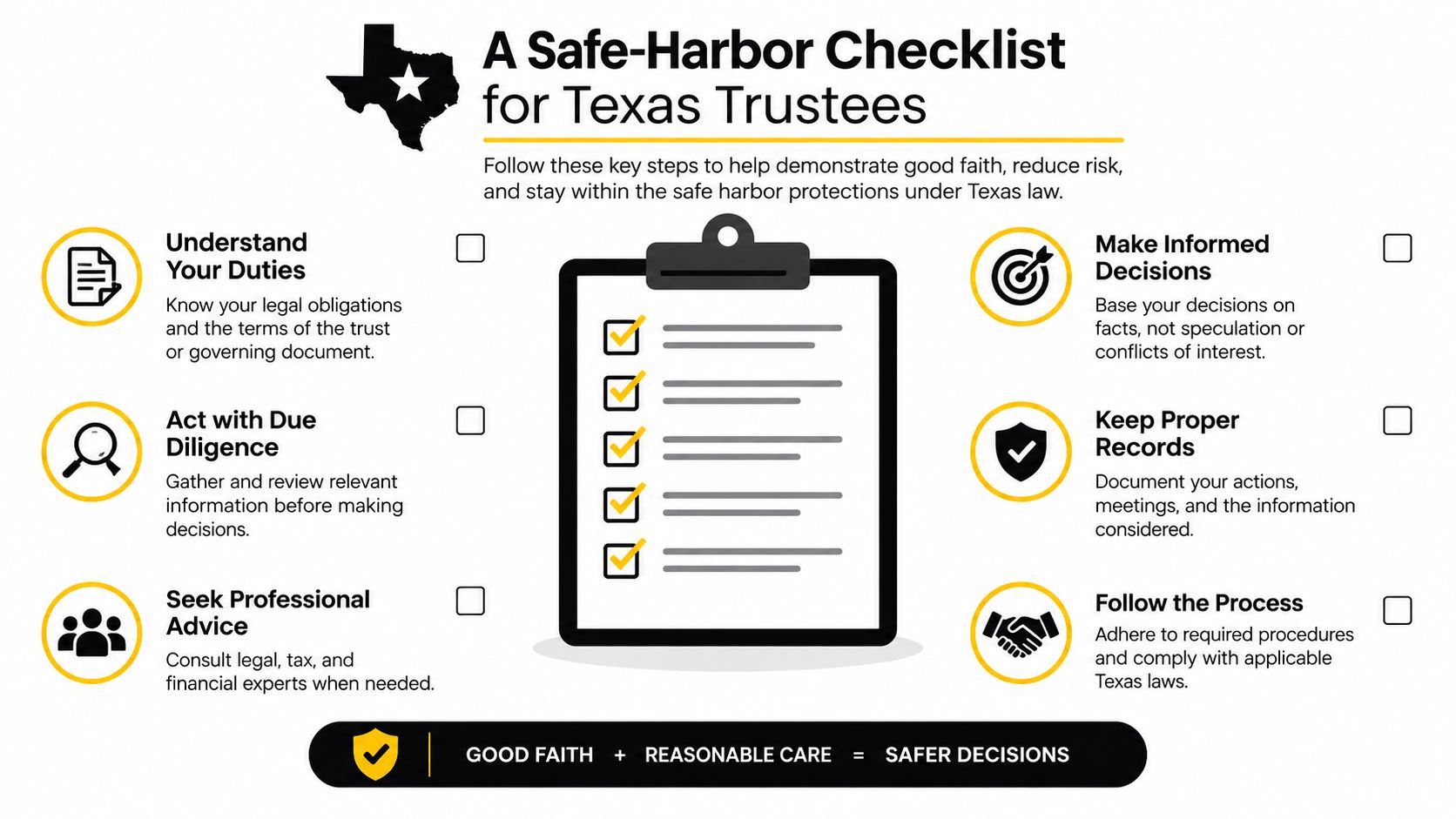
A Safe-Harbor Checklist for Texas Trustees
A careful trustee doesn't need to predict every future disagreement. The trustee does need a repeatable process before approving a discretionary distribution. Each step below addresses a different source of risk.
Read the trust instrument first. Confirm that the requested distribution is permitted and that the document doesn't impose a standard, approval process, or delivery restriction that changes the statutory defaults.
Confirm the beneficiary's capacity. Determine whether the beneficiary can safely receive property directly. Don't make a medical conclusion based only on a relative's statement, and don't assume that an adult beneficiary lacks capacity because family members disagree.
Match the method to the need. Decide whether direct payment, a guardian, direct payment of an expense, a UTMA custodian, caregiver reimbursement, or a separate fund best serves the beneficiary. Write a short explanation before issuing payment.
Verify the recipient. Confirm a guardian's authority, a custodian's role, the caregiver's actual involvement, or the beneficiary's ability to receive funds. This is especially important when relatives disagree or caregiving is informal.
Get a written receipt. The recipient should identify what was received and in what capacity. Under § 113.021, a written receipt from an appropriate recipient can provide a full and complete acquittance to the trustee.
Keep a dated decision memo. Record the trust purpose, beneficiary need, facts considered, delivery method, date, amount, and payee. Include supporting invoices, account records, and relevant communications.
Communicate consistently. A trustee doesn't have to disclose every private detail, but unexplained silence can fuel suspicion. Explain the governing trust provision and the general reason for the decision when appropriate.
Get counsel before conflict escalates. A Texas trust administration lawyer can help when capacity is disputed, family members threaten litigation, the trustee may be personally interested in the transaction, or the distribution involves complicated tax planning or asset protection concerns.
The process also supports related estate work. Families may need a Texas estate planning attorney for trust creation or modification, a probate lawyer when court administration is involved, a guardianship lawyer when incapacity requires formal protection, or asset protection counsel when trust property and creditor concerns overlap. The key is to address the right issue before a distribution becomes a crisis.
Questions Beneficiaries and Trustees Ask Most
Can a beneficiary force a distribution from a discretionary trust?
A beneficiary generally can't force a particular distribution merely because the beneficiary wants one. The trust language, the trustee's good-faith obligations, the trust's purposes, and the facts surrounding the request all matter. A beneficiary may have grounds to seek information, an accounting, or court relief if the trustee appears to be acting in bad faith, ignoring the trust, or abusing discretion.
The practical first step is a written request that identifies the need and the trust provision supporting it. Keeping the request specific helps the trustee evaluate it and creates a clear record if the disagreement continues.
What happens if a trustee pays the wrong person?
Personal liability depends on the facts. A trustee who knowingly or carelessly pays someone without proper authority may face a claim that the trust was misadministered. A trustee who verifies the recipient, selects a permitted method, documents the reason, and obtains a proper written receipt has a stronger defense.
A receipt isn't a substitute for careful decision-making. It should be part of a complete file showing why the recipient was legally and practically appropriate.
Do these delivery methods apply to every adult beneficiary?
Section 113.021 addresses distributions to a minor or incapacitated beneficiary. An adult beneficiary with full capacity may receive property directly if the trust permits the distribution and no other restriction applies. The trustee shouldn't use the statute as a reason to route an ordinary adult beneficiary's payment through a caregiver or custodian without a valid basis.
If capacity is uncertain, the trustee should avoid making a rushed determination. Medical information, guardianship records, trust language, and advice from counsel may help clarify the appropriate path.
What should a beneficiary do first when a trustee may be abusing discretion?
Start by gathering the trust document, distribution requests, notices, account information, and communications. Ask the trustee in writing for the reason for the decision and, where appropriate, an accounting or supporting information. Avoid threats or informal accusations that may make cooperation harder.
If the trustee refuses to respond, gives inconsistent explanations, or appears to favor one beneficiary without a trust-related reason, consult counsel early. A beneficiary-focused trust lawyer can evaluate fiduciary duties, available court remedies, and whether the issue is a disagreement or a potential abuse of discretion.
Getting Confident Guidance on Discretionary Distributions
Section 113.021 becomes less intimidating when you separate two questions. First, what delivery method best protects this minor or incapacitated beneficiary? Second, can the trustee show that the choice followed the trust's purposes and was made in good faith?
The statute gives trustees six delivery methods. Section 113.029 keeps discretion tied to good-faith administration, even when the trust uses broad language. Careful documentation, appropriate receipts, and consistent communication give the trustee a practical foundation for defending the decision if family conflict develops.
Trust administration may also connect with estate planning, probate, guardianship, tax planning, fiduciary accounting, trust modification, or asset protection. If you're asking how to modify a trust in Texas, dealing with an incapacitated beneficiary, or responding to a threatened trust dispute, the right legal advice can help you identify the issue before it becomes expensive or personal.
You don't have to handle every uncertainty alone. A trustee can ask for guidance before issuing a payment, and a beneficiary can seek advice before confronting the trustee. The important questions are now clear: what does the trust permit, what does the beneficiary need, who should receive the property, and what records explain the decision?
If you're managing a trust or planning your estate, Law Office of Bryan Fagan, PLLC offers Texas guidance on trustee duties, fiduciary accounting, distributions, estate planning, guardianships, asset protection, and trust disputes. Contact the firm for a free consultation and practical help with the discretionary distribution issues affecting your family.