Managing a loved one's trust can feel overwhelming, especially when the trust is named as the beneficiary of an IRA and the trustee must make decisions under pressure. A Texas family may be balancing grief, beneficiary disputes, tax concerns, creditor risk, and a deadline that doesn't move.
The central issue in conduit vs accumulation trust for retirement accounts isn't which structure wins on paper. It's how the trustee will coordinate the inherited IRA's payout schedule, the beneficiary's circumstances, the trust's protective purpose, and the tax cost of retaining retirement income. The right answer depends on who needs protection, who may receive the money later, and how the trust document works with the account's beneficiary designation.
When a Trust Inherits an IRA in Texas
A Texas parent dies with an IRA payable to a trust. The adult child is the primary beneficiary, while grandchildren are named as remainder beneficiaries. The trustee must then decide whether distributions go directly to the child or stay in the trust for protection and future needs.
That choice affects control, creditor protection, public-benefit eligibility, tax administration, and the rights of remainder beneficiaries. A conduit trust generally requires the trustee to pass retirement-account distributions to the beneficiary. An accumulation trust may let the trustee retain those distributions.
For most designated non-spouse beneficiaries of an IRA owner who died after December 31, 2019, the inherited account must be fully distributed by December 31 of the tenth calendar year after the owner's death. The beneficiary may have distribution flexibility during that period, but the account cannot remain unpaid after year 10. The IRS provides guidance on the SECURE Act's 10-year rule and exceptions in its retirement-account distribution materials.
The deadline does not answer the planning question by itself. The trustee must choreograph distributions around the beneficiary's classification, the trust's protective purpose, and the tax cost of retaining income. A distribution schedule that preserves protection may produce higher trust-level tax, while an immediate payment may create exposure to creditors, spending risks, or benefit-eligibility problems.
The trustee's immediate problem
The trustee should not treat the 10-year deadline as permission to wait until the final year. Depending on the owner's distribution status and the beneficiary's classification, annual distributions may be required before that deadline. The trustee must also determine whether the trust qualifies for treatment as a designated beneficiary under federal rules.
Begin with the documents. Review the trust instrument, confirm the IRA beneficiary designation, identify every relevant beneficiary, and collect the records requested by the plan administrator or custodian. The trustee should also document the proposed distribution schedule and the reasons for retaining or distributing each payment. A mistake at this stage can undermine the trust's intended protection.
A useful guide to trust as IRA beneficiary see-through rules in Texas explains related federal and trust-law issues. Trustees who need help organizing records and administrative tasks may use HireParalegals Virtual legal assistants for administrative support. Legal and tax decisions remain with qualified counsel and advisers.
Why the family facts matter
An outright distribution may place retirement assets within reach of creditors, divorce claims, poor spending decisions, or means-tested-benefit problems. Retention inside an accumulation trust may address those risks, but retained income can face compressed trust tax brackets and a broader beneficiary analysis.
The trustee's responsibility is to administer the trust according to its terms, follow fiduciary duties in Texas, communicate appropriately with beneficiaries, and coordinate legal and tax advice before acting. The right structure is the one that matches the beneficiary's needs and sets a workable payout sequence before the deadline arrives.
How Conduit and Accumulation Trusts Work
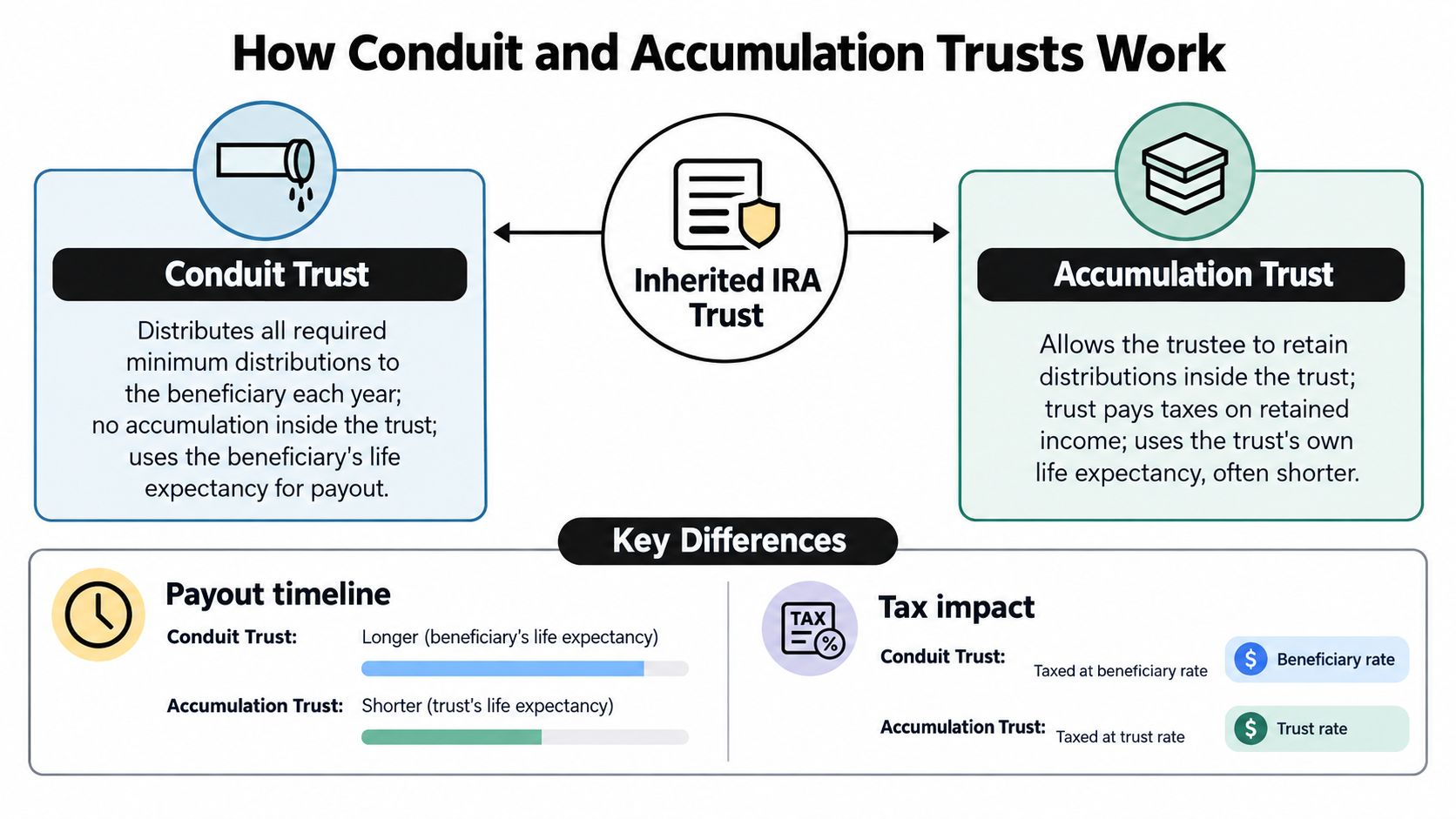
A conduit trust passes inherited retirement-account distributions through to the named beneficiary. Once the trustee receives a payment, the trust generally must distribute it directly to or for that beneficiary's benefit. The trustee cannot hold the payment for a later decision.
That structure can simplify beneficiary treatment because the person receiving the conduit payments is generally the relevant retirement-account beneficiary for post-death distribution purposes. Successor beneficiaries usually do not control that analysis. The SECURE Act changed the timing question, however. Most adult children and other non-spouse beneficiaries must complete the payout within the applicable 10-year period, so conduit drafting does not restore the older, extended payout approach.
An accumulation trust gives the trustee a different tool. The trustee may retain retirement-account distributions instead of paying them immediately to the beneficiary. Retention can support spendthrift administration, investment management, creditor protection, and continued eligibility for public benefits. It also gives the trustee discretion to choreograph payments around the beneficiary's needs and the account's deadline.
That control carries costs. The beneficiary analysis may include the primary beneficiary and certain successor or remainder beneficiaries. Income retained by the trust may also face compressed federal income-tax brackets. Families evaluating complex trust tax planning should coordinate the trust's distribution terms with legal and tax advice. Asset protection and tax efficiency often require different choices.
The SECURE Act baseline
For an IRA owner who died after December 31, 2019, most designated non-spouse beneficiaries must distribute the entire inherited retirement-account balance by December 31 of the tenth calendar year following the owner's death. The rules generally permit flexibility over the timing of payments during that period. The 10-year requirement remains the starting point for trustee decisions, not the end of the analysis.
Five categories generally receive special treatment:
- Surviving spouse, under spouse-specific rules.
- Minor child of the account owner, whose special treatment is temporary.
- Disabled individual, subject to applicable federal requirements.
- Chronically ill individual, subject to applicable federal requirements.
- Beneficiary no more than 10 years younger than the owner, under the governing rules.
An eligible designated beneficiary may generally receive distributions over the longer of that beneficiary's life expectancy or the deceased employee's remaining life expectancy. A minor child's special status generally ends at the age of majority, after which the remaining account follows the rules for the child's new classification. A trustee handling Distributing Trust Assets to Beneficiaries in Texas must align those federal rules with the trust's distribution language and set a workable payment sequence before the deadline.
Comparing Conduit and Accumulation Trusts
The practical difference is control. A conduit trust routes retirement distributions to the beneficiary, while an accumulation trust permits the trustee to hold them. That difference affects beneficiary classification, asset protection, tax administration, and the trustee's discretion.
| Criterion | Conduit Trust | Accumulation Trust |
|---|---|---|
| IRA payout beneficiary | The beneficiary receiving conduit payments is generally the relevant beneficiary | Primary and certain successor or remainder beneficiaries may matter |
| Asset protection | Distributions become available to the beneficiary and may face creditor, divorce, spending, or benefit-eligibility risks | Trustee may retain distributions for stronger protective administration |
| Tax exposure | Income generally reaches the beneficiary, where the beneficiary's tax position applies | Retained retirement income may face compressed trust tax brackets |
| Trustee control | Limited regarding retirement distributions because the trust must pass them through | Greater discretion over timing, retention, and reinvestment |
| SECURE Act timing | Most non-spouse beneficiaries still face the 10-year limit | Most non-spouse beneficiaries still face the 10-year limit |
| Drafting complexity | Beneficiary qualification may be simpler | Broader beneficiary review and detailed tax provisions are often needed |
Central trade-off: A conduit trust simplifies beneficiary treatment and routes money out. An accumulation trust retains control, but it may compress tax and require broader beneficiary qualification.
Beneficiary treatment
A conduit trust usually makes the beneficiary analysis more direct because the trust must pass distributions to the named beneficiary. That can help when the beneficiary's status is clear and the family wants a straightforward administration process.
An accumulation trust demands more careful review. If an eligible beneficiary is combined with a non-eligible beneficiary, the trust may lose access to the more favorable payout treatment associated with the eligible beneficiary. The result can be the standard 10-year rule for the trust as a whole.
Protection against creditors and divorce
Conduit treatment can be a poor fit for a beneficiary who is vulnerable to creditors, divorce, reckless spending, or loss of means-tested benefits. Once the distribution reaches that beneficiary, the trustee may have little ability to preserve the money inside the trust.
Accumulation treatment offers a stronger protective environment. The trustee may retain distributions, apply them for approved needs, and manage the assets under the trust's spendthrift and discretionary provisions. That protection comes with responsibility. The trustee must act impartially and follow the trust's terms rather than using discretion for personal preferences.
Tax bracket exposure
Retaining inherited IRA distributions can create tax inefficiency because trusts reach higher federal income-tax brackets at relatively low taxable-income levels. Distributing income to an individual beneficiary may produce a different tax result, but the beneficiary then receives greater control over the funds.
The correct choice depends on the family's priorities. If protecting a vulnerable beneficiary is essential, the family may accept greater tax administration. If the beneficiary is financially mature and protection risks are low, routing distributions out may be more efficient.
Texas Scenarios That Change the Answer
The same IRA can require a different trust design depending on the beneficiary's age, health, financial judgment, and family structure. A Texas trustee should not copy a form used for another family without reviewing the beneficiary classification and the trust's protective purpose.
A minor grandchild
A grandparent leaves an IRA to a trust for a minor grandchild. The child may fall within a special SECURE Act category as the owner's minor child only when the child is the account owner's child, not merely a grandchild. Even when the beneficiary qualifies for special treatment, that status generally ends when the child reaches the age of majority, as explained in IRS Publication 590-B.
A conduit structure may send required distributions to the minor's trust and then onward for the child's benefit. That can create immediate management and benefit-eligibility concerns. An accumulation structure may allow the trustee to retain funds, pay approved expenses, and avoid placing retirement proceeds directly under a young beneficiary's control.
Drafting implication: State clearly whether the trustee may retain distributions, how expenses are approved, and what happens when the beneficiary reaches adulthood.
A blended family
A Texas parent leaves retirement assets to a trust benefiting a child from a prior marriage, with a new spouse or other descendants named as successor beneficiaries. An accumulation trust may provide useful control, but its broader beneficiary pool can affect the trust's retirement-account classification.
If one beneficiary qualifies for favorable treatment and another does not, the trust may face the less favorable rule. The trustee must review the entire beneficiary structure before accepting or requesting distributions.
Drafting implication: Separate shares or clearly defined beneficiary classes may be necessary. The beneficiary designation must also match the trust instrument.
A disabled adult child
A disabled adult child receives means-tested benefits. A conduit trust can force retirement distributions into the child's hands, potentially affecting benefit eligibility and exposing the assets to claims or poor decisions. An accumulation trust may preserve a supplemental-needs approach by allowing the trustee to retain and apply funds without making unrestricted distributions.
The trustee must still confirm the beneficiary's disability status, preserve required documentation, and coordinate with benefits counsel. A trust that looks protective in theory can fail if the trustee pays funds directly or ignores the benefit program's rules.
For families worried that a beneficiary designation doesn't match the trust, a review of beneficiary designation disputes inside a funded trust can help identify where administration and intent diverge.
Drafting Tips and Sample Language
A trust that names an IRA beneficiary must do more than say “hold the money in trust.” The instrument should explain how retirement distributions are handled, who may receive them, and what discretion the trustee has after the account owner dies.
Start with the conduit language
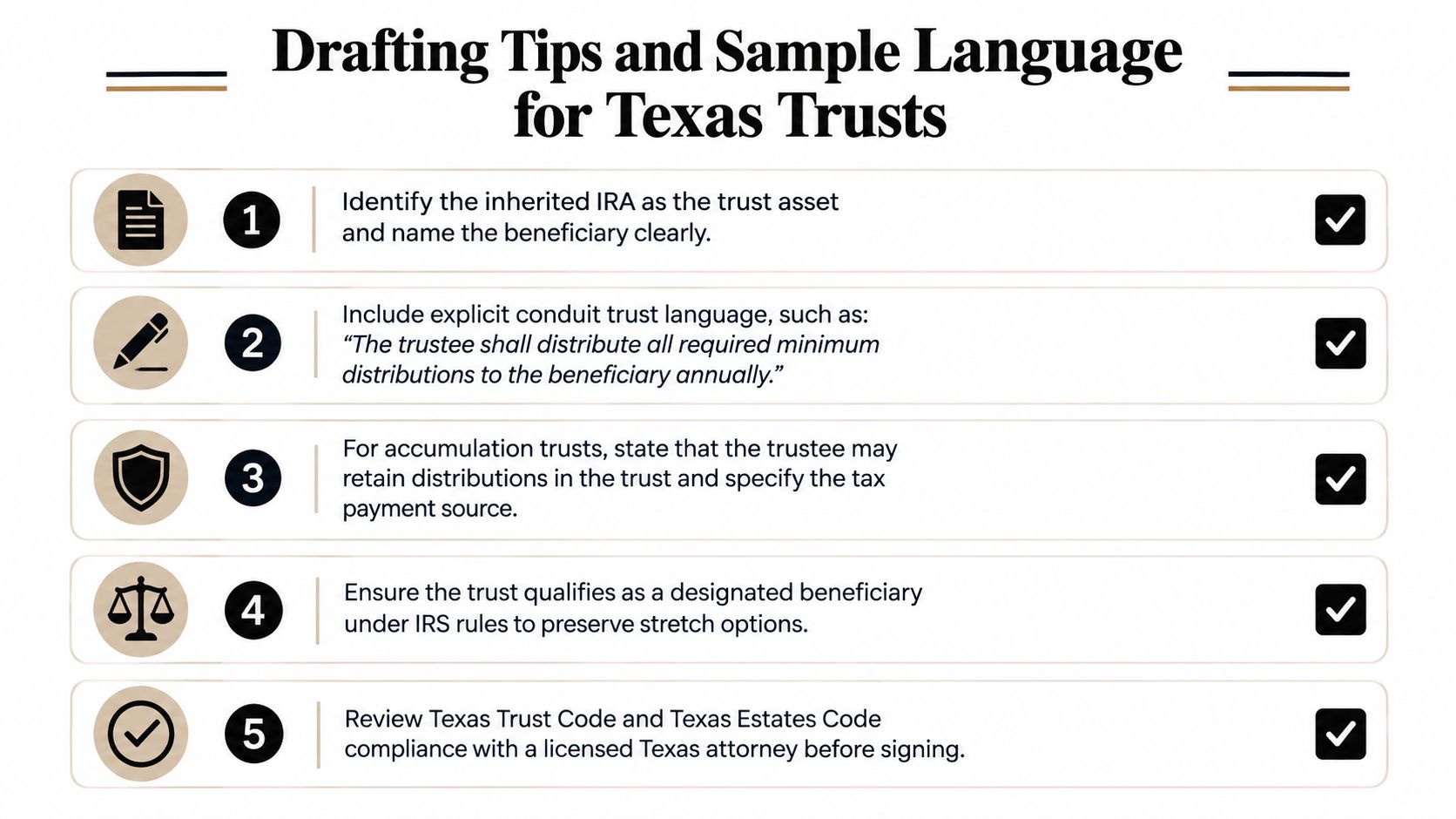
A conduit provision should identify the retirement account and require the trustee to distribute retirement-account proceeds to the named beneficiary when received. Sample concepts may include:
Conduit approach: The trustee shall distribute each retirement-account distribution received by the trust to or for the benefit of the designated beneficiary in accordance with the trust's terms and applicable federal law.
That language must be reviewed against the entire trust. A clause that requires immediate payment may undermine a separate provision intended to protect a beneficiary from creditors or preserve means-tested benefits.
Build real discretion into an accumulation trust
An accumulation provision should authorize the trustee to retain distributions rather than forcing an immediate payment. It should also address investment authority, permissible uses, tax reserves, and the source of tax payments.
Accumulation approach: The trustee may retain retirement-account distributions in the trust and may distribute or apply them for the beneficiary's needs under the standards stated in this agreement.
“May” matters. If the trustee has no real discretion, the trust may not deliver the protection the family expects. The instrument should also explain whether the trustee may distribute income, principal, or both, and how the trustee should consider public benefits.
Confirm see-through requirements
The trust must generally be valid under state law, irrevocable at the account owner's death, and structured around identifiable beneficiaries. The trustee must also deliver required trust documentation to the plan administrator or account custodian on time.
An accumulation trust generally requires examination of both primary and certain successor or remainder beneficiaries. If an eligible beneficiary is combined with a non-eligible beneficiary, the trust may lose favorable payout treatment, as explained in this analysis of see-through conduit and accumulation trusts.
Coordinate the beneficiary designation
The IRA beneficiary designation and trust document must point to the same plan. A well-drafted trust won't control an account if the form on file names someone else. The trustee should obtain the account statement, beneficiary designation, trust certification, death certificate, and any documents requested by the custodian before selecting a distribution strategy.
A Texas estate planning attorney should also review how the trust interacts with the Texas Trust Code and Texas Estates Code. Those state-law rules govern administration and fiduciary conduct, while federal retirement-account rules govern the account's payout treatment.
Administering the Trust Under Texas Law
Once the owner dies, the trustee must shift from drafting theory to careful administration. The trustee owes duties of loyalty, impartiality, prudence, and accurate accounting under Texas fiduciary principles. The Texas Trust Code provides the main framework for trust administration, while the Texas Estates Code may affect related estate and fiduciary matters.

The first administration tasks
A trustee should create a written administration file and work through the following sequence:
- Confirm the account record. Obtain the IRA statement, account owner's death information, and beneficiary designation on file.
- Review the trust instrument. Identify conduit or accumulation language, beneficiary classes, successor beneficiaries, and tax provisions.
- Notify the custodian. Submit the trust documents and other materials the plan administrator requests.
- Classify the beneficiaries. Determine whether any beneficiary is a surviving spouse, minor child, disabled individual, chronically ill individual, or person no more than 10 years younger than the owner.
- Check distribution timing. If the owner died after required minimum distributions had begun, annual distributions may also be required during years one through nine, followed by complete distribution in year 10. The Congressional Research Service's guidance on annual distributions and the 10-year deadline should be reviewed with tax counsel.
- Coordinate tax administration. Ask the CPA whether retained distributions require trust-level tax reporting, reserves, or an income tax return.
Avoid avoidable fiduciary mistakes
A trustee shouldn't commingle inherited retirement proceeds with unrelated trust property. Separate accounting helps show what came into the trust, what was distributed, what was retained, and which beneficiary received the benefit.
The trustee also shouldn't pay a beneficiary directly when the instrument requires accumulation. That action can defeat the protective purpose and create a dispute with other beneficiaries. Trustees seeking a practical overview can review this fiduciary guide for successor trustees.
A formal tax filing may also be necessary depending on the trust's income and distributions. The trustee can review trust tax return Form 1041 with the CPA and attorney.
Administration rule: Keep the beneficiary classification, distribution decision, tax calculation, and supporting documents together. If the decision is challenged, the written record will matter.
Choosing the Right Structure and Next Steps
A conduit trust usually fits a financially mature beneficiary who doesn't face significant creditor, divorce, spending, or public-benefits concerns. It offers simpler beneficiary treatment and sends retirement distributions out instead of leaving the trustee to manage retained IRA income.
An accumulation trust usually fits a vulnerable beneficiary, a spendthrift concern, a beneficiary receiving means-tested benefits, or a blended family where retention and controlled administration matter more than tax simplicity. It may be less tax-efficient, but protection can justify that cost.
Use this short decision checklist:
- Who receives the distributions, and are they financially capable?
- Does anyone depend on means-tested benefits?
- Could creditors, divorce, or spending decisions threaten the assets?
- Who are the remainder beneficiaries?
- Does the trust authorize retention and provide tax-allocation rules?
- Has the custodian received the required trust documentation?
- Are annual distributions required before the final deadline?
The Law Office of Bryan Fagan, PLLC helps Texas families and fiduciaries with trust administration, estate planning, asset protection, beneficiary disputes, and related probate and guardianship matters. A Texas trust administration lawyer can review the trust, IRA designation, beneficiary classifications, and administration record before a costly mistake occurs.
If you're managing a trust or planning your estate, contact The Law Office of Bryan Fagan, PLLC for a free consultation. Our attorneys provide trusted, Texas-based guidance for coordinating inherited retirement accounts, trustee duties, tax planning, and beneficiary protection. Visit Law Office of Bryan Fagan, PLLC to take the next step.