Managing a loved one's trust can feel overwhelming, especially when an inherited IRA is involved. A Texas family may expect the retirement account to pass directly to the children, only to learn that a trust was named as beneficiary. Suddenly, the trustee must understand federal distribution rules, Texas fiduciary duties, custodian procedures, and the family's long-term protection goals.
A trust can be an IRA beneficiary, but it must be drafted and administered carefully. The trust as IRA beneficiary see-through rules in Texas connect federal retirement regulations with the Texas Trust Code. A trust may protect assets from creditors, divorce, poor financial decisions, or loss of needs-based benefits, yet the same structure can create tax and administration problems if the beneficiary designations and trust terms don't work together.

A careful review can also reveal whether a beneficiary designation dispute exists inside an otherwise funded trust. Families dealing with that concern may benefit from reviewing beneficiary designation disputes inside a funded trust before anyone requests a transfer or distribution.
Navigating Inherited Retirement Accounts in Texas
Consider a common situation. A parent dies in Texas, and the adult children learn that the parent's IRA names a family trust rather than naming them individually. One child may need immediate financial help, another may have creditor concerns, and a third may receive needs-based benefits. The trustee now has to determine who can receive the IRA proceeds, how much must be distributed, and whether the trust provides the protection the parent intended.
The first distinction is simple but important. When an IRA names an individual, the custodian usually works directly with that person under the applicable beneficiary rules. When an IRA names a trust, the trust becomes the legal recipient, and the trustee must apply the trust terms while satisfying federal requirements. The IRS may look through the trust to qualifying individual beneficiaries, but it won't automatically treat every trust as though it were an individual beneficiary. The federal framework is described in the IRS final regulations and 2024 interpretive guidance.
Why families use trusts for retirement accounts
A Texas parent might use a trust because a beneficiary is young, financially inexperienced, vulnerable to creditors, facing a divorce, or receiving public benefits. The trust can establish a trustee-controlled process instead of placing the inherited funds directly in the beneficiary's hands. That control may support the family's goals, but it also means the trustee carries legal and tax responsibilities.
The Texas Trust Code supplies the state-law foundation for the trust. The Internal Revenue Code and federal retirement regulations determine whether the trust can receive favorable distribution treatment. These systems must be reviewed together, not in isolation.
A trust can provide protection, but protection doesn't replace careful retirement-account planning.
The family should gather the trust instrument, all retirement-account statements, beneficiary forms, amendments, and death records. A Texas trust administration lawyer can then help determine whether the trust became irrevocable, who may benefit, and how the custodian should process the inherited account.
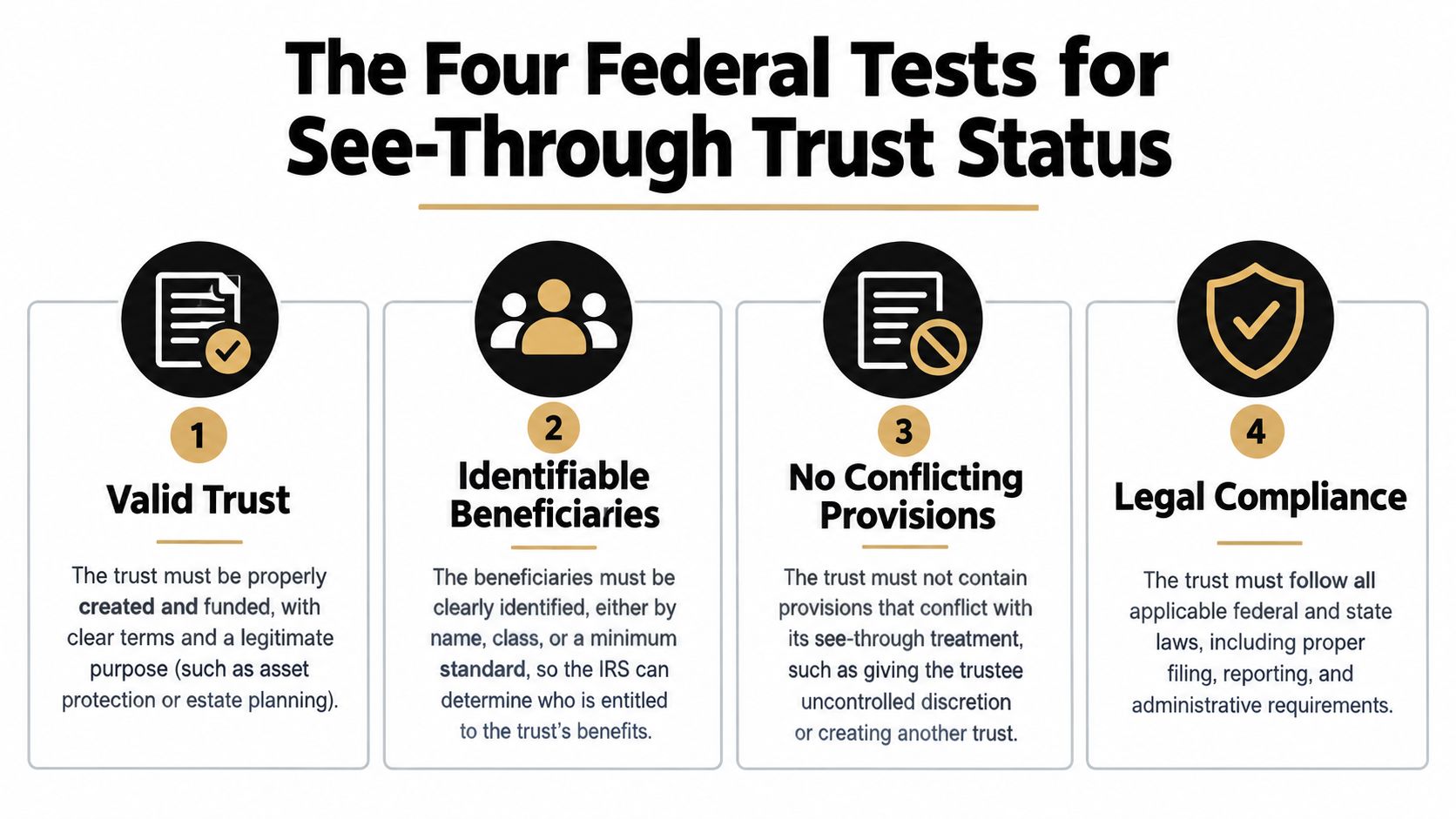
The Four Federal Tests for See Through Trust Status
A trust generally receives see-through treatment only when it satisfies four federal requirements. Think of these requirements as four legs supporting a table. If one leg fails, the distribution analysis may change, even when the trust was created with good intentions.
The trust must be valid under Texas law
The trust must be valid under applicable state law, or it must be valid except for lacking a trust corpus. For a Texas trust, counsel will examine whether the trust was properly created, whether the settlor had capacity, whether the trustee and beneficiaries were identified, and whether the trust terms are legally operative.
This review involves Texas trust principles, including the requirements addressed by the Texas Property Code. A trust that was never validly created can't receive see-through treatment just because the beneficiary form names it.
The trust must be irrevocable at death
The trust must be irrevocable when the IRA owner dies, or it must become irrevocable at that moment. A revocable living trust may become irrevocable under its terms at the settlor's death, but the actual language matters.
The trustee should identify the precise provision that causes irrevocability. An assumption that “the trust becomes fixed at death” isn't enough for administration. Counsel should compare the trust instrument with the account owner's death date and the custodian's records.
The beneficiaries must be identifiable
Federal rules require the beneficiaries relevant to the retirement interest to be identifiable. The trustee should look beyond the first beneficiary listed and examine every person who might receive IRA proceeds under the trust.
A broad class of unnamed heirs, an uncertain successor beneficiary, or a contingent beneficiary may affect the analysis. The IRS also recognizes circumstances in which a residual beneficiary can be disregarded, including situations where that person can receive retirement-account amounts only after another residual beneficiary dies. The trust's language and timing determine whether that exception applies.
Required documentation must be handled properly
The traditional federal framework requires trust documentation to be provided to the plan administrator or custodian. The trustee should preserve the trust, amendments, beneficiary information, and written communications in a complete administration file.
If one requirement fails, the trust may be treated as a non-designated beneficiary rather than receiving the intended look-through treatment. That can produce a shorter or less favorable payout framework. A trustee handling distributions should also understand Distributing Trust Assets to Beneficiaries in Texas as part of following the trust's terms.
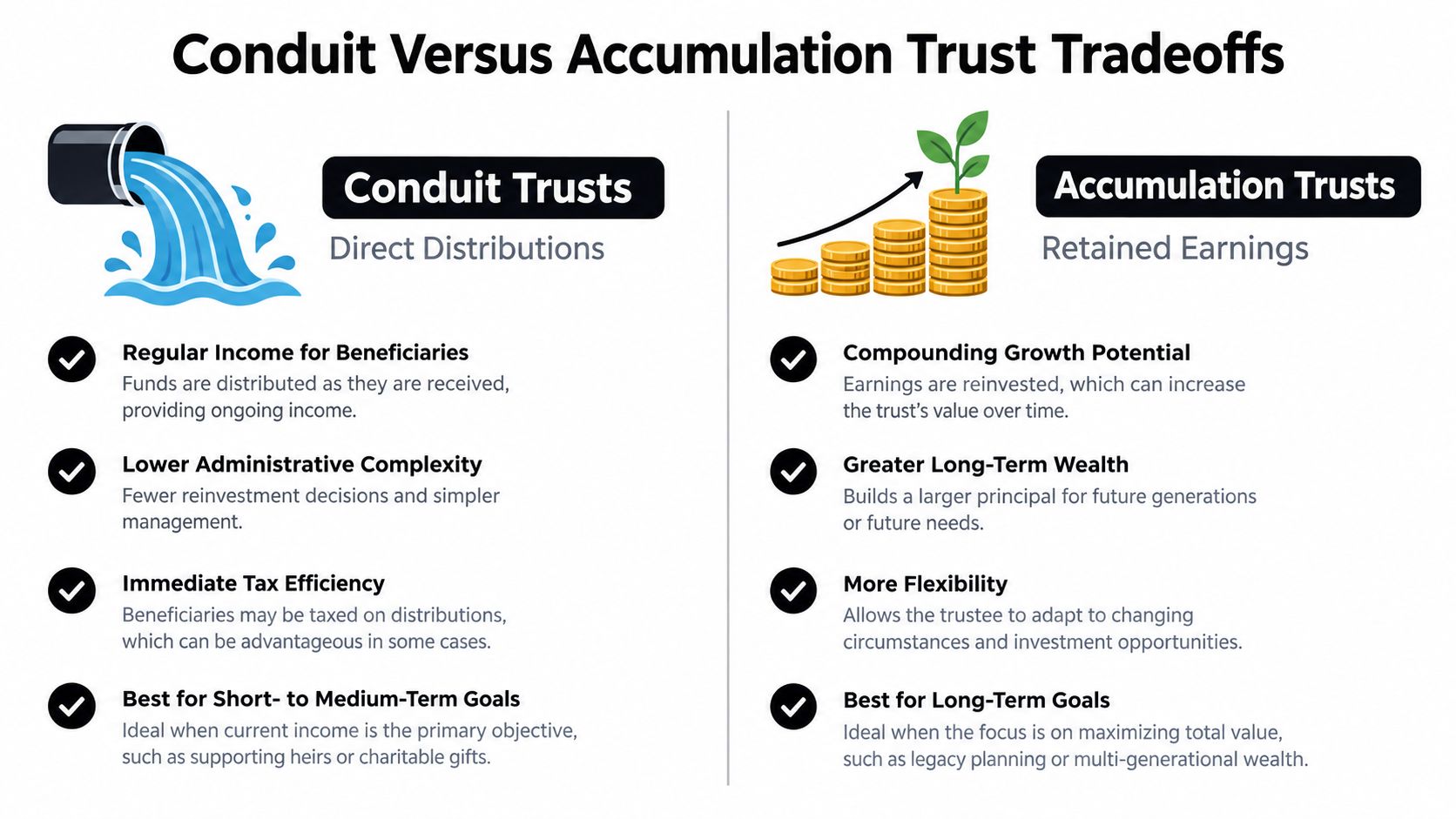
Conduit Versus Accumulation Trust Tradeoffs
Qualifying as a see-through trust answers only one question. It doesn't determine whether the trust is good for the family's tax, protection, and distribution goals. The next issue is how the trust handles money received from the inherited IRA.
Conduit trusts send distributions onward
A conduit trust generally requires the trustee to pass retirement-account distributions directly to the named beneficiary. This structure can be easier to administer because the trustee doesn't retain the distributed retirement income.
The tradeoff is control. Once the distribution reaches the beneficiary, it may be exposed to creditor claims, divorce negotiations, spending problems, or an effect on needs-based benefits. A conduit provision may therefore satisfy an income-distribution objective while undermining the family's asset-protection objective.
For example, a parent may want an adult child to receive retirement income but worry about the child's pending divorce. A conduit trust may require the trustee to distribute the money even though the parent wanted long-term protection. The trust's legal structure and the beneficiary's circumstances must be analyzed together.
Accumulation trusts retain distributions
An accumulation trust permits the trustee to retain some or all of the IRA distribution under the trust. This can preserve a protective barrier and allow the trustee to apply discretionary standards. The trustee may be able to hold funds for a vulnerable beneficiary or preserve assets for remainder beneficiaries, subject to the trust terms and fiduciary duties.
The tax cost can be significant. The payout analysis may look to the oldest relevant beneficiary, and an accumulation trust for a non-disabled beneficiary can be subject to the ten-year rule even when that beneficiary might otherwise qualify as an eligible designated beneficiary. Trust income tax brackets are also compressed, so retaining income can create a different tax result than distributing it.
| Structure | Primary benefit | Primary concern |
|---|---|---|
| Conduit trust | Directs IRA distributions to the beneficiary | Reduced control after distribution |
| Accumulation trust | Retains funds for protection and management | More complex payout and tax analysis |
| Either structure | Can support a carefully drafted estate plan | Qualification alone doesn't guarantee a good outcome |
The right question isn't only whether the trust qualifies. Ask which beneficiary controls the payout period and who bears the tax cost.
A trustee should model the trust's likely results before accepting inherited IRA assets. Review trustee discretion, successor beneficiaries, disability status, required distributions, and the effect of retaining income. A technically valid accumulation trust may still produce a poor result if the tax burden and family objectives weren't considered together.
How the SECURE Act Changed Texas Estate Planning
The SECURE Act replaced the old assumption that most beneficiaries could stretch inherited IRA distributions over a lifetime. Under the current framework, the ten-year rule can require the entire inherited IRA balance to be distributed by December 31 of the calendar year containing the tenth anniversary of the owner's death, as explained in IRS Publication 590-B and related guidance.

Who generally falls under the ten-year rule
Many designated beneficiaries who aren't eligible designated beneficiaries must use the ten-year framework. A trust that ultimately benefits adult children or other non-eligible individuals commonly raises this issue. If the IRA owner died before required minimum distributions began, the entire remaining balance may not need to be withdrawn during the first nine years, but it must be withdrawn by the end of the tenth year.
If the owner died after required minimum distributions had begun, annual distribution requirements may also apply during the ten-year period under the applicable regulations. The trustee must identify which rule applies rather than waiting until the final year.
A surviving spouse or a qualifying disabled beneficiary may receive different treatment under the federal rules. Trust drafting becomes especially important when a beneficiary's disability, age, or other status may affect the payout period.
Timing matters even when the deadline is distant
A trustee may be tempted to delay distributions until the final year. That can concentrate taxable income and conflict with the trust's distribution standards. On the other hand, distributing too quickly may remove funds from a protective trust or create an unnecessary tax burden for the beneficiary.
A CPA can model withdrawals throughout the ten-year period, while the trustee applies the trust's terms and fiduciary duties. Families seeking a plain-language overview of required minimum distribution concepts may also consult this Gold IRA Association RMD guide, then confirm the advice with their own tax and legal professionals.
The trustee, not the underlying beneficiary, must coordinate withdrawals, reporting, accounting, and compliance. The trust's protective purpose doesn't suspend the federal deadline.
The 2025 Documentation Rule Split for IRAs and 401ks
Many trustees still hear that a trust agreement must be delivered to the custodian by October 31 of the year after death. That advice may reflect older guidance, and it can create confusion when a decedent owned both an IRA and a qualified employer plan.
Final regulations effective for distributions beginning January 1, 2025 distinguish between IRAs and qualified plans. For an IRA beneficiary trust, the trust generally no longer has to provide the custodian with a current trust agreement under the updated rule. Trusts named on qualified plans, including 401(k) plans, remain subject to documentation requirements under the applicable framework. The distinction is discussed in current developments in taxation of individuals.
Why mixed accounts create an administration trap
A Texas decedent may have an IRA at one custodian and a 401(k) with a former employer. The trustee can't assume that one submission procedure, form, or deadline applies to both accounts. A rollover can add another layer of complexity because the account type and the plan administrator's procedures may change.
The trustee should create separate files for each retirement account and ask each custodian or plan administrator for its current requirements. Keep written confirmation of what was requested, what was submitted, and when the administrator accepted the information.
Should an IRA trustee submit documents voluntarily
Even when the federal rule no longer expressly requires a current trust agreement for an IRA, voluntary submission may still make practical sense. It can create a clear administrative record, help the custodian understand the beneficiary structure, and reduce later confusion about the trust's terms.
That choice depends on the custodian's procedures, the trust language, and the payout treatment the trustee is trying to preserve. A prudent trustee shouldn't rely blindly on a legacy form or assume a custodian's internal deadline accurately reflects current federal law. Legal and tax counsel can help decide what to submit and how to document the decision.
Trustee Duties Under the Texas Trust Code
Texas fiduciary duties apply to the trustee's handling of an inherited IRA. The trustee must follow the trust, act loyally, exercise reasonable care, keep proper records, and treat beneficiaries fairly under the circumstances. The trustee also must understand whether the trust's terms require immediate distribution, allow accumulation, or preserve funds for later beneficiaries.
Texas Property Code Chapter 111 defines a beneficiary broadly as a person for whose benefit property is held in trust, regardless of the nature of that person's interest. Texas law also recognizes a current beneficiary as someone receiving, or eligible to receive, a distribution of trust income or principal on the relevant date. These definitions matter because the trust's beneficiary structure affects both administration and federal retirement analysis. The relevant Texas definitions appear in Texas Property Code Chapter 111.
A practical first 90-day checklist
A trustee should move methodically rather than treating the custodian's first request as the entire administration process.
Secure the records. Collect the trust, every amendment, the death certificate, beneficiary forms, account statements, and communications with each administrator.
Confirm the trust status. Determine whether the trust was validly created and whether it became irrevocable at the account owner's death.
Map every possible beneficiary. Identify current beneficiaries, contingent beneficiaries, residual beneficiaries, and anyone whose interest may arise after another beneficiary's death.
Separate account types. Treat IRAs, 401(k) accounts, and other qualified plans as separate administration matters. Ask each provider for current procedures.
Coordinate advice. Work with estate counsel and a CPA before accepting or distributing inherited IRA assets. The trustee should understand tax reporting, required withdrawals, and the trust's distribution standards.
Communicate carefully. Explain the process to beneficiaries without promising a payout date or amount until the legal and tax review is complete.
A trustee managing caregiving responsibilities may also find practical financial-management ideas in how Velma supports family caregivers. That resource doesn't replace fiduciary or tax advice, but organization can help a family preserve records and meet deadlines.
For a focused review of trustee responsibilities, see Texas Trust Code trustee duties. If beneficiaries disagree about distributions, the trustee should preserve the records, avoid favoritism, and seek counsel before making a contested payment.
Securing Your Family's Legacy with Professional Guidance
A retirement account held in trust sits at the intersection of federal tax law, Texas trust law, and practical custodian procedures. A drafting defect can affect the payout framework. A misunderstanding about the 2025 IRA and 401(k) documentation split can lead to inconsistent administration. A valid see-through trust can still produce an unwanted result if the conduit or accumulation structure doesn't match the family's protection and tax goals.
The right review should answer several questions:
- Is the trust valid under Texas law?
- Did it become irrevocable at death?
- Are all relevant beneficiaries identifiable?
- Which account rules apply to each custodian?
- Who controls the payout period?
- Should the trustee distribute or accumulate retirement income?
- How will the trustee document decisions and communicate with beneficiaries?
Families may also benefit from broader planning conversations about professional relationships and building an authentic advisor brand, particularly when attorneys, CPAs, financial advisers, and trustees need to coordinate. The legal work remains specific to the trust, beneficiary designation, account type, and family circumstances.
A Texas estate planning attorney can review or draft retirement-focused trust provisions, while a probate lawyer, guardianship lawyer, or asset-protection counsel may address related family needs. The Law Office of Bryan Fagan, PLLC provides Texas trust administration guidance concerning fiduciary accounting, beneficiary communication, asset distribution, trust disputes, estate planning, guardianships, and asset protection. Families seeking focused help can review the firm's trust administration attorney services in Texas.
The rules are complex, but families don't have to handle them alone. A careful legal and tax review can turn an uncertain inherited-account process into a documented plan that respects the trust, the beneficiaries, and the account owner's intentions.
If you're managing a trust or planning your estate, contact Law Office of Bryan Fagan, PLLC for a free consultation about inherited IRAs, see-through trust requirements, fiduciary duties in Texas, and beneficiary protection. Our Texas attorneys can help review the trust, coordinate with retirement-account custodians and tax advisers, and guide your family through administration or trust changes with clarity and compassion.