Texas generally imposes a four-year statute of limitations on breach-of-fiduciary-duty claims arising from trustee misconduct, but that deadline applies strictly to monetary damages and doesn't necessarily eliminate every form of relief available to beneficiaries. A court may still consider equitable remedies, including trustee removal, when current administration problems or statutory grounds support intervention.
Managing a loved one's trust can feel overwhelming, especially when you discover a questionable distribution, missing account information, or a transaction that appears to benefit the trustee. Many beneficiaries immediately ask whether they've waited too long. The answer depends on what remedy you're seeking, when legal injury occurred, and when the problem was known or reasonably should have been discovered.
The phrase “statute of limitations breach of fiduciary duty Texas trust” describes a legal issue that requires more than counting calendar years. The trust document, Texas Trust Code, fiduciary principles, accountings, communications, and the precise relief requested all matter. A Texas trust administration lawyer can help separate an expired damages theory from a potentially viable request for accounting, removal, restoration, or other court-supervised relief.
Understanding the Texas Trust Limitations Timeline
A beneficiary may receive trust records years after a parent's death and notice that an investment was sold below expectations, a distribution favored one family member, or the trustee used trust property for personal purposes. The beneficiary may feel shocked and assume the delay ends the matter. That assumption can be wrong, but delay creates serious evidence and limitations concerns.
Texas generally applies a four-year limitations period to breach-of-fiduciary-duty claims, including claims based on trustee misconduct, under Texas Civil Practice and Remedies Code § 16.004(a)(5). The statute identifies breach of fiduciary duty among claims subject to that period. Texas Civil Practice and Remedies Code § 16.004 provides the statutory reference.
The key question isn't always the date a trustee signed a document or moved money. Texas courts generally focus on when the claimant knew, or should have known through reasonable diligence, of the wrongful injury. That rule requires a transaction-by-transaction review rather than a broad conclusion that the trustee's conduct was “ongoing.”
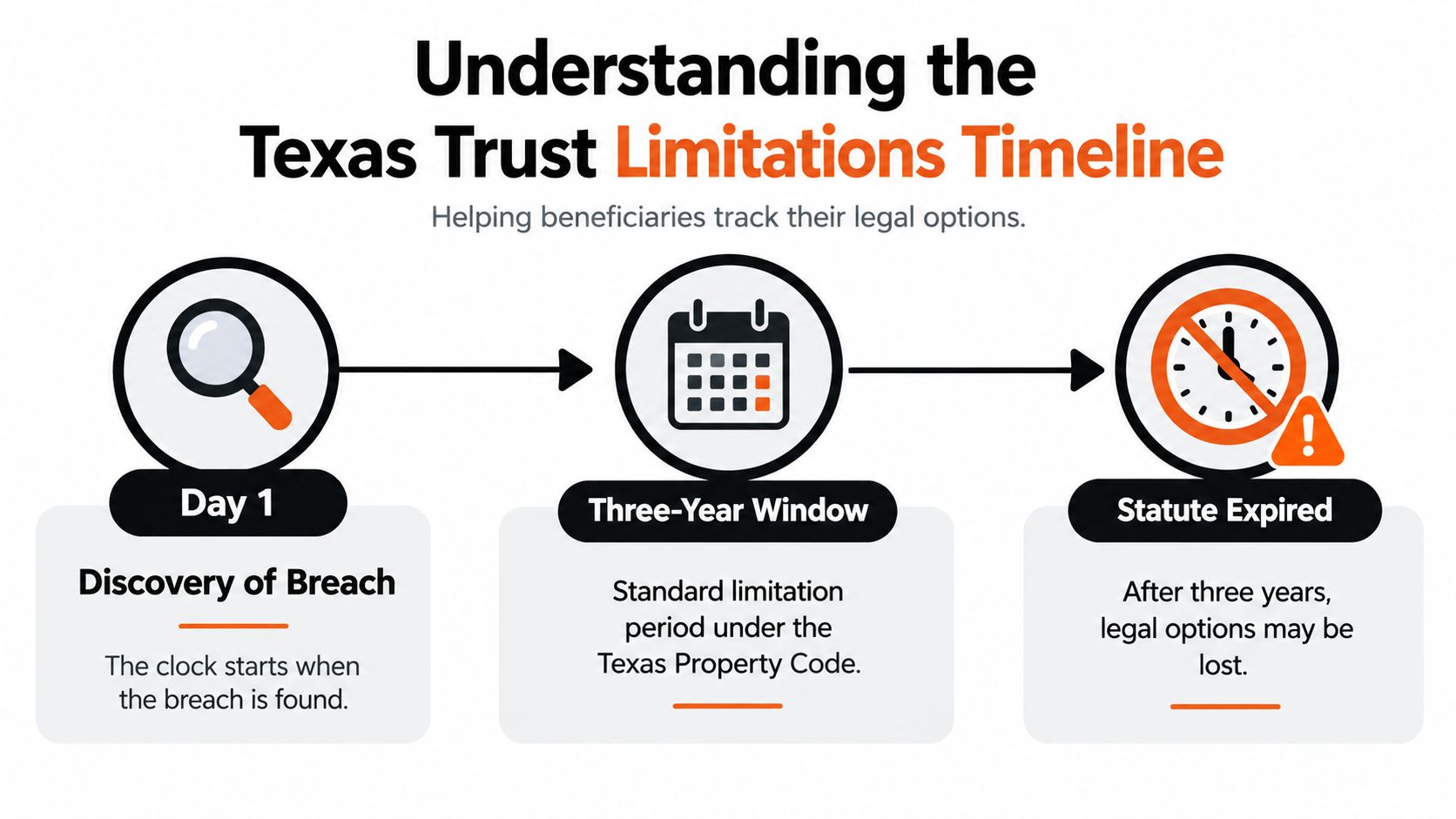
The required graphic uses a three-year description, but the verified Texas rule applicable to breach-of-fiduciary-duty claims is generally four years, not three. Beneficiaries shouldn't rely on a generic timeline graphic or assume every trust dispute has the same deadline. A careful review should identify:
- The challenged act: Determine whether the issue involves self-dealing, an improper distribution, investment management, or failure to account.
- The injury: Identify when the conduct caused a legally recognizable harm, even if the full amount of loss wasn't known.
- The available remedy: Separate money damages from accounting, restoration, removal, or other relief.
- The evidence: Preserve statements, notices, tax records, trustee communications, and trust documents.
A beneficiary who discovers a problem years later should act promptly rather than assume the claim is automatically barred. The practical starting point is a dated chronology and a review of the trust instrument. For a focused discussion of timing, see Texas trust contest statute of limitations, while remembering that trust contests and fiduciary-duty claims can involve different theories and deadlines.
When Does the Clock Start Ticking in Texas
The general rule is legal injury accrual. A limitations period ordinarily begins when the trustee's allegedly wrongful conduct causes a legally cognizable injury, not necessarily when the beneficiary later calculates the complete financial loss. Texas courts generally apply the four-year period to breach-of-fiduciary-duty claims under § 16.004(a)(5), subject to narrow exceptions.
Consider a trustee who makes a distribution that violates the trust's distribution standard. If the beneficiary receives a notice describing the payment and has enough information to recognize the alleged violation, that disclosure may become important evidence of when the claim accrued. The beneficiary does not necessarily get a new limitations period just because a later review reveals a larger loss.
Build the chronology around the injury
A reliable chronology should answer four questions for every disputed transaction:
- What happened? Identify the payment, sale, omission, investment decision, or conflict.
- When did it happen? Record the transaction date and any related approval or disclosure date.
- When did harm occur? Determine when trust property or a beneficiary's legal rights were affected.
- What did the beneficiary know? Note account statements, accountings, notices, tax records, and conversations that revealed or should have revealed the issue.
This approach matters because a trust may contain several separate disputes. A questionable distribution, a later accounting failure, and an unrelated investment decision shouldn't automatically be treated as one continuing claim. Each theory may have its own accrual analysis.
The core duties of loyalty, prudence, and impartiality under the Trust Code are summarized in The Fiduciary Duties of a Texas Trustee. Those duties provide context for evaluating whether conduct violated a duty, but they don't replace the need to identify injury and timing.
Practical rule: Don't wait to quantify every dollar before seeking advice. The law may focus on when the injury became legally recognizable, not when an accountant finishes the final calculation.
Why accountings matter
Accountings can help both sides. A beneficiary may use them to identify a transaction and establish when information became available. A trustee may use consistent disclosures and organized records to show transparency and clarify what beneficiaries knew.
That doesn't mean an accounting automatically starts or ends a limitations period. Courts examine the actual information provided and whether reasonable diligence should have exposed the injury. The safest response to a suspected breach is a prompt legal review, not informal assumptions about the date.
The Discovery Rule and Its Narrow Exceptions
The discovery rule can defer accrual, but Texas courts treat it as a narrow exception, not an automatic protection for a beneficiary who was unaware of misconduct. The Texas Supreme Court has explained that the injury must be undiscoverable and objectively verifiable. The question is objective: whether the claimant should have known of the wrongful act and resulting injury through reasonable diligence.

Trust administration can create difficult discovery questions because a trustee may control bank records, investment information, accountings, and communications. That control alone doesn't establish that an injury was undiscoverable from the start. The beneficiary still needs evidence showing why reasonable diligence couldn't have exposed the problem earlier.
A beneficiary who receives regular statements showing a disputed transfer may face a different analysis from one who never received meaningful information about the trust asset. Likewise, a trustee's failure to provide an accounting may be relevant, but the court will examine the specific facts, available records, and the nature of the alleged injury.
Evidence that may shape the analysis
The following materials often deserve immediate preservation:
- Account statements: These may show withdrawals, transfers, investment sales, or unusual charges.
- Trust accountings: These may identify transactions and the dates information was disclosed.
- Distribution notices: These may reveal the amount, recipient, and stated purpose of a payment.
- Tax records: These may show income, asset sales, related-party transactions, or omissions.
- Trustee communications: Emails and letters may establish explanations, objections, or concealment.
- Bank and investment records: These may help match the trustee's decisions to resulting injury.
A beneficiary shouldn't assume that “I didn't know” ends the inquiry. Courts generally ask whether the claimant should have known. A delayed investigation, without a reason the injury was not discoverable at the time, may not support deferred accrual.
For an issue involving a trustee's personal benefit, compare the facts carefully with self-dealing versus an honest mistake in proving breach of fiduciary duty. The characterization of conduct can affect both the merits and the evidence needed.
This court summary provides useful context on the objective discovery-rule analysis and trust-related fiduciary claims:
Fraudulent concealment may also affect limitations, but it requires evidence that the fiduciary concealed the wrong and that the claimant exercised reasonable diligence. Because these questions are fact-intensive, a beneficiary should preserve records and obtain advice before making admissions, signing a release, or allowing more time to pass.
How the Texas Trust Code Shapes Your Rights
A trust document sets important rules, but it operates within the Texas Trust Code. Trust terms generally control administrative matters unless the Code makes a requirement mandatory. Texas Property Code § 111.0035 limits a trust's ability to change specified protections, including applicable limitation periods and the trustee's duty to act in good faith and follow the trust's purposes. See this analysis of Texas Trust Code § 111.0035 default versus mandatory provisions and the Texas Trust Code provisions on default and mandatory rules.
That distinction affects both the merits of a claim and the time available to pursue a remedy. A trust provision cannot authorize conduct that mandatory law prohibits. It also cannot necessarily shorten or eliminate rights that the Code protects. Because damages and equitable relief may be treated differently, identify the requested remedy before relying on a limitations argument.
The Code defines a breach of trust as a trustee's violation of a duty owed to a beneficiary. The practical inquiry is therefore specific: which duty applied, what did the trust require, what action did the trustee take, and what effect did that action have on the beneficiary or trust estate?
Read the instrument and statute together
Review the trust alongside the governing statute:
- Distribution standards: Determine whether the trustee applied the required standard and considered the proper beneficiaries.
- Investment directions: Check for specific instructions, restrictions, or required levels of care.
- Accounting provisions: Identify duties concerning reports, records, notices, and beneficiary information.
- Conflict provisions: Examine clauses governing related-party transactions and trustee discretion.
- Exculpation language: Do not assume a waiver excuses bad faith, self-dealing, or conduct prohibited by mandatory law.
A trustee's stated authority does not end the analysis. Even broad discretion must be exercised consistently with the trust's purposes and mandatory fiduciary standards. A beneficiary should compare the trustee's explanation with the instrument, records, and the conduct's effect on the trust.
The Texas Estates Code may also apply when the dispute involves a decedent's estate, executor conduct, probate administration, or estate planning. The same facts can raise trust-administration and probate issues, so counsel should determine whether one proceeding or several is appropriate.
A trust can grant discretion without granting permission to disregard mandatory fiduciary obligations.
Taxes require separate attention. Trustees and executors should coordinate with qualified tax professionals about income reporting, asset basis, estate tax issues, and trust distributions. Tax planning may explain a transaction, but it does not decide whether the trustee complied with the trust and Texas law. A tax result also does not, by itself, preserve a damages claim or prevent other available equitable relief.
Damages vs Equitable Remedies in Trust Disputes
The most important practical distinction is between recovering money for a past injury and asking the court to supervise or change the trustee's current role. A four-year limitations defense may seriously affect a damages claim for an old fiduciary breach. It doesn't necessarily eliminate every trust remedy.
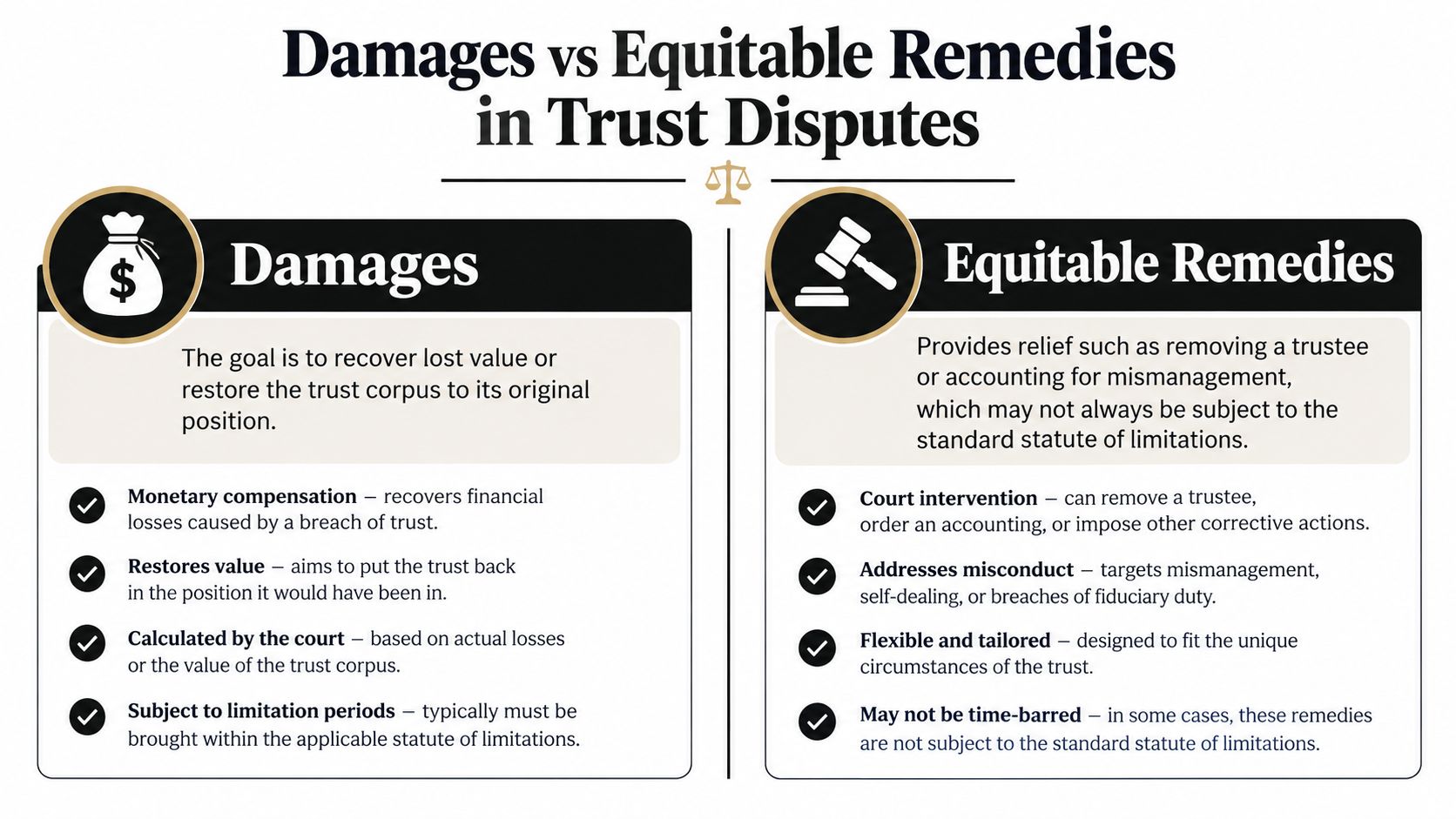
In Ditta v. Conte, the Texas Supreme Court distinguished monetary recovery for breach of fiduciary duty from statutory trustee removal. The Court held that the limitations period applicable to damages doesn't restrict a court's statutory discretion to remove a trustee. Removal is a distinct remedy, not merely a request for historical damages.
Two different questions for two different remedies
| Requested relief | Practical focus |
|---|---|
| Damages or compensation | Whether a past breach caused loss or depreciation in the trust estate and whether the claim accrued within the applicable period |
| Restoration of property | Whether trust property can be returned or the estate restored under available statutory relief |
| Accounting | Whether the trustee should provide financial information and explain trust administration |
| Trustee removal | Whether present statutory grounds justify replacing the trustee |
| Prospective administration relief | Whether current conduct requires court intervention going forward |
Texas Property Code § 114.008 identifies potential remedies including compensation for loss or depreciation, restoration of property, an accounting, trustee removal, and other appropriate relief. The remedy must be matched to the facts. A beneficiary shouldn't plead only old damages when the immediate concern is that the trustee remains unable or unwilling to administer the trust properly.
Removal grounds identified in the verified case law include a material violation or attempted violation causing material financial loss, failure to make a required accounting, incapacity or insolvency, and other cause. These grounds require careful proof. A time-barred damages theory doesn't automatically establish removal, and removal doesn't automatically produce recovery for every historical loss.
Plead the timeline by category
A practical pleading and case-assessment structure separates:
- Completed acts and accrued damages: Identify the old transaction, injury, and limitations defense.
- Potentially delayed discovery: Explain why the injury was undiscoverable and identify the diligence evidence.
- Current administration problems: Describe present non-accounting, conflicts, or conditions supporting prospective relief.
- Requested remedy: State whether the goal is money, restoration, accounting, removal, or a combination.
That distinction gives the court a clearer path and helps the family understand what remains at stake. It also prevents a common mistake, treating every trust complaint as one undifferentiated claim.
Protecting Your Interests and Next Steps
Time-sensitive trust disputes reward organization. Whether you're a beneficiary investigating misconduct or a trustee trying to administer correctly, start with documents and dates. Emotional accusations rarely clarify the legal issue, while a careful record can show what happened and when.
If you're a beneficiary
Use a disciplined process:
- Secure the governing documents: Obtain the trust instrument, amendments, notices, and related estate documents.
- Create a transaction chronology: Record each disputed act, injury, disclosure, objection, and response.
- Preserve financial evidence: Keep statements, accountings, tax records, deeds, investment reports, and messages in their original form.
- Request information carefully: Ask for records in writing and keep the request factual. Avoid making unsupported accusations.
- Identify the remedy: Decide whether the immediate need is an accounting, restoration, damages, trustee removal, or court direction.
- Seek counsel early: A lawyer can evaluate accrual, discovery, concealment, venue, pleadings, and available relief before evidence disappears.
Don't sign a receipt, release, settlement, or waiver without understanding its effect. A document that appears administrative may affect later claims, depending on its language and surrounding facts.
If you're a trustee
Transparency is practical risk management. Keep trust and personal funds separate, maintain complete records, document investment and distribution decisions, communicate consistently, and respond to reasonable beneficiary requests. If a conflict arises, pause before completing a transaction that benefits you or a related person.
Trustees should also review the trust's purpose, distribution standards, accounting provisions, and mandatory Texas Trust Code requirements. When a disagreement emerges, a neutral accounting or court instruction may be more effective than allowing suspicion to grow. A trustee who ignores an accounting obligation can create both administrative problems and potential grounds for court intervention.
Include the broader estate plan
Trust disputes often expose gaps in the family's larger plan. An estate planning review may address successor trustees, beneficiary designations, powers of attorney, guardianship planning, business succession, and asset protection. Families should also distinguish trust administration from probate, because the documents, procedures, and court involvement may differ.
The most useful first meeting usually includes the trust instrument, amendments, account statements, accountings, distribution records, trustee communications, tax documents, and a written timeline. That preparation helps counsel assess both the merits and the limitations issues without guessing.
If you're managing a trust or investigating possible fiduciary misconduct, Law Office of Bryan Fagan, PLLC offers Texas-focused guidance on trust administration, fiduciary accounting, dispute resolution, estate planning, probate, guardianship, and asset protection. Schedule a free consultation to review the timeline, documents, and remedy-specific options available in your situation.