 Skip to content
Managing a loved one's trust can feel overwhelming, especially when a court notice lands in the mailbox and the family assumes a jury will sort out the dispute. In Texas trust litigation, that assumption often creates the first strategic mistake.
A jury trial right in a Texas trust case isn't automatic. The answer usually depends on the claim, the remedy requested, and whether the party preserved the issue early enough. That matters to trustees trying to administer a trust correctly, beneficiaries questioning a fiduciary's conduct, and families dealing with probate, guardianship, tax planning, or changing life circumstances that make an old trust hard to manage.
Calm legal analysis helps here. The Texas Trust Code, the Texas Estates Code, and core fiduciary principles all shape the dispute, but they do different jobs. The Trust Code governs trust administration and many trust remedies. The Estates Code often intersects when a case also involves probate or estate administration. Fiduciary law supplies the duties of loyalty, prudence, disclosure, and proper administration that courts expect trustees and executors to follow. The practical question is who decides what, and when you must act to preserve that right.
When a Texas Family Expects a Jury and Learns Otherwise
A daughter opens a notice about her late father's trust dispute. She believes the case will work the way civil lawsuits are usually imagined. Both sides tell their stories, jurors listen, and the jury decides who's right. Then her lawyer starts asking different questions.
What exactly is being filed. Is it a claim that the trustee breached fiduciary duties in Texas. Is it a request to modify the trust because the distribution terms no longer fit current needs. Is it an accounting dispute. Is someone asking for damages, or is someone asking the court to supervise administration and change the terms of the trust.
Those questions change everything.
A trust case can contain several moving parts at once. One claim may look like a traditional legal dispute over conduct and damages. Another may ask for equitable court supervision over a trust's administration. Families often see one lawsuit. Courts see separate claims, separate remedies, and separate decision-makers.
Why this surprises people
Most clients don't spend time thinking about the line between legal and equitable issues until litigation forces the point. By then, emotions are high. A beneficiary may feel ignored. A trustee may feel unfairly accused. An executor may also be juggling probate deadlines under the Texas Estates Code while trying to preserve records and communicate with family members.
A trust dispute often turns less on the label of the case and more on how each claim is framed.
That's why practical planning matters early. Trustees should gather the trust instrument, amendments, account statements, notices, tax records, and professional advice. Beneficiaries should collect distribution history, written objections, trustee communications, and anything showing how administration affected their interests. Families dealing with incapacity issues should also think about whether parallel guardianship or asset protection concerns are in play.
What actually moves the case
Three things usually move the needle at the start:
- Claim characterization: Courts need to know whether a party is pursuing modification, damages, accounting, removal, injunction, or some combination.
- Procedural preservation: Even a strong jury argument can be lost if the demand isn't preserved on time.
- Remedy discipline: Asking for equitable relief doesn't always mean every fact issue belongs to the judge, but it also doesn't mean the jury gets the whole case.
For families, the right first step isn't panic. It's getting a clear map of the claims, remedies, deadlines, and likely fact finder.
Where the Jury Right Comes From in Texas Law
The starting point isn't the trust label. It's the Texas Constitution.
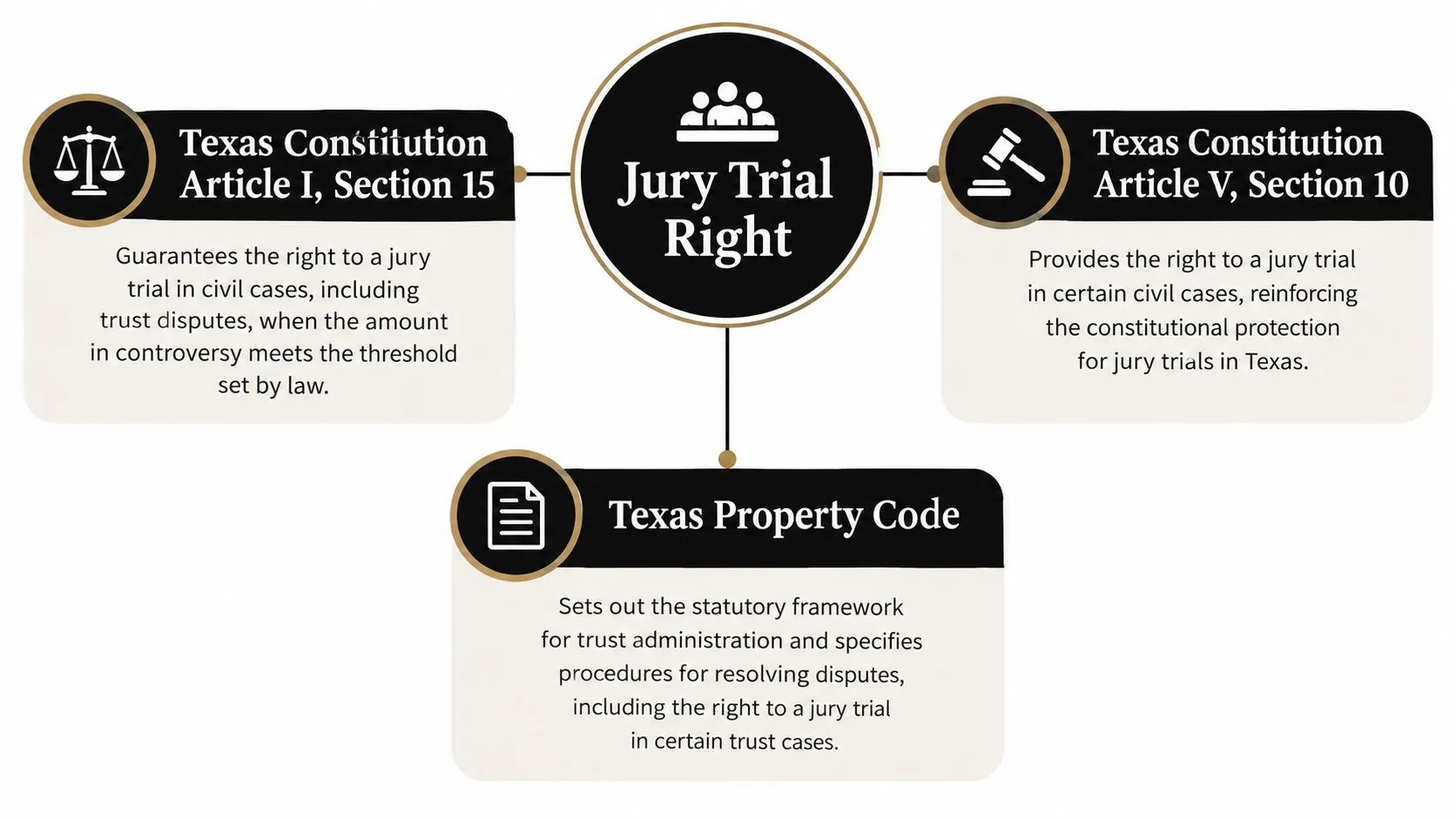
Texas's jury-trial framework rests on Article I, Section 15 and Article V, Section 10 of the Texas Constitution. Article I, Section 15 preserves the right to a jury in civil cases involving matters historically recognized as legal disputes. Article V, Section 10 states that, in causes tried in district court, a plaintiff or defendant has the right to a jury upon application made in open court. The constitutional text also requires two procedural steps: the party must demand the jury, and the required jury fee must be paid. A jury doesn't appear automatically just because the dispute involves a trust, as explained in the Texas Supreme Court's discussion of the constitutional framework in this Texas trust jury-right decision.
What that means in plain English
If you're asking whether there's a jury trial right in a Texas trust case, the first question is not, “Is this filed under the Trust Code?” The first question is, “What kind of dispute is this, historically and practically?”
A claim that looks like ordinary wrongdoing, contested facts, and damages may support jury-triable fact issues. A request for the court to supervise administration, reform terms, or issue equitable relief may remain largely with the judge. The Constitution can still protect jury determination of some ultimate fact questions even when the overall action has an equitable character, but that doesn't turn every trust matter into a full jury trial.
Why the Trust Code doesn't answer the whole question
The Texas Trust Code governs a great deal of trust administration, trustee powers, beneficiary disputes, and court involvement. But the Code does not itself answer every jury question. That's why trustees and beneficiaries need to understand the source of the right before they fight about the forum.
For beneficiaries trying to understand their role in administration, Beneficiary Rights in a Texas Trust addresses rights to information and proper administration. Those rights often become the factual core of later litigation.
Practical rule: Treat the Constitution as the source analysis, and treat procedure as the preservation analysis.
A workable framework for families and fiduciaries
When trustees, executors, and beneficiaries review a potential dispute, they should sort the case this way:
- Identify the claim. Is it breach of trust, modification, accounting, removal, or administration?
- Identify the remedy. Is the party seeking damages, an injunction, a constructive trust, or judicial instructions?
- Preserve the procedure. Even if the court later limits the jury's role, the right has to be invoked properly.
That same discipline helps with related planning work too, including estate planning, probate administration, and guardianship decisions that overlap with trust management.
What Poe Trust Changed About Modification Proceedings
The biggest recent shift for many families came from In re Troy S. Poe Trust. Before that decision, some parties treated a trust-modification proceeding as if filing under the Texas Trust Code and invoking civil procedure rules would carry a jury right with it. The Texas Supreme Court rejected that approach.
The Court held that Texas Property Code Section 112.054 does not itself create a statutory right to a jury trial in a judicial trust-modification proceeding. It also rejected the argument that Section 115.012 or the Texas Rules of Civil Procedure, by themselves or together, automatically supplied that right. The Court treated a Section 112.054 proceeding as a special statutory proceeding rather than an ordinary cause of action carrying an automatic jury guarantee under Article V, Section 10, as set out in the Poe Trust opinion.

Why this matters in real trust administration
A modification request often comes from an understandable family problem. A beneficiary develops a disability. A distribution standard no longer works in practice. A tax issue affects how the trust should operate. A trustee needs court guidance because the original terms now create friction instead of protection.
In those situations, families often ask, “If facts are disputed, won't a jury decide them?” After Poe Trust, that's not the right assumption for a Section 112.054 proceeding.
A court may conduct a bench trial and decide both the legal issues and the factual questions relevant to modification. That's a major strategic point for anyone thinking about how to modify a trust in Texas through judicial modification under Section 112.054.
The two-step analysis that works after Poe Trust
The better approach is a two-step inquiry.
First, ask whether the statute independently gives a jury right. In a Section 112.054 modification proceeding, the answer is no under Poe Trust.
Second, ask whether the Constitution preserves a jury right for particular disputed fact issues tied to the actual claims presented. That constitutional analysis remains separate.
This distinction changes how lawyers plead hybrid cases. If a trustee seeks modification and a beneficiary separately pleads breach of fiduciary duty for damages, the case may no longer be one undifferentiated “trust dispute.” It may involve one track that stays with the court and another that preserves jury-triable fact issues.
The most common mistake after Poe Trust is treating a modification petition as if it automatically carries the same jury posture as a damages suit.
What doesn't work
Several approaches usually fail or create unnecessary risk:
- Relying on the Trust Code alone: The statute doesn't supply an automatic jury right for Section 112.054 proceedings.
- Assuming civil rules create substance: Procedure can preserve a right. It doesn't manufacture one.
- Pleading everything together without separation: When claims and remedies blur, the court may treat the whole dispute more narrowly than the party intended.
For trustees, beneficiaries, and executors, that means trust litigation strategy has to start with claim-by-claim analysis, not broad assumptions about what a jury will hear.
Separating Legal Facts From Equitable Remedies
This is the line that decides most fights over the forum. In Texas trust litigation, a jury may decide ultimate disputed facts in an equitable action, while the judge decides whether equitable relief is proper, necessary, or expedient. The Texas Supreme Court's trust-related opinions draw that distinction clearly in the Court's discussion of fact issues and equitable relief.

How this plays out in a real pleading
Suppose a beneficiary alleges that a trustee favored one branch of the family, ignored the trust instrument, and used trust assets for personal benefit. Those allegations can create factual disputes about what the trustee did, what communications occurred, how money moved, and whether losses resulted.
A jury may be asked to resolve those factual disputes if the claim supports jury determination. But if the beneficiary also asks for disgorgement, a constructive trust, injunctions, or court supervision over future administration, the judge typically retains the equitable decision about whether to grant that relief.
Legal facts versus equitable remedies
| Issue Type | Examples | Who Decides |
|---|---|---|
| Legal fact questions | What the trustee did, whether conduct occurred, whether a breach happened, factual disputes tied to damages | Jury, if the claim is one for which a jury is available |
| Equitable remedies | Disgorgement, constructive trust, injunction, supervision of administration, trust modification or deviation orders | Judge |
| Hybrid matters | Accounting disputes with factual conflicts plus requests for equitable oversight | Split role, depending on the claim and remedy |
A beneficiary seeking damages for breach of fiduciary duty may preserve jury-determined fact issues, while a request for equitable remedies may remain with the court. Families considering claims for misuse of trust assets often review available remedies for breach of trust in Texas before drafting final pleadings.
Worked examples that help
- Breach of fiduciary duty: Jurors may decide disputed facts such as self-dealing, concealment, or loss causation. The judge handles equitable relief tied to those findings.
- Accounting case: If records are contested and the parties disagree about transactions, some factual disputes may be jury-facing if tied to a proper legal claim. Court supervision of the accounting remains judicial.
- Modification request: The court usually keeps the decision whether to modify or deviate from trust terms.
Separate the question “What happened?” from the question “What should the court do about it?”
What good pleading looks like
Good pleadings don't dump every complaint into one paragraph and ask for “all relief.” They identify:
- the specific claim,
- the precise fact disputes,
- the requested remedy,
- and whether the party seeks jury findings on particular factual questions.
That kind of drafting also helps in mediation, because everyone can see which issues are factual fights and which issues depend on judicial discretion.
A Trustee and Beneficiary Walk Through a Real Dispute
A successor trustee steps in after the original trustee dies. Within weeks, she finds transactions that don't match the trust's purpose. A co-trustee appears to have benefited from trust funds, and the records are incomplete. At the same time, one beneficiary says the trustees have refused to make a discretionary distribution that the trust should allow.
The family sees one conflict. Legally, it may become two.
Two claims, two tracks
The successor trustee files a Section 112.054 request asking the court to clarify or modify the distribution standard because the current language has become unworkable. That request focuses on administration. It asks the court to make the trust workable for the future.
The beneficiary files a separate claim for breach of fiduciary duty, alleging self-dealing and seeking damages for losses caused by past conduct. That claim focuses on what already happened and who should answer for it.
Those aren't the same dispute just because they involve the same trust.
What evidence matters first
In a case like this, recordkeeping becomes decisive. Trustees need complete statements, check registers, tax filings, emails with beneficiaries, notes from professionals, and any written explanation for discretionary decisions. Beneficiaries need the trust instrument, amendments, demand letters, response letters, payment history, and evidence showing how the trustee's choices affected them.
If an executor is also involved because estate assets are still being marshaled under the Texas Estates Code, the paper trail matters even more. Probate administration can overlap with trust funding, trustee succession, and creditor issues. That's why families often need a coordinated view that includes probate, estate planning, and asset protection concerns.
What usually helps and what usually hurts
Helpful moves include narrow pleadings, organized exhibits, and direct explanations of fiduciary duties in Texas. Harmful moves include accusing everyone of everything, mixing future-administration requests with past-damages claims, and assuming the court will sort out the procedural differences without being asked.
In practice, the modification request may head toward a bench trial. The separate breach claim may preserve factual questions for a jury. Same trust. Same family. Different procedural tracks.
In hybrid litigation, the outcome often turns on whether counsel separated the claims before the court had to do it for them.
How to Demand a Jury and Avoid Waiver
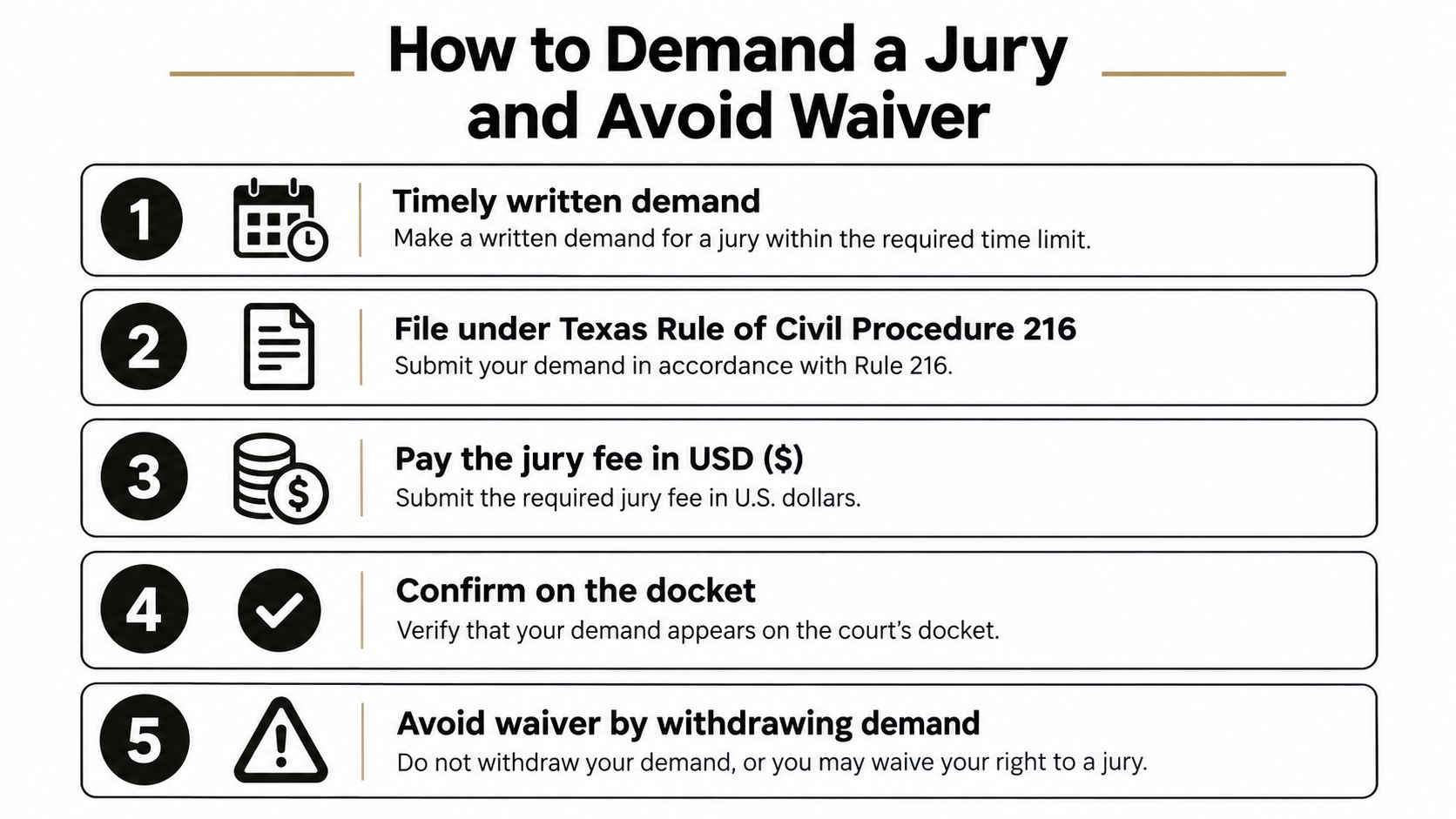
Even when a claim supports a jury, the right can be lost through inattention. Texas Rule of Civil Procedure 216 requires a written jury demand to be filed no later than 14 days before the date the case is set for trial, and a late demand generally waives the right unless the judge excuses the delay for good cause, as stated in Texas Rule of Civil Procedure 216.
Preservation is the point
A jury demand does not create a jury right in a Section 112.054 modification proceeding after Poe Trust. It preserves the right only if the Constitution, statute, or applicable law provides one. That's why filing the demand is still wise in many hybrid trust disputes. Preservation and entitlement are different questions.
The harder cases are the ones where the court hasn't yet decided how to characterize the proceeding. Waiting for that ruling can be risky. A party may think, “We'll ask for a jury after the judge decides whether one is available.” That delay can lead straight into waiver.
A practical checklist that works
Use a written system. Don't rely on memory.
- Calendar the trial setting immediately. As soon as the court sets trial, count back the deadline under Rule 216 and put it on a shared calendar.
- File a written demand with the clerk. Make sure the filing clearly requests a jury trial.
- Handle the fee requirement. Confirm that the required jury fee is paid, or that a proper statement of inability to afford costs is on file when applicable.
- Check local practice. Some courts have docket preferences or scheduling procedures that affect how the request appears in the file.
- Review amended pleadings before the deadline. New claims can change the jury analysis.
A short video can help families understand why procedure matters in trust and estate disputes before trial strategy hardens.
Where waiver problems usually start
Most waiver problems don't come from difficult legal doctrine. They come from ordinary case management mistakes.
- Someone waited for clarity: The party wanted a definitive ruling on jury eligibility before preserving the request.
- The pleadings changed late: A damages claim was added, but no one revisited the jury deadline.
- The fee step was overlooked: The demand was filed, but the supporting procedural requirement wasn't completed.
File the demand as a preservation step. Argue entitlement separately.
That approach protects trustees, beneficiaries, and executors in cases where claim character may shift during litigation.
Strategic Choices for Trustees and Beneficiaries
Once the claims are sorted and the deadline is preserved, forum choice becomes a practical business decision, not just a legal one. Trustees and beneficiaries often want different fact finders for understandable reasons.
Why trustees may prefer the court
Trustees usually have stronger reasons to favor a judge when the dispute centers on administration, discretion, or modification. A bench setting can be useful when the court needs to weigh fiduciary judgment, trust language, tax planning, and future administration together. Judges also handle the overlap between the Texas Trust Code and the Texas Estates Code more comfortably in technical cases involving probate or coordinated estate planning.
That doesn't mean a trustee should avoid a jury at all costs. If the facts are clean, records are complete, and the trustee's communications show careful process, a jury may not be a problem. But trustees usually lose ground when records are thin or explanations shifted over time.
Why beneficiaries may want jurors
Beneficiaries often prefer a jury when the dispute turns on credibility, self-dealing, favoritism, or evasive accounting. Jurors tend to focus on lived conduct. They listen closely to who knew what, who said what, and whether a fiduciary acted loyally.
Settlement strategy changes with the forum too. Cases built around credibility often mediate differently when a jury remains possible. Presentation matters more. Witness preparation matters more. Even public-facing issues can matter. Firms that educate families clearly before litigation often avoid preventable confusion, which is one reason some lawyers invest in a digital-first marketing plan for lawyers to publish practical guidance on trust disputes before a family ever reaches trial.
What usually works
The best strategic choice is usually the one that matches the claim chart. If you want jurors on conduct and damages, plead and preserve those issues with discipline. If you want judicial discretion on administration, keep the request focused and equitable.
Sample Pleading Language and Your Next Steps
In a hybrid case, the goal is clarity. Plead the claims separately. State the fact issues separately. Preserve the jury issue without overstating what the jury gets to decide.
Sample language to adapt
A petitioner or counter-petitioner might use language along these lines:
“Party requests a jury trial on all fact issues triable to a jury under the Texas Constitution and applicable law and tenders the required jury demand in accordance with Texas Rule of Civil Procedure 216.”
For a damages claim tied to fiduciary duties in Texas, counsel might add:
“Party alleges breach of fiduciary duty, including disputed fact issues concerning the trustee's conduct, communications, management of trust property, and resulting damages.”
For an equitable trust-administration request:
“Party seeks judicial relief concerning trust administration, including modification, instructions, and other equitable remedies to be determined by the Court.”
That language won't solve every dispute. It does force precision.
A practical file-building plan
Before hearings begin, families should organize the file in a way that matches the likely fact finder.
- Trust instrument first: Include the original trust and every amendment.
- Administration records next: Gather account statements, notices, accountings, and distribution records.
- Communications in one place: Emails, letters, text screenshots, and meeting notes often matter more than people expect.
- Professional advice preserved: Tax planning notes, CPA input, and legal guidance can help explain why a trustee acted as they did.
This is also the stage to think beyond the lawsuit itself. Some families need a Texas trust administration lawyer for current litigation. Others also need a Texas estate planning attorney to revise outdated documents once the dispute ends. Some need probate guidance, guardianship planning for a disabled beneficiary, or asset protection review to reduce the chance of the next conflict.
If you want a clean summary, keep it simple. Characterize each claim. Calendar the Rule 216 deadline. Preserve constitutional arguments while the court decides the proceeding's character. If the dispute touches trust administration, probate, or fiduciary duties in Texas, early legal guidance usually saves far more stress than late procedural repair.
If you're managing a trust or planning your estate, contact Law Office of Bryan Fagan, PLLC for a free consultation. Our attorneys help trustees, beneficiaries, and families evaluate jury issues, trust modification requests, fiduciary disputes, probate overlap, and next-step strategy under Texas law.


