A daughter in Houston opens her father's will and finds a phrase she hasn't seen before: “independent administration.” She's grieving, relatives are asking what happens next, and she's unsure whether the phrase means the court won't be involved or that she's expected to manage everything alone.
The answer is somewhere in between. Independent administration can reduce routine court involvement, but it doesn't remove the executor's legal duties. The executor takes on more of the day-to-day decision-making, and careful records, creditor notices, and timely filings become especially important.
What Independent Administration in Texas Actually Means for a Family
In practice, independent administration means the executor can handle many estate matters without asking the probate court to approve each routine action. That may make it easier to pay valid debts, manage property, and distribute assets according to the will. The court still admits the will to probate and appoints the executor, and the executor remains responsible for following the will and Texas law.
For the Houston daughter, the phrase in her father's will is a starting point, not a promise that the estate will settle itself. She still needs to find out what her father owned, identify debts and interested beneficiaries, and understand the deadlines that apply. If the estate includes a home, she may also need to consider the practical steps for preparing and selling inherited property. This guide to inherited house sale steps in TX can help her think through the real-estate side of that task.
The simplest mental model is this: the court sets the legal framework, while the independent executor manages much of the work inside it. That's different from dependent administration, where the administrator generally needs court approval for more actions. Less routine supervision can reduce procedural friction, but it also means the executor must be organized and prepared to explain decisions.
Practical rule: Independent doesn't mean unaccountable. It means the executor carries more responsibility for doing the work correctly without routine court review.
A family can feel reassured by the added flexibility and still take the process seriously. Before signing documents or transferring property, the executor should confirm authority, preserve estate records, and communicate clearly with beneficiaries. Those habits help everyone understand what's happening and give the executor a sound record if questions arise.
How the Texas Estates Code Defines Independent Administration
Texas Estates Code Chapter 401 provides the legal foundation for independent administration. In plain language, a person making a will may direct that, after the will is probated and recorded, no further probate-court action be required beyond filing any required inventory, appraisement, and list of claims. Chapter 401 also addresses when independent administration may be established by agreement.
Chapter 402 explains the effect of that arrangement. Once the court appoints the independent executor and the required inventory materials, or an authorized affidavit in lieu of them, have been submitted, the court generally may not take further action unless the Estates Code specifically permits it. The executor can ordinarily take actions available to a court-supervised personal representative without obtaining a new order for every transaction, while still complying with the will, statutory limits, fiduciary duties, and creditor protections.
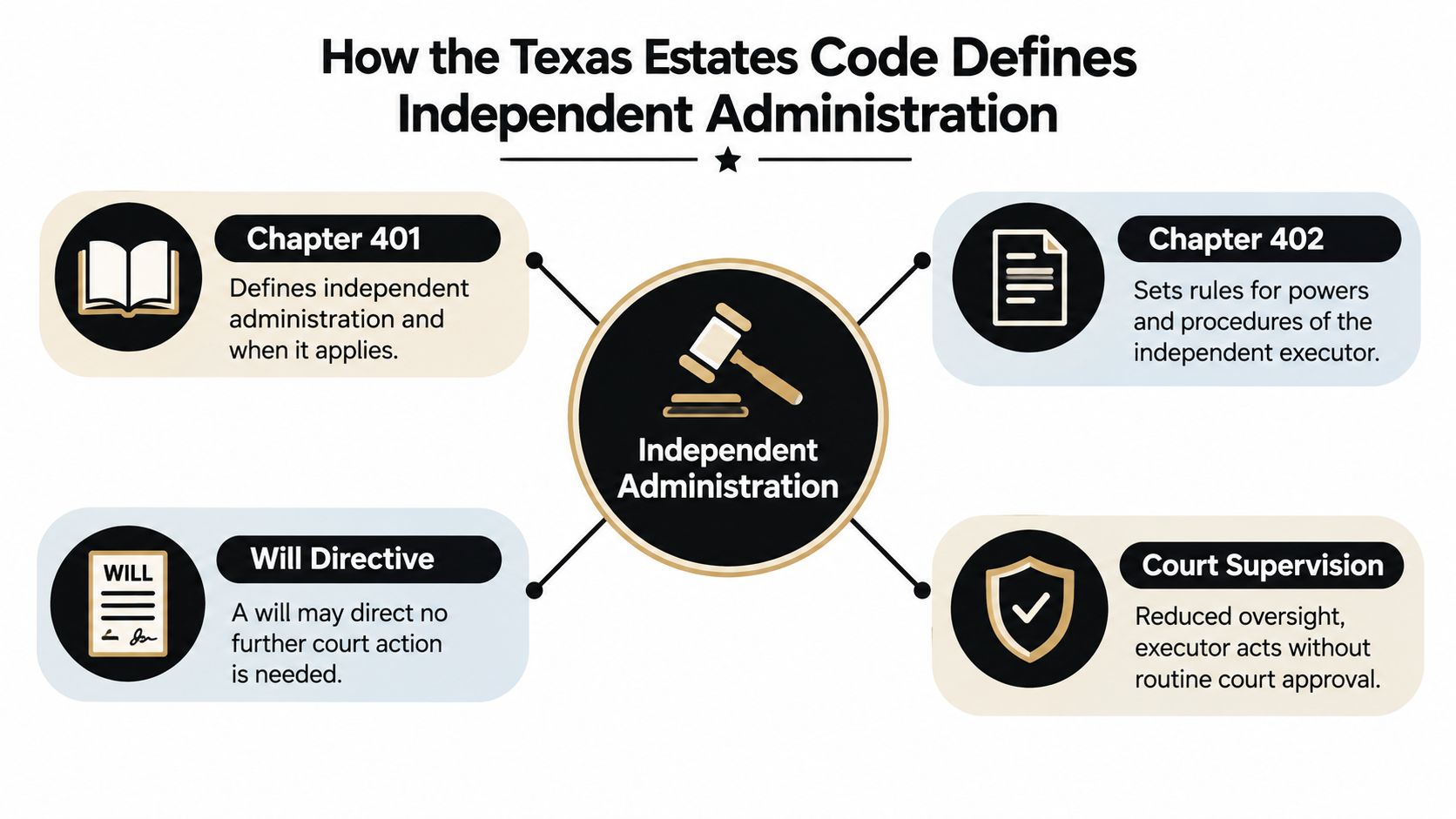
That framework draws a clear distinction between the two approaches. In independent administration, the executor handles most routine estate decisions without asking the court to approve each one. In dependent administration, the court remains more directly involved in authorizing estate actions. The Texas Estates Code doesn't make an independent executor free to disregard legal duties; it changes who carries out and documents much of the administration.
Texas's system has deep roots. Historical legal scholarship identifies 1848 as the year Texas became the first state to authorize independent administration. The approach developed from an earlier rule allowing a testator to limit probate-court involvement, followed by a requirement to file an estate inventory. The current statutory framework traces its codification to Senate Bill 1198, enacted by the 82nd Texas Legislature in 2011 and effective January 1, 2014. These historical details help explain why independent administration is a foundational feature of Texas probate rather than a recent procedural shortcut. You can review the Texas Estates Code overview for related statutory context.
The key distinction is reduced routine supervision, not reduced fiduciary responsibility. An executor must still act in the estate's interests, follow the governing documents and statutes, and keep records that support the decisions made.
Who Qualifies for Independent Administration in Texas
A will that authorizes independent administration gives the family the clearest path. The executor named in the will can ask the probate court to appoint them under that arrangement. The court still reviews the application and makes the appointment, but the will supplies the basis for independent administration.
If the will names an executor but says nothing about independent administration, the distributees may agree to it. All distributees must agree, so one person's objection can prevent the family from relying on this route. Unanimous consent isn't just a preference that makes the process smoother. It's part of the statutory process.
For an estate with no will, all distributees may likewise agree to independent administration, designate a qualified administrator, and request appointment. The court can deny the request if it finds the arrangement isn't in the estate's best interest. It may also reject a proposed executor if the appointment would not serve the estate's interests.
That safeguard matters when relatives don't agree about how the estate should be managed. A blended family may disagree about who should serve. A dispute over who qualifies as a distributee, pressure from creditors, or concern about how an executor will handle property can make unanimous consent difficult or make independent administration unsuitable.
Before choosing a path, the family should identify who the distributees are, read the will carefully, and clarify whether everyone is willing to sign the necessary agreement. The probate application and supporting papers should reflect the legal basis for the request, whether it comes from the will or from the distributees' agreement.
A simple first review can help you understand your position:
- Read the will: Look for language authorizing independent administration and check who is named as executor.
- Identify all distributees: Confirm who is legally entitled to receive estate property, including people whose interests may not be obvious to the family.
- Ask whether consent is unanimous: Don't assume silence or a family conversation is enough.
- Consider the estate's circumstances: If conflict, creditor concerns, or doubts about the proposed executor exist, get legal advice before asking the court to approve the arrangement.
Step-by-Step Process for Opening an Independent Administration
Opening an independent administration still begins in probate court. The application must explain the basis for the requested administration and identify the proposed executor or administrator. If there's a will, the applicant submits it for probate. The court must review the filing and appoint the representative before that person can act with authority on behalf of the estate.
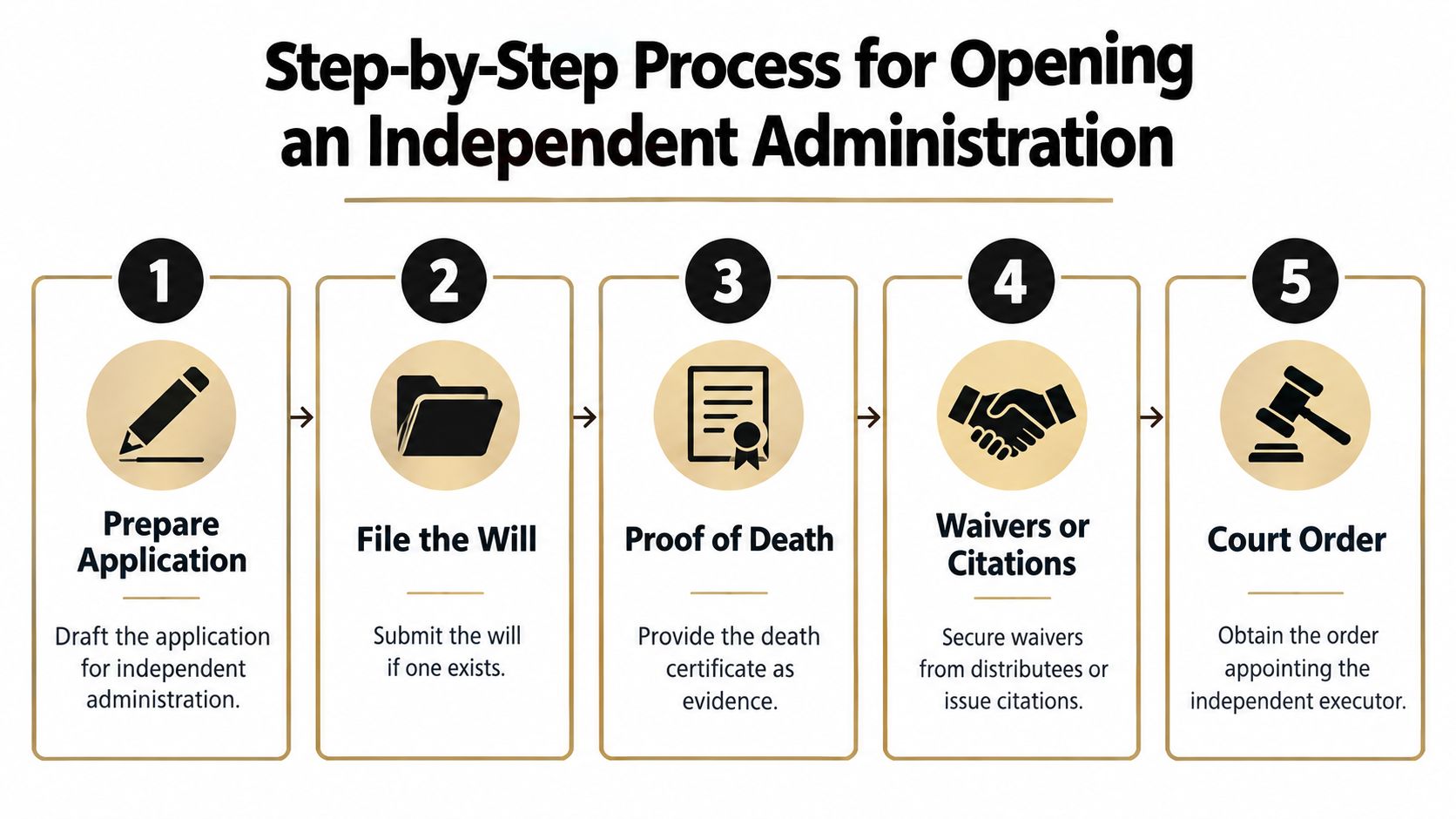
Families can expect the process to involve proof of death, information about the will and heirs or distributees, and waivers or citations as required. Once the court enters the appointment order and the executor qualifies, the clerk issues letters testamentary or letters of administration. These letters provide evidence of the representative's authority when dealing with banks, title companies, and others who hold estate property.
The court's appointment is the beginning of the executor's working responsibilities, not the end of the family's paperwork.
The early compliance calendar deserves close attention. A Travis County probate guide describes these practical deadlines for an independent administrator:
- Within 30 days after qualification: Publish notice to creditors.
- Within two months: Mail certified or registered notice to each secured creditor.
- Within 90 days: File the inventory, appraisement, and list of claims, or a permitted affidavit in lieu of the inventory.
These deadlines come from the Travis County guide for Texas independent administrators. The right filing depends on the estate and the law that applies, so an executor shouldn't assume an affidavit is available without checking. A missed notice or incomplete inventory can create problems precisely because the court may not be tracking every routine step.
A practical file should include copies of the court papers, letters, notices, creditor communications, asset information, and proof of filings. The executor should also distinguish debts owed by the estate from claims the estate may have against someone else. When trustee or fiduciary responsibilities raise questions, When a Trustee Should Consult a Texas Attorney describes situations where legal guidance can protect a fiduciary and the property they manage.
For a general visual explanation of the opening process, the following video may also help:
Fiduciary Duties and Responsibilities of the Texas Independent Executor
Because routine court review is limited, the executor's own compliance system becomes a central safeguard. The executor should identify and collect estate assets, keep estate funds separate from personal money, preserve records, meet tax obligations, communicate with beneficiaries, and avoid using the estate for personal benefit. These responsibilities reflect fiduciary duties in Texas, which require a representative to act properly for the interests they are charged with protecting.
Consider an executor who needs to sell a Houston condominium that's partly rented. Before listing it, the executor should confirm title and the will's terms, gather information about the rental arrangement, consider any conflicts of interest, and document the reason for selling. The executor should also keep records of the property's condition, valuation information, offers, expenses, and how sale proceeds are handled. If a beneficiary later asks why the property was sold or how the price was chosen, the executor can point to an organized record rather than relying on memory.

A disciplined record also helps with routine administration. Keep a ledger of income, expenses, debts, and distributions. Preserve invoices and tax documents, record beneficiary communications, and write down the reasons for major choices. Those steps make it easier to prepare an accounting and to answer questions about how the executor handled the estate.
Texas Estates Code Chapter 402 allows an independent executor to act without a new court order for many actions that a supervised representative could take, subject to legal limits. That authority may include selling estate property, entering leases, or borrowing money. The Texas Estates Code also provides for an interested person to demand a detailed sworn accounting after the statutory waiting period described later in this guide. Independent administration isn't immunity from review.
Executors can also consult information about the executor of a will when clarifying their role and responsibilities. If an executor fails to carry out fiduciary obligations, the consequences may fall on that person rather than being caught through routine court supervision. Accurate records, careful judgment, and timely communication are practical protections for both the estate and the executor.
Closing the Estate and Handling Disputes
An executor should treat closing as a documented process, not an informal announcement that everything is finished. Texas law provides two principal ways to document completion. One option is a verified closing report that identifies estate property received, debts paid, debts still owed, property remaining after debts, and the names and addresses of distributees. If the executor has distributed property, the report must include signed receipts or other proof that the distributees received it.
The other option is a verified notice of closing estate. The notice states that known debts have been paid, or paid as far as available assets allow, and that remaining assets have been distributed. Before filing it, the executor must give each distributee a copy and include signed receipts or other proof of delivery. The requirements are set out in Texas Estates Code Section 405.006.
A careful closing file should include a distribution ledger, records of paid debts and expenses, tax information, and beneficiary receipts. A closing filing may help show banks, registrars, and other custodians that the administration has ended, but it doesn't erase liability for mismanagement or false statements.
When a beneficiary can ask for an accounting
After 15 months from the date the clerk first issues letters testamentary or letters of administration, an interested person may demand a detailed, sworn accounting. The accounting must identify estate property received, debts and expenses still owed, and property remaining in the executor's possession. The timing and required contents are stated in Texas Estates Code Section 404.001. Keeping records from the outset makes it far easier to respond to a proper demand.
A distributee may also seek formal closure after the estate has been fully administered and no further independent administration is needed. Under Section 405.009, the distributee can apply to the court; after citation to the executor and a hearing, the court may require a closing report, end the administration, terminate the executor's authority, cancel the letters, and release bond sureties from liability for future acts. The resulting order can authorize people holding estate property to transfer it to the distributees entitled to receive it. Details appear in Texas Estates Code Section 405.009.
Disputes over creditor claims, asset values, distributions, or an executor's conduct don't automatically mean the estate must unravel. The parties may resolve questions through clear records, direct communication, and legal advice. But when a dispute requires court involvement, the executor should preserve documents and avoid making a contested distribution until the legal issue is understood.
Comparing the two forms of administration
| Feature | Independent administration | Dependent administration |
|---|---|---|
| Routine court involvement | The executor handles many actions without new court orders, subject to statutory exceptions | The court supervises more of the administration |
| Decision-making | The independent executor manages routine estate decisions within legal limits | The administrator generally seeks court authorization for more actions |
| Documentation | The executor needs reliable records to support actions and distributions | Court-supervised procedures require additional filings and approvals |
| Accountability | Fiduciary duties, accounting obligations, and specific court powers remain | Court oversight is more direct throughout administration |
Costs, Timelines, and When Independent Administration Is the Wrong Choice
The cost and timing of probate depend on the estate's assets, the work required, and whether family members cooperate. Texas's State Law Library describes independent administration as typically faster and less expensive than dependent administration, while noting that eligibility depends on testamentary authorization or the required agreement of heirs or beneficiaries. The difference comes partly from the reduced need for court approval of routine actions.
That doesn't mean every independent administration will be simple. A business that needs active management, property in multiple states, disputed creditor claims, family conflict, or difficult asset tracing may require substantial professional help. Independent administration can still be the right legal structure, but it may demand more careful oversight than a straightforward estate.
Families should also understand the kinds of expenses that may arise. Court filing and citation costs, bond premiums when required, publication charges, appraisal work, and attorney fees can all affect the total. Legal fees may depend on the work involved and how the firm bills; ask counsel to explain the expected tasks and billing arrangement rather than assuming every estate costs the same. For a discussion of probate duration, see how long probate can take.
Dependent administration may be worth considering when the will's validity is contested, heirs are hostile, the estate's ability to pay its debts is uncertain, or a significant sale needs court confirmation. More supervision can add process, but in a high-conflict or high-risk situation it may provide a clearer structure for decisions and disputes. The right choice depends on the will, the distributees' positions, the estate's obligations, and the executor's ability to manage the work.
Local Guidance for Texas Families and When to Hire an Attorney
Families in Houston, Dallas–Fort Worth, Austin, San Antonio, The Woodlands, and nearby communities should confirm the filing procedures that apply in the county handling the estate. Local court practices can affect how proposed orders are submitted, which e-filing steps are used, and where required creditor notices are published. A form that worked in one county may not answer every procedural question in another.
Consider speaking with a Texas estate-planning attorney or probate counsel if the estate involves a blended family, property outside Texas, a closely held business, real estate that must be sold, creditor pressure, family disagreement, or distributees who may not all consent. Counsel can review the will, confirm the proper path to appointment, help organize the compliance calendar, and advise on documenting major decisions. Those are practical ways to reduce the risk of missed filings or an avoidable dispute.
Estate administration can also intersect with trusts. A trust may hold some property while other assets pass through probate, so the executor and trustee may have different responsibilities. The Texas Trust Code governs many trust matters, while the Texas Estates Code governs probate and estate administration. For families deciding whether an asset belongs to a trust or an estate, this guide to trust administration vs. probate in Texas explains how the two processes differ.
A Texas trust administration lawyer can help a trustee understand trust obligations, while a Texas estate planning attorney can help a family plan for future administration and asset protection. The Law Office of Bryan Fagan, PLLC serves families and fiduciaries across Texas with guidance on estate planning, probate, guardianship, and asset protection. A free consultation can help you identify which questions need attention before a deadline or disagreement becomes harder to manage.
If you're serving as an independent executor or planning your estate, the Law Office of Bryan Fagan, PLLC can help you understand Texas probate requirements, fiduciary responsibilities, and the options available to your family. Contact Law Office of Bryan Fagan, PLLC to schedule a free consultation and get guidance for your situation.