
Fiduciary accounting income is the portion of a trust's gross income allocated to its income account under the governing instrument and applicable state law. It isn't necessarily the same as taxable income or the cash a beneficiary receives.
Managing a loved one's trust can feel overwhelming when money is coming in from different sources and each transaction may affect a beneficiary's rights. You might see interest and dividends in the bank account, proceeds from a stock sale, and a bill for business repairs, yet still need to determine which amounts belong to income and which belong to principal.
That answer matters to income beneficiaries, remainder beneficiaries, trustees, and families trying to keep an administration fair and transparent. A transaction can make economic sense and still be recorded incorrectly under the trust's accounting rules. The careful approach is to look at each receipt and expense, then consider how the trust document, Texas law, and federal tax rules treat it.

Trust accounting isn't a tax return with different labels. It's a record of what belongs to the income and principal accounts, why it was placed there, and what may be distributed under the trust's terms. A guide to legal billing software can help a law office organize matter records, but software can't decide how a particular trust receipt must be classified.
The guide below builds from that basic distinction to Texas allocation rules, worked examples, business interests, and practical verification. Trustees and executors can use the same disciplined habits to keep records clear; beneficiaries can use them to understand an accounting and ask focused questions.
When Trust Income Becomes a Difficult Question
A trustee sits down with the quarterly statement and finds four deposits: bond interest, mutual fund dividends, proceeds from selling shares that had appreciated, and a check from a family company the trust partly owns. The account balance is higher. That fact alone doesn't say which deposits count as income, which belong to principal, or how much the trustee may pay the income beneficiary.
Four different numbers hide inside that one balance. The stock's rise in value is economic gain, real wealth on paper, and Texas law still directs the sale proceeds to principal unless an exception applies. Bond interest and ordinary dividends are usually current returns allocated to income, which is the fiduciary accounting income side. Distributable net income is a separate, tax-law measure that determines how much of a distribution carries the trust's taxable income out to the beneficiary. Then there's the amount the beneficiary may receive, which the trust's terms and any trustee discretion control.
Four amounts, four different rulebooks.
The company check raises its own question: did the business distribute current earnings, or did it return capital? The answer can differ under entity law, the trust instrument, and tax rules.
The practical point: A cash receipt isn't automatically accounting income, and a cash balance isn't automatically the amount a beneficiary is entitled to receive.
Fiduciary accounting income is a legal-accounting concept distinct from taxable income. Its treatment depends on the governing instrument, applicable state law, how receipts and expenses are classified, and the trustee's accounting period, as the IRS overview of trust and estate income concepts explains.
The trustee's task is to document the decision and apply the governing rules consistently. A guide to legal billing software can help a law office organize matter records, but software can't decide how a particular trust receipt must be classified.
Working through the statement one transaction at a time keeps the accounting reviewable. Beneficiaries get a clearer account of what happened and why, and a disagreement over classification stays a question about rules rather than a presumption of wrongdoing.
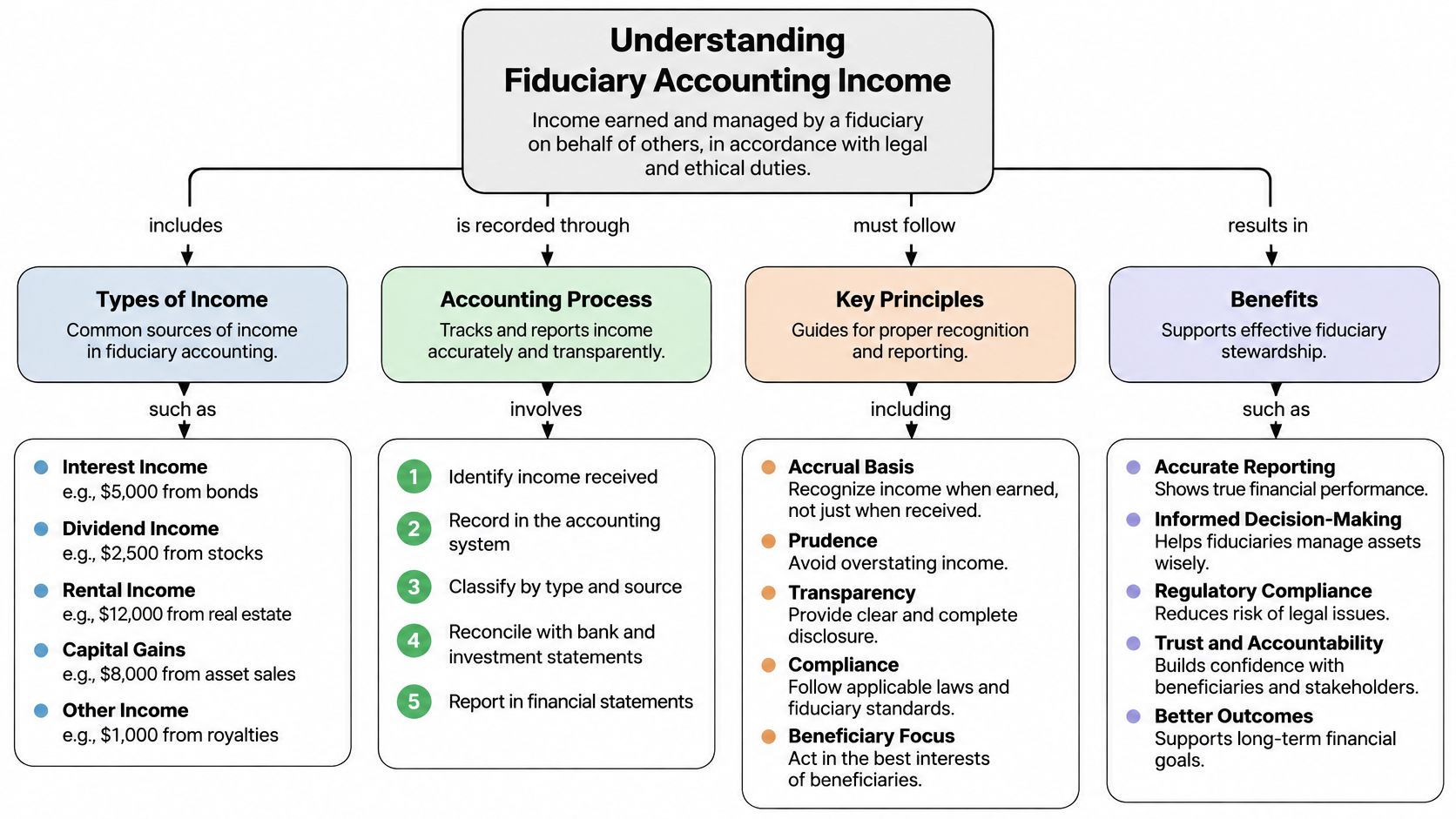
Understanding Fiduciary Accounting Income
A useful starting analogy is a house held in trust. The house is principal, the asset the trust holds for eventual distribution to a remainder beneficiary. Rent received from tenants is a current return from that asset and may be income for accounting purposes.
The analogy helps, but it has limits. A house can rise in value while producing rent, and its sale proceeds aren't automatically income because they arrive as cash. Taxes may treat rental receipts, depreciation, and sale gains under rules that differ from the trust's accounting rules. A business or investment portfolio can create the same split between cash flow and growth in value.
Start with the asset and the receipt
Texas's Uniform Principal and Income Act distinguishes income from principal. Income generally means money or property received as the current return from a principal asset; principal is property held for eventual distribution to a remainder beneficiary. Net income is generally income receipts minus disbursements charged to income, with relevant adjustments for transfers between income and principal. The Texas definition of income, principal, and net income provides the statutory starting point.
The trust instrument matters too. It may establish allocation rules or give the trustee powers that affect how a receipt is treated. The trustee should read the document first, then apply the relevant Texas rules to matters the document doesn't resolve. The trustee shouldn't assume that a tax label controls the accounting result.
Track both sides of the account
A useful accounting keeps separate income and principal records. For each transaction, record what came in or went out, its source or purpose, the account charged or credited, and any transfer between accounts. Reconcile the records over the complete accounting period, rather than relying on a snapshot of cash in the bank.
That method protects both beneficiary groups. An income beneficiary can see how current returns and expenses were handled, while a remainder beneficiary can see whether principal was preserved and properly accounted for. It also gives the trustee a record for explaining choices.
This short video offers another introduction to the topic:
Comparing Accounting Income With Taxable Income
A trustee reviewing Form 1041 may be tempted to treat the return's income figure as the amount a beneficiary should receive. That shortcut confuses separate questions. Tax reporting concerns federal tax treatment; fiduciary accounting concerns allocation under the trust instrument and applicable law; a distribution depends on the trust's terms, expenses, reserves, and the trustee's authority.
A transaction matrix helps keep those questions apart:
| Review question | What the trustee is checking |
|---|---|
| What came in economically? | The actual receipt, such as interest, a dividend, rent, or sale proceeds. |
| Where does it go in the trust accounts? | Whether the instrument and Texas law allocate it to income or principal. |
| How is it treated for federal tax? | Whether it is taxable, deductible, or reported as a gain or other item on Form 1041. |
| Does it enter DNI? | Whether federal distributable net income rules affect the distribution deduction or a beneficiary's tax reporting. |
| What may the beneficiary receive? | What the trust permits after applying expenses, reserves, distribution terms, and fiduciary duties. |
Apply the questions to one sale
Suppose a trustee sells appreciated stock to raise cash. Economically, the trust has received sale proceeds, including any realized gain. Under Texas's usual principal-and-income treatment, proceeds from selling a principal asset generally go to principal unless an exception applies. For federal tax purposes, the gain is generally excluded from distributable net income, but exceptions may apply depending on the governing instrument, local law, the trustee's authority, and applicable tax rules. The federal Treasury regulations on distributable net income address that general treatment and its exceptions.
That means selling an asset to produce cash doesn't automatically make the gain income for trust-accounting purposes or mean it passes through to a beneficiary for tax purposes. The trustee must examine the trust document, the allocation rules, and the tax consequences separately.
Form 1041 reports a trust's tax information, but it doesn't itself decide a beneficiary's entitlement under Texas accounting law. For more detail on the tax-return side, see this resource on the trust tax return and Form 1041.
A beneficiary may receive cash without being taxed on the same amount as income, or a trust may have taxable items that don't correspond to cash available for distribution. A careful trustee therefore reconciles the accounting, tax reporting, and distribution decision instead of copying one figure into every record.
How Texas Trustees Allocate Receipts and Expenses
Texas trustees need a repeatable method for deciding where each transaction belongs. Start with the trust document, identify the transaction, apply the governing rule, and record the reason for the allocation. This makes the accounting easier to check and gives the trustee a sound explanation for beneficiaries.
Work through receipts before expenses
First, confirm the receipt's source and nature. Interest, ordinary dividends, rents, and similar current returns are commonly treated as income, subject to the trust terms and applicable law. A distribution from a company or partnership may require closer review because the payment could reflect current operations, return of capital, or another category.
Next, examine sales and exchanges. Texas law generally allocates money or property received from the sale, exchange, liquidation, or change in form of a principal asset, including realized profit, to principal unless the Uniform Principal and Income Act provides otherwise. The Texas provision on receipts from the sale of principal assets sets out that general rule.
Classify the costs and transfers
An expense should be charged to the account that the instrument and applicable rules require. Don't assume every bill reduces income just because the trustee paid it from the same bank account that received rent or dividends. Consider what the expense paid for, whether it relates to income production or principal, and whether the trust authorizes an adjustment or transfer.
A transfer between income and principal should have a recorded reason. It isn't a substitute for an unexplained balancing entry. Trustees can learn more about the statutory framework through this overview of Texas Uniform Principal and Income Act allocations.
The accounting statement should separately identify principal and income receipts and give a complete account of trust transactions, including each receipt's source and nature. In practice, the trustee can build a clear record by documenting:
- Opening balances: Reconcile the beginning income and principal balances to the prior accounting.
- Receipts: Keep statements and records showing the source, date, and nature of each item.
- Disbursements: Retain invoices and note the account charged and the reason for the charge.
- Transfers: Record the amount, direction, authority, and explanation for each transfer.
- Distributions: Tie each payment to the trust's terms and the relevant beneficiary account.
- Ending balances: Reconcile the accounts and investigate unexplained differences before issuing the statement.
Worked Examples of Income Calculations
Consider a hypothetical Texas trust with separate income and principal ledgers. The trustee begins the accounting period with a documented balance in each account. During the period, the trust receives interest and an ordinary dividend, sells appreciated stock, pays a bill allocated to income, pays a separate bill allocated to principal, and makes a discretionary payment to a beneficiary.
The entries are easier to understand in sequence:
| Transaction | Income account | Principal account |
|---|---|---|
| Interest received | Credit, if classified as current income under the instrument and law. | No entry unless an applicable rule requires an adjustment. |
| Ordinary dividend received | Credit, subject to the trust's terms and applicable law. | No entry unless the allocation rules require one. |
| Appreciated stock sold | No automatic credit for the realized gain. | Credit the proceeds as principal under the general Texas rule, unless an exception applies. |
| Income expense paid | Charge the expense here if the governing rules allocate it to income. | No entry unless an adjustment is required. |
| Principal expense paid | No charge to income solely because cash was used. | Charge the expense here if the rules allocate it to principal. |
| Discretionary payment | Record the amount against the account authorized by the trust and supported by the trustee's decision. | Record against principal if the terms and decision authorize a principal distribution. |
After recording these items, the trustee calculates net income by starting with income receipts, subtracting expenses properly charged to income, and applying required adjustments. That accounting result isn't necessarily the cash available to pay. The trustee still needs to consider the trust's distribution terms, any permitted reserves, and the beneficiary's rights.
Before paying a discretionary distribution, record which account funds it, what trust provision or authority supports it, and why the decision serves the trust's terms and fiduciary obligations.
Now add a reserve for a foreseeable repair to a trust-owned property or business. If the trustee is authorized to retain the funds, the accounting should show the reserve's purpose and how it affects the amount paid. If a transfer between accounts is appropriate, record the reason and authority rather than changing the ending balance without explanation.
A trustee can adapt this method to any accounting period: reconcile opening balances, enter every receipt and disbursement, document transfers, then compare the final balances with the distribution decision. Keep the tax analysis separate. As discussed earlier, federal rules generally exclude capital gains from distributable net income, subject to exceptions, so a gain's appearance on the tax records doesn't by itself decide its trust-accounting treatment.
Special Rules for Businesses and Investments
A trust holding a business or investment assets may receive current cash while also facing capital needs. A company could generate cash but need to retain funds for working capital, equipment replacement, or reasonably foreseeable expenses. Texas law allows a trustee managing a separately accounted business activity to retain net cash receipts for those purposes before deciding what remaining receipts should be recorded in the trust's general accounts.
That judgment affects both beneficiary groups. Retaining cash may protect operations and preserve the business's value for remainder beneficiaries. Distributing too much may leave the company unable to meet its needs. But retaining too much can also reduce the current beneficiary's legitimate income interest, so the trustee needs a reasoned and documented basis for the decision.
Depreciating assets add another layer. A property may produce rent while also requiring repairs, replacement, or reserves. Tax depreciation and trust-accounting treatment aren't interchangeable. The trustee should follow the instrument and applicable law, and should document any reserve or adjustment rather than assuming a tax deduction reduces accounting income in the same way.
Preserve the basis for the decision
When cash flow and asset value move together, keep the business records, investment statements, invoices for capital work, and any projections used to evaluate foreseeable needs. Also retain a written record of the governing provision, statutory rule, reserve decision, and the effect on income and principal beneficiaries.
A trustee considering a total-return approach or a unitrust option should first confirm whether the trust and applicable Texas law permit it. This overview of a unitrust election and total-return approach in a Texas trust can help identify the topic for further legal review. It doesn't replace analysis of the particular instrument or the trustee's duties.
The practical test is not whether the business has cash. Ask what the cash represents, what obligations the enterprise reasonably faces, and how the proposed treatment fits the trust's terms. A written explanation made at the time of the decision is more useful than trying to reconstruct the reasoning after a beneficiary questions the accounting.
Common Trustee Mistakes and Dispute Risks
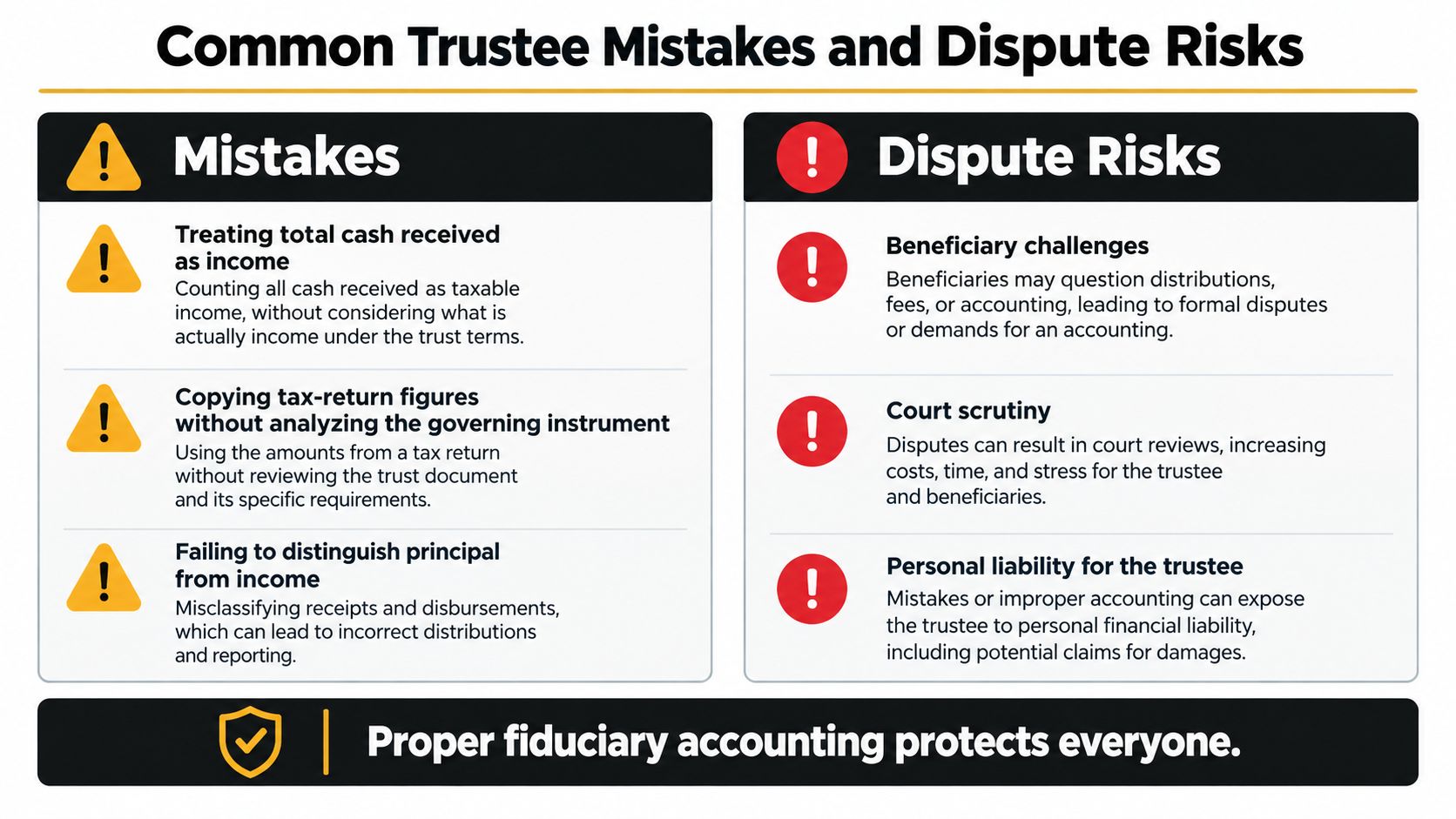
The most common shortcut is treating all cash received as income. A sale of a trust investment can produce a substantial deposit, but Texas law generally treats proceeds from selling a principal asset as principal unless an exception applies. Spending from a bank account also doesn't determine which accounting account should bear the expense.
Another shortcut is copying Form 1041 figures into the trust accounting. Federal tax reporting and fiduciary accounting answer different questions. Tax classifications can help the trustee coordinate reporting, but they don't replace review of the trust instrument and Texas allocation rules.
Keep records that show the reasoning
Other avoidable problems include keeping only one ledger, charging every expense to income, overlooking transfers, and distributing cash without documenting reserves or discretionary decisions. These choices can affect beneficiary payments, tax reporting, and confidence in the trustee's administration. A disagreement over classification doesn't automatically prove a breach, but unclear records can make a reasonable decision harder to defend.
Texas Estates Code Section 404.001 also offers a practical reminder for independent executors. After the statutory waiting period, an interested person may demand a written, sworn accounting that describes estate property received and disposed of, debts and expenses, property still held, and other facts needed to show the estate's condition. The executor generally has a statutory period to respond; if the demand isn't met, the interested person may ask the probate court to compel an accounting. The Texas Estates Code provisions for independent executor accountings explain the requirements.
Executors should preserve bank statements, closing records, receipts, distribution details, and correspondence as administration proceeds. Beneficiaries who need clarity should ask focused questions and consider legal advice before escalating a dispute. A careful accounting can help families resolve questions through explanation and correction rather than allowing an avoidable recordkeeping problem to grow.
Verify the Accounting and Seek Legal Help
Before finalizing an accounting, read the trust instrument and confirm the accounting period. Match each receipt and disbursement to supporting records, verify its classification, and reconcile opening balances, transfers, distributions, and ending balances. Then check that the proposed distributions comply with the trust's terms and the trustee's fiduciary duties in Texas.
A tax professional can help when the trust holds a business, has significant sales, or faces an unusual tax-reporting question. Legal advice may be appropriate when the document is unclear, beneficiaries disagree about an allocation, or a trustee is considering a corrective distribution. Trust modification or termination also requires separate legal analysis, not a bookkeeping shortcut.
Tax filing obligations are another distinct issue. The IRS states that a trust may have a Form 1041 filing obligation if it has taxable income or meets the applicable gross-income filing threshold. That federal filing test doesn't determine whether a receipt belongs to the trust's income or principal account. For a broader explanation of what trust administration involves and how it differs from probate, use a resource that addresses those separate processes.
If you're a trustee, bring the trust instrument, accounting records, statements, and unresolved questions to a Texas trust administration lawyer. Beneficiaries may want independent advice before sending a formal demand, and families planning ahead can consult a Texas estate planning attorney about how the document may guide future administration. Similar care may be needed for probate, guardianship, and asset-protection planning.
If you're managing a trust or planning your estate, contact Law Office of Bryan Fagan, PLLC for a free consultation about fiduciary accounting, Texas trust administration, estate planning, probate, guardianship, or asset protection. Our attorneys can help you review the trust terms, organize the accounting questions, and identify practical next steps for your family.