Managing a loved one's care can feel overwhelming, but with the right legal guidance, it doesn't have to be. Many Texas families hear the word guardianship and assume court is the only option. In many situations, it isn't. Alternatives to guardianship in Texas let you solve the specific problem in front of you while preserving your loved one's voice, rights, and independence.
Why Texas Families Look for a Different Path
A daughter in the Houston area notices her father still knows his doctors, his home, and what he wants for dinner. What he can't manage reliably is his monthly benefits check. Bills pile up, due dates slip, and she's worried someone could take advantage of him. A well-meaning neighbor tells her to file for guardianship.
That word can sound much heavier than the actual problem. Guardianship asks a court to transfer decision-making authority to another person. Her father doesn't need someone to make every choice for him. He needs help with one narrow gap, benefits and bill paying.

Start by Naming the Gap
That's the first task for families considering alternatives to guardianship in Texas. Don't start with a petition. Start with a clear sentence about what's not working.
- Money management gap: Benefits arrive but aren't tracked, saved, or spent safely.
- Health care gap: Medical information is hard to understand or communicate.
- Daily support gap: Housing, services, or employment choices need coordination, not replacement.
Once you name the gap, the right tool often becomes obvious. A representative payee may handle benefits. A medical power of attorney may handle health decisions if he can't communicate. Supported decision-making may help him understand options while he keeps final say.
Practical supports matter too. If staying home safely is part of the goal, a guide on aging safely at home can help families think through the home environment alongside the legal plan. Legal documents work best when daily life is also set up for safety.
Practical rule: Match the tool to the gap, not to your fear. A narrow problem usually calls for a narrow solution.
Texas law supports that approach. It prefers less restrictive options first, and many families who plan early never need a full guardianship at all.
The Texas Rule That Less Restrictive Comes First
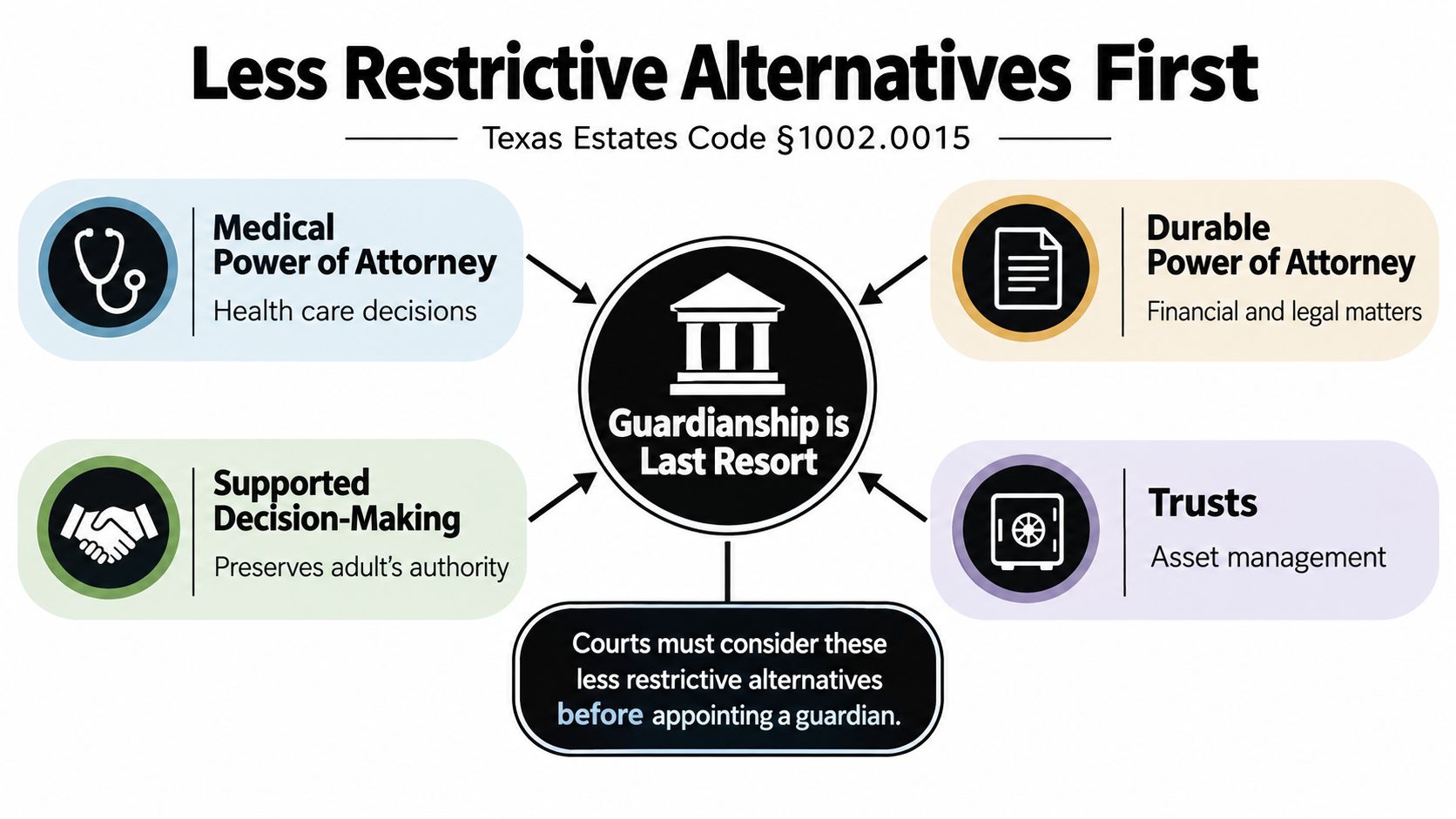
Texas doesn't treat guardianship as the default. Under Texas Estates Code §1002.0015, courts and families must consider alternatives before creating a guardianship, as reflected in the statutory list in §1002.0015. The statute gives you a menu, not a single answer.
The infographic below maps how that menu works in practice.
The Statutory Menu in Plain English
- Medical power of attorney: Lets a chosen agent make health care decisions under Health and Safety Code Chapter 166 when the person can't do so.
- Durable power of attorney: Lets an agent handle specified financial or legal matters, even after incapacity.
- Declaration for mental health treatment: Records preferences for mental health care in advance.
- Representative payee: Manages qualifying public benefits, and only those benefits.
- Joint bank account: Lets a trusted person help with an account, though it also creates ownership and access risks to review carefully.
- Management trust and special-needs trust: Place assets under structured management without giving a guardian control over every personal choice.
- Advance designation of guardian: Names who the person would want, or not want, if guardianship ever became necessary.
- Person-centered arrangements: Include supported decision-making and other individualized supports.
Each tool solves a different problem. A medical power of attorney doesn't manage a bank account. A representative payee doesn't consent to surgery. A trust doesn't decide where someone lives. When families mix those roles up, they often choose a document that's too broad or too narrow.
This video walks through the principle in a visual format before you compare documents in detail.
The deeper principle is self-determination. Texas moved away from substitute decision-making, where someone else decides, toward keeping authority with the individual whenever a less restrictive arrangement can meet the need.
Powers of Attorney for Health Care and Finances
Families often say power of attorney as if it's one document. In Texas, you're usually talking about two different tools with two different jobs.
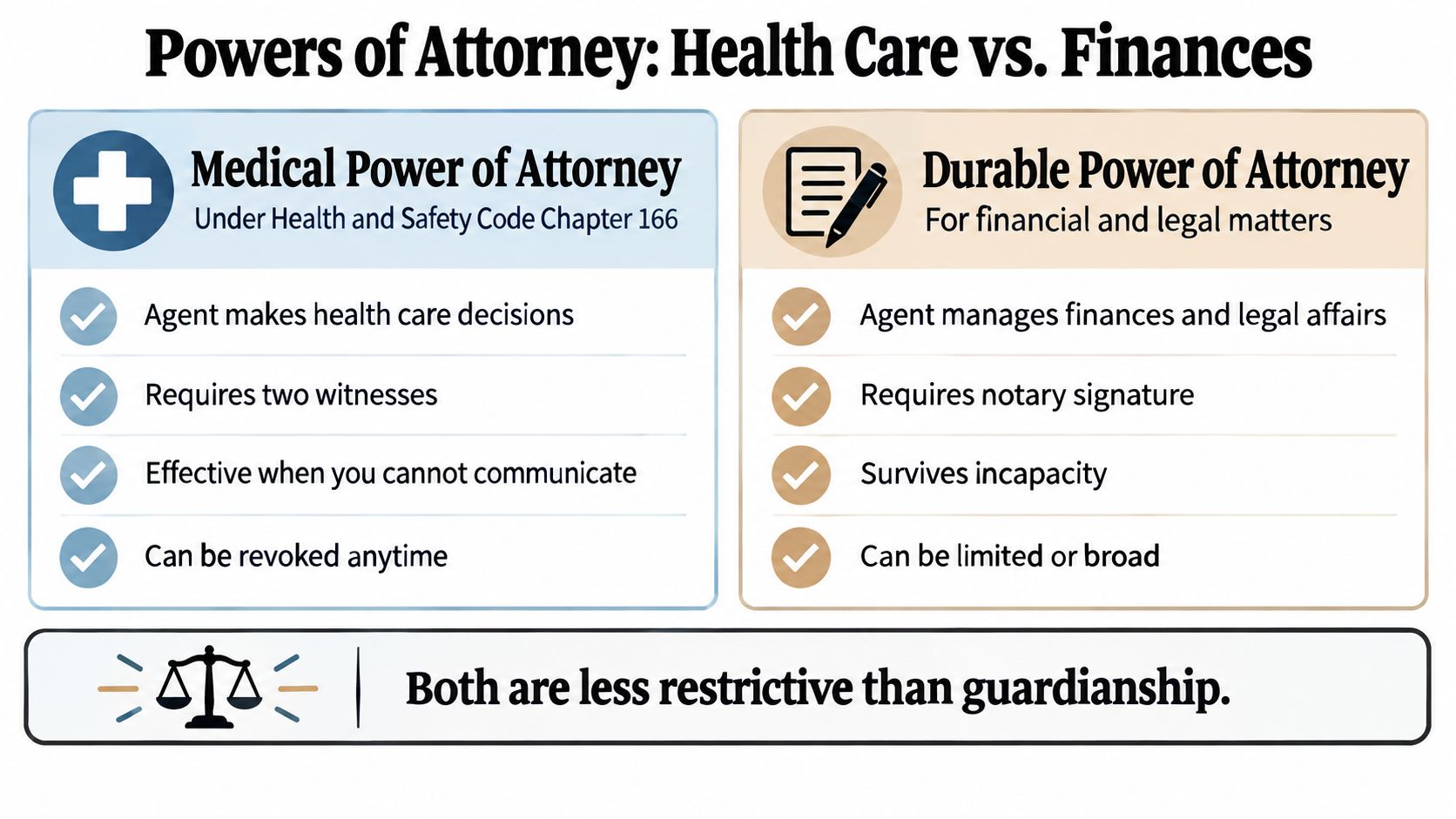
The comparison below helps separate health care authority from financial authority.
Two Documents, Two Jobs
A medical power of attorney focuses on health care decisions. It's for the moment your loved one can't communicate a treatment choice and a trusted agent needs to speak with providers. A durable power of attorney focuses on financial and legal matters. It can authorize an agent to pay bills, deal with accounts, sign specified documents, or handle property matters within the limits written into it.
Scope is where careful drafting matters. A durable power of attorney can be broad, or it can be limited to certain accounts or tasks. A medical power of attorney doesn't give access to money. Stacking both documents often covers the concerns that first made a family consider court.
If you're weighing these tools against court appointment, our explanation of the difference between a guardian and a power of attorney breaks down who grants the authority and how each role ends.
Where Families Hit Friction
A signed document isn't always the end of the story. Banks may have internal review steps. Health care providers may ask for their own forms or need to confirm who the agent is. That friction doesn't mean the document failed, but it does mean you should confirm acceptance procedures before a crisis.
Agents also carry responsibility. They must act within the authority granted, keep records, and avoid using the person's money as their own. Those expectations connect to broader fiduciary duties in Texas, whether someone serves as agent, trustee, or executor. Trustees facing similar questions can review When a Trustee Should Consult a Texas Attorney, which covers the situations where legal guidance protects the trustee and the trust.
Choose agents for judgment and availability, not just family order. The best agent is the person who will answer the phone, keep paperwork organized, and respect your loved one's wishes.
Supported Decision-Making Under Texas Law
Supported decision-making starts from a different premise. The adult keeps legal authority. A chosen supporter helps obtain information, understand options, weigh consequences, and communicate the decision, a model described in Texas guidance on alternatives to guardianship.
Texas made this a formal alternative through legislation in the 84th Texas Legislative Session in 2015, becoming the first state in the nation to place supported decision-making directly into statute, as noted in the Governor's disability policy materials on guardianship. That reform also addressed less restrictive alternatives, the rights of people subject to guardianship, and court consideration of alternatives first.
The photo below reflects the everyday nature of this arrangement. It's often two people at a desk, reviewing real choices together.

What Support Looks Like Day to Day
A supporter might read a lease aloud and explain the deposit terms. She might organize questions before a doctor visit, compare care plans side by side, or help communicate a banking choice. The adult still accepts or rejects the option.
That's the key contrast with guardianship. There's generally no court order appointing a substitute decision-maker. The agreement can identify areas where help is useful, such as housing, health care, services, relationships, and employment. It's signed by the adult and supporter in the presence of two witnesses or a notary.
A supporter helps the adult make and express a decision. The supporter does not automatically gain authority to decide instead of the adult.
Supported decision-making works best when the person can express preferences but benefits from structured help. It can end according to its terms, including following findings involving abuse, neglect, exploitation, or related criminal conduct by the supporter.
It also has limits. If a task requires legally delegated authority, such as signing financial documents as agent or managing trust assets as trustee, you'll need a power of attorney or trust alongside it. Think of supported decision-making as complementary, not interchangeable. A Texas estate planning attorney can help you layer the pieces so support and legal authority don't get confused.
Trusts, Joint Ownership, and Other Person-Centered Tools
Some gaps are mainly about assets or benefits. In those cases, a trust, a representative payee, or a carefully limited account arrangement may fit better than any decision-making agreement.
Under §1002.0015, Texas lists a management trust under Chapter 1301, a special-needs trust, joint bank accounts, and representative payees among its alternatives, as set out in the Estates Code provisions in Chapter 1002. A management trust provides structured handling of assets. A special-needs trust can help manage resources while families pay close attention to benefits eligibility. If that issue is central for your family, review how a special needs trust in Texas is structured before moving money into one.
Matching the Texas Alternative to the Decision-Making Gap
| Decision-Making Gap | Best-Fit Alternative | What It Does | Key Limitation |
|---|---|---|---|
| Health care consent | Medical power of attorney | Agent makes health decisions when needed | Doesn't manage money |
| Bills and legal tasks | Durable power of attorney | Agent handles specified financial matters | Agent must stay within granted powers |
| Benefits checks | Representative payee | Manages qualifying public benefits | Limited to those benefits |
| Asset protection and management | Management or special-needs trust | Trustee manages trust assets under its terms | Doesn't cover personal or medical choices |
| Help understanding choices | Supported decision-making | Supporter explains and helps communicate | Adult retains final authority |
Joint ownership needs extra care. Adding someone to an account can make bill paying easier, but it may also give that person broader access than the family intended. Never treat joint ownership as a harmless shortcut without discussing ownership, creditor, and inheritance effects.
Trustees, agents, and payees share practical duties. Keep separate records. Don't commingle funds. Follow the governing document or appointment. Act only within the authority you were given. Those habits are core to fiduciary duties in Texas, and they're also where a Texas trust administration lawyer can help with accounting, tax planning, and questions such as how to modify a trust in Texas under the Texas Trust Code.
Families supporting younger adults may also find perspective in this guide on independence for autistic adults, which speaks to building autonomy with support rather than removing rights by default.
Building a Timing and Escalation Roadmap
The hardest cases aren't families who choose the wrong document. They're families who wait until capacity has already declined and then discover the preferred alternative may no longer be available.
Supported decision-making requires the adult to understand the process, purpose, and consequences of the agreement. Powers of attorney also depend on valid execution. Texas materials emphasize less restrictive options and limiting any guardianship to what's necessary, a staged approach reflected in Texas Health and Human Services guardianship guidance.
A Staged Roadmap You Can Follow
- Identify preferences early: Ask who your loved one trusts, where they want to live, and what help feels acceptable.
- Execute documents while capacity is clear: Sign powers of attorney, trust documents, or a supported decision-making agreement before an emergency forces rushed choices.
- Store and share copies safely: Make sure agents, supporters, and trustees know where originals are kept and how to reach each other.
- Confirm acceptance in advance: Ask banks and health care providers what they need to recognize an agent or supporter.
- Document communication needs: Write down how the person best receives information, whether that's large print, extra time, a quiet room, or a trusted person present.
- Plan for escalation: Decide what triggers a move to a limited power of attorney, a representative payee, a trust, or a narrowly scoped guardianship.
Why Timing Is Getting More Attention
Recent Texas developments show the law is still refining these boundaries. In 2025, SB 746 was signed and took effect September 1, creating stronger protections around representation and conflicts in guardianship proceedings. Proposed SB 66 would study whether supported decision-making agreements should include assistance in legal proceedings.
That matters because supported decision-making may work well for everyday choices but leave unclear pathways for litigation, contested benefits, or urgent protective action. Your roadmap should answer the crisis question in advance. Who can act, under what document, and how quickly?
Review the plan after major health changes, moves, or family conflicts. A roadmap you revisit is far more useful than a folder no one has opened in years.
When Guardianship in Texas Is Still Necessary
Sometimes every less restrictive option has been tried and it still isn't enough. An adult may no longer be able to consent to necessary medical treatment. Another person may face imminent exploitation and can't engage with a supporter, agent, or trustee in any meaningful way.
In those situations, guardianship isn't a failure. It's a protective court process, and Texas requires it to be limited to what's necessary. Families should be ready to show what alternatives were considered, what was tried, and why those tools couldn't meet the need. That record helps the court tailor any authority it grants.
If you're approaching that point, learning how to apply for guardianship can clarify the filing steps, evaluations, and court oversight involved. Even then, ask for the narrowest tool that solves the problem, whether that means authority over specific decisions rather than every aspect of a person's life.
Remember this: Guardianship should be the last resort, not the first reaction, and it should never be broader than the proven need.
Take the Next Step With a Texas Trust and Estate Attorney
A family in The Woodlands faced a familiar mix of worries, medical decisions, a benefits check, and daily choices their loved one still wanted to make. They paired a medical power of attorney with a representative payee and a supported decision-making agreement, and they avoided a broad guardianship. If you're managing a trust or planning your estate, contact The Law Office of Bryan Fagan, PLLC for a free consultation. Our attorneys provide trusted, Texas-based guidance for every step of the process.
If you're weighing alternatives to guardianship in Texas, Law Office of Bryan Fagan, PLLC can help you match powers of attorney, supported decision-making, trusts, and guardianship options to your loved one's actual needs. Schedule a free consultation to review your family's documents, timing, and escalation plan with a Texas trust and estate attorney who will explain your next steps in plain English.