A sudden death can turn ordinary family decisions into legal problems overnight. A spouse may be trying to grieve while finding out who can access a bank account, pay household bills, or manage a home. If there's no will or other planning, Texas law supplies rules for property that the person didn't direct elsewhere, and family members may disagree about what the person would have wanted.
Consider a Houston-area family whose loved one dies without written instructions. The surviving spouse and adult children may have different expectations about the home, accounts, or personal belongings. Some assets may pass under beneficiary forms or joint ownership, while other property may require probate or a court process to establish who inherits. No one needs to have acted badly for confusion to grow. Missing instructions can make a painful time harder.
That's why estate planning is important. A sound plan gives your family a clearer path by coordinating the documents, ownership records, and decisions that control what happens if you die or can't act for yourself. It can't prevent grief, but it can reduce uncertainty and help the people you care about carry out your wishes.
A Texas Family Story You Have Probably Heard Before
A family's trouble often begins with a practical question: who can handle the bills? A bank may need proof of authority before someone can manage an account, and a relative's confidence about what the deceased wanted doesn't replace legal instructions. If property is in the deceased person's name alone, the family may need to address probate and heirship before the asset can be transferred.
The family may also discover that different assets follow different rules. A life insurance policy or retirement account may pass according to its beneficiary designation, while property covered by a will follows the will, and property with no controlling instruction may pass under Texas intestacy law. If a will is missing, the Texas Estates Code determines who inherits eligible probate property. The result can depend on whether property is community or separate, and on the family structure.
The conflict often starts with assumptions
One child may believe the house should stay in the family. A surviving spouse may assume that everything automatically belongs to them. A stepchild may expect to inherit, though a stepchild isn't automatically treated as an heir under intestacy rules. These are understandable expectations, but expectations don't control title or inheritance.
The same uncertainty can arise while someone is alive. If illness or an accident leaves a person unable to make decisions, a family member may not have authority to access finances or speak for them medically. A will won't solve that problem because it takes effect at death, not during incapacity.
The practical point: A family shouldn't have to guess who inherits, who makes decisions, or where the instructions are. Put those directions in documents that work together.
A Texas estate plan addresses five connected concerns: who receives property, how assets transfer, who can act during incapacity, how fiduciaries carry out their duties, and whether tax or liquidity planning is needed. It also has to account for digital property and current account settings. The sections ahead focus on the decisions that make those protections work in real life.
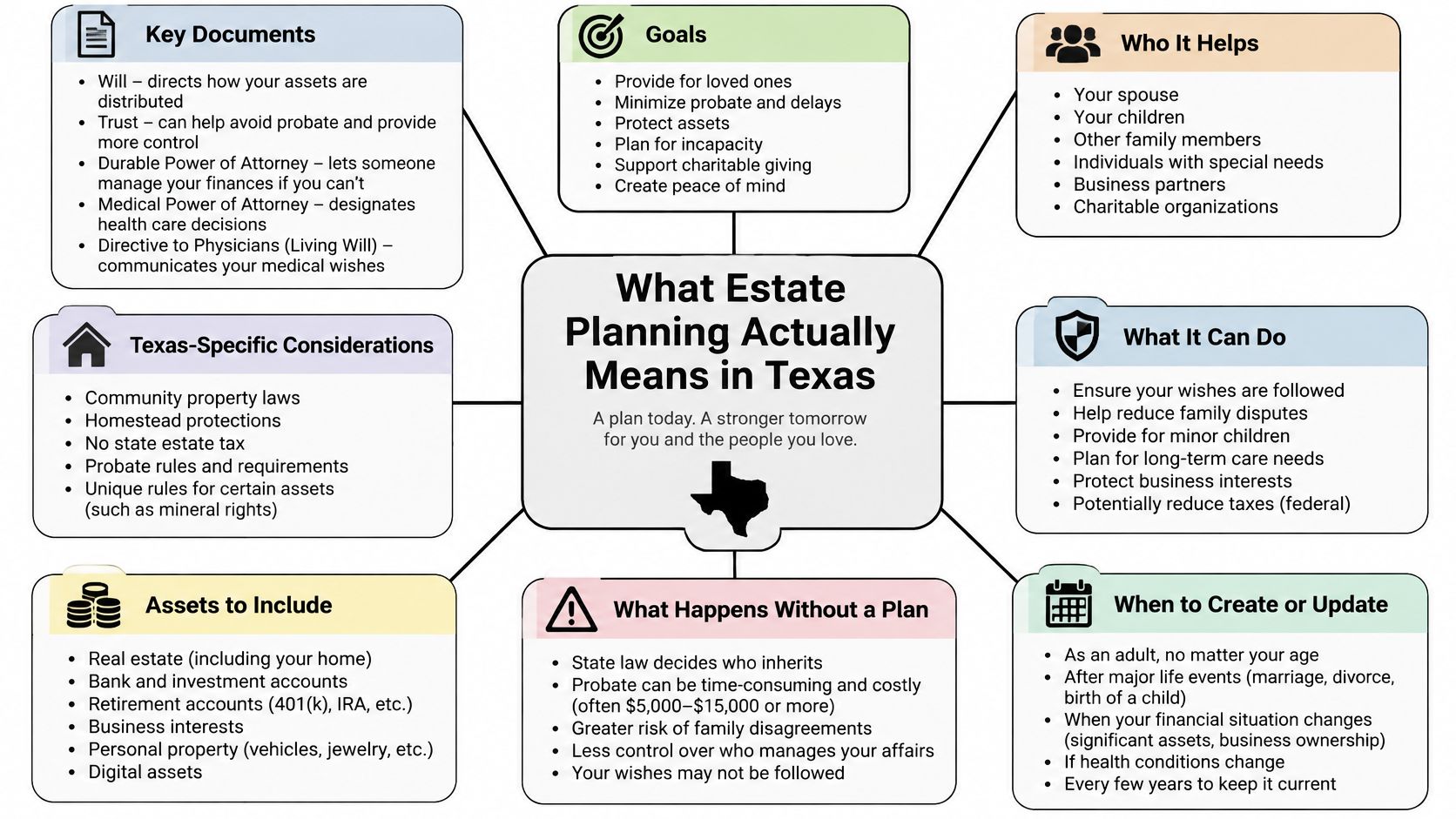
What Estate Planning Actually Means in Texas
Estate planning is the process of deciding, in legally usable documents and account records, who should receive your property and who may act for you if you can't make decisions. It isn't just a will. A plan coordinates your will, powers of attorney, health-care instructions, trust provisions where appropriate, beneficiary designations, and the way assets are owned.
Five problems a plan should solve
First, it should identify who inherits. Without a will, Texas intestacy law can determine who receives probate property. A will gives you a way to state your choices, but it doesn't control assets that pass by beneficiary designation or ownership arrangement.
Second, a plan should consider how property transfers. Some assets may pass outside probate, while other property may require probate administration. A trust may help keep assets properly transferred into it out of probate, but signing a trust without funding it can leave important property outside the trust.
Third, it should prepare for incapacity. A financial power of attorney and health-care documents can name people to act or communicate for you while you're alive. Pew Research Center's 2025 survey of U.S. adults found that 31% had created a living will or advance health-care directive, compared with 32% who had created a conventional will (Pew Research Center's estate-planning survey). Planning while you're able to make and communicate decisions is better than leaving your family to sort out authority during an emergency.
Fourth, a plan should address tax and liquidity questions when relevant. Larger estates, lifetime gifts, business interests, and illiquid assets can require coordination with tax and legal professionals.
Fifth, it should consider how beneficiaries will be protected. A trust may be appropriate when a beneficiary is young, needs ongoing support, or shouldn't receive property outright. The right arrangement depends on the family and the trust terms.
A will is a starting point, not a complete plan. The documents and asset records have to agree with each other.
The gap between intentions and written instructions is real. A 2024 AARP survey of 1,869 adults age 50 and older found that 51% had a legal will, while 93% said an updated document identifying intended recipients was important (AARP's survey on wills and inheritance). The survey also found that 61% of respondents without a will said they hadn't gotten around to creating one. Estate planning isn't reserved for wealthy families. It's a way to turn wishes into directions others can follow.
For families considering a trust, Texas Trust Administration: A Trustee's Guide describes what trust administration involves and how it differs from probate.
How Texas Intestacy Law Decides Who Gets Your Property
When someone dies without a will, the Texas Estates Code supplies default inheritance rules for probate property. Those rules don't ask what the person said at the kitchen table or what the family considers fair. They apply based on legal relationships, property classification, and family structure.
Community property and separate property aren't interchangeable. Texas intestacy law treats them differently. The surviving spouse and children commonly inherit, but the exact result depends on circumstances such as whether the children are also the surviving spouse's children and whether the property is community or separate. If there's no spouse or child who inherits, the potential heirs can extend to parents, siblings, nieces, nephews, or others under the statutory order. The Texas State Law Library provides an overview of Texas probate and intestacy rules.
Why family structure matters
A blended family should not assume that a stepchild inherits automatically under intestacy. A surviving spouse shouldn't assume that every asset becomes theirs because they were married to the deceased. Those assumptions can be especially damaging when a home, family business, or inherited property is involved.
A will can state who should receive probate assets and name an executor, but it doesn't override every transfer path. Some accounts, insurance proceeds, and jointly held property may pass outside the will. If the beneficiary form names someone who no longer reflects your wishes, that designation may control the transfer even if a later will says something different.
A coordinated review should cover both the documents and the records attached to each asset:
- List ownership: Identify whether real estate, accounts, and business interests are individually owned, jointly held, or held in trust.
- Review beneficiaries: Check retirement accounts, insurance, and other assets with beneficiary designations.
- Revisit after change: Review records after marriage, divorce, births, deaths, refinancing, or business changes.
- Match the plan: Make sure the will and trust terms don't conflict with how property is titled or designated.
For a practical discussion of whether a will is needed, see Do I Have to Have a Will in Texas?. A will is often an important part of a plan, but it can't fix every mismatch in ownership or beneficiary records. The reliable approach is to make the documents and asset-transfer instructions work together.
The Core Documents Every Texas Plan Should Include
Documents are controls, not paperwork. In Texas, the right set decides who can act while you are alive, who receives community property versus separate property at death, and whether your executor can serve independently with less court interference.
Match each document to its job
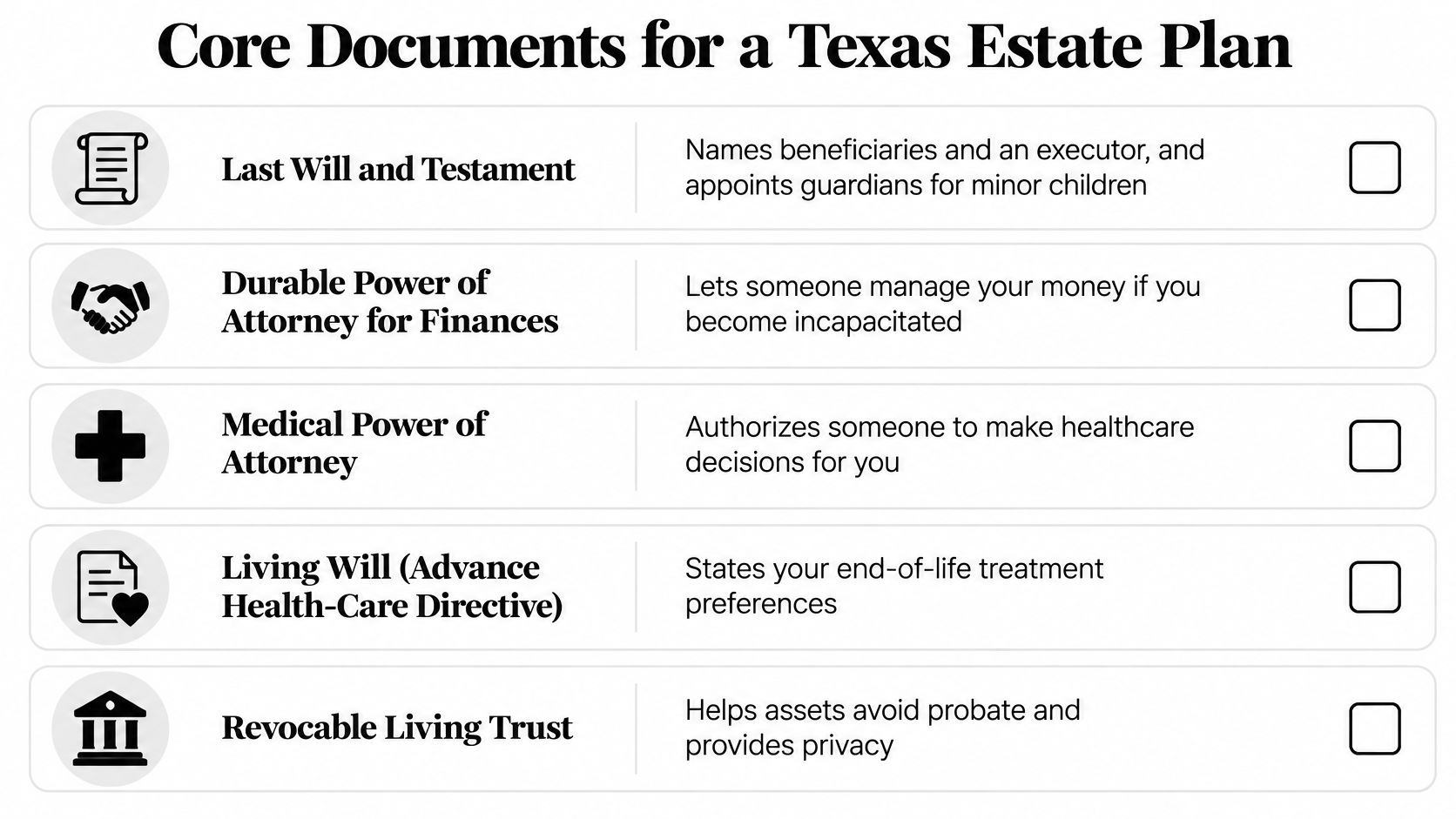
A last will and testament names beneficiaries for probate property, appoints an executor, and can nominate guardians for minor children. For many Texas families, the will should also state the intent for independent administration and address community and separate property so a later heirship fight is less likely.
A durable power of attorney for finances authorizes someone you choose to handle financial matters within the document's scope if you cannot act. Choose an agent who is organized, trustworthy, and willing to follow your interests. This authority carries real responsibility, so do not select someone just because they are the closest relative.
A medical power of attorney names someone to make health-care decisions if you are unable to make them yourself. A living will, also called an advance health-care directive, communicates preferences about end-of-life treatment. A HIPAA authorization lets designated people obtain protected health information, subject to its terms.
A revocable living trust can keep assets transferred into it out of probate and provide a management framework if you become incapacitated. It does not control property left in your individual name, and it does not replace a will for every purpose. Families comparing those paths can review Trust Administration vs. Probate in Texas.
A useful completeness check
Ask whether you have a valid will, named financial and medical decision-makers, written treatment preferences, medical-information access, and trust terms that match how your assets are titled. Add digital authority: email, cloud storage, photos, password managers, cryptocurrency access, and social accounts should have a named fiduciary and clear instructions. Generic AI-generated forms often miss these Texas choices, especially independent administration, property characterization, and fiduciary access to accounts.
Refresh the HIPAA authorization and powers after moves, provider changes, marriage, divorce, deaths, or when a bank or hospital questions an older form. Then confirm the people you named know where the originals are and are willing to serve. Use our estate planning documents checklist to confirm nothing is missing.
Real Texas Scenarios and How the Right Plan Helps

A blended family in Dallas–Fort Worth may include a parent with children from a prior marriage and a new spouse. If the parent dies without coordinated documents, the surviving spouse and children may have different legal interests and expectations. A will, carefully chosen trust terms, and updated beneficiary designations can make the intended distribution clearer. The parent should also speak with the people being asked to serve as executor or trustee before naming them.
A San Antonio small-business owner may have a company that depends on the owner's daily decisions. A personal will alone may not explain what happens to business interests or how a successor should manage them. The owner should coordinate the estate plan with business ownership records and any buy-sell or succession arrangements, then consider who can act if the owner becomes incapacitated.
A Houston-area caregiver may notice that an aging parent is having difficulty managing bills or remembering medical preferences. Waiting until a crisis can leave the family uncertain about who has authority. The parent should review financial and medical decision-making documents while able to make choices, and the family should discuss where those documents are kept.
Each situation turns on different facts, but the lesson is the same: a document that looks complete on paper won't protect a family if it names the wrong person, doesn't fit the asset, or can't be found when needed. Trustees and executors also have to act carefully after a death. A trustee's duties depend on the trust instrument and Texas law; an executor must follow the will and applicable estate procedures. Both should keep records, communicate appropriately, and seek advice before taking steps that could affect beneficiaries.
The following video offers another overview of estate planning considerations for families.
Texas Probate, Federal Estate Tax, and Independent Administration Explained
Texas independent administration can reduce routine court involvement, but it doesn't remove an executor's legal duties. Under Texas Estates Code Chapter 402, after an independent administration is created, the order appointing the independent executor is entered, and the required inventory, appraisement, and list of claims or an affidavit in lieu is filed, further probate-court action generally doesn't occur unless the Estates Code authorizes it (Texas Estates Code Chapter 402).
The executor still needs to locate the will, identify and value estate property, address valid claims, preserve records, and distribute property only after legal obligations are handled. Distributing a house before confirming ownership and creditor issues can create disputes or personal exposure. Independent administration means less routine court supervision, not permission to skip careful work.
| Factor | Independent Administration | Dependent Administration |
|---|---|---|
| Court involvement | Generally less routine court supervision after statutory requirements are met | More court supervision of administration steps |
| Executor's work | Executor handles authorized tasks while meeting fiduciary duties | Executor follows court-supervised procedures |
| Records and claims | Must still identify assets, preserve records, and address valid claims | Must still identify assets, preserve records, and address valid claims |
| When disputes arise | Court action may be needed where authorized or where a dispute requires it | Court oversight is part of the administration process |
Transfer-tax planning needs current numbers
For deaths in 2026, the IRS states that the federal estate-tax filing threshold is $15,000,000, calculated with the gross estate, adjusted taxable gifts, and the applicable exemption framework. Estates above the threshold generally must file Form 706, even if deductions or planning reduce tax owed (IRS estate-tax guidance).
The IRS also states that the 2026 basic exclusion amount is $15 million and the annual gift-tax exclusion is $19,000 per recipient. Qualifying gifts can use the annual exclusion separately for each recipient; married couples may generally combine exclusions and give $38,000 per recipient when requirements are met (IRS guidance on estate and gift-tax changes). These rules depend on gift type, valuation, prior taxable gifts, ownership, and filing requirements. Don't assume a transfer is tax-free just because it falls below a stated amount.
Families with concentrated business or real-estate interests should inventory assets, document valuations, review prior gifts, and discuss portability and liquidity with estate counsel and tax professionals. A tax plan should be checked periodically, because exemptions and rules can change.
The Digital and AI Gap Most Texas Plans Still Miss
Probating the house takes months. Losing access to a decedent's email can take years. A will does not hand your family the keys to cloud photographs, cryptocurrency, social-media accounts, online businesses, or password managers, and every platform sets its own rules about who may see what after a death.
One recent U.S. report found that 48% of adults have no written instructions for digital accounts and files, only 21% have formal written instructions, 12% use account-level controls such as platform legacy settings, and 20% of Americans trusted AI-generated legal advice more than human attorneys while another 34% trusted it equally (Trust & Will's estate-planning report). Read that the way I do: most Texas families leave no roadmap for digital property, and a large share of the public thinks a chatbot can draft their documents.
Fix the digital side on paper and in practice. Build a secure inventory of accounts, note which platforms offer legacy or recovery settings, and name who should manage or receive each asset. Keep passwords out of the will itself, since a will filed for probate becomes public record, and tell your fiduciary where the instructions live. A guide to digital-asset estate planning covers the specific issues to address.
AI tools can organize your questions and sort documents. They cannot confirm that a form meets Texas execution requirements, matches your beneficiary designations, or handles community versus separate property correctly. One useful starting point is Documind on AI for legal work, which covers technology's role in legal-document tasks. Use these tools to prepare for a meeting with your attorney, never to replace one. A document that reads well and fails in a Texas probate court protects nobody.
Your Next Steps and Common Questions Answered
Start by reviewing beneficiary designations, signing or updating core documents, confirming decision-makers, making a secure digital-asset inventory, and checking how Texas property is titled.
Is a will enough? Usually not by itself. It doesn't address incapacity or control every nonprobate asset.
How often should I update my plan? Review it after a major family, property, or business change, and whenever your instructions may no longer fit.
What does a Texas estate plan cost? It depends on the documents, assets, and complexity. Get advice based on your situation rather than relying on a generic price.
When should I involve a lawyer? When family structure, business interests, trusts, tax questions, or Texas-specific execution rules make a mistake costly.
If you're planning your estate or serving as a trustee or executor, The Law Office of Bryan Fagan, PLLC provides Texas-based guidance on estate planning, trust administration, probate, guardianship, and asset protection. Contact the Law Office of Bryan Fagan, PLLC to schedule a free consultation and discuss a plan designed for your family.