Managing a loved one's trust can feel overwhelming, but with the right legal guidance, it doesn't have to be. You may have paid bills, sold property, and made distributions in good faith, then received a simple question you can't answer from memory alone. A clear accounting turns scattered statements into a calm, traceable story of what happened and why.
Why a Clear Trust Accounting Matters in Texas
A Texas trustee sells a rental house, pays taxes and repairs, then distributes money to a beneficiary for health and education. Months later, another beneficiary asks why the distribution came from principal, whether rent covered the repairs, and what remains. If the trustee answers from a bank balance alone, the conversation can become tense even when nothing improper occurred.
More Than a Year-End Balance
A useful accounting explains what the trust owned, received, paid, gained, lost, and distributed during a defined period. It connects each number to a transaction, a date, and a supporting record. That structure protects beneficiaries who need information and trustees who need to show careful work.
Texas law gives that expectation specific content. A written accounting under Texas Property Code §113.152 must identify newly known trust property, provide a complete record of receipts, disbursements, and other transactions, show the source and nature of each transaction, and separate principal receipts from income receipts. It also lists property being administered, the cash balance and depository, and known liabilities.
Legal Compliance and Family Communication
Good records serve two purposes at once. They help a trustee meet fiduciary duties in Texas, including loyalty, prudence, and impartial treatment. They also give family members a shared set of facts before suspicion fills gaps in the record.
A beneficiary who can trace a payment from authorization to bank statement to final balance has less reason to assume the worst.
That doesn't mean one format resolves every dispute. Valuation, compensation, and distribution standards can still require legal review. A structured process gives everyone an organized starting point and helps a Texas trust administration lawyer spot the underlying issue faster.
What Uniform Fiduciary Accounting Principles Cover
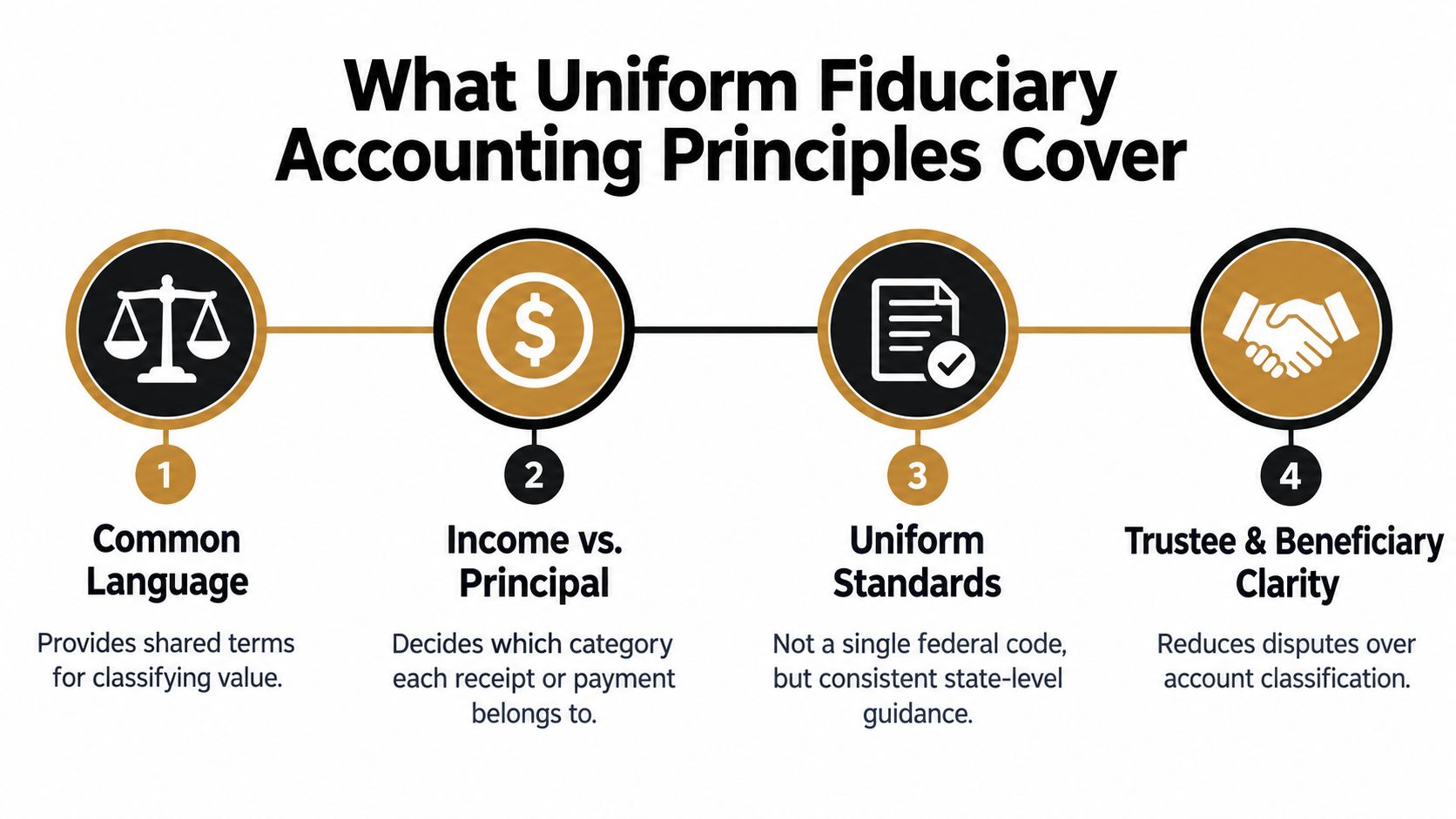
The phrase uniform fiduciary accounting principles describes a common framework, not a single federal accounting code. These principles give trustees shared language for deciding whether value belongs to income for current beneficiaries or principal for future and remainder beneficiaries. They also guide how changes are presented across an accounting period.
The timeline below summarizes the core ideas trustees use before they turn to the controlling document and statute.
How the Uniform Framework Developed
Uniform principles developed mainly through the Uniform Principal and Income Act, or UPIA. The Uniform Law Commission approved the first UPIA in 1931, and it was enacted by 24 states and remained in effect in 7 states by the late 1990s, according to the history of the first and revised uniform acts. A revised act followed in 1962, and summaries report broad adoption of the early versions across many states.
That history matters because allocation has real consequences. Classifying a receipt as income may increase what a current beneficiary receives now. Classifying it as principal preserves value for remainder beneficiaries later. Uniform rules were designed to reduce conflicting approaches, but states enacted and adapted them through their own legislation.
What the Principles Address in Practice
In daily administration, trustees use these ideas for receipts, disbursements, allocations, gains, losses, accounting periods, and reconciliations. They may also encounter adjustments and unitrust concepts when modern investments don't produce traditional interest and dividends in a balanced way.
Don't treat model guidance as automatic authority. The trust instrument, governing state law, and court orders can change the answer for a particular trust. Uniform principles supply the vocabulary and structure. Controlling law supplies the obligation.
How to Identify the Rules That Control Your Trust
Start with the document, not with a spreadsheet template. Before you code any transaction, identify the source that governs it and write that source in your work papers. This small habit prevents a familiar model rule from overriding a specific instruction the settlor chose.
A Practical Hierarchy for Decisions
Use this order each time a question arises:
- Trust instrument first: Follow express directions, distribution standards, allocation instructions, and any valid discretionary power the document grants.
- Governing-law provision next: Check whether the trust selects Texas law or another state's law, especially if the trust was drafted elsewhere.
- Applicable statute: Apply the controlling state principal and income statute when the instrument is silent, while checking Texas Trust Code §111.0035 on default and mandatory provisions for limits on what a document can change.
- Court orders and agreements: Follow any order, settlement, or approved modification that directs administration.
- Documented discretion last: If you have authority to choose, record your reasoning, impartiality analysis, and supporting records.
Uniform statutes follow a similar hierarchy. The fiduciary follows the governing instrument first, and the statute supplies a default when the instrument is silent, as reflected in the uniform principal and income hierarchy and accounting period rules. The fiduciary must act in good faith and impartially between income and remainder beneficiaries.
Three Common Texas Scenarios
A trust created in Colorado may move to Texas with a successor trustee, but its governing-law clause may still matter. A Texas trust may own minerals, rental property, and accounts in several states, raising administration questions beyond one bank location. Another document may direct all investment returns to principal, even if a default statute would treat part of a return differently.
In each case, don't choose the rule you recognize first. Identify the controlling source, then classify the transaction.
Principal Income and Adjustment Account Categories
Think of the trust account as three labeled buckets, with gains and losses tracked visibly rather than hidden. The labels help beneficiaries understand who benefits from a transaction and when. They also help you apply the same decision consistently across months and years.
Principal in Plain English
Principal, often called corpus, is the core property that funds the trust and is generally preserved or distributed under the document's terms. A settlor's initial contribution of cash, a house transferred into the trust, and the purchase price paid to acquire an investment are typical principal-side items. A distribution expressly authorized from principal also belongs in your principal records.
Principal answers a basic question. What foundational property does the trust hold, and how has that base changed?
Income in Plain English
Income is the return produced by trust property under the controlling document and law. Interest on a trust account or rent from trust real estate often illustrates the category, subject to the instrument and statute. Income records show what current beneficiaries may be entitled to receive or what may be accumulated if the document allows it.
For example, a trustee deposits monthly rent, pays ordinary property expenses from the category the governing rules designate, and reports the net activity. The beneficiary can then see whether rent arrived, what it paid for, and what remains available.
Adjustments and Separate Gain or Loss Reporting
An adjustment moves value between income and principal only when the governing instrument or applicable law authorizes it. It's not a miscellaneous bucket for items you can't classify. Note the authority, amount, date, and reason for every adjustment.
Don't net gains and losses into an asset balance where they disappear. Show a sale gain or loss separately so a reader can connect the original asset, sale proceeds, and ending holdings.
| Account category | Typical activity | Supporting records | Question answered |
|---|---|---|---|
| Principal | Funding, asset purchases, authorized principal distributions | Deeds, closing statements, custodian records | What core property remains? |
| Income | Interest, rent, designated cash returns | Bank statements, leases, payment notices | What return did the property produce? |
| Adjustment | Authorized transfer between principal and income | Instrument provision, statute analysis, trustee memo | Why did value move between categories? |
| Gain or loss | Sale or other disposition result | Trade confirmations, settlement statements, valuations | How did the disposition change value? |
This guide organizes review. It doesn't replace the trust instrument or Texas law.
Required Schedules and Reconciliation Structure
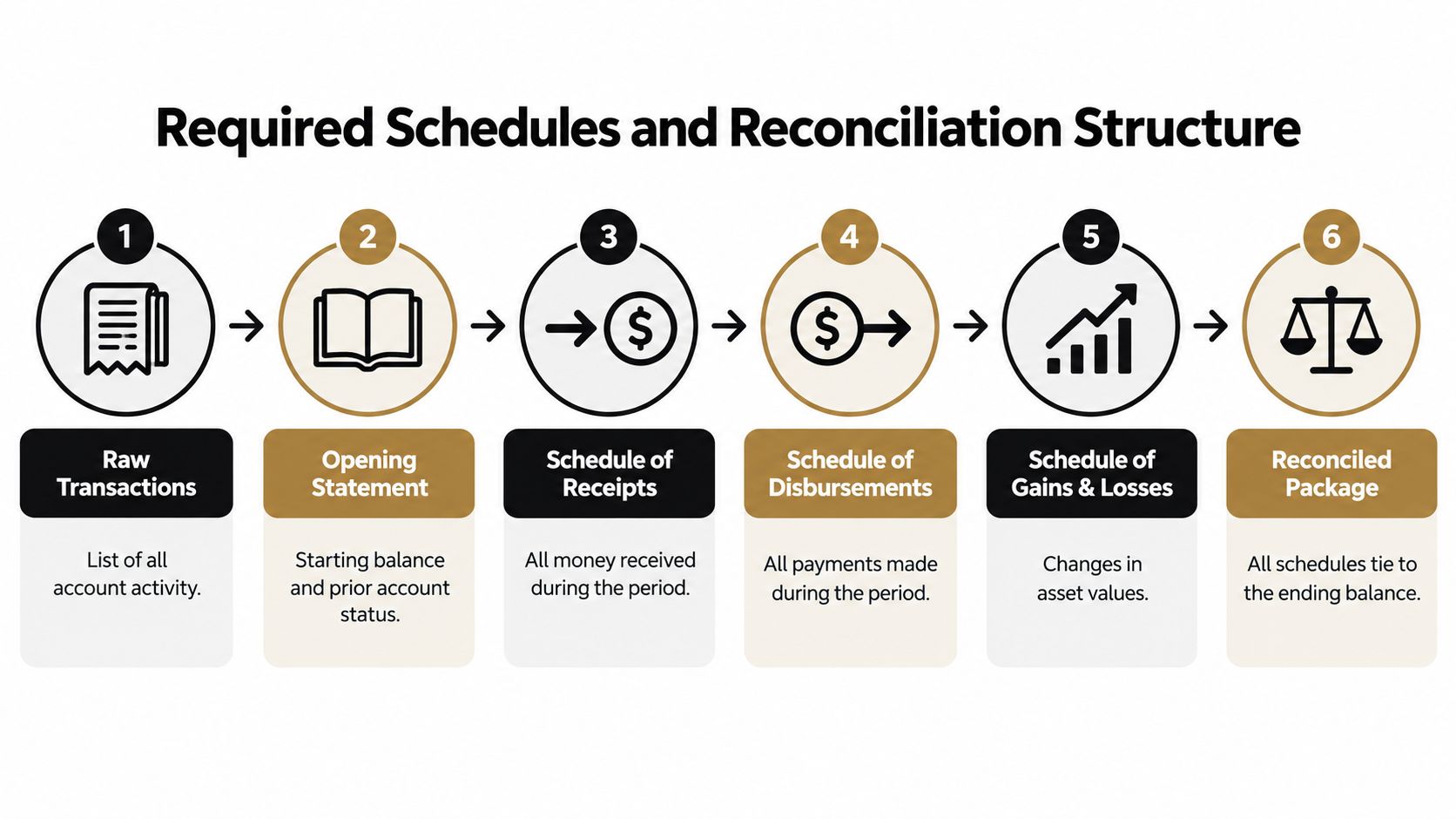
A transaction list becomes useful when you arrange it into schedules that prove the ending balance. Each schedule should answer one question clearly, then tie to the next. If a beneficiary must hunt through statements to reconstruct your math, the package isn't finished.
The flow below shows how raw activity becomes a reconciled accounting.
The Schedules That Carry the Story
Begin with a concise statement of purpose and the accounting period. An account should provide enough detail to place interested parties on notice of every significant transaction, under the presentation approach in the National Fiduciary Accounting Standards. That framework uses carrying values and current values at the beginning and end of the period, with gains and losses shown separately.
A practical package usually includes:
- Opening property schedule: Assets and values at the start of the period.
- Receipts schedule: Money and property received, separated by principal and income.
- Disbursements schedule: Expenses, taxes, fees, and distributions paid.
- Gains and losses schedule: Results from sales or other dispositions.
- Capital changes schedule: Purchases, adjustments, and other changes not captured above.
- Ending property schedule: Assets, cash, depository information, and known liabilities at period end.
Make the Math Reconcile
Use a simple proof. Beginning assets plus receipts and gains, minus disbursements and losses, should lead to ending assets, after you account for purchases, sales, and other capital changes. Tie each schedule total to bank or custodian statements.
Carrying value shows the value assigned when the fiduciary acquired an asset. Current value shows what it's reported to be worth at the period boundary. Showing both can help beneficiaries understand performance without confusing a value change with cash received.
Fit the final package to the trust document, Texas requirements, and asset mix. A trust holding one brokerage account needs less explanation than a trust holding rental property, a business interest, and mineral rights.
Common Allocations and Adjustments
Allocation questions rarely arrive labeled by category. A deposit appears from an investment platform, a property manager sends a bundled statement, or a business makes a cash distribution. Your job is to identify the source and nature of the payment before you classify it.
Ordinary Receipts Need Source Review
Interest and rent often point toward income, while proceeds from selling an asset often point toward principal, with any gain or loss shown separately. Dividends require closer attention because the issuer's characterization and the governing rules may matter. Don't rely only on how a bank feed labels a deposit.
Review Texas principal and income allocation rules alongside the trust document before you finalize difficult items. Also check tax treatment, since fiduciary accounting income and taxable income aren't always the same concept. A classification that's right for beneficiary rights may need separate tax reporting analysis.
Expenses Taxes and Distributions
An expense doesn't automatically belong to income just because it's recurring. Ask what the payment protects or produces, what the instrument directs, and what the controlling statute provides. Trustee compensation, investment fees, insurance, repairs, and taxes can each require a documented analysis.
Distributions need a different check. Confirm the distribution standard, beneficiary, category charged, and authorization. If you distribute principal for health, education, maintenance, and support, your records should show that standard and the supporting request or invoice where appropriate.
Modern Assets That Strain Old Categories
An ETF may distribute amounts with different characteristics during a year. A private fund may return capital, allocate income for tax purposes, and report value changes on delayed statements. A closely held business may distribute cash without clarifying whether it's profit, compensation, or a return of capital. Illiquid real estate may produce rent while also needing a roof that benefits future years.
These are review situations, not automatic answers. The 2018 Uniform Fiduciary Income and Principal Act expanded adjustment and unitrust tools for total-return portfolios, but adoption and variations differ by jurisdiction, as explained in the comparison of uniform model rules and controlling governing law. Before you adjust, document good faith, impartiality, beneficiary impact, tax review, and legal authority. A total-return portfolio can be prudent and still create unfair results if you allocate every return by habit.
Sample Accounting Entries for Trust Activity
Sample entries teach the mechanics, but they aren't universal journal commands. Use labels your beneficiaries and advisors can follow, then connect every entry to a schedule and source document. If your software uses debit and credit fields, keep a plain-English description beside the technical entry.
Six Illustrative Entries
- Principal asset receipt: Record cash or property funded into the trust on the principal receipts or capital changes schedule. Support it with the funding document, deed, or transfer confirmation, and increase ending principal assets.
- Income receipt: Record interest or rent on the income receipts schedule. Support it with a bank statement, lease ledger, or payer notice, and increase the income balance.
- Expense payment: Record an insurance premium or accounting fee on the disbursements schedule in the category directed by the controlling rules. Keep the invoice and proof of payment, and reduce the charged category.
- Distribution to a beneficiary: Record the payment on the disbursements schedule with the beneficiary name, date, standard relied on, and category charged. Keep the request, approval, and canceled check or transfer record.
- Realized gain or loss: When the trust sells an investment, record proceeds, carrying value, and the separate gain or loss. Keep the trade confirmation and custodian statement, then update the asset schedule.
- Authorized adjustment: Record a transfer between income and principal only with cited authority and a short trustee memo. Show equal movement out of one category and into the other so total trust assets don't change merely because of the label.
A Short Reconciliation Example
Start with beginning assets. Add principal and income receipts from your schedules, add gains, subtract expenses and distributions, and subtract losses. The result should match the ending property schedule, bank balances, and custodian totals after you explain pending items.
Review rule: If an entry changes a schedule total, you should be able to point to the document that caused the change within minutes.
Treat these examples as educational. Review each real entry against the trust instrument, Texas law, tax treatment, and any court order before you post it. When families ask how to modify a trust in Texas because allocation language no longer fits the assets, that's a legal question separate from routine bookkeeping.
Build a Defensible Audit Trail
Correct classification is only half the work. A defensible accounting lets an independent reader verify the classification without asking you to reconstruct events from memory. That evidentiary trail is where many otherwise tidy reports fall short.
Connect Every Line to Proof
For each material line item, retain the bank record, custodian statement, invoice, tax form, valuation support, authorization, and distribution standard that apply. Practical guidance on organizing Texas trust records and documents can help you build a consistent file from the start. Keep trust accounts separate from personal accounts so the trail doesn't begin with a commingling question.
Use consistent file names with the date, asset, and document type. Add a short note when you exercise discretion, choose a valuation date, or allocate a bundled fee. Contemporaneous notes carry more weight than explanations written after a dispute begins.
Hard-to-Document Assets and Corrections
Digital assets may require exchange records, wallet identifiers handled securely, and transfer confirmations. Private-company interests may rely on operating agreements, capital account statements, distribution notices, and periodic valuations. Illiquid real estate may need appraisals, broker opinions, rent rolls, and repair records.
Bundled investment fees deserve special care. Ask the provider for a breakdown when the fee covers management, custody, and other services, then document how you allocated it. If a statement is amended, keep both versions, identify what changed, and note who received the correction.
Texas public fiduciary guidance offers a useful comparison. GASB 84 was implemented to improve consistency and comparability in fiduciary-activity reporting, and Texas requires certain trust agreements to be submitted for review in specified fiduciary funds, according to Texas fiduciary fund reporting guidance. Governmental reporting isn't private trust law, but the lesson travels well. Uniform labels don't produce comparable accounts without standard definitions and controls.
Prepare the Account Step by Step
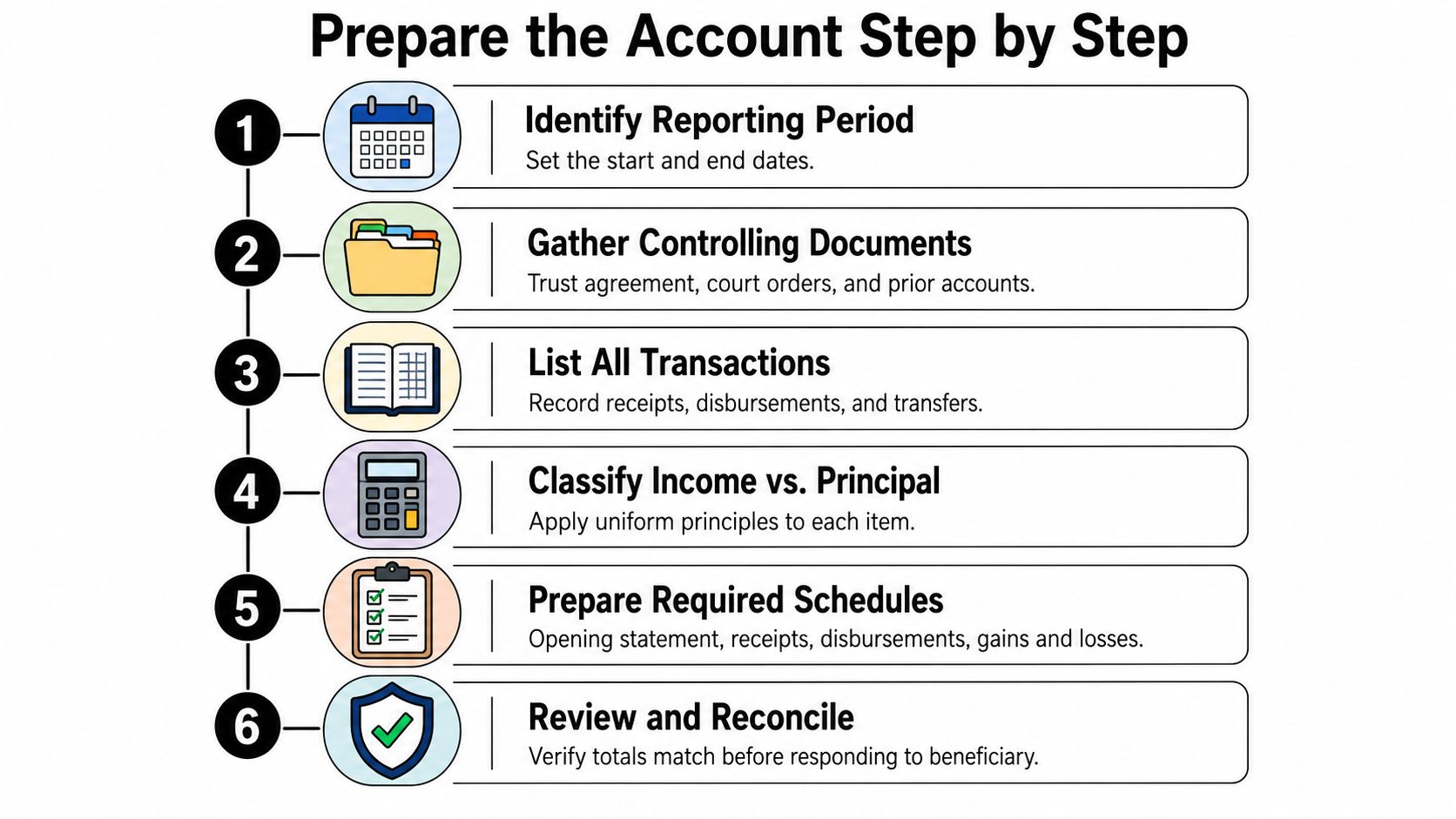
Use the same workflow for routine administration and for a beneficiary request. A repeatable sequence reduces missed items and helps a successor pick up the file. If you're new to the role, First Steps for a Successor Trustee in Texas addresses what to do immediately after stepping into the trustee role.
The visual below outlines the preparation sequence from reporting period to final review.
Your Repeatable Workflow
- Set the period and controlling documents: Confirm start and end dates, the trust instrument, amendments, prior accounts, and court orders.
- Build the opening inventory: List assets, carrying values, current values where required, cash depositories, and known liabilities.
- Confirm separate accounts: Verify that trust bank and investment accounts aren't mixed with personal property.
- Organize every transaction: Gather receipts, disbursements, transfers, distributions, and compensation records in date order.
- Classify and code: Assign each item to principal, income, gain or loss, or an authorized adjustment, with authority noted.
- Reconcile each schedule: Tie totals to bank and custodian statements and investigate differences before drafting explanations.
- Prepare valuation support: Attach appraisals, statements, or other support and identify valuation dates.
- Review unresolved items: List pending claims, unpaid liabilities, missing documents, and judgment calls rather than hiding them.
- Obtain professional review: Ask a Texas estate planning attorney, trust counsel, or fiduciary accountant to check classifications and completeness when needed.
- Deliver and retain the package: Keep the final account, proof of delivery, source records, and later corrections together.
The short video below reinforces the value of slowing down and organizing each stage before you respond to questions.
Document exceptions calmly. A note saying a private fund statement arrived late and will be supplemented is better than silent delay. Clear checkpoints for trustee compensation, liabilities, cash balances, and distributions keep a routine accounting from turning into a dispute.
Trust Accounting Compared With Texas Estate Accounting
Trustees and executors both account for other people's property, but Texas gives them different statutory paths. Mixing those paths can cause a family to use the wrong deadline or ask for the wrong document. Identify the fiduciary role first.
The Trust Accounting Path
For a trust, a beneficiary may make a written demand under Texas Trust Code §113.151 for a statement covering transactions since the later of the previous accounting or the trust's creation. If the trustee doesn't provide it within 90 days after receiving the demand, or a longer court-ordered period, a beneficiary may sue to compel an accounting. A trustee generally isn't required to provide accountings more than once every 12 months unless a court orders more.
The trust instrument may add reporting duties. Review it before assuming the statutory minimum is the only obligation.
The Independent Executor Path
An estate follows the Texas Estates Code. After 15 months from the date the clerk first issues letters testamentary or letters of administration, an interested person may demand a written, sworn accounting from an independent executor under Texas Estates Code Chapter 404. That accounting covers property received, disposition, debts paid, amounts still owed, property remaining, and facts needed to understand the estate's exact condition.
Both systems require a traceable record of assets, receipts, payments, liabilities, and remaining property. The triggers and procedures differ, though. Don't apply a trust's 90-day response point to an executor demand, and don't assume probate closing rules govern an ongoing trust.
Quick Reference for Trustees and Beneficiaries
Use these questions when you need a fast, organized review. They won't decide a disputed item, but they'll show you where to look and when to ask for help.
Five Questions to Ask First
- What document controls: What do the trust instrument, amendments, governing-law clause, and court orders say before you rely on a default rule?
- Which category applies: Is the item principal, income, a gain or loss, or an authorized adjustment, and what authority supports that choice?
- What schedules should appear: Can you trace beginning assets through receipts, disbursements, gains, losses, and capital changes to ending assets?
- What records prove it: Do bank and custodian statements, invoices, valuations, tax forms, and authorizations support each material line?
- Is this routine or disputed: Is the beneficiary asking for clarification, or has a formal written demand started the 90-day trust accounting response period?
Seek legal or accounting review when classifications affect competing beneficiaries, values are hard to verify, compensation is questioned, or records are missing. Also seek help when a routine question becomes an allegation about loyalty, prudence, or unauthorized distributions. Early review often costs less than rebuilding years of records after positions harden.
Beneficiaries should ask specific questions tied to schedules and documents. Trustees should answer with records, corrections where needed, and a clear timetable. That approach respects fiduciary duties in Texas while keeping family communication focused on facts.
If you're managing a trust or planning your estate, contact Law Office of Bryan Fagan, PLLC for a free consultation about fiduciary accounting, trustee duties, and Texas trust administration. Our attorneys provide trusted, Texas-based guidance for every step of the process, from organizing a defensible accounting to resolving beneficiary questions with clarity and care.